
Richard G. Wilkinson, Kate E. Pickett
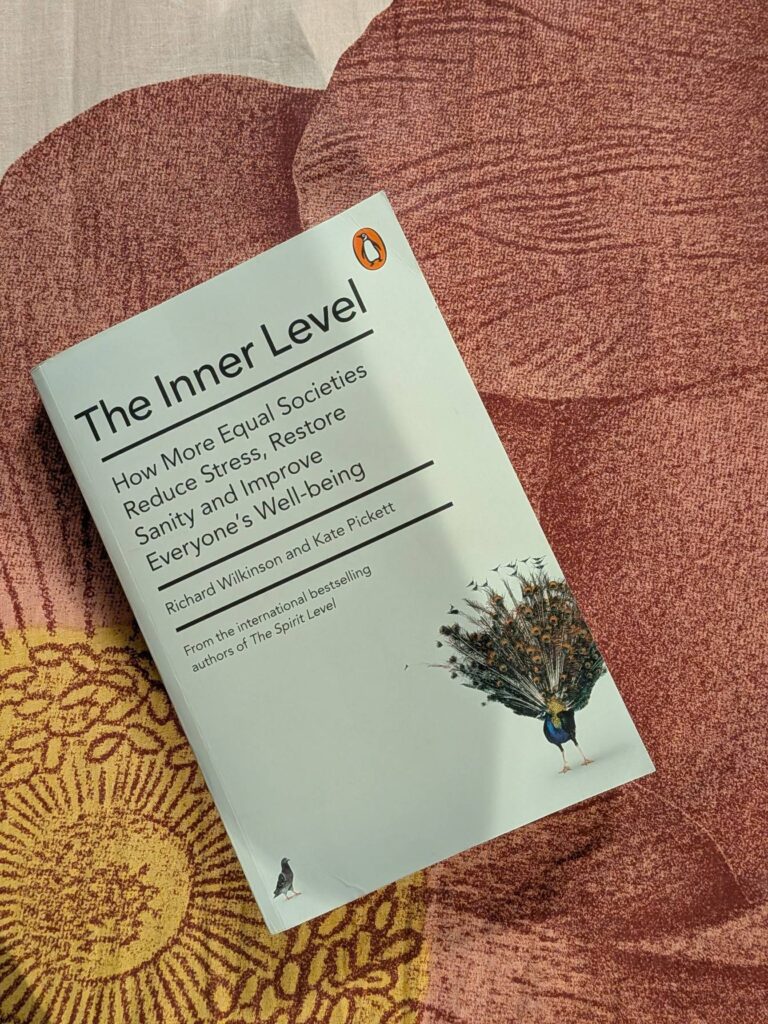
The Spirit Level (2009) has been on my list for so long that it got relegated to unread. I didn’t want to repeat that mistake with The Inner Level, so I bought it as soon as it came up on my radar. 8 years after it was published, but hey! The authors provide a quick get-to-speed about the former whose core idea was that people in societies with bigger income gaps are more likely to suffer from a wide range of health and social problems. Not just the poor, mind you, but a vast majority of the population.
The Inner Level focuses on how the increased social stress and psychological effects that lie beneath that phenomenon impact how we think, feel, relate to each other, and evaluate ourselves and others. In doing that, they weave their arguments using psychology, sociology, neuroscience, and real-world data to show that it’s not just economic outcomes that inequality impacts, but our psychological well-being, inner lives, and social fabric too.
The paradox of modern life is quite fascinating – even in wealthy nations, though material standards have risen – better housing, technology, medicine, education etc – levels of anxiety, depression, loneliness, addiction, and social discontent are high and, in many cases, increasing.
While the authors acknowledge that inequality is not the only factor affecting well-being, they argue that it is a powerful and under-recognised force. They question assumptions that economic growth automatically improves happiness, showing instead that relative position matters as much, if not more, than absolute material gain once basic needs are met. Social context matters: the more unequal a society, the more likely people are to suffer in invisible but profound ways.
The authors push back on the idea that individual failings – lack of effort, moral weakness, or character flaws – are the primary drivers of these trends. And introduce the underlying reason – “status anxiety” early on. Its origins are a combination of two differing legacies – pre-human dominance ranking system (might is right) and the egalitarian period of our prehistory (resistance to dominance).
As a social species, our sensitivity to each other and ability to avoid words/behaviour that offends others were important for survival and reproductive success. We are inherently social evaluators, and our brains are tuned to assess where we stand in the social hierarchy. But, just as with stress, when it gets triggered regularly in daily life, for even people who are materially comfortable but constantly compare themselves with others to judge their worth, the psychological stress that arises is incessant.
In relatively equal societies, status comparisons still occur, but the gaps are smaller and the competition less obsessive. In unequal societies, the scope of comparison widens and intensifies, people are acutely aware of who has more, who has less, who wins and who loses. Large income gaps stimulate three kinds of response – some are overcome by low self-esteem, lack of confidence and depression, others become increasingly narcissistic, and deploy various forms of self-aggrandizement to bolster their position in others’ eyes. Both are responses to increased anxiety and so, both types of people are likely to fall prey to drugs, alcohol, and consumerism to improve their self presentation.
The Inner Level throws light on five important links. One, inequality makes problems with social gradients worse – health, violence, poor education rates, substance abuse etc that are seen more down the social order are 2-10x more common in unequal societies. Two, inequality affects social mixing, as social hierarchy becomes more rigid and people in different classes become even more separated from each other. Three, inequality affects social cohesion, as people not only find social contact increasingly awkward (for fear of being judged) but are also less empathetic and less keen on community and less willing to contribute to collective goods. Four, inequality increases anxieties about status. Some people respond to heightened social evaluative threats (Dominance Behavioural System, notes below), the potential downward mobility and loss of confidence through self enhancement – flaunting more, others fall to schizophrenia and other mental health issues. Five, inequality heightens consumerism and conspicuous consumption. Money becomes even more important in unequal societies, as a means to flaunt more by way of consumption.
Broadly, the mechanism is pretty obvious – when income gaps widen, social distances grow, trust erodes, and people become more focused on self-presentation and status markers. An important theme in the book is the interplay between external conditions and internal states. The Inner Level illustrate how unequal environments shape our self-perceptions- people become more self-focused, more vigilant about threats to status, more distrustful, more inclined to see others as competitors rather than collaborators, and exhibit greater prejudice toward those perceived as lower status.
This psychological shift, it suggests, fuels many contemporary problems – from the opioid epidemic in the U.S. to rising suicide rates in Japan and Scandinavia. Children growing up in such environments face particular challenges, experiencing more bullying, lower self-esteem, and reduced educational performance regardless of their family’s actual income level. To note that our self perception and feelings about our social situation and circumstances can alter the expression of hundreds of genes.
Again, the authors emphasise that these psychological harms affect everyone, not just the poor. They argue that inequality isn’t merely an economic issue or an individual issue but a profound public health crisis affecting our inner lives. Even wealthy individuals in unequal societies experience more anxiety and status stress than their counterparts in more equal nations. The constant need to maintain position, display success, and defend against perceived threats creates what they describe as a toxic psychological environment.
The final portion of The Inner Level is on how reducing inequality can reverse these trends. Countries that have narrowed income gaps show corresponding improvements in social trust, mental health, and community cohesion. The authors advocate for policies including progressive taxation, stronger labor protections, and employee ownership models that can create more economically democratic societies. Not as abstract economic reforms, but as investments in psychological health, social cohesion, and human dignity.
I found The Inner Level reveals connections with many books I have read in the recent past – Why Zebras don’t get Ulcers, Humankind, The Worm At The Core, to name a few. Death anxiety (The Worm at the Core) connects to stress (Why Zebras don’t get Ulcers) as well as status (The Inner Level). Both are survival skills that have started working against us in the modern environment. Humankind also refers back to egalitarian pre-agriculture societies because we used to apply reverse-dominance strategies to rein in those who tried to be dominant, and is optimistic about how we are fundamentally kind and can still retrieve things before it gets out of hand. The Inner Level provides a good perspective of why it is important and how we could attempt this. An important read for this age.
Notes from The Inner Level
1. The modern rates of high mobility mean that whether we like it or not, our identity is no longer settled, maintained and confirmed by other people’s lifelong knowledge of us. As a result, our sense of ourselves becomes less well anchored, more prone to ups and downs, and more at the mercy of passing moods.
2. Ascribed and achieved social class. In societies with less
3. Dominance Behavioural System – 2X2 of dominance-submission, hostile-warm creates 4 quadrants, and except for dominance-warmth, all cause mental health issues of some sort.
4. Materialism makes us unhappy. But being unhappy also makes us materialistic.
5. IQ tests measure ‘habits of mind’ that are cultural and learned, rather than innate.
6. Inequality actually fell between 1930 and 1970, and then started rising again.
7. How everyone understands and experiences their relatively superior or inferior position in society also differs according to whether people normally remain in the class or caste they (and often previous generations of their family) were born into, or whether their social position can change. This is the distinction between what sociologists call ‘ascribed’ and ‘achieved social class. In societies when there is little or no social mobility, class is seen simply as an accident of birth and, although your class or caste may be seen as inferior there is little sense that you are personally culpable for your low social status: you can’t be blamed for your parentage. But in societies where people are regarded as moving up or down the social ladder according to individual merit and effort, status appears much more as a reflection of personal ability or virtue, making low social status appear as a mark of individual failure.
8. The belief that modern market democracies are ‘meritocratic’, that class position therefore reflects ability, implies that these societies are in some sense fair: that differences in status are justified . The result is that low social status appears even more as if it were a mark of personal inadequacy and failure. It strengthens the widespread tendency to assess people’s ability and intelligence on the basis of their social position, making low social status still demeaning. Nor are these tendencies confined to how we judge others. They also raise or lower people’s belief in their own intelligence and ability. The belief that social status reflects personal worth starts in schools (comparison of abilities) but continues in adulthood through interviews and assessments of many different kinds.
9. All societies like to think of themselves as ones in which honest, law-abiding, hard-working citizens can make a living, contribute to society and find fulfilment. We expect our institutions – whether schools, businesses or governments – to reward moral, ethical behaviour, hard work and co-operation. However, inequality and the heightened status competition and individualism which go with it seem to contribute to a culture in which ‘greed is good’, risk-taking is admired, and the differences between overly dominant behaviour and leadership are elided. In such a climate, it is perhaps no wonder that individuals with a personality disorder characterised by lying, manipulation, deceit, egocentricity and callousness can often be found at the very top of modern corporate structures. Greater inequality not only causes psychopathic tendencies to manifest in more people, it provides the cut-throat environment in which those tendencies come to be seen as admirable or valuable, and competitiveness as more important than co-operation.
10. Entry into school systems is almost always determined by an annual cut-off date. If, for example, children must be aged five years by : September in any year to start school, then children born just after that date will enter school almost a full year older than children in the same classroom with birthdays just before 1 September. The children who are among the oldest in their class have a small but significant developmental advantage over their classmates. Studies show that, as a result, they do better in many ways: their educational attainment is better, they have more friends, take on more leadership roles, and are more likely to succeed throughout life.

Leave a Reply