
Anne-Laure Le Cunff
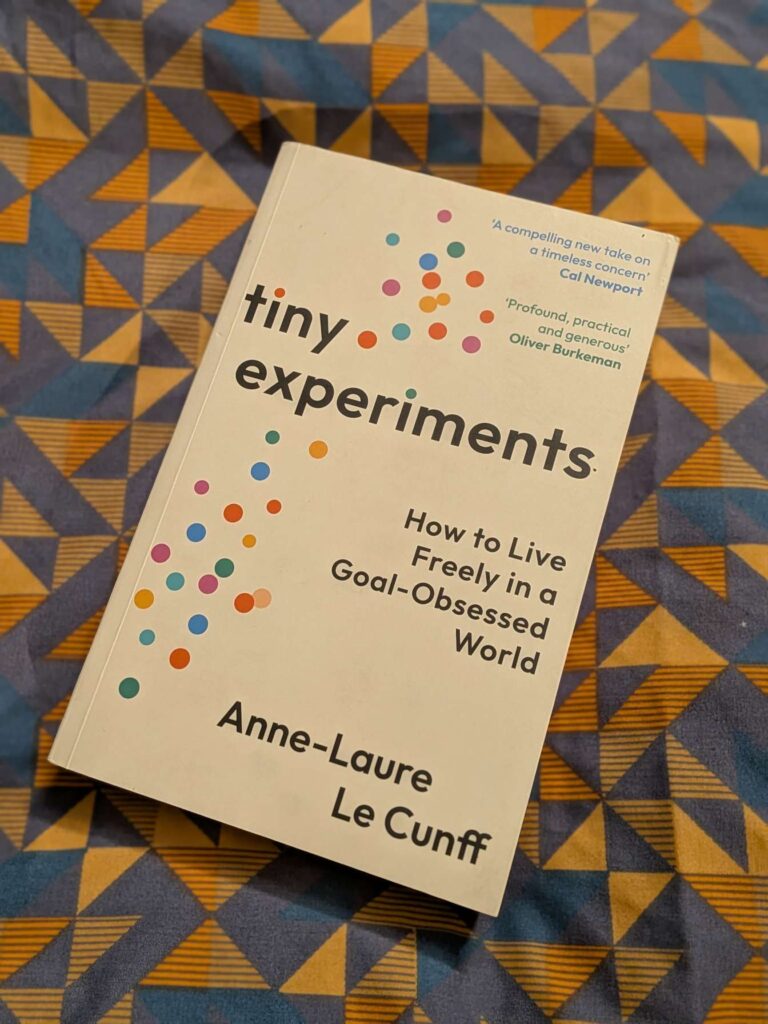
“How to live freely in a goal-obsessed world” is the sub title of Tiny Experiments and that was what I was looking forward to. The tl;dr version is that it didn’t work for me. It might work for those still in a typical corporate hamster wheel. It also might work for those who step out of that straight into the ‘creator’ hustle culture. But if you’re picking this for the ‘live freely’ part, I am not so sure.
Let’s start from the beginning though. Tiny Experiments is about rethinking how we pursue personal growth and navigate life’s uncertainty, making a case against the rigid, outcome-driven goal-setting culture that dominates modern self-help thinking. It argues that life and work should be approached less like a fixed plan and more like a series of small, low-risk experiments. A curiosity-driven approach rooted in the idea of running small, low-stakes experiments on yourself.
The narrative flows from diagnosis to remedy. The book begins by examining “why goal-setting is broken”, questioning the conventional “linear goal” model of success: pick a destination, optimise toward it, and measure progress narrowly. The case against it is that this approach often traps people in cognitive scripts – identities, careers, and ambitions that are either borrowed from external expectations or have stopped fitting over time.
This misalignment stimulates fear, creates anxiety, and encourages toxic productivity while also causing stagnation, and a fragile sense of identity tied to achievement, breeding competition and isolation.
The proposed fix? A more generative approach – “tiny experiments”. Small, time-bounded tests designed to explore curiosity without the pressure of permanent outcomes, explained through the concept of “pacts” – a hypothesis (what you want to explore), a duration (often a few weeks), and a way to reflect on what you learned.
These experiments are designed to be low-pressure and genuinely informative, whether they succeed or fail. The emphasis is on learning about yourself rather than proving something. The book provides research examples, anecdotes and also addresses common psychological barriers such as fear of wasted time, social expectations, and perfectionism.
So, what’s the problem, you might ask? Like I said, it’d work for a set of people at a certain stage and with a certain worldview. I even agree with many of the themes in the book – letting go of cognitive scripts, the fundamental emphasis on curiosity, choosing Kairos (qualitative time) over Chronos (quantitative time), the approach to procrastination, metacognition as a superpower, ‘dancing with disruption’, ‘letting go of legacy’.
And there are places where she gets very close to the direction I’d have wanted to see – ‘there is more to success than scaling up’, and a fantastic 2×2 of low/high curiosity/ambition (cynic, escapist – me, perfectionist, experimental).
That last bit is the perfect place to address my disenchantment. It happened because I’d have liked to move from escapist to experimental without the tag of ambition. I believe I have ‘enough’ in most aspects of my life, what I seek is ‘feeling alive’. In my own framework of FML – Fame, Money, Love, I want to do things because I love to do it anyway.
Like writing these. That is ‘living freely’, but it’s tough when you’re bombarded with the ‘growth’ narrative. The book’s frameworks still go by measurements – subscribers and followers, business wins etc, which IMO, will most likely lead to Goodhart’s Law. We are merely substituting one path for another, and it’s not the radical change I hoped for. Is it better than the other hamster wheel? I don’t really know, except you could say you ‘own the narrative’ now.
Notes and Quotes from Tiny Experiments
1. “When people ask me what I do for a living, I tell them I breathe” ~ Ron Finley
2. The 2 step reset – “I could see that the practice of surrender was actually done in two, very distinct steps: first, you let go of the personal reactions of like and dislike that form inside your mind and heart; and second, with the resultant sense of clarity, you simply look to see what is being asked of you by the situation unfolding in front of you.” ~ Michael Singer
3. “Anxiety can help you to face a potential threat, anger can help you stand up for yourself, and sadness can signal to other people that you need their social support. It’s how we interpret our emotions that can cause suffering.” ~ Emily Willroth
Leave a Reply