
Brian Greene
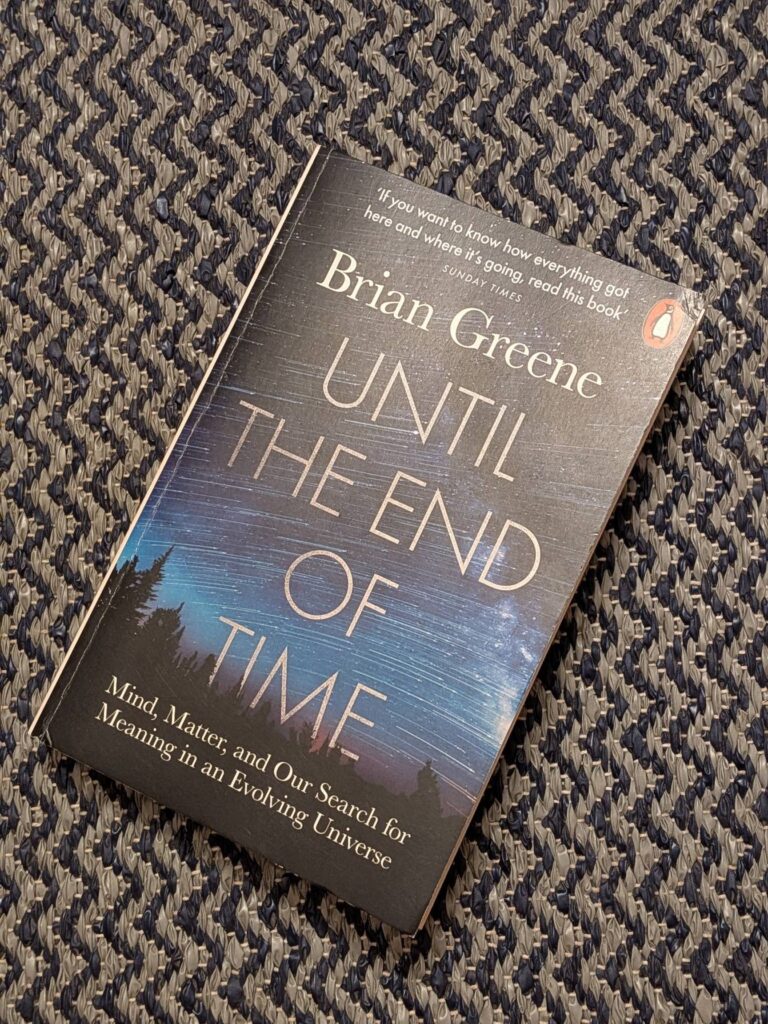
Brian Greene’s Until the End of Time is ambitious in scope. It’s an attempt to tell the story of everything – from the Big Bang to the ultimate fate of consciousness. Almost like a biography of the universe through the lens of the species which is (in our understanding) the first to ask why and how it all happened – how physics, chemistry and biology led to matter, mind and meaning. And how all that will dissolve back in time.
The book began with three of my favourite subjects – entropy, evolution as a force against it, and death as its comeback. Entropy is the gradual increase of disorder described by the second law of thermodynamics. It provides the arrow of time, distinguishing past from future and allowing processes such as memory, evolution, and storytelling. Interestingly, and paradoxically, local pockets of order – like living organisms – can arise and evolve because the universe as a whole trends toward disorder. Greene uses the concept of entropy as a narrative thread that ties together cosmology, biology, consciousness, art, and religion.
From the Big Bang to the distant era when the last black holes will evaporate into nothing, he traces the arc of cosmic history and asks what structures – stars, life, minds, civilisations – can temporarily (and that’s the significant poignant point) arise against entropy’s relentless pull, and why. Life itself is framed as a magnificent but impermanent rebellion against the second law of thermodynamics. For the second time this year, Ernest Becker’s The Denial of Death made its appearance. It’s now on my next month’s reading list.
Until The End of Time begins with the birth of the universe, outlining how simple physical ingredients- particles, forces, quantum fluctuations – gave rise to structure. Stars formed, forged heavier elements, and seeded galaxies with the raw materials for planets and life. From this cosmic scaffolding, chemistry deepened into biology. Complexity, Greene argues, is not an accident layered onto physics; it is an expression of it. Given energy flows and time, matter self-organises.
It then turns to consciousness and culture. Human minds, shaped by evolutionary pressures, generate language, myth, science, art, and religion. We construct narratives to orient ourselves within a vast and indifferent universe. Meaning is not written into the cosmos at the fundamental level, it is an emergent phenomenon produced by particular arrangements of matter – brains embedded in societies. That does not make meaning illusory, but contingent and temporary. And to me, this continues to evoke a sense of awe.
The last couple of sections confront cosmic and biological endings. Stars will exhaust their fuel. Galaxies will dim. Black holes will evaporate over inconceivably long timescales. Eventually, if current models hold, the universe approaches heat death – a thin, cold expanse with no usable energy to sustain structure or thought. In such a future, memory itself becomes physically impossible. Every record of our existence would fade.
And with that comes the existential questions. The book also confronts that emotional weight of cosmic finitude. Greene reflects on how humans construct meaning in the face of impermanence – through religion, through art, through science itself. Through all this, the tone is optimistic, though poignant.
What is admirable is that the book attempts to cover a whole bunch of complex subjects – from quantum mechanics, evolutionary biology, neuroscience, to the philosophy of mind, free will (nope, the answer is no, there is only a sensation), and the human condition. I could see flashes of quite a few books that I had read. The explanations in physics and chemistry are very accessible and taught me a lot on entropy and molecular reactions!
What is an understandable drawback is that in just over 300 pages, some of the topics will be skimmed and/or undercooked. It doesn’t help that in many areas, the answer is still a debate among the thinkers and the consensus is “we don’t really know”.
To me, there was also an obvious bias towards his own focus areas, which made at least one section at the end a slog for me, more so because of the billion-year time frames, and despite an elegant Empire State Building construct to explain it. I think this bias also explains why though the fundamental impermanent nature and the brief flare of awareness is very reminiscent of Hinduism and Buddhism, Greene didn’t seem very impressed by the ‘superficial’ connections.
Having said that, it’s a good book that’s mostly accessible, and could be a great primer for folks to get a broad idea of many things, and then maybe explore further.
Notes & Quotes from Until The End of Time
1. “I do mathematics because once you prove a theorem, it stands. Forever.” (by an older friend of his)
2. Whereas the first law of thermodynamics declares that the quantity of energy is conserved over time, the second law dictates that the quality of that energy deteriorates over time. Low entropy – high quality energy and vice versa.
3. Entropic two-step – any process in which the entropy of a system decreases because it shifts a more than compensating increase in entropy to the environment.
4. All life codes the instructions for building proteins in the same way
5. The reason why conscious experience floats unmoored in the mind because as with everything else, the brain prioritises schematic representations that aid survival rather than true understanding, and in this context, that makes consciousness distinct from the physical processes being carried out
6. Some fantastic hypotheses on the origin of speech – crying of the baby and cooing by the mother resulting in higher survival rates and making it an evolutionary feature, darkness/using tools (and making/keeping hands ineffective/busy) forced a different kind of communication, as tribe members grew grooming became a difficult way to make and maintain social ties, social exchange tool and gossip
7. Ditto for storytelling – mind’s way of rehearsing for the real world, mental catalogue of strategic responses to life’s curveballs, a powerful means of inhabiting other minds
8. Many things lie underneath our belief systems – science, authority, community, tradition, intuition
9. Why arts? Art might have begun as a way to stir and shape emotions that helped bind a group together. By breaking the real-imaginary boundary, art also could be a means of innovation. Both evolutionarily useful. I am also wondering if original ‘artists’ might have been popular too for showing something different, and that helped survival too?
10. “When I asked why he chose music, my dad answered “To keep away the loneliness”” (This personal note really moved me)
Leave a Reply