
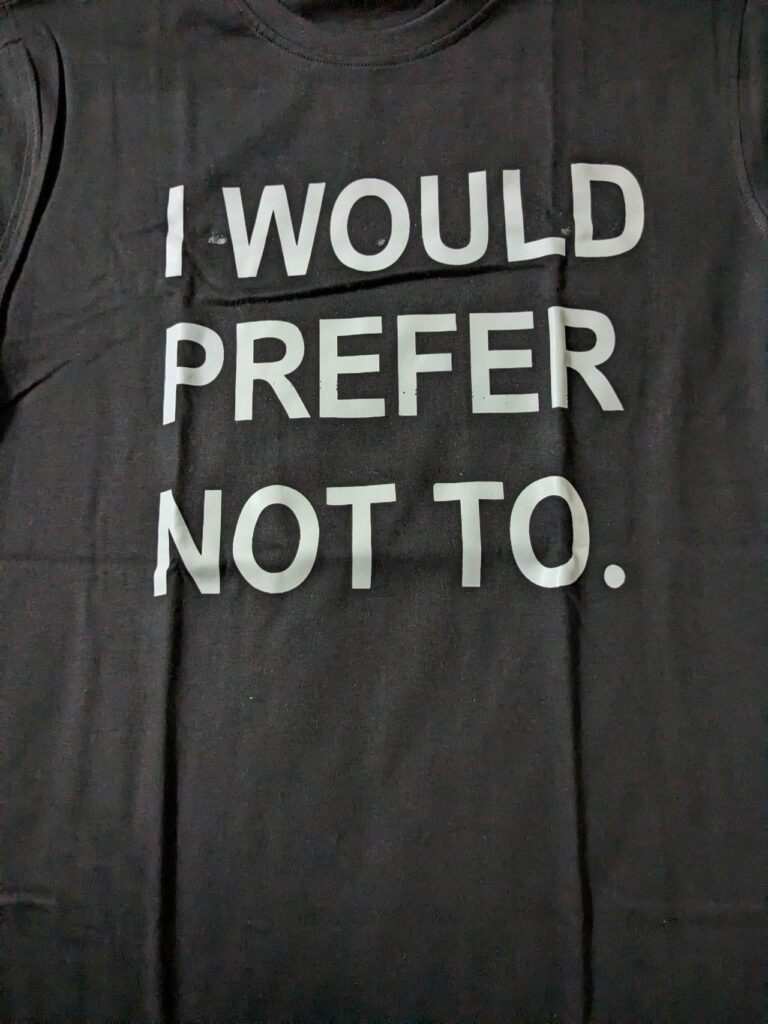
This is one of my favourite t-shirts. It is based on Herman Melville’s “Bartleby, the Scrivener: A Story of Wall Street”. Set in the 1800s, it’s Bartleby’s response to the world, and has a tragic ending. I have to admit, I bought it intuitively because of a mindset, before I went around figuring out the origin story.
What mindset? I am hardly the first person in middle age to come to the realisation that one should spend more time on things that actually matter to one’s life, rather than what the world dictates. That is, of course, easier said than done. But that, I think, is also how one loses character.
Let’s rewind a bit. A long time ago, one had to operate in very limited contexts and deal with a small set of people. As the world got connected – first physically, and then digitally, this exploded.
Agnes Callard has framed it brilliantly with her idea of ‘unicontext‘, which also led to this post. The brief description of unicontext is this : for most of history, we inhabited many contexts – home, work, religion, neighbourhood – and each came with different norms. Today, we increasingly live as though there’s one universal room with one audience and one set of expectations. Think of all your social feeds and you’ll get the idea.
She also brings up a downstream effect that relates to this post. In a world with one audience, we’re rewarded for being immediately understandable. Tribal affiliation opens doors of emotion and opportunity, right? As we interact with more and more people, ideas and contexts, the brain needs shortcuts to slot people. Identities solve that.
It doesn’t end there. Further downstream, once identity becomes the dominant way of making sense of people, comparison becomes effortless. We no longer compare ourselves with a few people in a few settings. We compare careers, parenting, hobbies, bodies, politics, reading habits and even leisure.
Unicontext also explains why identity has become more important than character. Character only reveals itself across contexts. Facets of character, like courage, generosity or integrity look different depending on where and how you encounter someone/ something. You discover it slowly. Identity is less nuanced. To the extent, where I’d say that in a world full of signals, a lot of us now use identity as a heuristic for character.
I used to treat a person’s stance on Modi as character, not identity. Until I realised some of them are also smart people who are generous in other contexts. We can choose to oppose them in the politics context, and share the whisky’s provenance story while sipping it.
Now we can get back to the t-shirt. Like I said, the realisation in middle age is that the older I get, the fewer contexts I want to inhabit.
As is my wont, I did wonder why. My hypothesis was that it’s because every new context creates another audience. Every audience creates another identity to maintain. That’s partly why I’ve become comfortable not following every news cycle, every debate or every cultural moment. And not having an opinion. I read something recently that explained this better than I could:
Complexity creates obligations. Obligations create constraints. And constraints eventually narrow your choices until the decision you never wanted to make starts looking like the only one left.
I could replace ‘complexity’ with ‘identities’ in the quote above, and it would still hold. For the longest time, I thought freedom meant optionality – more choices, fewer constraints. I have recently moved away from that. Freedom feels more like play. And play doesn’t demand endless possibilities, just enough room to remain yourself. From experience, most of the time, that means fewer contexts, fewer audiences, and yes, fewer identities to maintain.
That’s also where “It’s not the destination, it’s not the journey…” comes in. Therefore, these days, when asked about many contexts, experiences, and people, “I would prefer not to”. Just so I can stay in character. 🙂

Leave a Reply