I recently watched John Cena’s Peacemaker S2. To my mind, DC’s best recent work, Joaquin Phoenix’s Joker notwithstanding. It aired around the same time as John Cena’s WWE retirement tour, and I couldn’t help but notice the overlap of Cena’s WWE persona and the character – flawed, often clueless, but fundamentally good-hearted. Not everyone saw it that way though. A minority commented on his past politics in WWE, how he’d used his power to hold others back. Fair, I thought. But incomplete.
Krakow to Wroclaw is just over three hours by train. You must absolutely book your tickets in advance. You get about 5 minutes to find your wagon on the platform, but barring that little adventure, the ride was smooth, passing by white landscapes and small towns.
Where to stay in Wroclaw
The stay was at Radisson Blu again. This one was older than the one in Krakow, and the staff were a little less helpful. It is a 10 minute walk from the Main Square.
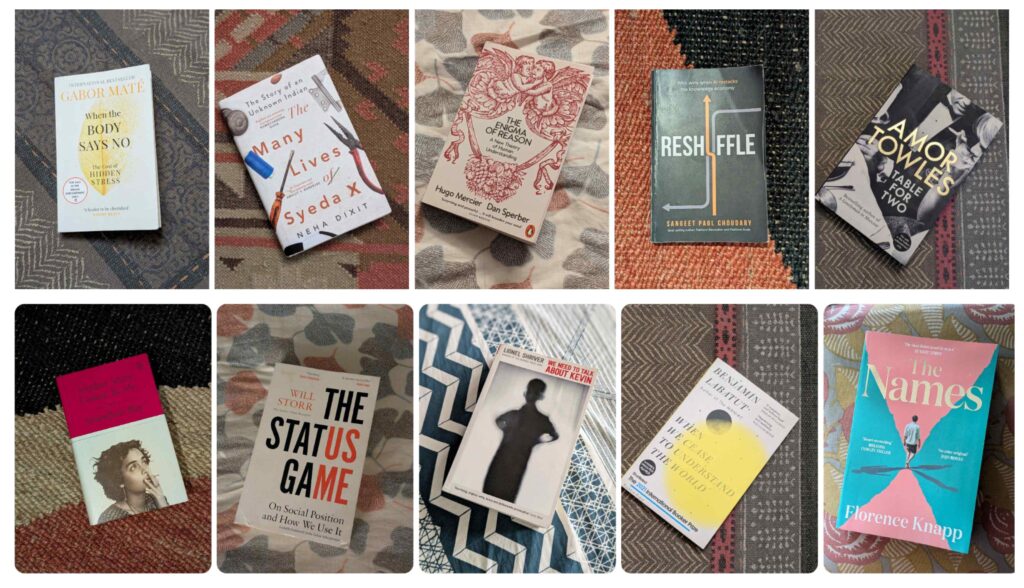
Compared to the last couple of years, I read fewer books in 2025, but I think the variety was higher. That probably explains the highest number of fiction books in a long time.
And so, once again, like 2019, 2020, 2021, 2022, 2023 , and 2024, presenting #Bibliofiles 2025’s list of ten (plus the long list). From the 58 books I read this year…
I read something beautiful on a LinkedIn post sometime back. Yes, miracles do happen.
उन्हें कामयाबी में सुकून नजर आया तो वो दौड़ते गए,
हमें सुकून में कामयाबी दिखी तो हम ठहर गए !
Not that I had scaled some Himalayan peak of success, but the first line fits my 30s, and the second, my 40s. The underlying mindsets are different, and so are the journeys that give me joy. But it took the larger life journey and the choices of my past self to get here.
You cannot stay on the summit forever; you have to come down again. So why bother in the first place? Just this: What is above knows what is below, but what is below does not know what is above. One climbs, one sees. One descends, one sees no longer, but one has seen. There is an art of conducting oneself in the lower regions by the memory of what one saw higher up. When one can no longer see, one can at least still know.
Some would say kids are spoilt these days. I’m not going there, but kids are definitely spoilt for choice when it comes to chasing their interests, academic pressures notwithstanding. But what’s a deep interest and what’s a fad? What’s a passion and what is a routine that has overstayed its welcome?
I thought it was an excellent reminder that not all childhood interests need to become lifelong pursuits. Maybe a reminder for adults too – both influencers suffering burnouts as well as us standard mortals. For those interests that are staying beyond their shelf lives, and for those that haven’t seen the light of day, because they are dictated by habit/self image/identity?
I wrote this on LinkedIn in the context of a Hyundai ad that ended with “Never give up on finding what you love. There’s joy in every journey.”
A recent event reminded me of a post about karma I had written half a dozen years ago. The idea of the post was thanks to Umair Haque, who had a definition of karma that was different from the garden variety ‘consequences of your actions’.
Karma isn’t what you “have” or something you “do”. It’s what you are….. Karma is all the concepts and notions you hold in that tiny little head. All those concepts are stitched together by the idea of “you”, right? So karma is all those concepts, together, which determine your intentions, actions, behavior, all of it.
Japan was always the plan, it was only a matter of when. 🙂 We planned well in advance, but even then, thanks to it being Sakura season, a lot of hotels were sold out. The visa took less than a week to get processed. Bangalore has a direct flight to Tokyo. So all you have to do is, to quote Amrita Rao, ‘JAL lijiye’. Interestingly, the pilot took off immediately after we landed, confusing all of us! We finally landed again after about 20 minutes. Tokyo was our first stop. We began, and ended, our 11-day Japan trip in Tokyo. This is our list of where to stay, what to see, and where and what to eat.
What’s a visit to Scotland without a trip to the Highlands! Thanks to the Rabbie’s Tours itinerary, we were able to cover a decent bit of ground in 3 days.
Stay
Our base technically was Portree, where we stayed for two nights at the Pier Hotel, run by a very homely Effie and family. The place is right next to the water, and less than 5 minutes walk from the town square. The building, Effie told us while making us breakfast, was more than 200 years old. But for a small stay, it’ll do just fine.
The one on the top left was our room. That meant a good view of the water.(more…)
It was a little over 4 years ago that I first brought up the increasingly transactional nature of our interactions and even existence in general. I was reminded of it while listening to Amit Varma’s podcast with Nirupama Rao. Interestingly, they brought up contexts similar to what I had used – mails and rails. I had used birthday greetings going from long mails/cards to a ‘Like’ on someone else wishing the person a birthday. Travel was the other context, and I liked Amit’s example of train journeys being a unique experience. In contrast to say, the flight from point A to B.
Last year, around the same time, I had framed it as An Efficient Existence, and used the example of Taylor Pearson’s 4 minute songs – the timeframe he had mentioned for songs in the context of certain rules that creators need to follow if they want their work to be consumed and appreciated. I had brought up an earlier era of Floyd, Springsteen, Fleetwood Mac etc whose songs didn’t follow that template. Demand or supply, what happened first, I asked. Does it have to do with the abundance of choice now, and the demands of instant gratification? While templated packages for all sorts of consumption are increasingly the norm, people also want to finish and move on to the next thing on their list. Transactions. (Generalising), there seems to be very less desire to have an immersive experience. Outside the screen, that is. As the Spotify ads show (unintentionally and literally) we’re usually in a bubble, oblivious to our surroundings.
D and I watched Crime Stories: India Detectives on Netflix a few days after it was released. The episode that saddened both of us was “Dying for Protection”, which was based on the murder of a sex worker. Not surprisingly, it turned out to be the subject of discussion on a Saturday late evening, which these days are spent on the balcony, in the company of spirits, watching the sun and the world part ways. Yes, that is privilege.
The thought first occurred to me a couple of years ago, when I realised that thanks to outsourcing and automation, we would struggle today to do many things that were once life skills. We also lost a little more than that – learning.
Sometimes directly, and sometimes, through the interactions with the world, they facilitated a learning experience that taught one how to navigate the world and the different kinds of folks that made up its systems.
It was continued with a bit more specificity in a subsequent post.
Instagram, Facebook, Tinder, Spotify, Netflix, Amazon – everything is a feed of recommendations, whether it be social interactions, music, content or shopping! Once upon a time, these were conscious choices we made. These choices, new discoveries, their outcomes, the feedback loop, and the memories we store of them, all worked towards developing intuition.
Intelligence, intuition and instincts. The journeys in the first two are what have gotten the third hardwired into our biology and chemistry. When we cut off the pipeline to the first two, what happens to the third, and where does it leave our species?
An excellent coincidence that I finished reading James P Carse’ “Finite and Infinite Games” the same day I wrote this post. The book helped me frame thoughts to my satisfaction.
There was an age when accumulating possessions – from apparel brands to places visited to career designations to property ownership and anything that signals prosperity – was the game I played. Or games, because a milestone was a victory in that finite game, and I quickly moved on to another. Trophies that the world dictated. (more…)
On one hand, I really hoped Humankind would be meaningful, and on the other, I am quite a cynic. Bregman writes towards the end of the book that cynicism is just another name for laziness, an excuse not to take responsibility. I am not sure I agree completely because I do feel the rage against injustice, and do take action sometimes, but largely my question has been ‘what is the point?’
But Humankind did work for me, because of two reasons. One, Bregman does make a strong pitch with a coherent narrative. Two, at least in a few ways he reminds me of David Graeber – the appeal to see each other as humans without labels, the call to stand against injustice, and the meticulous research that bursts quite a few myths fuelled by authors who were less conscientious.
In Humankind, Bregman primarily challenges one of the deepest assumptions about human nature- that people are selfish, competitive, and prone to cruelty unless restrained by laws or authority. Instead, his perspective is that humans are wired for kindness and cooperation, and that our history offers more evidence of decency than of brutality. Clearly for Rousseau and against Hobbes.
The cynic in me looked around and immediately did an #smh but over the course of Humankind, through a mix of historical analysis, psychology, and anthropology, he does a good job of validating that perspective, and showing how we might view ourselves and organise society if we went in with the assumption that folks were inherently good. I have to admit, I have tried this in the past, and then hardened even more because of the outcomes, but Humankind inspires me to keep trying. (Rule #1 from the last part of the book – when in doubt, assume the best)
Humankind begins by addressing the ‘veneer theory,’ the idea that civilisation is just a thin layer of order covering an inherently violent species. Thinkers from Hobbes to Freud to Richard Dawkins (who later walked back on The Selfish Gene) have leaned on this idea to justify strong states, strict religions, or rigid markets.
Bregman dismantles it by meticulously researching famous studies that supposedly prove our darker instincts. The Stanford Prison Experiment, for example, is revealed to have been nudged into cruelty by the researchers themselves. Stanley Milgram’s obedience experiments, too, relied on selective reporting and pressure that distorted participants’ natural reluctance to harm others.
A good point here on Hannah Arendt’s layered philosophy that humans are tempted by evil masquerading as good. I had also gone with Jared Diamond’s explanations about what happened on Easter Island – tree chopping to build those statues, and the resulting ecological collapse, but turns out the real reason was rodents brought by ships, and germs by returning natives who had been kidnapped as slaves! Malcolm Gladwell publicised the ‘broken windows theory’, another myth based on flawed research!
All were myths that I had read and believed, but were actually narratives that were shaped to fit expectations. In fact, running counter to the uber popular Lord of the Flies, he cites the example of six Tongan boys stranded on a remote island in the 1960s, who survived not by violence but by forming routines, resolving conflicts peacefully, and caring for each other when injured. Rather than being exceptions, Bergman believes that this is what humans do when stripped of external institutions – they choose dialogue and build cooperation.
From here, Humankind turns to anthropology and archaeology. Our prehistoric ancestors, contrary to the image of brutal cavemen, lived for millennia in small, cooperative groups with high levels of equality (including gender) and mutual support. Traits like friendliness, trust, and curiosity were not liabilities but evolutionary advantages, social learning being critical, helping Homo sapiens outlast other species. In fact, he states that originally we were a loveable ‘Homo Puppy’.
The trouble began 10,000 years ago when we started settling in one place and amassing private property. Scarcity, hierarchies, leaders raising armies (the good us vs the bad them), all led to our uglier side coming out. But even now, in modern disasters, Bregman shows, people tend to help one another rather than descend into chaos. Accounts of the London Blitz, Hurricane Katrina, and other crises reveal spontaneous solidarity rather than savagery.
The implications, if we change our thinking to a more positive view of other humans, are quite profound. Think about schools designed around control, prisons based on punishment, governments founded on mistrust. And Bergman shows how there are examples that have proven his point – Norwegian prisons that prioritise rehabilitation, democratic schools that nurture trust, and experiments in participatory governance in Torres and Porto Alegre, democratic schools that nurture trust and a playful, curiosity-led learning like Sjef Drummen’s Agora. Not to forget Nelson Mandela’s work with his militant Afrikaner counterpart to bring peace to South Africa.
He also revisits ideas like universal basic income (dividend payment for oil for all citizens in Alaska), noting that when people are trusted with resources and freedom, they generally act responsibly and contribute positively.
The narrative arc also has a call to action. Believing in human goodness is not naïve, Bregman argues that it is pragmatic. Cynicism breeds systems that treat people as untrustworthy, and those systems often create the very selfishness they fear. Like a Golem effect. Optimism, by contrast, can be a self-fulfilling prophecy: if we design societies around trust and cooperation, we unlock more of our species’ potential. Like the Pygmalion effect. What can break a cycle of hatred is contact – prejudice and hostility dissolve with real interaction.
The last part consists of ten rules he proposes to bring the best out of ourselves and others to build a better society. The narrative is compelling, debunking pessimistic myths, showing evidence of cooperation, explaining why systems go wrong, and then presenting hopeful models and offering a practical roadmap. It pushes the reader to reconsider the stories we tell about ourselves and others. And to recognise that beneath the myths of brutality, humans, more often than not, are inclined toward kindness. It’s a much-needed narrative for the times, although the cynic in me wonders what is the incentive for individuals and societies to change.
1. Examples of the wry British humour during the Blitz – more open than usual; our windows are gone but our spirits are excellent, come in and try them.
2. Domesticated animals are similar – smaller than their predecessors, smaller brains, teeth and floppy ears, curly tails. All are by products of one trait – friendliness. Played out by friendly hormones. Whites in our eyes that allow us to follow others’ eyes, blushing, eyebrows that can signal a bunch of things, are all things that help us send and receive signals, and aid social learning. That’s also how humans beat the much better and smarter Neanderthals and others in the evolution game. Smart geniuses vs social copycats – the latter win because they are better connected.
3. Empathy and xenophobia are two sides of the same coin.
4. Power reduces empathy because anyone who disagrees with you can be eliminated.
5. The Enlightenment brought forth ‘reason’ as the way in which humans can build institutions (democracy, rule of law) to factor in our innate selfishness. But things like the Holocaust and capitalism has proven that it wasn’t enough.
6. All of the evils in society is possibly pluralistic ignorance. None of us think things are right, but go along because everyone is going along.
7. Economy comes from the Greek word oikonomia, meaning ‘management of a household’
8. Two words engraved in the forecourt of the Temple of Apollo in Delphi – Gnothi Seauton – know thyself
Indian Craft Brewery is psychologically closer to the airport than home, so it made sense that we dropped in there for dinner on our way back from a vacation.
As with most breweries, the place is huge, and the high ceilings add to the effect. I thankfully missed the mandatory artificial water body, but it does exist.
I have to admit that I began reading Nexus with a bias – courtesy Harari’s earlier works. While I liked them when I first read them, further reading and critical takes reduced the good impression considerably.
So, while I really liked the first two chapters, I did find irony in him writing about information and truth after bring rebutted by experts on agricultural revolution and various other things he is not an expert on. And while I really like reading history, his meandering on Niall Ferguson mode in the first part of the book didn’t endear himself to me at all.
Part 1 was on the OS of my life, Part 2 the professional version, both written in 2022. This one is a little more ambitious – civilisational!
The thought stream started thanks to one of my favourite newsletters, which gave me an insightful metaphor – “Religion is the operating system of a civilisation” – attributed to Rudyard Lynch.
One of the other insights that has taken up quite a lot of space in my mind is courtesy Ernest Becker (via The Worm at the Core) – that the awareness of our own mortality is the hidden engine of human thought, emotion, and culture. Humans apparently invented symbolic systems – everything from soul to religion to nation to art to legacy as a means of managing the terror of death.