Timothy W. Ryback
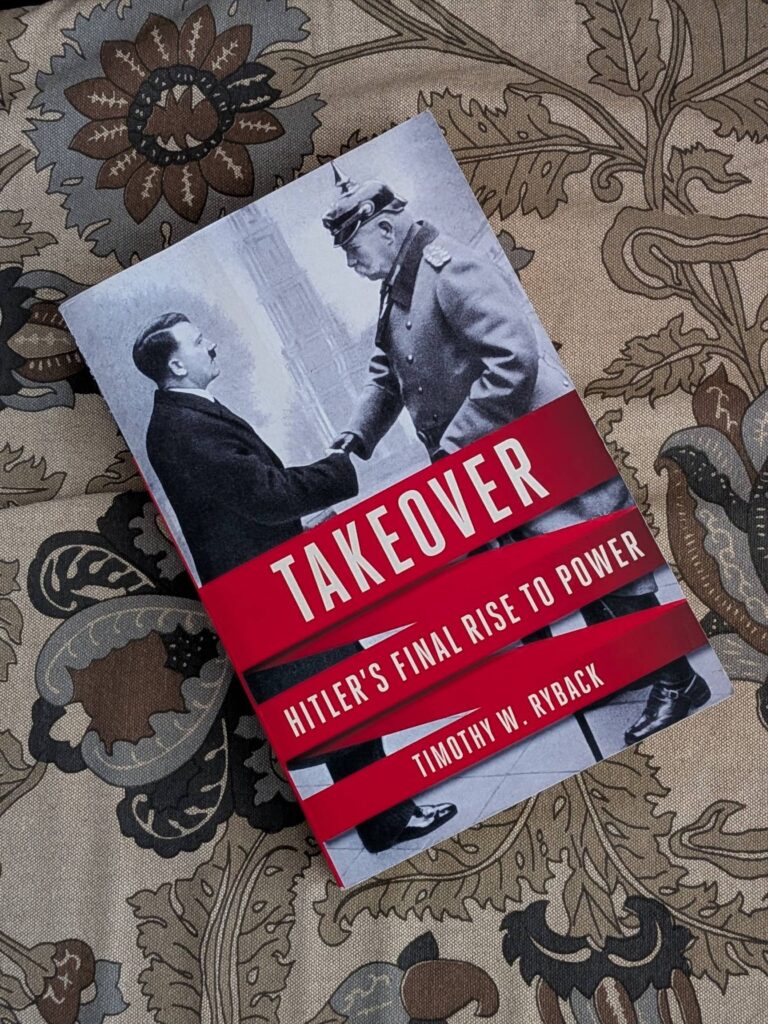
Timothy Ryback’s Takeover is an absolute thriller, even though the outcome is known history, and it doesn’t let go until the nail-biting finale because even five minutes before President Paul von Hindenburg was scheduled to acknowledge Hitler as the Chancellor of Germany, the coalition partners were still in disagreement. It is fascinating to realise how differently things might have turned out for the world if even a small move from any of a bunch of personalities had slightly diverged.
Takeover is a tight narrative history of how Adolf Hitler and the Nazi Party seized control of Germany in 1933 – not through a single coup or dramatic overthrow, but via a sequence of legal manoeuvres, political miscalculations (by them as well as opponents and partners), and moral abdications. Hitler had vowed to destroy democracy through the democratic process and replace it with a dictatorship, and that’s exactly what he did.
The timeline begins in the political chaos of the late Weimar Republic. Germany is exhausted-economically battered, socially polarised, and governed by fragile coalitions that rely increasingly on presidential decrees. Hitler is already a prominent figure, but not yet dominant. It was only in February 1932 that he managed to become a German citizen through a roundabout way.
His electoral support peaked in July 1932 when he got 37% of the popular vote. He was a legit candidate but lacked a majority and failed to build a coalition. President Paul von Hindenburg refuses to appoint him Chancellor, viewing him as vulgar and dangerous. Instead, Franz von Papen, a conservative aristocrat with little popular support, and seen as a puppet of General Kurt von Schleicher, the real kingmaker, continues as Chancellor, governing through presidential emergency decrees.
But Papen lacked legitimacy and alienated both the left and the conservatives. He dissolved the Reichstag and called new elections in November 1932, expecting the Nazis to fracture. They do lose seats, falling to 33 percent, and Nazi finances and morale deteriorate. Even his stormtroopers begin to show their true colours (asking for payment for political beliefs). To the point that political commentary suggested he was almost done. “Hitler is a man with a bright future behind him“
Hitler also loses the second most powerful man in the party – Gregor Strasser, who leaves frustrated, with plans to form a coalition with Schleicher. Schleicher manoeuvres Papen out and becomes Chancellor in December. Schleicher attempts to split the Nazi Party and construct a ‘cross-front’ government, but fails to secure parliamentary backing or presidential confidence, despite his long and close association with Hindenburg. His tenure lasts mere weeks.
Meanwhile, humiliated and resentful, Papen sees an opportunity and begins secret negotiations with Hitler, and brought him down from his (until then) steadfast demands of dictator-like powers. Convinced he could control him, Papen proposes a deal: Hitler as Chancellor, Papen as Vice -Chancellor, with conservatives like Hugenberg (who had a volatile relationship with Hitler) dominating the cabinet. Everyone assumed that Hitler could be boxed in by rules, institutions, and experienced statesmen. And be taken for his word.
Hindenburg though, remains the final obstacle. Initially resistant, he is worn down by advisers, by the fear of continued instability, and by the absence of any workable alternative. His own star too was fading because of multiple factors like embezzlement by his friends, the incapability of his son, and his own health. In January 1933, Hitler is constitutionally appointed Chancellor, third time a charm, not because he won overwhelming popular support, but because he became the only viable alternative against the Left.
Within months of coming to power, he eliminated opponents, and unified the Chancellor and President roles to become unquestioned dictator. The general public just wanted more employment, better wages and the climate was less of large scale fanaticism but of fatigue and normalisation. Hitler did take advantage of this, but appears less as an evil mastermind and more as a political opportunist – being patient, while seeming impatient, adaptive, and acutely aware of when to let others make their own mistakes.
Takeover traces how despite all his hysteria and threats of suicide, he had a nature resilient to adversity. Fiercely determined, he could accurately read a room and provide a response that worked. His success was also a result of institutional failure and elite complacency – people thinking they’re smarter.
Takeover is a fantastic read if you like history. The slow erosion of democracy as small steps against it become normalised is a lesson for this time, as more strongmen are rising to power.
Leave a Reply