Category: Future & Tech

  • The Sixth Extinction

    Elizabeth Kolbert

    A pandemic is probably the best time to read a book on mass extinctions. Or not, depending on taste. 

    But this is a book I thoroughly enjoyed, even though I am not really a big fan of nature – plants or animals or for that matter, some humans either! Some of it is because of the many, many things I learned, and some of it is the accessible narrative style of the author – it evoked the sense of curiosity that I had for science in general as a child, and I confess, infused that sense of romanticism in science that I haven’t seen in a long time. 

    It is scientifically interesting to see how concerned we are about the pandemic, when, earlier this century, a species of Chytrid fungi (a genus had to be created for it, and it is called Bd for short) systematically started killing of frogs across continents. Making many of them endangered species. Or the Geomyces destructans, that killed off bats to the tune of 6 million! 

    Until the end of the 18th century, the idea of extinction did not exist. It then moved to a “uniformist” view that each species struggled and vanished. Then the discovery of the asteroid impact happened. The current version accommodates both lines of thought- long periods of nothing happening and then one cataclysmic event. It involves oceans, rising and falling, tectonic shifts, global warming and cooling etc and yes, an asteroid too. On a related note, there is also a small parallel narrative on Darwin, The Origin of Species and how it weighed in on the extinction debate.

    The last 500 million years are divided into three eras, and a lot more periods. While there have been extinctions, in isolation and clusters, and mass extinctions occur every 26 -30 million years, the short list contains only the “big five”. The most famous one is the one that features the asteroid. That was the last one, which happened 66 million years ago, in the End Cretaceous period, leading to the extinction of 75% of species. The ones before were 201 million years ago -that led to the dominance of the dinosaurs, but killed 75% of species that existed then, 252 million years ago – the biggest one that knocked off 96% of all species, 375-360 million years ago – killing 70% of species, and 450-440 million years ago – 60-70% again. The sizes and descriptions of both the tiny organisms and the megafauna that lived, co-existed, and died is fascinating. 

    The name of the book, as you might have guessed, comes from the possibility of the sixth event that could be added to the big 5. From all the evidence so far, humans will most likely be the cause, but the twist is that we could be the victims too. In the context of the larger lifespan of earth, a short while ago, a species created a way to go beyond only the genetic code to store and distribute information. Language. They then found ways to communicate and collective think about and solve “problems”. And we’re here now. 

    The book gives a lot of food for thought, but more importantly, at least to me, invokes a sense of curiosity and awe. A lot thanks to science, and some because of the variety of places she visited to write this book. The moment she narrates, while on a tiny island at the edge of the Great Barrier reef under a starry sky – For a brief moment I felt I understood what it must have been like for an explorer like Cook to arrive at such a place, at the edge of the known world – sums up the effect of the book very well.

  • Indistractable

    Nir Eyal

    Towards the end of the book, the author cites a survey which found that “almost a third of Americans would rather give up sex for a year than part with their mobile phone for that long”. Sex has been hardwired in us by evolution, and it’s a testament to technology that it has managed to hack even that! But then again, there was a time when even the printing press was called the biggest source of distraction. So this isn’t a new story. But we do live in a world in which the attention economy has optimised its notifications and nudges to ensure that it is heard/seen/felt. All the time. Whether we need it or not. It has us hooked and sometimes we don’t even know how much!

    This is the challenge that Nir Eyal writes about in Indistractable. He approaches it with a simple framework of internal and external triggers and distraction and traction (some nifty wordplay, that). The first thing to focus on, he says, is our own motivations – internal triggers. Not just the proximal reasons that are making us distracted, but the root cause. Our distractions are more often than not a way of escaping something we do not want to confront. He also believes we never run out of willpower and warns us against labelling ourselves as “easily distracted” or “addictive personality”. An opinion that I am not sure I agree with.

    The rest of the book is a step by step guide on how to get to an “indistractable” state – from making time for traction (things we value) to taking control of external triggers by various means in personal and professional lives, and in social settings as well as when you’re by yourself. The suggestions are practical and quite doable once you decide that they need to be done. Ironically, the section that I found most interesting was how to inculcate this quality in children. Ironic, because I don’t have any. What made it interesting was the logical approach, one that seemed quite feasible.

    The book keeps it simple, and is a good guide if you find yourself distracted more often than you’d like to be. I have been doing my own wrestling with “staying in the moment” for a while now and found most of the things mentioned a validation of what I try to practice.

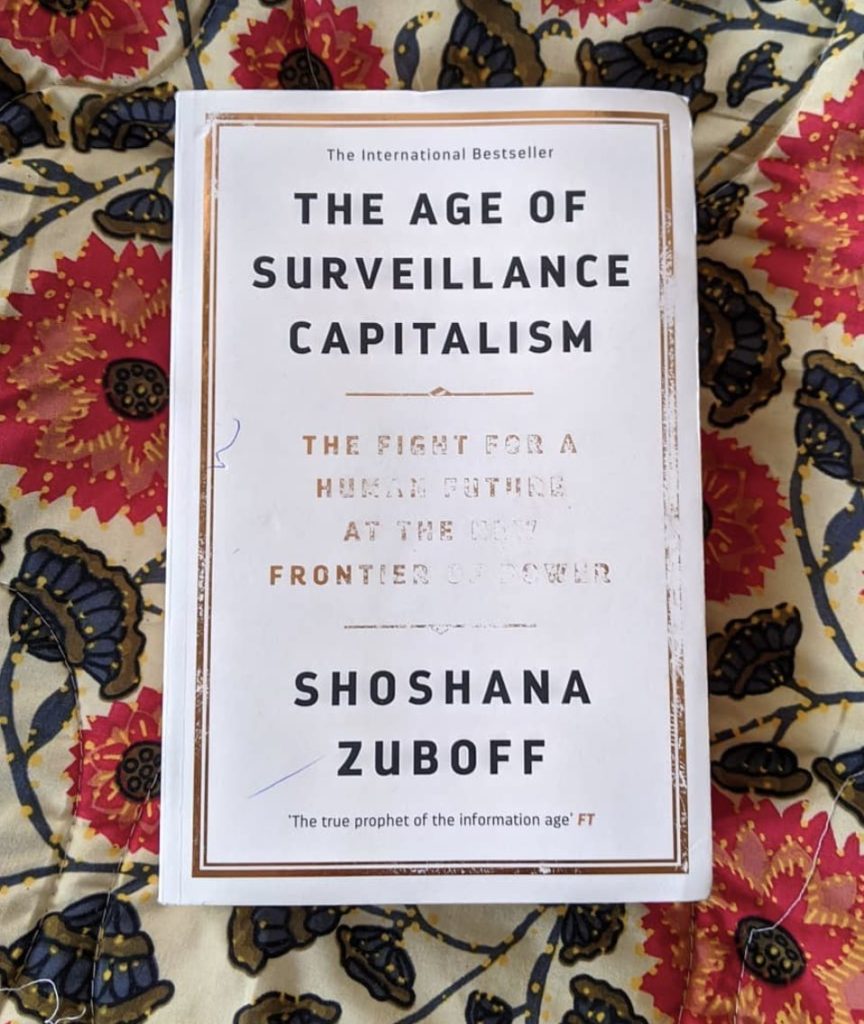
  • The Age of Surveillance Capitalism: The Fight for a Human Future at the New Frontier of Power

    Shoshana Zuboff

    Around the same time last year, I remember tweeting a quote attributed to Jamie Bartlett – “The end result will be ad targeting so effective that you may well question the notion of free will altogether“. Connecting digital advertising to free will seems absurd, but it wasn’t a facetious remark. It reflected the reality of our times. This is the reality that Shoshana Zuboff explores and confronts in The Age of Surveillance Capitalism, frequently echoing the thought that keeps cropping up in my mind – how did we get here?

    She begins with a deeply personal story about her home, and brings up an “aware home” project in 2000, which among other things, assumed that the rights to the knowledge would lie in the hands of the human living in it. She then juxtaposes it against the current privacy policy and usage agreements of Google’s Nest, which all but completely gives the ownership to the search giant. This is just one example.

    Industrial capitalism thrived by exploiting nature, and surveillance capitalism is thriving by using human nature as a resource. That means that even though, due to rapid industrialisation and mass production, we got to a “second modernity” that provided millions access to experiences which were until then the preserve of a smaller elite, we are now being led back into a “neofeudalism”, a consolidation of elite wealth and power. How did this happen?

    Google plays the primary antagonist in this narrative, and though Brin and Page were initially reluctant, the 2000 bust set Google on a path that used the “behavioural surplus” generated by users. At a basic level, it is probably difficult to imagine that when one carries out a search on Google, the machine is searching for patterns in the expressed intent, and making rapid incursions into one’s life. And yet, that’s exactly how it works. It then leads to prediction products, economies of action and future behaviour markets, fuelled by an ever expanding scope of information extraction. Those ridiculous permissions apps require make sense now? And how does a corporation create and grow a future behaviour market? Simple, behaviour modification, whether you realise it or not.

    Over a period of time, Google has institutionalised its invasions into private human domains, helped in the beginning by the national security imperative following the 9/11 attacks. Chrome, GMail, Android, Photos, YouTube and so on have created a dependency that now borders on feeling left out of the societal narrative if one is not using these. The behind-the-scenes look at Pokémon Go is chilling – in terms of how users were giving away data of their own volition, how partners were brought on board to expand the scope of surveillance, and how human behaviour was controlled at global scale.

    Facebook makes its presence felt in the latter half of the book, thanks to its exploitation of social connections. By creating a prototype of a hive mind through the weaponisation of peer group reinforcement, it increasingly shapes minds and behaviour, especially that of young adults. The author uses Goffman’s framing in The Presentation of Self in Everyday Life and shows how the “backstage”, where individuals are truly themselves, is now shrinking thanks to the omnipresence of social incursions. Where does this lead to? One example is when the state starts using this power – China’s social credit system now has a direct impact on an individual’s life, driving economies of action in the real world. More broadly, totalitarianism, driven by powerful corporations.

    The consequences are that there is increasingly no refuge, no sanctuary, from the relentless efforts of corporations that are intent on controlling every facet of an individual’s existence. At a broader level, it threatens the fabric of society and democracy itself. Capitalism’s latest avatar has clearly gone rogue, refusing to abide by the reciprocal nature of every kind of interaction we have experienced thus far. Regulation isn’t really keeping up, except for some efforts by the EU. But there are those who refuse to give up – activists, and artists who use technology to keep out surveillance. However, this is a fight we have to contribute to, because what’s at stake is what makes us human – free will, or at least the notion of it. This is not an easy read, but it is a must-read.

  • Invisible Women: Exposing Data Bias in a World Designed for Men

    Caroline Criado Perez

    Enlightening! While a part of the title reads “exposing data bias in a world designed for men”, I think it extends well beyond that. It provides perspectives that I had not even considered, even though in the last few years, I have tried to be more conscious of the challenges that women face at the workplace, in public spaces, their everyday lives, and how the world works differently for them in the many, many things that men take for granted. This, therefore, is a book that I think men and women should read, for different reasons.

    For women, it will probably serve as an insightful articulation of many things that they have thought about, talked about, or attempted to change, and give them information about how women around the world have taken them up as challenges and sometimes succeeded in setting things right. I will stop at that, and not be presumptuous in assumptions.
    For men. Where do I even start? I think we will see the world differently after reading this book. The challenge for us would be to be conscious of the inherent bias in our thinking, our behaviour, and the way we design objects and systems. As the blurb says, imagine a world where the phone you use is too large for your hand, where the safety of the vehicle you travel in has not really been designed with you in mind, and the medicine you have been prescribed is just wrong for you because you weren’t adequately represented in trials! In essence, “the lives of men have been taken to represent those of humans overall.”

    The author uses data and case studies from multiple domains to highlight how women haven’t been fairly represented, and in many cases to also show how correcting this could lead to a better result not just for women, but for humanity overall. Public transport, urinals (ever wondered why there’s always a queue for women while men seem to find things much easier), workplace practices, product design, medicine, disaster relief, the pain is everywhere. And they are at various levels of seriousness. Some made me say “oh, I didn’t think of it that way”, many made me grimace, and most are just appalling.
    It has given me many perspectives, and a resolve to work harder at contributing to fix this. One really doesn’t have to be a genius to understand the impact better representation can make, at an individual and species level. With all that being said, in the end, I also have to admit, quite sheepishly, and to underline the point, that while many of my favourite authors are female, I might have completely missed this book if my wife hadn’t made it part of our list! See? 🙂

  • Uncharted: Big Data as a Lens on Human Culture

    Erez Aiden, Jean-Baptiste Michel

    The book was published in 2013, relatively the early days of what has come to be a fairly common buzzword. Therefore, it is probably unfair to expect this book to have the understanding or perspectives that the field has accumulated in the last few years.

    Having said that, I still think my expectation from the book was higher. It stemmed mostly from the title, and I thought there was tremendous scope there. We now consume, produce and share tons of data on a daily basis. What could it say about us at a societal level? Wouldn’t that be a great way to study how our culture has evolved as a species and perhaps differently in various parts of the world? How do ideas spread, how many of them are universal, and do some have more velocity than others? But hold on. While this book does try to give some answers, it is solely based on the authors’ experiments with datasets using Google Books Ngram Viewer.

    This is a formidable tool – 30 million books digitized by Google. But it is limited too. These are only books published, and a subset of them. Books are only a small representation of culture, and by virtue of publishing being gated (in the past) would carry inherent biases. To be fair, the authors are aware of this and bring it up towards the end. It also raises the concerns that have now grown louder – who owns the data, who has access, what is it being used for?

    So, if you go by the title, you might be a little disappointed, but it is an interesting story well told and made accessible. It does provide many, many interesting trends and findings across disparate things like technology, popularity, grammar. You would like it especially if you’re interested in language – words, their usage, grammar etc.