Category: Future & Tech

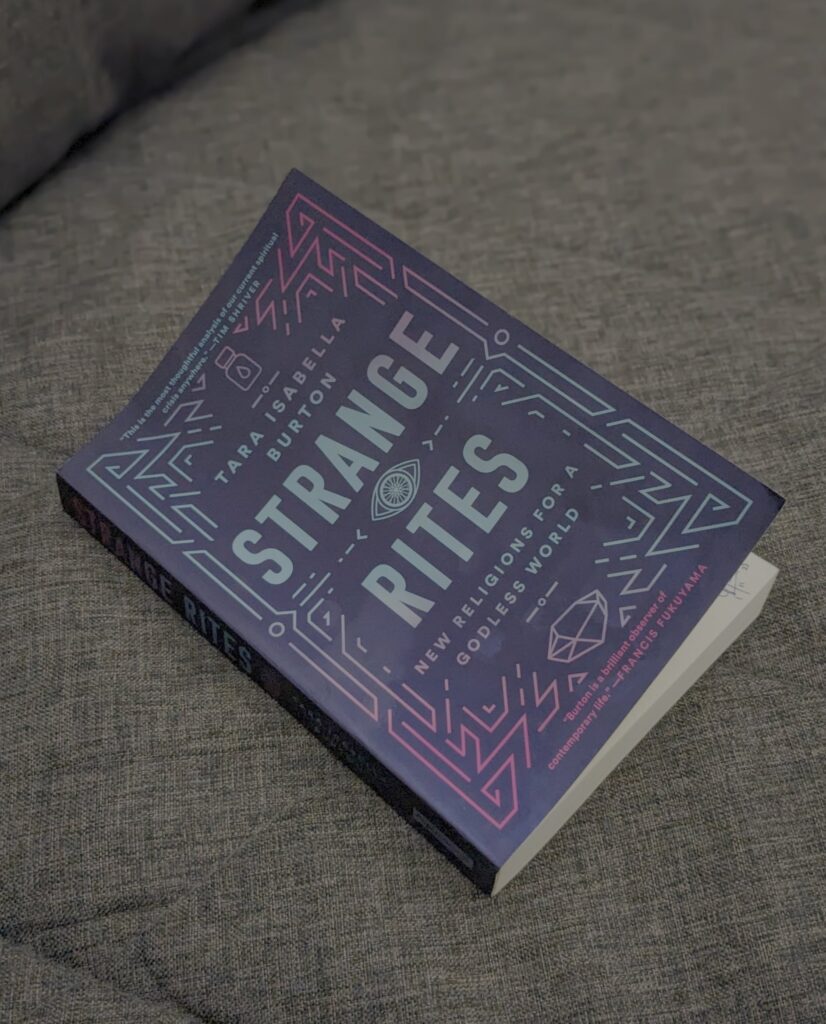
  • Strange Rites: New Religions for a Godless World

    Tara Isabella Burton

    Strange Rites is another book I discovered only thanks to a podcast. I found it a fascinating exploration of how the (almost) post-religion United States is evolving. Folks who call themselves Christians have been steadily decreasing, and ‘Nones’ who claim no affiliation to any organised religion is the fastest growing group. One-third of millennials (and one fourth of all adults) have no affinity to religion. Tara Isabella Burton tries to find out who (or what) is filling the God-sized hole.

    She begins with her personal experience at the McKittrick Hotel, home to the British theatre company Punchdrunk’s production – Sleep No More, an experiential phenomenon that she describes as “equal parts video-game, voyeurism and religious pilgrimage”. It’s a retelling of Macbeth but every part of it is subject to interpretation by the performers and the audience, with the latter also having the option to be part of the ‘play’.

    This serves as a preview of the world of SoulCycle, Korean beauty routines, Gwyneth Paltrow’s juice cleanse, Crossfit, Internet fan fiction, Headspace, and so on. A long list of options from which people can mix their own religious cocktail of spiritual, philosophical, aesthetic and experiential dimensions. It influences not just individual lifestyle but societal politics too.

    The author broadly classifies the non-affiliated into SBNRs (Spiritual but not religious), Faithful Nones (who hunger for something larger than themselves) and Religious Hybrids (who practice a portion of their religion, and supplement it with things outside it). All of them (and us) are looking for what religion originally delivered – meaning, purpose, community, and ritual.

    She then spends a chapter on the war that has been fought on religion within America – the institutional (centred around Church and society) vs the intuitional (centred around the person). And that progression and the heterogenous mixes that happened reflects in the changes in culture and mindset within society during the 60s, 70s and so on.

    And thus, while the new forms of religion aren’t new, the author cites three factors that makes this era different and likely to stick around – the absence of wider demographic pressure, the power of consumer capitalism, and the rise of the internet. While millennials are caught between their lack of belief in their parents’ religion and the political conservatism on societal issues, capitalism finds a way in, helping them create identities and tribes. It will sell us meaning, brand our purpose, custom-produce community, tailor-make rituals and commodify our humanity. That includes a spiritual entrepreneurship course at the Columbia Business School!

    This new age version of religion (spiritualism) has an interesting parallel – the role that the printing press and the spread of mass literacy played for Protestantism is what the internet is doing today for new age movements. From Yahoo Groups for The X Files and Xena to Harry Potter and World of Warcraft, people were no longer bound to their geography to find their tribe. Fan fiction boomed. The author cites two watershed moments which show how ‘fans’ started taking ownership – the call for Rowling to step away from the Harry Potter universe after her fall from grace, and Gamergate, when there was a backlash against a section of gamers who wanted video games to address the interests and concerns of minority players. Though it wasn’t the first of its kind, the movement was the first to get into a large cultural conversation. Many of the players on the reactionary side (against the demand) would later become alt-right/alt-lite celebs.

    Another evident phenomenon is wellness culture, which focuses on self improvement and commoditises self care. It has the fandom and the ‘theology’ of purpose and meaning to back it. The philosophy of SoulCycle, Goop etc have their roots in New Thought, one of America’s earliest spiritual traditions that blended liberal Christianity with Transcendentalism, and the path includes folks like Norman Vincent Peale (The Power of Positive Thinking), and the discourse in the contemporary era even included self care as a revolutionary act against Trump’s America! The other phenomenon that the author brings up is the revival and rise of witchcraft. The number of adherents are over a million. Here too, Trump served as a nemesis, with the larger narrative connecting the rituals of witchcraft to a higher social and spiritual purpose – dismantling toxic and oppressive structures associated with patriarchy, white supremacy and other unjust hierarchies.

    Another massive shift is in social-sexual identities. Though swapping, kink etc existed in the 1900s, many interests and groups were in the closet are now lifestyles accepted by the mainstream. A key role was played by the internet in transforming the modes and rituals of these communities too, accelerating access and consumption. Simultaneously monogamy is receiving a pushback. The 1970s and 80s were the peak time for divorces in the US, that means children growing up then have a fairly dismal view of marriage.

    74% of American millennials now say that “whatever is right for your life or works best for you is the only truth you can know”. While fandom, wellness, witchcraft, sexual utopias all play out, are there organising thoughts that can take the place of religion? The author works out three of them. The first is ‘social justice culture’ – a progressive mix of self care, moral determination through lived experience, and a fight against racism, sexism and other forms of bigotry and injustice. The second is a Silicon Valley based version who work towards an optimised self. Libertarian techno-utopians, rewriting biology and society through ‘hacking’. Despite their cosmetic differences, both groups have much in common. They both have a disdain towards society’s mores, maxims and rules. And both seek self actualisation. And yes, both are viable consumer categories for capitalism. Wokeness, self care and more!

    However it is the third that the author considers the most viable contender, and the most dangerous. Authoritarian, reactionary, materialist, and one that valourises submission to a higher political or biological truth. They find spiritual and moral meaning in primal, masculine images of heroes past. Yes, mostly white. They believe that biological determinism, gender binary, and natural hierarchies are what leads to progress. Not progressivism and political correctness. Jordan Peterson is one of the high priests, and r/TheRedPill forum is an active shrine of the movement. They provide a sense of brotherhood. Meme magic in 4chan, Pepe and Kekism all were connected to the Donald Trump campaign. Many mass shootings and other acts of violence are by graduates of this school of thought.

    Religion and politics have been connected throughout history, but is remarkable to watch the narrative in the contemporary era unfold as the author connects the pieces and lights up the path that got us to where we are. But then again, to learn of something and to learn from something are two different things. In my favourite reads of 2023, and highly recommended if you have any interest in modern society and/or religion/ and/or culture.

    Notes
    1. In 1890, a businessman Elijah Bond patented a “talking board” for mass use. That’s the Ouija board.
    2. Apparently Fifty Shades of Grey started out as fan fiction – based on Twilight’s lead characters!

    Strange Rites
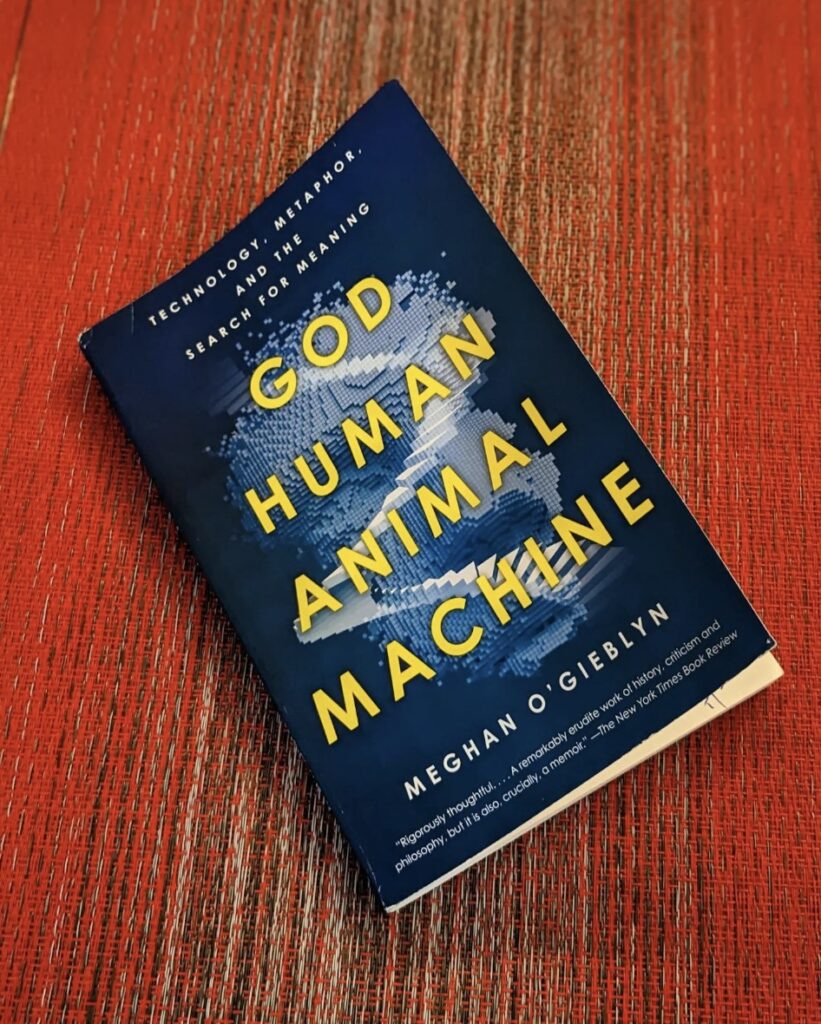
  • God, Human, Animal, Machine: Technology, Metaphor, and the Search for Meaning

    Meghan O’Gieblyn

    It is difficult to slot God, Human, Animal, Machine: Technology, Metaphor, and the Search for Meaning. Meghan O’Gieblyn sets us off on a thought-provoking exploration of the intersection of faith, technology, and the human experience, and traverses many interesting paths to understand what makes us human, and our search for meaning. Descartes started us on the path to the Enlightenment by ‘separating’ the material world and our ‘soul. From then, we took pride in using scientific temperament and technology to systematically solve nature’s puzzles. And now, when the same toolkit has created machines whose learning and thinking models are increasingly ‘black boxes’, there is fear, uncertainty and probably a bit of ego.

    Through chapters that are at once seamless and disparate, she navigates philosophy, technology, and theology and our different ways of understanding God, ourselves, and the world we are creating through technology. The metaphors of our time are built around technology, and AI and tech are raising questions that have for long been asked by philosophers – free will, immortality, the relationship between mind and body. Science by definition requires an objective perspective, and consciousness can only be felt, and measured inside. I can never know what it feels like to be another person. While there are many hypotheses, this is an area which science has been unable to really crack.

    In ‘Pattern’ it is interesting to see the many parallels between the Bible and the belief systems of technologists, despite many of the latter being atheists. Transcendence through the Singularity and trans-humanism, just as through the Book of Revelation, the resurrection and rapture, for instance. I really liked Kurzweil’s idea of consciousness as a pattern of information that persists over time. Essentially like a stream that rushes past the rocks in its path. The actual molecules of water change, but the stream remains the ‘same’. In a letter to the author, he shares a wonderful insight that “the difference between so-called atheists and people who believe in ‘God’ is a matter of the choice of metaphor, and we could not get through our lives without having to choose metaphors for transcendent questions.” From (divine) clockmakers to computers.

    In the chapter ‘Network’, the idea of emergence is discussed in the context of consciousness, and so is the work of many scientists to recreate that – experimenting with robots to see if they evolve complex behaviour from simple rules. It hasn’t really worked thus far, but I did wonder about the amount of time evolution took to ‘produce’ us.

    In ‘Paradox’, there is mention of the parallels between quantum mechanics and eastern mysticism, and the idea of us being in a simulation, and/or a multiverse. It is interesting to note that all paths require a reasonable dose of faith! There is a very intriguing part that uses video games to illustrate how the first-person view makes it look like a world that is always complete as things appear when you move. But were they around when the player was not looking? Does the world “only render that which is being observed”?

    ‘Metonymy’ moves into materialism (science and its ability to reduce everything to causal mechanisms), dualism (mind-body), panpsychism (all things have a mind-like quality) and finally idealism (the physical world is wholly constituted by consciousness). The mind serving as a microcosm of the world’s macroscopic consciousness reminded me of Aham Brahmasmi. Towards the end of this chapter, she quotes Hannah Arendt, who wrote about scientists who believed that computers can do what a human brain cannot comprehend.

    That paves the way for ‘Algorithm’, which begins with Chris Anderson’s 2008 view that data deluge has made our scientific method obsolete. It has now gotten to a state where we will accept the algorithm’s perspective probably more than our own mind’s! But as Nick Bostrom has pointed out, there is no reason for a super intelligence to share our values including benevolent concern for others. The algorithm does not necessarily worry about downstream consequences or collateral damage. And yet, even as algorithms are plagued by errors and the biases we have fed it, ‘dataism’, as Yuval Noah Harari states, is the new ideology. That if we have enough data, we can know everything, thereby increasing surveillance and tracking.

    The end of this chapter has a chilling, and yet fascinating observation – “What we are abdicating, in the end, is our duty to create meaning from our empirical observations — to define for ourselves what constitutes justice, and morality, and quality of life — a task we forfeit each time we forget that meaning is an implicitly human category that cannot be reduced to quantification. To forget this truth is to use our tools to thwart our own interests, to build machines in our image that do nothing but dehumanize us.”
    In ‘Virality’, the final chapter, she discusses how in the digital domain, quantitative measures of success like clicks and likes have overtaken the virtue or validity of the content. There is also the funny (and yet quite true) part of how, when we treat Trump as an algorithm which has mastered social media, it all makes sense!

    God Human Animal Machine is intensely thought-provoking, and O’Gieblyn manages to balance curiosity and a healthy skepticism, distilling thoughts from various streams and thinkers, to provide a coherent narrative that fuels more thinking. For all of this, the book is also deeply personal and extremely accessible. Highly recommended.

    God Human Animal Machine
    Screenshot
  • Broad Band: The Untold Story of the Women Who Made the Internet

    Claire L. Evans

    I had a sense of deja vu while reading this, and later realised that it was thanks to Maria Popova’s Figuring. The books are very different in terms of scope, but are connected by the women-oriented narrative, the idea of intellectual successors, and the presence of what one could call a ‘crossover character’ – Maria Mitchell.

    When we think about the internet’s history, and its current pantheon, the names that pop up are all, or at least mostly, male. But Claire Evans points out that the origin stories are actually mostly female. Their contributions are practically invisible both in the public eye, and while we use the web.

    (more…)
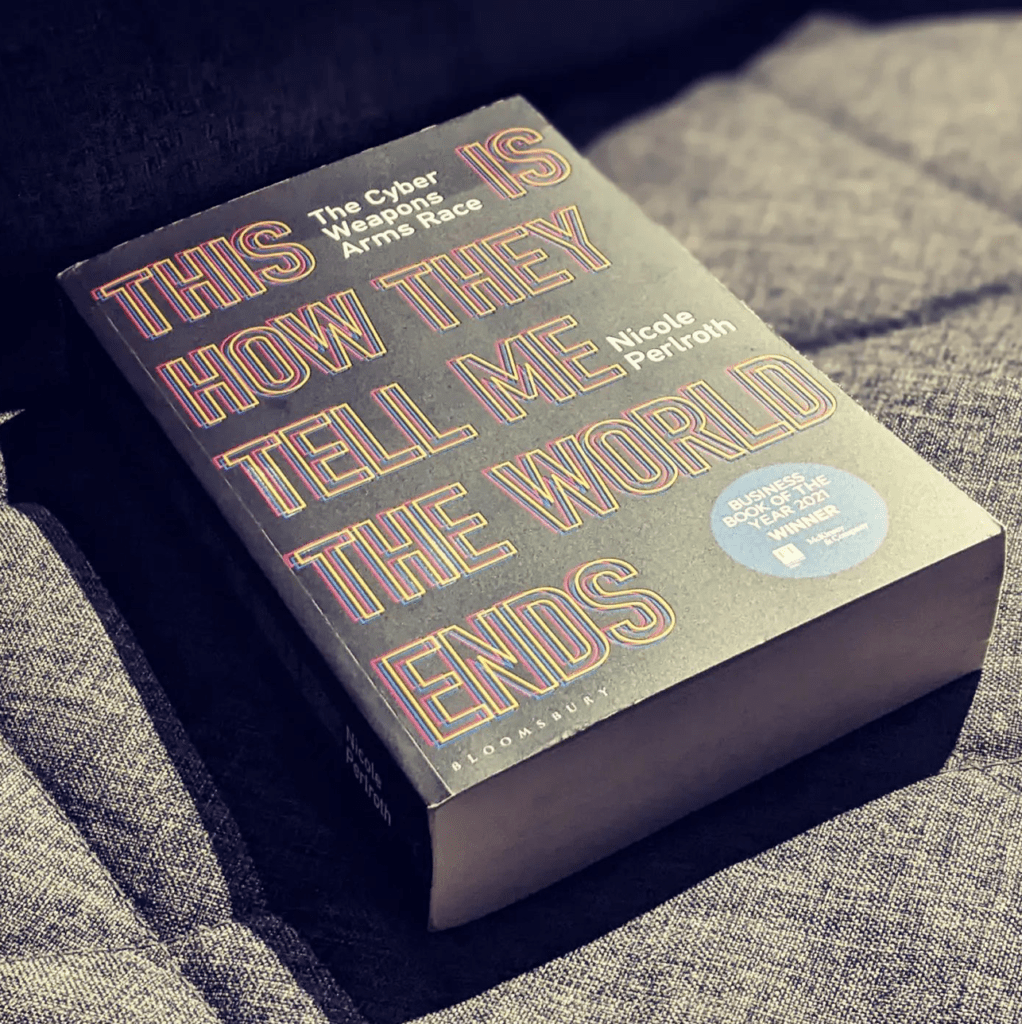
  • This Is How They Tell Me the World Ends: The Cyberweapons Arms Race

    Nicole Perlroth

    In the epilogue, Nicole Perlroth goes back in history to a summer afternoon in 1976, when in the parking lot of a biker bar, a team of scientists from SRI International (which had an office in Menlo Park) sent the first email over the internet to ARPANET, as a demo for Pentagon officials who had flown in for this. In the world then, national security was largely a function of things in the physical domain – hijacked planes, rogue nations with nukes, drug trafficking, terrorists and so on. (Almost) half a century later, the world is a different place. Forget rogue nations or terrorists, a single hacker can seize control of a plane in mid-air with nothing more than a play on the code in the software running the plane. Everything from election systems, power grids, nuclear power plants, gas pipelines to hospital systems can be held hostage with ransomware. Most of them have been, and every device we use – from mobiles and laptops to connected homes and cars – is vulnerable. This is the story of that transition. 

    Nicole begins the book in Ukraine, where she was surveying the aftermath of a devastating cyberattack, which included the Chernobyl radiation monitors going offline. The culmination of Russia’s revenge for the 2014 Ukrainian elections, which they unsuccessfully tried to hack. That the hack boomeranged and destroyed Russia’s own oil giant Rosneft’s data is a good example of how even those who unleash attacks cannot be sure of its speed and direction. 

    But the story begins in the Cold War era, back in 1945, when bugs were ‘microphones’ and the advanced exploits were through anything that was attached to a plug – typewriters, copiers, printers etc. There is an extraordinary story from 1984 of Project Gunman, and how a coil in an electric typewriter was ‘weaponised’ with a magnetometer and a recording device for spying! 

    And then came the computers. The first version of Linux had 176000 lines of code, now Microsoft’s Vista has 50 million. Each a potential vulnerability. Back in the day – from the late 90s, brokers started paying coders to purchase exploits in hardware/firmware/software – Sun, Cisco, Microsoft, HP, Oracle. They then sold it to these companies, sometimes having to show them proof of how it could be exploited. As the internet grew in size and became a global network, an underground market for exploits formed and the US government started building an arsenal including zero-days (a software/hardware flaw which doesn’t have a patch yet, called so because the ‘good guys’ have zero days to fix them). Some zero days are ‘ideal state’ – they require zero interaction from the target’s end, no mails or messages, and also ‘clean fail’ – they wouldn’t trigger an alert or crash a computer. But since the days of Stuxnet (2010), which had as many as seven zero-days and was used by the US to neutralise Iran’s Natanz nuclear facility), things changed. Just like Hiroshima, a weapon had been revealed and it would not go back into the box (Michael Hayden, former NSA director).

    Also, in 2007 came the iPhone, supercharging the era of government snooping, and an invasion of privacy with minimum effort! By 2015, the NSA was even snooping on their own First Lady! It is now a minefield with different governments including not just powers like Russia and China but Iran, North Korea, Israel their opponents within the country and outside, hacker groups, tech companies, and government agencies all in an arms race to win cyber wars in milliseconds. 

    The book has many interesting stories. The origins of Pegasus (by the NSO in Israel), named after the winged horse, and which could capture vast amounts of data from the air without leaving a trace. Aurora – the Chinese Legion Yankee attack on Google, and Brin’s strong response, though it was only for a short while. Argentina’s thriving hacker ecosystem, Iran’s ‘burning flag’ response to the US in its Aramco hack, Russia’s hacking of the DNC, WannaCry by Lazarus from North Korea, HeartBleed based on a widely used OpenSSL software, the linkage between the assassination of Jamal Khashoggi, the purchase of exploits by Emiratis, and the publishing of Bezos’ private photos (the source was actually the mistress’ brother, but the phone was simultaneously hacked too) are all signs of an escalating war. There is also a funny story on how, after Trump ordered Russia to close their San Francisco consulate, plumes of black smoke began pouring out of their building’s chimney. They were obviously burning something, and when a reporter asked an exiting man and woman about it, with acrid smoke billowing around them, they replied, “there is no burning.”

    The weapon will not go back into the box, and it is now capable of devastation in milliseconds. The world, while aware of this, is not willing to find alignment on things that will now start taking human lives. One excellent place to start is to stop taking buggy code to market. In an economy that rewards first-to-market and “move fast and break things”, this is not going to be easy. As usual, Scandinavia leads the pack for safety, but Japan offers an instructive lesson in making cyber hygiene a priority for everyone from government agencies to individuals. But this provides no comfort because it is really an arms race with seemingly no end. 

    The narrative is relentless and extremely accessible. It throws light on an area which we shouldn’t be ignoring, given how much is at stake. For me, it is also a validation on not going beyond the mobile phone in terms of tech hardware. But that really is small relative safety, nothing more. And just like Nicole, I wonder when we will see the ‘mushroom cloud’. 

  • This is not Propaganda

    Peter Pomerantsev

    As the old joke goes, ‘Truth will prevail’, but no one said whose truth! I think if there is one book you should read to understand the sociopolitical information warfare on social media happening daily, this is it. From Mexico to Manila and London to Kiev, there is a playbook that is being followed to distort reality. The same tools that were originally used to create revolutions are now being used by autocrats to gain and hold power. More information was supposed to be more power, but it also provided new ways to silence dissent. Censorship through noise. And where did it all begin? In Russia. Peter Pomerantsev has a first-hand experience of how it all started. Forty years ago, his parents were forced out of Kiev (then part of the USSR), and their journey since then serves as a great narrative guide. 

    The book is divided into six parts. The first part uses examples like Rappler vs Duterte (Philippines’ version of Trump in the US and Bolsonaro in Brazil) and Lyudmilla Savchuk, who exposed Russia’s troll farms, to show how new instruments of information are being used to break people. Russia denies connection with the troll armies, like every other state – Turkey, Bahrain, Azerbaijan etc – that uses similar means. 

    The second moves to Latin America and EU to show how entire resistance movements have been dismantled. Clever rulers have found ways to remove the clarity around the ‘enemy’ by coopting the language and tactics as those who fight oppression. Srđa Popović knows a thing or two about the original playbook. A Serbian political activist, he was a leader of the student movement Otpor!, which was instrumental in toppling Serbian president Slobodan Milošević. He has since then trained activists in Georgia, Ukraine and Iran. It’s an irony that his manuals and courses are being used against the very purpose for which they were created, and it’s now come down to an arms race of tactics and technology between guys like Alberto Escorcia and Mexico’s corrupt politicians. Russia invaded Estonia in 2007 without setting foot in it by mimicking the entire playbook and using Estonia’s own pro-Russian citizens in protests. Another trick is to state that genuine protesters are being paid by the US. From Facebook to Discord there are people being recruited and systematic strategies being used to undermine pro-democracy efforts.

    The third part is on how one nation is able to ‘invade’ another without real contact by blurring the idea of war vs peace and domestic vs international. War is no longer in just physical space, it is hybrid, non-linear, full-spectrum (all terms used by experts) and is focused on decaying the opposing group/country from within. Information warfare is the first play and the military follows, if required. Russia’s attack on Ukraine in 2014 is the classic example. “Faced with wildly conflicting versions of reality, people selected the one that suited them.”

    The fourth explains how, without a tangible idea of the progress and future, anything goes! When Putin invaded Crimea, he first said there were no Russian soldiers there, and then later casually said there were. Replaced one reality with another. Another example – 76% of Trump’s statements in the election were mostly false or untrue! The case made for these distortions is that objectivity anyway doesn’t exist. Related to this is the glorification of the past. ‘The twentieth century began with utopia and ended with nostalgia. The twenty-first century is not characterised by the search for newness, but by the proliferation of nostalgias’. And in the era of ‘soft facts’, we can know everything happening in Aleppo and pretend to not see it.

    Pomerantsev sets a prelude for Chapter 5 with his own confused identity in childhood – British or Russian? When old notions of identity around demographics and religion get blurred, all politics now revolves around ‘identity’ they can create and use for their own ends. The story of Rashad, one of the founders of Hizb in the UK, who was early into this game but now works to dismantle it, is fascinating. This part also has the working of the Brexit campaign. Eighty types of targeted messages for 20 million people. Animal rights, environmentalism, gay rights, potholes all somehow made to connect with Brexit. And it all began in Russia. Starts by Pavlovsky for Yeltsin, but polished by Putin. 

    The final part is about the future – China, but begins with Nigel Oakes, founder of SCL, whose game was repurposed by one of its other founders to create Cambridge Analytica. China is well on its way to target people with demographic, psychographic and behavioural patterns. The book ends with a brilliant closure – of the subject as well as the personal history.

    While the wiring is clear, what remains to be seen is the second order consequences of this combination of trolls, psyops, dark ads, bots, soft facts etc. Not just at an individual or societal level, but at a species level. The book is extremely well-researched and has a narrative and language that is easily accessible. The interweaving of the personal narrative is at once sharp and seamless. This is a book I’ll hugely recommend. 

    P.S. I wish he had also covered India too, the playbook is being religiously followed here!