Reshuffle is a book I had been looking forward to reading ever since I started seeing Sangeet Paul Choudary’s excerpts and related posts. And despite reading all those posts, the book had sufficient meat to make it an excellent read. One that offers great perspectives on dealing with the influx of AI in work – at an individual and business level.
I think I have a bias for the book because of a few reasons. One, it follows a clear systems thinking approach, and the logic and reasoning is robust. Two, it is a strategic and framework-driven exploration, which means it offers tools to think about this in one’s own contexts. Three, it’s not just theory. The book provides sufficient examples that can serve as starting points on how to think through this. That, as you’d notice is an elegant why-what-how approach.
I have to admit that I began reading Nexus with a bias – courtesy Harari’s earlier works. While I liked them when I first read them, further reading and critical takes reduced the good impression considerably.
So, while I really liked the first two chapters, I did find irony in him writing about information and truth after bring rebutted by experts on agricultural revolution and various other things he is not an expert on. And while I really like reading history, his meandering on Niall Ferguson mode in the first part of the book didn’t endear himself to me at all.
Just so we are clear, the scope of this book is only the US, the rest of the world will have to figure its own way to abundance, though we might learn a few tricks from this. Ezra Klein and Derek Thompson wonder why, for all its enormous wealth and technological capability, the US cannot address the fundamental human problems of hunger, homelessness, life-threatening diseases, and fuel an equitable world with clean energy.
Indeed, the introductory chapter ‘Beyond scarcity’ does imagine an utopian world really well. And it’s clear that it isn’t technology that is stopping us. Sigh.
As someone who has worked with founders in the startup space for over a decade and a half, the megalomania, the lack of empathy, and the moral bankruptcy in Careless People all seemed familiar. But Sarah Wynn-Williams’s first person account is about arguably the biggest phenomenon that has hit culture in the last decade and a half – social media, and specifically, the biggest player in it – Meta (then Facebook). She worked at Facebook from 2011 until her termination in 2017, the time when Facebook went from infancy to a full-blown global power base.
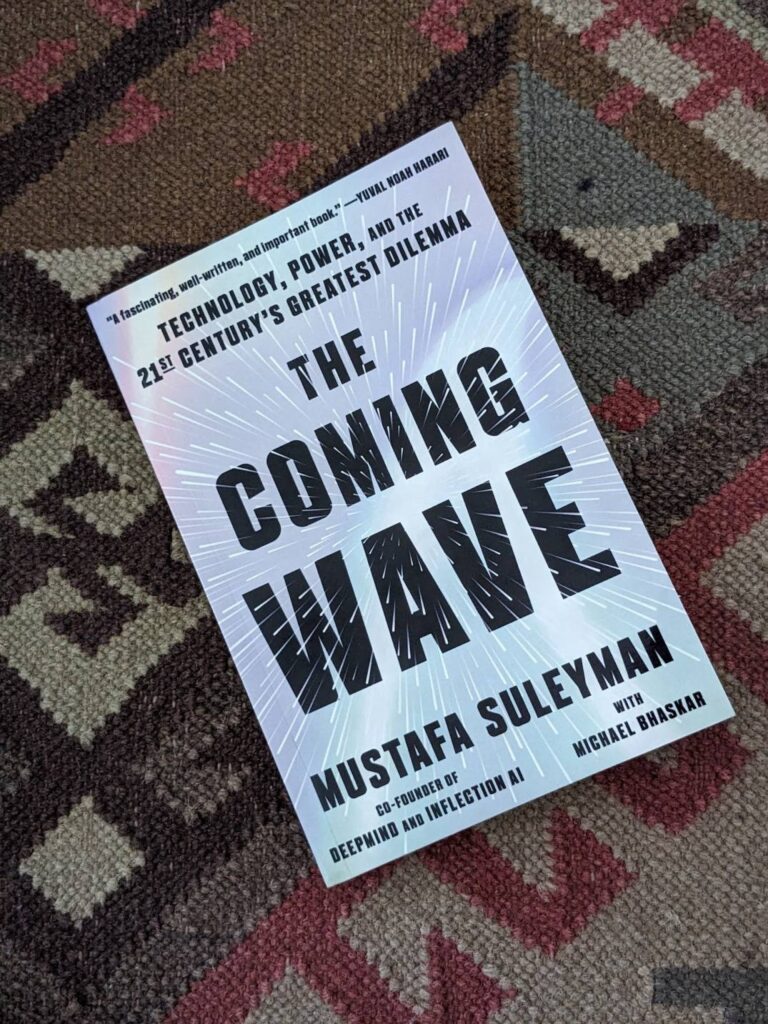
Co-founder of first DeepMind (the company behind a couple of massive leaps in AI – AlphaGo, AlphaFold, acquired by Google), then Inflection AI and now (before the book published, I think) CEO of Microsoft AI, I think there are few better people than Mustafa Suleyman to write about AI. And I suspect there will be few better moments than now. The Coming Wave was a book I was looking forward to reading, and it didn’t disappoint.
The book is divided into four sections. The first looks at the history of technology and how it spreads. The second gets into the detailing of the coming wave – two general purpose technologies – AI and synthetic biology, and associated technologies like robotics and quantum computing. This section also goes into the features and incentives that drive them. Part 3 takes a side step into the political implications of this on the nation state, the only institution that can temper the wave. The last section looks at what is the ‘containment problem’ – a wave of technology is near impossible to contain, history has ample proof, but can we still take a shot at it.
In the first section of The Coming Wave, Suleyman shows how technology has a clear, inevitable trajectory: mass diffusion in great rolling waves. New discoveries are used by people to make cheaper food, better goods, more efficient transport etc. As demand grows, competition increases, the technology becomes better and cheaper, and easier to use. From farming to the internet, history has enough examples. A big challenge is that the inventor has no way of knowing the nth order consequence (the ‘revenge effects’ of technology – fridge makers didn’t start out with the intent to punch a hole in the ozone later), and once a technology is out there, there is very little we can do to contain it. From fossil fuel emissions to opioid abuse to space junk, this is the story. The only partial exception is nuclear weapons.
There is a fascinating story in the beginning of the second section on DQN, an algorithm the DeepMind team created to play the game Breakout, and it discovered a strategy that most humans didn’t think of. The trailer for AlphaGo. The section also goes deep into synthetic biology and robotics. Apparently, one can buy a benchtop DNA synthesiser for $25k.
But this section is even more important because it brings out the four intrinsic features of this wave that compound the containment problem. One, it has a hugely asymmetric impact. Which this has happened before (cannon vs a large set of people) it has been scaled massively with the internet and now AI (a single algorithm can hold massive systems to ransom). Two, they are developing fast – hyper-evolution – providing very little time to react, let alone regulate ((look at cars vs the frequency of the versions of GPT). Third, they are omni-use (AI can be applied in multiple domains, and can come up with compounds for cure or as poison). And fourth, its degree of autonomy is beyond any previous technology.
Add to that the incentives and the containment problem just gets magnified. Geopolitics and the power involved, a global research system that has rituals rewarding open publication – curiosity and the pursuit of new ideas, financial gains, and the the most human one of all – ego.
The third section of The Coming Wave is on the impact of all this on the nation state. He calls out that technology is not value-neutral, and quotes Langdon Winner, “Technology in its various manifestations is a significant part of the human world. Its structures, processes and alterations enter into and become part of the structures, processes and alterations of human consciousness, society and politics.” From the printing press to weapons, tech has helped build the nation state. My favourite chapter in this is ‘Fragility Amplifiers’ – from robots with guns to lab leaks to 3d printing everything, even people with good intent can cause things to go wrong. “What does the social contract look like if a select group of ‘post humans’ engineer themselves to some unreachable intellectual or physical plane?”Add to it massive job displacement, and other social issues and the nation state faces challenges far beyond the standard issues of the day. The possibilities are a continuum from an extremely powerful nation state to completely decentralised groups of individuals.
In the last section, he looks at nine ways, working in cohesion to provide some sort of containment. Technical safety, audits, using choke points, maker responsibility to build in controls from the start, aligning business incentives with containment, helping governments build tech to regulate tech, international alliances for regulation and mitigation, a culture of sharing errors and learning from them, public input to make this all accountable. The tenth point he makes is that there is no silver bullet that will take us to any permanent solution. It is a narrow path which humanity must walk on. That probably is the biggest lesson.
I found The Coming Wave full of great insights and perspectives, and written in a way that makes it accessible to those outside tech. An important book for everyone to read since it’s a pragmatic look at what the future holds for the species. Part of my 2024 favourites list.
Notes 1. (Life + Intelligence) x Energy = Civilisation 2. Liverpool’s MP William Huskisson was killed under the wheels of the locomotive during the opening of the Liverpool – Manchester line, the first passenger railway because the crowd had no idea of the machine’s power! 4. How the stirrup changed everything. Fused the rider to the horse, and the ability to power through. It became a leading offense strategy, and changed Europe. Horses – church land for rearing- ties to the kingdom – feudalism. 3. Today, no matter how wealthy you are, you simply cannot buy a more powerful smartphone than is available to billions of people 4. Primum non nocere – “first, do no harm”. (Hippocratic Oath)