Category: Future & Tech

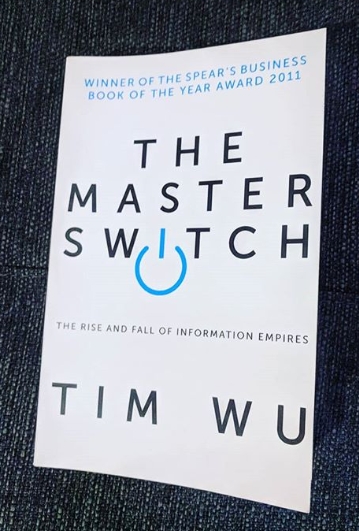
  • The Master Switch

    Tim Wu

    Wow!
    Two of my favourite books in the recent past have been The Moral Animal and The Sovereign Individual. I liked them because they brought out the fundamental patterns that underlie the evolution and behaviour of humans and the system of the world respectively. The Master Switch does the same with communication and information empires.

    His premise is this – history has shown that communication/information technologies follow a predictable path : it starts as an idea in a mind/group of minds typically in a small room, is then brought to life in the most rudimentary manner, and keeps itself open to improvements and changes until it becomes a solid proposition. It then shifts to industrial scale, predictable outputs, and controlled by a corporation which then decides to make it a closed system. He calls this the Cycle.

    The author’s contention is that all information businesses go through the cycle. The question he seeks to answer is “which is mightier : the radicalism of the Internet or the inevitability of the Cycle?” He gets there by taking us through the history of information empires.

    The story begins in the 1870s, when Alexander Graham Bell’s small telephone company goes up against the ruler of the times – Western Union. A classic underdog story that resulted in the continuing empire that is called AT&T. Is At&T still the hero? Will get to that in a bit. Similar stories with its own heroes and villains then play across radio (AM & FM), television, movies and now, the internet.

    It is not just the magnificent scope that makes the book interesting. The author retells history in the mould of a thriller! There are anecdotes and (not so) trivia that make the book really engaging. Multiple inventors of the same technology (and uncredited firsts), towering personalities from JP Morgan to Steve Jobs who left a firm imprint, fascinating origin stories of movie studios like Universal and Warner that are now household names and how movie making is now less to do with the movie and more to do with the business of the franchise (a movie is a 2 hour advertisement of an intellectual property which makes money through a franchise that sells everything from tshirts to DVDs to theme parks), companies that rise again like phoenixes in revenge arcs that span a century (GE buying Universal)!

    The author obviously does not give a definitive answer to whether the Internet will beat the Cycle. He suggests a constitutional approach (not regulatory) and a “Separations Principle” to make sure that the ownership of information creation, distribution (networks, infrastructure) and access control remains with different parties to prevent it from corporate or governmental misuse. The nuance he highlights is that the monopoly actually begins and even continues with noble intentions and utopian values, but loses the plot subsequently. Almost like “you either die a hero or live long enough to see yourself become the villain.” (Remember the question earlier about AT&T)
    He also points out (and this is where it meets The Sovereign Individual) that the user has the power to control how this plays out – “Habits shape markets far more powerfully than laws”.

    A fantastic read on multiple counts!

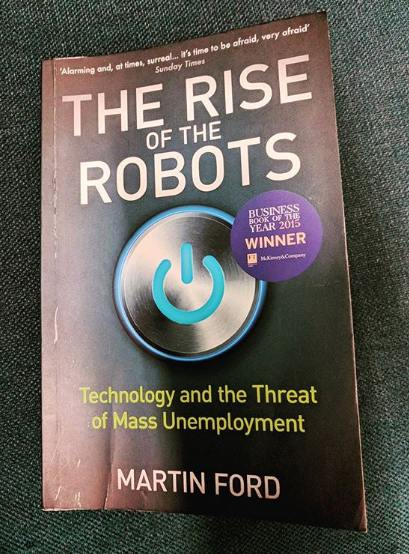
  • The Rise of the Robots

    Martin Ford

    The bad news – it would seem that the robocracy is inevitable. The good news – this is a very well written book!
    In most robotics and AI narratives, what gets lost is the nuance as folks very firmly root themselves in polarising camps on the future of our species. The reason why this book worked for me was because its focus was less on the dramatic headline (what) and more on why it would happen. It is a very well researched book and sets about debunking popular schools of thought in a very clinical manner. The author is also wise enough to call out the things he is not sure of and mention alternate points of view, as well as objective enough to not fall for the hype of everything that’s new and supposedly disruptive.

    Though he does begin with the now ascertained fact that the first wave of automation will take away the routine and predictable jobs, he also warns that it won’t stop there. Even what we would call the higher end jobs will be safe only for a while longer. He is clear that this is a wave of disruption different from what we have seen before because the cognitive abilities that get developed will be replicable and scalable. He also demolishes a couple of currently popular coping mechanisms – consistent re-skilling, and man-machine collaboration.

    The second half of the book focuses on the economic and societal implications of the rise of the robots. He predicts the fall of middle class demand as well as economic mobility, as incomes stagnate or disappear completely, and warns that economic growth would not be sustainable since robots cannot be expected to be consumers, and the plutocracy (top 5% of the population) which has the money can only consume so much!

    The solution he believes in is some version of a universal income which would ensure the participation of a larger segment of the population and give some semblance of prosperity to everyone. But he also sees several challenges in execution.

    Beyond the broader narrative, there are some fascinating statistics and anecdotes – the development of Watson, the scarily increasing time it takes for employment to regain its original levels after a recession, the sale price of Internet behemoths (YouTube, Instagram, Whatsapp) framed as a cost/employee, and so on.

    While the outcomes may not really be palatable to anyone who belongs to the species, it doesn’t take away from what a fascinating read this is!

  • Blockchain : Blueprint for a new economy

    Melanie Swan

    As bitcoin and its ilk start becoming mainstream, I think the book would serve as a good primer for those who would like to learn about the underlying technology – blockchain. It also provides a catalog of existing projects across diverse domains.

    Without doing a lot of technical deep diving, it not only provides an understanding of the concepts and features of blockchain, and highlights the current uses of the technology, but also provides a broad view of the different kinds of applications that could be made possible in the near future.  (more…)

  • Heartificial Intelligence

    John C. Havens

    The title might seem like a bit of a corny wordplay, but I think you’d find it hard to come up with an alternative that best describes the premise of the book. Artificial Intelligence is slowly but surely becoming an inherent part of our lives, and I’d say that our situation is a bit like the ‘frog in boiling water’ scenario. That’s not to say that we will be ‘cooked’ but our sensitivity to the challenge is not really at the levels it should be at. Most of the discussions are around two themes – the extermination of our species by malevolent robots, and the increasing automation of jobs and the economic and societal repercussions. Both usually end up with polarising stances.

    One of the reasons I liked this book is that the author is not on either of the extremes – doomsday or paradise – his approach is very pragmatic. The first six chapters take the reader through the process of understanding the lay of the land – from describing how our happiness is slowly getting defined by tracking algorithms, and the complete lack of transparency and accountability in those who have access to this data, to the economics and purpose of a human life and how it’s changing, to the (seeming) limits of artificial intelligence, and finally the need to have an ethics/value system in place as we go faster in our journey of designing increasingly complex AI. (more…)

  • Homo Deus

    Yuval Noah Harari

    The follow up to Sapiens, and therefore it arrived with huge expectations. To begin with, while this is a progression from the earlier work, it is also a standalone work. The book has three parts which I would broadly classify as past, present and future. The author spends the first third of the book summarising what he wrote in Sapiens, and if you have read that book, especially recently, you might find yourself muttering “Why doesn’t he get on with it?” 🙂
    To be fair, he outlines his broad premise right at the beginning – having (relatively) conquered hunger, disease and war, humanity’s next agenda would be to master happiness, immortality and divinity. The path to that is what Yuval Noah Harari slowly but surely proceeds to elaborate on.

    The second part of the book is where Harari sets the premise and context for the future by analysing the present. As is his wont, he goes about dissecting the origins of our current belief systems and the occurrences that have led us to what he calls humanism, and our collective belief in man’s central role in the scheme of things. (more…)