
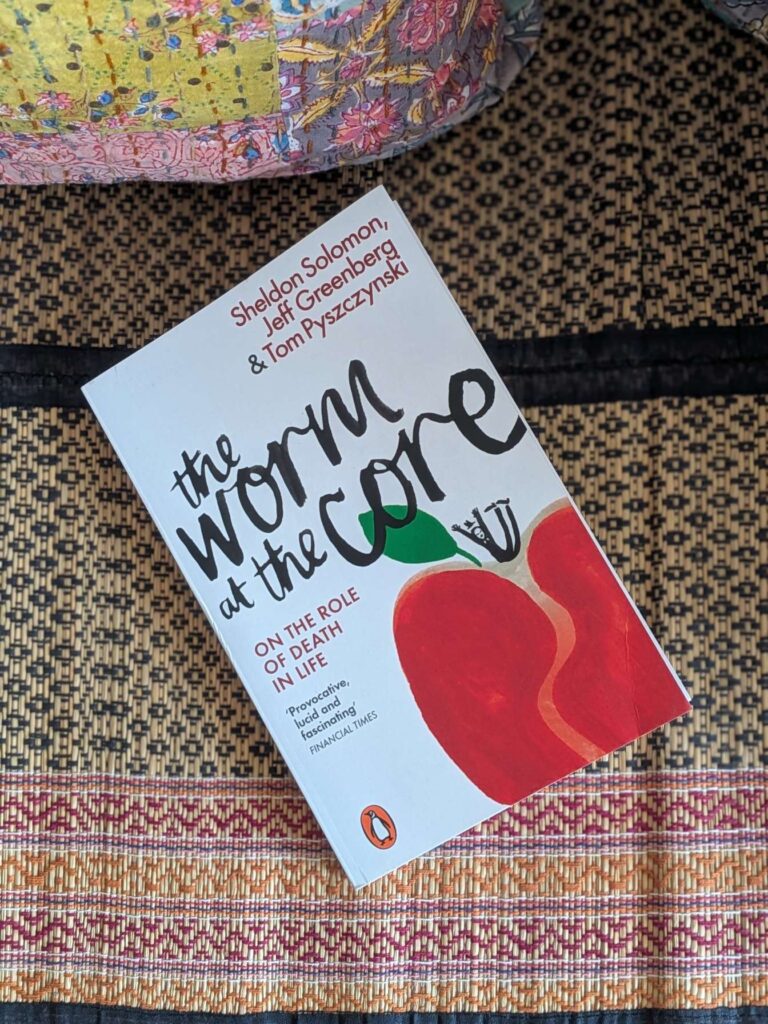
Sheldon Solomon, Jeff Greenberg, Tom Pyszczynski
A big theme of my reading in 2024 was around answering “why am I like this?” The Worm at the Core has given that understanding a paradigm shift. The basic premise of the book is that the awareness of our own mortality is the hidden engine of human thought, emotion, and culture.
The title is based on William James’ framing of this awareness (more poetic than the scientific neurocortical version) and the origins of the book are courtesy cultural anthropologist Ernest Becker. Further work on the latter led to the Terror Management Theory (TMT) conceived by the authors, which suggests that because humans are the only animals aware of their inevitable death, we have developed sophisticated psychological defence mechanisms to manage the resulting “terror”.
A core contribution of TMT is the idea that cultural worldviews and self-esteem act as psychological defence mechanisms against death anxiety. Culture worldviews are beliefs we create to explain the nature of reality to ourselves. Rituals, art, myth, religion all make it possible for us to construct, maintain and concretise our ‘supernatural’ concepts of reality.
They provide meaning and permanence, offering a roadmap for how to live, regulate social behaviour and, crucially, provide a path and systems of value to either literal immortality (through religion and soul, probably the first cultural invention in this context) or symbolic immortality (through systems like nationalism or legacies, art, or children who will carry forward DNA as well as worldviews).
By viewing ourselves as significant contributors to a meaningful universe, we buffer the anxiety that would otherwise arise from the realisation that we are merely biological organisms destined to decay.
The narrative moves smoothly between rigorous experiments and real-world illustrations. For example, one set of studies had participants write about either their own death or a neutral topic, then measured how this influenced attitudes toward others. Those reminded of mortality tended to defend their cultural beliefs more fiercely, show greater in-group favouritism, and react more negatively to outsiders. This pattern suggests that cultural defence mechanisms strengthen when we feel most vulnerable.
Self-esteem plays a complementary role. It starts right from our birth – because of our helplessness and vulnerability, we are prone to anxiety and need our caregivers to provide us psychological security. Over time, being a ‘good’ child becomes associated with protection and well-being, and feeling valued. As we grow up and slowly realise the mortality of people who provided this, we shift to culture as the primary source of psychological equanimity.
Thus, in adulthood, when people feel they are living up to the standards of their culture, they experience high self esteem, a buffer against death anxiety. Achievements, relationships, and social status aren’t just ego gratification, they are markers of symbolic survival. To feel valued by one’s community is to feel part of something bigger and longer-lasting than oneself.
High self-esteem acts as a protective shield against death anxiety. Low self-esteem leaves an individual vulnerable to the “worm at the core,” leading to increased anxiety and existential dread. To note that self esteem is not just a mental abstraction – we feel it deeply in our bodies. The authors suggest that one way to acquire more self-esteem is to cultivate diversified self-concepts. i.e. psychological eggs in multiple baskets and not be overly reliant on one.
Collectively, this provides a plausible explanation for two of the biggest political problems now – the popularity of strongmen, and the rise of large scale conflicts around the world, be it around nationalism, racism, religion or any ideology including a lifestyle. If our psychological stability depends on the validity of our worldview, then anyone who can manifest that with confidence is someone we favour, and anyone holding a different set of beliefs is a direct threat. Animals fight for food, water and mates, only humans fight for symbolic concepts, derogating ‘enemies’ and seek to assimilate or annihilate.
The book is a succinct examination of examining how subconscious death anxiety influences everything from the pursuit of wealth (if you can pay for finer things, people pay attention to you, and self esteem rises) to shopping habits (fundamentally to distance ourselves from animals to deny that we share their fate) to idolisation of celebrities (imperishable fame), and political choices (self esteem from belonging to the ‘chosen group’ and eternal continuity through survival of the worldview). Schizophrenia, anxiety disorders, PTSD are all maladaptive responses to mortal terror, when previous meaning systems have been inadequately formed in youth or undermined in adulthood.
In the final sections, The Worm at the Core also suggests ways to manage our ‘terror of death’ (because curing seems impossible). They propose that awareness of death can be transformative by making life richer. It can sharpen priorities, deepens relationships, and promote creative expression, helping us lead more authentic lives. From a lived experience, I am in agreement with this, though the journey is always WIP.
The narrative is very accessible and crisp – the book is just 225 pages. I found it to be very insightful, because it provided me a different lens to study and understand my motivations. Absolutely recommended.
Notes and quotes from The Worm at the Core
1. “We build character and culture in order to shield ourselves from the devastating awareness of underlying helplessness and terror of our inevitable death.” Ernest Becker
2. The evolution of the human brain led to two particularly important human capabilities: a high degree of self-awareness, and the capacity to think in terms of the past, present, and future. Because we are aware we exist, we also know that someday we will no longer exist. This awareness is the downside of the human intellect.
3. Reactive attachment disorder shows up in traumatised children who don’t have an opportunity to bond with their very first caregivers – usually their mothers.
4. Göbeklitepe’s archaeological evidence challenge the view that agriculture brought permanent dwellings to humans. It could be the reverse. Living around monuments constructed for ritual and religion might have encouraged people to farm. Digging graves tilled the soil and removed weeds, and burying grains with the dead might have been the first seeds, with decaying flesh providing nutrients to fertilise the seeds.
5. Similarly money originated in religious rituals as consecrated tokens with immortal connotations. The sacred value of the exchange was the primary purpose. Bulls were sacrificed (capital originates from the word for cattle) and the ‘surplus’ meat was called ‘obelos’ (related to “obligation” and the word origin of ‘coin’) made from metal. Outsiders could use these to join the feast and thus goods were exchanged for it.
6. Sophisticated mathematics began in ancient Greece, courtesy Pythagoras’ attempts to confirm soul migration! Pyramids were also connected to death. Chemistry and physics came from alchemists’ observation and experiments
7. We have two distinct psychological defence mechanisms against death – proximal (based on conscious awareness, and quelled by rationalisation methods) and distal (from unconscious thoughts, subdued by culture, self esteem).
8. People with high self esteem are less fearful of death, so are optimistic people, the opposites of both would seek distraction of some kind.
9. The key to forging good relationships that reduce feelings of existential isolation and loneliness is to have the goal of getting to know another person rather than the goal of meeting your own needs.
10. Robert Jay Lifton’s five modes of death transcendence – biosocial (literal connection to future generations through genes, history, values, possessions), theological (faith and literal immortality or spiritual connection to an ongoing life force), creative (innovations, teachings), natural (identifying with all life, nature or even the universe), experiential (sense of timelessness accompanied by a sense of awe and wonder, say through meditation, drugs, rituals etc)
11. Cultural worldviews can be the rock type (black and white – us vs them, for example) or the hard place (malleable and accepting ambiguity). Former provides psychological security but at a cost to self and others, and the latter provides a compassionate view but is less effective at buffering death anxiety
Leave a Reply