
Sam Quinones
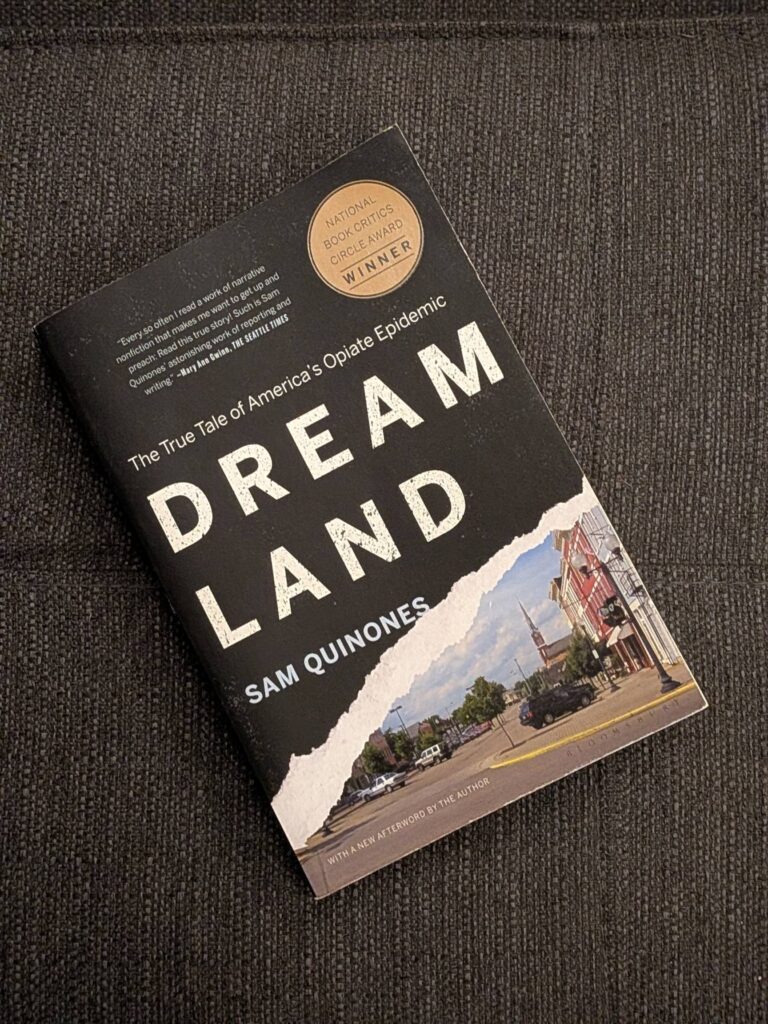
Dreamland: The True Tale of America’s Opiate Epidemic by Sam Quinones is a sweeping, deeply reported account (he is a journalist) of how the United States slid into the worst drug crisis in its history. The book is named after a private swimming pool that opened in Portsmouth in 1929, which became a community’s bedrock, and a symbol of a good American life, where generations transitioned through their life stages. It closed in 1993, once again a symbol – of a community crippled by a crisis.
The opioid epidemic involved more users and deaths than the crack plague of the 90s or the heroin plague of the 70s. It was not a single failure or a sudden event, it was the convergence of multiple long-running forces – irresponsible corporate behaviour, medical culture, economic decline, and entrepreneurial drug trafficking- that together created a perfect storm. And one that wrecked middle class, (mostly) white America.
Dreamland details the transformation of pain treatment in America. Quinones traces how, beginning in the 1990s, pain came to be reframed as something that could and should be eliminated, rather than managed. Pharmaceutical companies, most notably Purdue Pharma (founded by Arthur Sackler who pioneered modern pharmaceutical advertising for Pfizer), aggressively marketed prescription opioids as safe and non-addictive for chronic pain, downplaying risks while targeting doctors through persuasive sales tactics, sponsored education, and selective science.
It’s fascinating how a single paragraph published in 1980 titled ‘Addiction rare in patients treated with narcotics‘, which was based on negligible data, became the source used by Purdue for all its claims! This campaign reshaped medical norms, encouraged overprescribing, and flooded communities with pills.
Quinones shows how this was not merely about greedy corporations, but also about a medical system that embraced simple, pharmaceutical solutions to complex human suffering. Doctors began to prescribe OxyContin for any sort of pain. Meth and cocaine dealers shifted to Oxy as addicts learned to crush/snort/inject (by advising against this, the packaging inadvertently revealed the way to short the intended time release mechanism) and senior citizens became dealers as they subsidised retirement costs by selling their prescription!
OxyContin became a currency in itself as people exchanged it for everything from food stamps to household goods to Lowe gift cards! Walmart inadvertently contributed by being the most easily accessible place to shoplift to feed the addiction. There was even a urine economy to circumvent the periodic urine tests mandated by clinics.
Running parallel to the prescription opioid story is Quinones’ detailed account of a new, highly efficient model of drug dealing. He describes how a never-ending stream of young men from a small town in Mexico – Xalisco – developed a pizza-style(!) delivery-based heroin distribution system that spread across America like a virus.
With direct sources in Mexico, and cheap overheads, they operated as cells, salaries were paid by the cell owner. It was modelled less like a cartel and more like a customer-service business. They kept the heroin inside balloons in their mouth, and when caught by cops, swallowed it, but it came out intact (shit) the next day!
They never used the drug, never partied in their territory, avoided mainstream heroin cities, especially the ones operated by Blacks, and always tried to blend in. This system avoided violence, focused on reliability, and expanded rapidly into suburban and rural America. While every other immigrant narcotics mafia broadcasted their wealth in the US, the Xalisco boys’ took money back to Mexico and upgraded their (and their families’) lifestyle there.
The epidemic thus shifted seamlessly from pills to heroin, as the cells discovered that methadone clinics, originally set up as a treatment for heroin addicts, were a great source of ‘new’ users! When prescription opioids like OxyContin became harder to obtain, this heroin network was perfectly positioned in terms of price and distribution to absorb millions of newly addicted users.
Another key theme in Dreamland is the role of economic and social dislocation. Quinones repeatedly returns to towns hollowed out by deindustrialisation – places where stable jobs disappeared, social institutions weakened, and despair was high. In these environments, prescription opioids and later heroin filled emotional and psychological voids as much as physical pain. Addiction, the book notes, did not arrive randomly; it took root where community structures had already eroded.
Institutional blindness played an important role too. Quinones shows how regulators, law enforcement, pharmaceutical boards, and even communities failed to connect the dots for years. Problems like the rapid rise of Medicaid and SSI applicants, increasing overdoses, and proliferation of pill mills set up by unscrupulous doctors (like David Procter) were addressed in isolation – without a systemic understanding of what was unfolding. By the time the scale of the crisis became undeniable, addiction had already embedded itself deeply into American life.
The final part of Dreamland shows a ray of hope, in which the near and dear of addicts have started rebuilding communities, encouraging others to go beyond the shame, accept reality and work towards changing it. Towns are being rebuilt, with gyms and parks, with citizens contributing to maintain cleanliness and law and order.
Dreamland is about loss and responsibility. Quinones portrays an epidemic born from incentives, assumptions, and neglect spread across many players. The book argues that the opioid crisis is not just a drug problem, but a mirror reflecting deeper American tendencies: faith in quick fixes, reverence for markets, weakening community bonds, and discomfort with pain- both physical and emotional.
Dreamland is an excellent read and I had only a couple of peeves – as a non-American, the frequent geographic jumps through cities and towns was difficult for me to track. The same problem happens for time as well, as Quinones moves back and forth from 90s to 2010s and then 2000s etc. Better editing could have also avoided repetitions in anecdotes that didn’t bring up anything new.
I chose to read this specifically because we’re in the era of GLP-1 medications. Both heroin and opioids, in their early days, were considered medications without significant side effects. Dreamland is a deep diagnosis that serves as a cautionary tale. An outcome of structural choices made over decades that resulted in the destruction of human potential and happy lives.
Notes from Dreamland
1. Certain parasites in nature exert the kind of control that makes a host act contrary to its own interests. One protozoan, Taxoplasma gondii, reproduces inside the belly of a cat, and is then excreted by the feline. One way it begins the cycle again is to infect a rat passing near the excrement. Toxoplasma gondii reprograms the infected rat to love cat urine, which to healthy rats is a predator warning. An infected rat wallows in cat urine, offering itself up as an easy meal to a nearby cat. This way, the parasite again enters the cat’s stomach, reproduces, and is expelled in the cat’s excrement and the cycle continues. The morphine molecule exerts an analogous brainwashing on humans, pushing them to act contrary to their self-interest in pursuit of the molecule. Addicts betray loved ones, steal, live under freeways in harsh weather, and run similarly horrific risks to use the molecule.
2. In 1853, meanwhile, an Edinburgh doctor named Alexander Wood invented the hypodermic needle, a delivery system superior to both eating the pills and the then-popular anal suppositories. Needles allowed more accurate dosing. Wood and other doctors also believed needles would literally remove the patient’s appetite for the drug, which no longer had to be eaten. This proved incorrect. Wood’s wife became the first recorded overdose death from an injected opiate.
3. Levi’s 501s were the pantswear gold standard for men in Mexico’s ranchos in the 1990s. They were very expensive in Mexico. One thing that made the Xalisco Boys’ retail system so popular, and young men cager to work in it, was that the system provided a way to accumulate quantities, large stacks, of 501s very cheaply. That was because US. junkies soon learned these dealers’ tastes and offered endless supplies of shoplifted sors in exchange for their daily dope. This thirst for Levi’s 501s, she said, is part of what propelled the Walsco system as it began to expand out of the San Fernando Valley and through the western United States in the mid-1990s.
4. Columbus, Ohio is known as the “test-market capital of America”. No place represents the country more faithfully. Companies use the town to gauge new market offerings.
Leave a Reply