
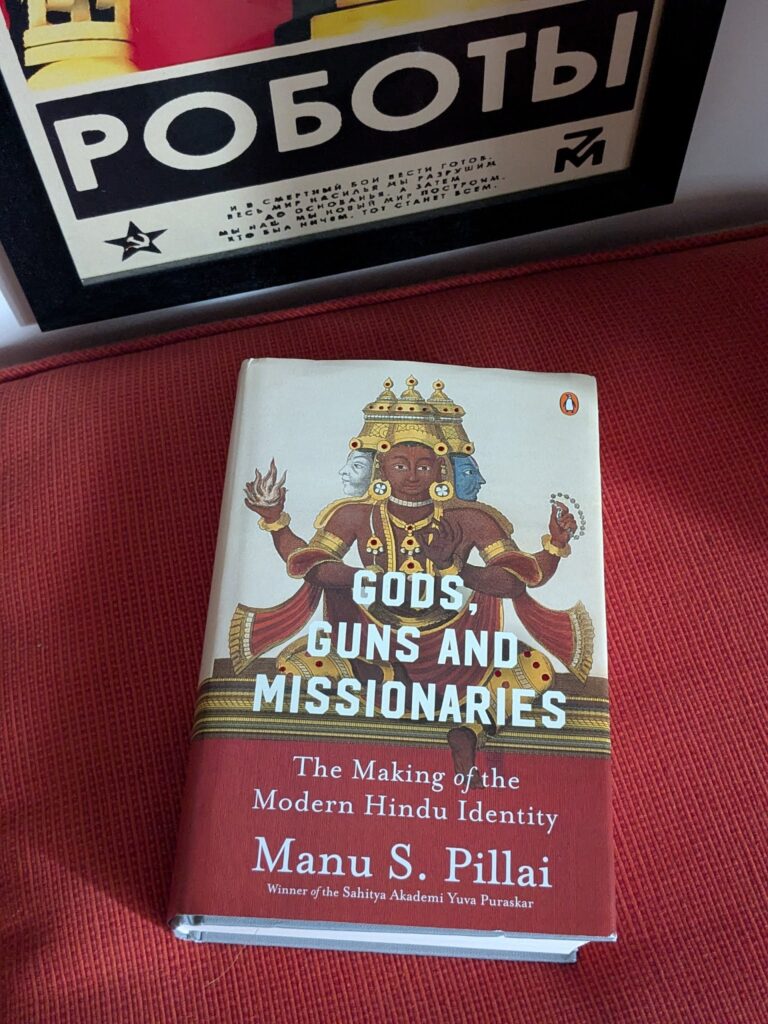
Manu S Pillai
The alternative title of Gods, Guns and Missionaries should be Bharat Ek Khoj – the Hindu Nationalism edition. But seriously, the amount of research that seems to have gone into this book is staggering – over 220 pages of this 549 pager consist of Notes.
In some ways, it is a study of Hindu culture, seen through the perspectives of rulers and politicians, both Indian and European, and philosophers, missionaries, and revolutionaries, juxtaposed against ground reality, but if one had to pick a thread through the chapters, it would be the study of the dynamics across history (till Independence, not contemporary, smart choice for many reasons) that led to the Hindu nationalism we now see.
The seven chapters of Gods, Guns and Missionaries span centuries, regions, and worldviews, switching between political, spiritual, and cultural currents and combining archival detail, anecdotal richness, and contemporary relevance. The evidence of the first two is right in the first page, in the story of the maharaja of Jaipur attending the coronation of King Edward VII in London in a steamer, with cows!
From then on, the book, through about four centuries, traces the evolution of Hindu identity from the late medieval period up to the early 21st century, highlighting the political, religious, and cultural developments that shaped modern Hinduism as a more defined, self-conscious identity.
The central theme of the book is that Hinduism has never really been a monolithic concept. In fact, it has thrived precisely because it was malleable – argued over, enriched and transformed in theology, ritual and identity, by contact with others. The early parts of the book is mostly about the rich and inherent diversity – what fascinated and caused bewilderment among early European missionaries.
Practices varied widely across geography and sects, with no centralised authority. This religious elasticity was critical to Hindu society’s resilience. The anecdote I mentioned earlier is interesting for this detail on adaptability too – the Jaipur maharaja’s ship had an idol that the priests kept onboard so that the Raja wouldn’t technically violate the taboo against crossing the seas.
Towards the end of Gods, Guns and Missionaries, there is an excellent analogy. Five brown persons in a room – each a different shade from the other – might not view themselves as a single organism. They might even fight with each other. But when a white person enters the room, they become aware of their common features, and if under threat, the shared brownness becomes a means to mount a joint action. This assertion happens because of the context. And that is what happened with Islamic rulers and later with European missionaries.
These external pressures became the catalyst for a growing sense of communal identity. Muslim rule sharpened regional self-awareness among Hindus, and Christian missionaries, backed (inconsistently though) by the colonial rulers, pressed Hindus to consolidate a unified theological and ideological framework. Missionaries brought critiques: denouncing polytheism, idol worship, and caste-based inequality. The British East India Company initially viewed missionaries as distractions, but gradually, thanks to the influence of evangelical groups and reform-minded legislators, accommodated them to support a civilising mission, transforming Company policy.
Reformist Hindus responded playing and many a time winning arguments even according to the rules of the West- sometimes embracing monotheism, sometimes rejecting rituals. They used these critiques to reform or rebrand Hinduism into a perceived monotheistic core compatible with Enlightenment values. Rammohan Roy, Dayananda Saraswati, Jyotirao Phule are what the book calls ‘native Luthers’. Special mention for Serfoji II of Tanjore, really ahed of his time. They challenged tradition while shaping the contours of modern faith. Roy introduced the term “Hinduism” into modern discourse; Saraswati denounced idolatry and brought back Vedic teachings into the discourse; Phule attacked caste structures from within a reconstituted Hindu framework.
The final section – Drawing Blood – features the two men who really gave shape to the brand of Hindu nationalism we see today. The first, Bal Gangadhar Tilak, had an overlap of Hinduism and nationalism early in his career. Converting large religious festivals into mass political rallies, riding on Ganapati, pun slightly intended. For him, internal caste differences were no impediment, it was all one religion. Everyone else would only be ‘tolerated’. For critics, Tilak wanted nationalism, but without surrendering caste prerogatives. Tilak doesn’t come out looking good in the book. (read Notes)
The second – Vinayak Damodar Savarkar – the architect of modern political Hindutva. Savarkar clarified that Hindu-ness and Hinduism wasn’t the same. He unified cultural, racial, and religious identity into a nationalist ideology that deliberately drew boundaries between who was “in” and “out.” His criteria- India must be one’s fatherland, or the home of one’s ancestors, but it must be equally one’s “holy land”- hardened as he aged (partly because of the Muslim warders he dealt with in Andaman), but not only found emotional appeal, and , it now serves as the ideological foundation for the lotus kids.
Gods, Guns and Missionaries is a fascinating read on how, through several centuries of interactions and mutations, a kaleidoscopic, regionally diverse Hindu world gradually became a (relatively) more consolidated modern identity that is now being harnessed in politics. An excellent read because it is balanced in that it neither romanticises pre-colonial unity nor does it accept colonial narratives uncritically. In my 2025 Bibliofiles long list.
Notes from Gods, Guns and Missionaries
1. Brahmi was the ancestor to almost all Indian scripts
2. Hinduism’s evolution as per Savarkar was ‘a process of assimilation, elimination, and consolidation’
3.The older portion of the Vedas are often called karma kanda (focused on sacrifice, rituals, and invocations). The vedanta is called jnana kanda – the repository of wisdom.
4. Jacob Rama Varma (1814-56) existed!
5. Tilak recommended that Pandita Ramabai restyle herself as reveranda – punning on reverend and randa (whore)
6. Tilak was once driven off stage once with tomatoes and eggs when he spoke against women’s rights, and tucking away intra-Hindu dissonances on caste
Leave a Reply