
Rutger Bregman
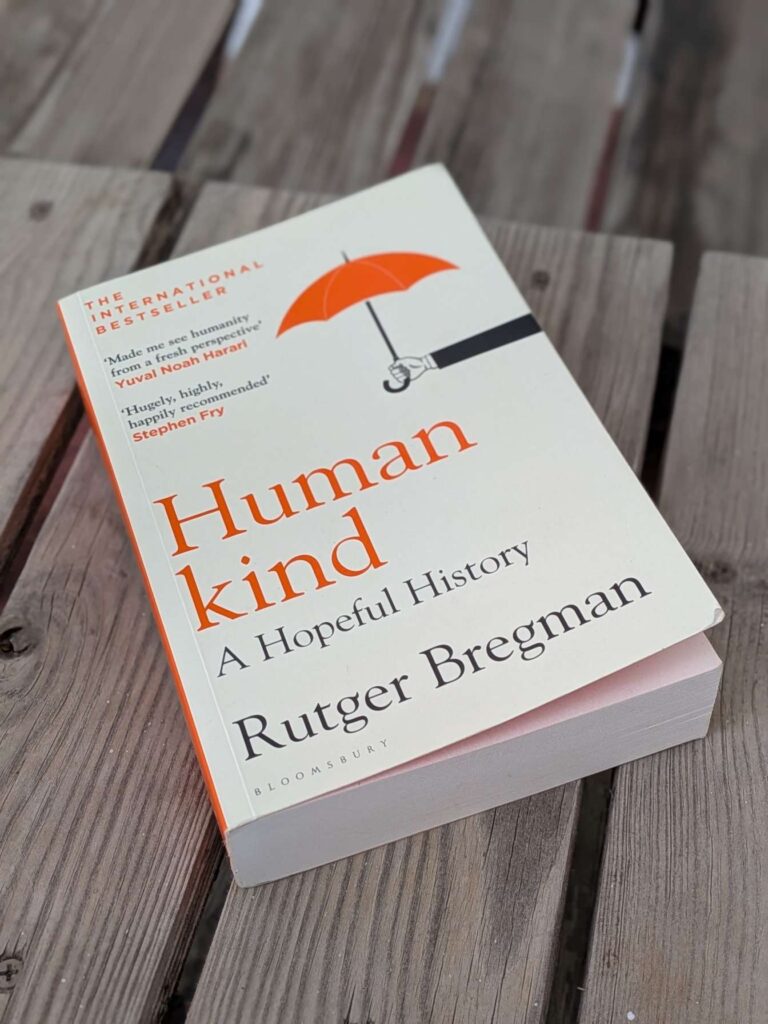
On one hand, I really hoped Humankind would be meaningful, and on the other, I am quite a cynic. Bregman writes towards the end of the book that cynicism is just another name for laziness, an excuse not to take responsibility. I am not sure I agree completely because I do feel the rage against injustice, and do take action sometimes, but largely my question has been ‘what is the point?’
But Humankind did work for me, because of two reasons. One, Bregman does make a strong pitch with a coherent narrative. Two, at least in a few ways he reminds me of David Graeber – the appeal to see each other as humans without labels, the call to stand against injustice, and the meticulous research that bursts quite a few myths fuelled by authors who were less conscientious.
In Humankind, Bregman primarily challenges one of the deepest assumptions about human nature- that people are selfish, competitive, and prone to cruelty unless restrained by laws or authority. Instead, his perspective is that humans are wired for kindness and cooperation, and that our history offers more evidence of decency than of brutality. Clearly for Rousseau and against Hobbes.
The cynic in me looked around and immediately did an #smh but over the course of Humankind, through a mix of historical analysis, psychology, and anthropology, he does a good job of validating that perspective, and showing how we might view ourselves and organise society if we went in with the assumption that folks were inherently good. I have to admit, I have tried this in the past, and then hardened even more because of the outcomes, but Humankind inspires me to keep trying. (Rule #1 from the last part of the book – when in doubt, assume the best)
Humankind begins by addressing the ‘veneer theory,’ the idea that civilisation is just a thin layer of order covering an inherently violent species. Thinkers from Hobbes to Freud to Richard Dawkins (who later walked back on The Selfish Gene) have leaned on this idea to justify strong states, strict religions, or rigid markets.
Bregman dismantles it by meticulously researching famous studies that supposedly prove our darker instincts. The Stanford Prison Experiment, for example, is revealed to have been nudged into cruelty by the researchers themselves. Stanley Milgram’s obedience experiments, too, relied on selective reporting and pressure that distorted participants’ natural reluctance to harm others.
A good point here on Hannah Arendt’s layered philosophy that humans are tempted by evil masquerading as good. I had also gone with Jared Diamond’s explanations about what happened on Easter Island – tree chopping to build those statues, and the resulting ecological collapse, but turns out the real reason was rodents brought by ships, and germs by returning natives who had been kidnapped as slaves! Malcolm Gladwell publicised the ‘broken windows theory’, another myth based on flawed research!
All were myths that I had read and believed, but were actually narratives that were shaped to fit expectations. In fact, running counter to the uber popular Lord of the Flies, he cites the example of six Tongan boys stranded on a remote island in the 1960s, who survived not by violence but by forming routines, resolving conflicts peacefully, and caring for each other when injured. Rather than being exceptions, Bergman believes that this is what humans do when stripped of external institutions – they choose dialogue and build cooperation.
From here, Humankind turns to anthropology and archaeology. Our prehistoric ancestors, contrary to the image of brutal cavemen, lived for millennia in small, cooperative groups with high levels of equality (including gender) and mutual support. Traits like friendliness, trust, and curiosity were not liabilities but evolutionary advantages, social learning being critical, helping Homo sapiens outlast other species. In fact, he states that originally we were a loveable ‘Homo Puppy’.
The trouble began 10,000 years ago when we started settling in one place and amassing private property. Scarcity, hierarchies, leaders raising armies (the good us vs the bad them), all led to our uglier side coming out. But even now, in modern disasters, Bregman shows, people tend to help one another rather than descend into chaos. Accounts of the London Blitz, Hurricane Katrina, and other crises reveal spontaneous solidarity rather than savagery.
The implications, if we change our thinking to a more positive view of other humans, are quite profound. Think about schools designed around control, prisons based on punishment, governments founded on mistrust. And Bergman shows how there are examples that have proven his point – Norwegian prisons that prioritise rehabilitation, democratic schools that nurture trust, and experiments in participatory governance in Torres and Porto Alegre, democratic schools that nurture trust and a playful, curiosity-led learning like Sjef Drummen’s Agora. Not to forget Nelson Mandela’s work with his militant Afrikaner counterpart to bring peace to South Africa.
He also revisits ideas like universal basic income (dividend payment for oil for all citizens in Alaska), noting that when people are trusted with resources and freedom, they generally act responsibly and contribute positively.
The narrative arc also has a call to action. Believing in human goodness is not naïve, Bregman argues that it is pragmatic. Cynicism breeds systems that treat people as untrustworthy, and those systems often create the very selfishness they fear. Like a Golem effect. Optimism, by contrast, can be a self-fulfilling prophecy: if we design societies around trust and cooperation, we unlock more of our species’ potential. Like the Pygmalion effect. What can break a cycle of hatred is contact – prejudice and hostility dissolve with real interaction.
The last part consists of ten rules he proposes to bring the best out of ourselves and others to build a better society. The narrative is compelling, debunking pessimistic myths, showing evidence of cooperation, explaining why systems go wrong, and then presenting hopeful models and offering a practical roadmap. It pushes the reader to reconsider the stories we tell about ourselves and others. And to recognise that beneath the myths of brutality, humans, more often than not, are inclined toward kindness. It’s a much-needed narrative for the times, although the cynic in me wonders what is the incentive for individuals and societies to change.
In my Bibliofiles 2025 longlist
Notes and Quotes from Humankind
1. Examples of the wry British humour during the Blitz – more open than usual; our windows are gone but our spirits are excellent, come in and try them.
2. Domesticated animals are similar – smaller than their predecessors, smaller brains, teeth and floppy ears, curly tails. All are by products of one trait – friendliness. Played out by friendly hormones. Whites in our eyes that allow us to follow others’ eyes, blushing, eyebrows that can signal a bunch of things, are all things that help us send and receive signals, and aid social learning. That’s also how humans beat the much better and smarter Neanderthals and others in the evolution game. Smart geniuses vs social copycats – the latter win because they are better connected.
3. Empathy and xenophobia are two sides of the same coin.
4. Power reduces empathy because anyone who disagrees with you can be eliminated.
5. The Enlightenment brought forth ‘reason’ as the way in which humans can build institutions (democracy, rule of law) to factor in our innate selfishness. But things like the Holocaust and capitalism has proven that it wasn’t enough.
6. All of the evils in society is possibly pluralistic ignorance. None of us think things are right, but go along because everyone is going along.
7. Economy comes from the Greek word oikonomia, meaning ‘management of a household’
8. Two words engraved in the forecourt of the Temple of Apollo in Delphi – Gnothi Seauton – know thyself
Leave a Reply