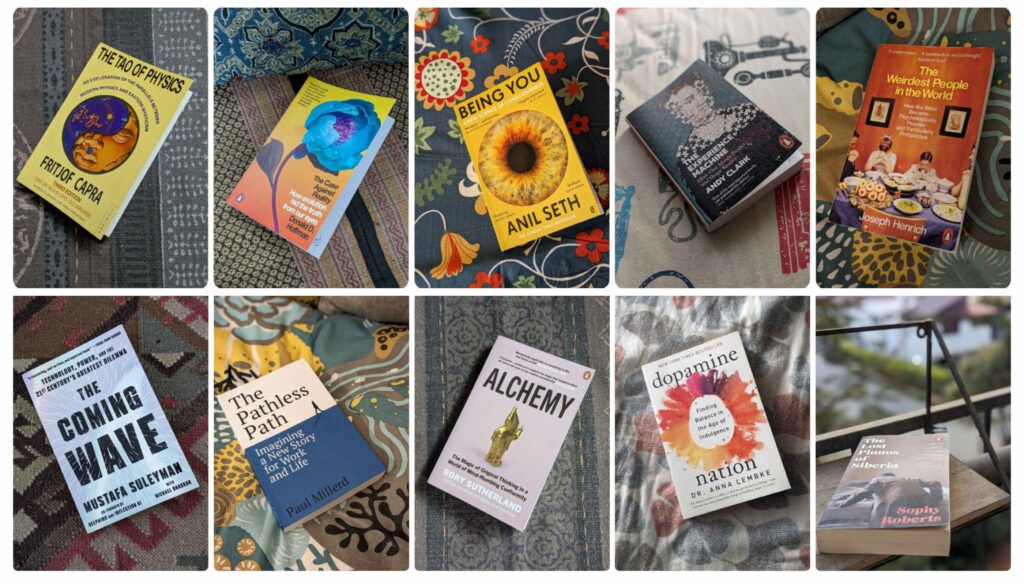
In 2024, the mind seemed to be obsessed with the mind and the reality it perceives, and that’s a good thing because I was able to take a shot at some synthesis on why I am the way I am. When you see the books, you’ll know why/how. And so, as per tradition – from 2019, 2020, 2021, 2022 and 2023 – we have this year’s list of ten (plus a few extras 🙈). From the 63 books I read in 2024…
(Think of the first 5 books as a why, what, and how of “how we got here”)
The Tao of Physics by Fritjof Capra was first published in 1975, and I’d say that it’s even more relevant now in the context of science and the direction of human advancement in general. As the subtitle of the book states, the idea is to explore the parallels between modern physics and eastern mysticism.
Both science and religion/philosophy are trying to get to the reality that lies beyond our senses. One approaches it predominantly through rational means, the other through a non-intellectual experience by quieting the mind with meditation and fine tuning intuition. Broadly, it turns out that many Eastern philosophies/religions – Hinduism, Buddhism, Tao, Zen – had already reached the understanding that modern (in the 80s) science later discovered through relativity and quantum theories. It is fascinating to read how both paths make us realise the unity and interconnectedness of all things in the universe, and what we think of as the basis of our perception – our body and mind – are mere transient manifestations – an event in an underlying energy field, not a thing or a substance. Not an easy read, but well worth it.
[Extra: The Book of Life by Jiddu Krishnamurti is a sublime read that goes deep into what I’d think every religion/philosophy tries to communicate]
The Case Against Reality: Donald Hoffman posits that “some form of reality may exist, but may be completely different from the reality our brains model and perceive.” Why is that? Fitness-Beats-Truth (FBT) theorem. Natural selection optimises for fitness payoffs, and thus organisms develop sensory systems and internal models of reality that increase these fitness payoffs but don’t offer a correct perception of reality. In fact, natural selection doesn’t just not favour true perceptions, it routinely drives them to extinction, and instead, favours perceptions that hide the truth and guides useful actions. Our perceptions don’t even have the right language to understand/ describe reality. And on this line of thought, even spacetime and the objects/ smells/ sounds/ texture/ motion etc we take for granted in it, crumble. They are just the data formats which have evolved and survived eons of tradeoff between knowledge and utility. Each species creates its own interfaces to deal with reality. Hoffman calls it the interface theory of perception (ITP). Hoffman invokes the red pill/ blue pill early on, and I must admit, the book does deliver on that. Again, not easy, but very much worth reading.
Being You was my favourite read. Anil Seth sets out to explore how billions of neurons within the brain end up creating a conscious experience – a uniquely personal, first person experience. The book is divided into four sections – defining the ‘problem’ and showing the approach to the scientific exploration of consciousness, looking at it through how it relates to ‘content’ and external phenomena, and then going inwards to the experiences of conscious selfhood, and finally applying the learning to non-human entities – animals and AI.
The book introduced me to two concepts which I think I will be pursuing for a long time. One – reality is an interpretation, and the entire process is not optimised for accuracy, it is designed for utility. ‘We perceive the world not as it is, but as it is useful to us.’ The brain constantly makes predictions about the causes of its sensory signals through a Bayesian process in which the sensory signals (also) continuously rein in the brain’s various hypotheses. Perception is a continual process of prediction error minimisation (reducing the difference between what the brain expects and what the signal provides). Two – the fascinating FEP (free energy principle) and specifically how it applies to living systems and consciousness. In this context, it boils down to this – being alive means being in a condition of low entropy. Any living system, to resist entropy, must occupy states which it expects to be in. Free energy here approximates sensory entropy, and apparently, it amounts to the same thing as prediction error. Broadly, that connection with physics and the universe, and the brain’s regulation of the perception of the worlds outside and inside!
The Experience Machine The subtitle of Andy Clark‘s book is “How our minds predict and shape reality”, and that’s what the book is about. The conventional notion of cognition, at least to me, is that it begins with sense organs perceiving and providing inputs from what we experience, and the brain quickly piecing it all together to present me a coherent picture of what is, and what I should do next. But if we go by the “predictive brain” thesis, the brain doesn’t just passively interpret the world but is constantly predicting, shaping, and refining our reality based on sensory inputs. Clark goes into the underlying process of it all and the result is a fascinating exploration which provides quite a few answers to our experiences in daily life.
The Weirdest People in the World As an anthropologist, Joseph Henrich realised that much of the published work (and hence commentary) on human psychology (and social sciences at large) were based on work with experimental subjects who were based in or around Western universities. And when attempts were made to replicate these results with people in Africa/Asia, some of them even elites, it came to light that the subject pool was biased. They were WEIRD – Western, educated, industrialised, rich, democratic – and though only a small part of the species, are disproportionately represented in culture and thinking. How did this happen?
To understand how people became WEIRD, he brings up the importance of cultural learning in evolutionary psychology. “Unlike other animals, we have evolved genetically to rely on learning from others to acquire an immense amount of behavioural information, including motivations, heuristics, and beliefs that are central to our survival and reproduction.” From our own motor patterns to projectile technology and food processing to grammar and social norms. Cultural learning adaptively rewires our brains and biology to calibrate them for navigating our culturally constructed worlds. This is cumulative cultural evolution, and the crux of the book. I increasingly see the people in metros having a WEIRD mindset, and that impacts the future. Another not-so-easy read, but if you get on the trip, it is intellectually enriching!
The next four books are under the broad theme of the system of the world and how I can navigate it, with a better understanding of my own wiring.
The Coming Wave Co-founder of first DeepMind (the company behind a couple of massive leaps in AI – AlphaGo, AlphaFold, acquired by Google), then Inflection AI and now (before the book published, I think) CEO of Microsoft AI, I think there are few better people than Mustafa Suleyman (with Michael Bhaskar) to write about AI. And I suspect there will be few better moments than now. The book has four sections. The first looks at the history of technology and how it spreads. The second gets into the detailing of the coming wave – two general purpose technologies – AI and synthetic biology, and associated technologies like robotics and quantum computing. This section also goes into the features and incentives that drive them. Part 3 takes a side step into the political implications of this on the nation state, the only institution that can temper the wave. The last section looks at what is the ‘containment problem’ – a wave of technology is near impossible to contain, history has ample proof, but can we still take a shot at it. This was a book I was looking forward to reading, and it didn’t disappoint.
[Extras in this theme: Carol Roth‘s You Will Own Nothing delivers on the shocker title with a deep dive on the various power and money grab mechanisms already underway, and how we can fight against it. I think of Having and Being Had as Eula Biss having a conversation with capitalism – trying to understand its origins, its ethos, and its insidious and pervasive role in our lives. In terms of narrative flow, it is mediative and reminded me of a favourite from last year – God, Human, Animal, Machine]
The Pathless Path Once again, the subtitle is pretty much an explainer – Imagining a New Story For Work and Life. The timing was fantastic since I was shifting to a self-employed life. So there is a bias, also because I also share some of Paul Millerd‘s influences in terms of thinkers – Erich Fromm, David Graeber. The book is divided into two very broad sections. The first, with six chapters, focuses on the default path. The default is what most of the world does – predictable incomes, predictable lives, “life’s existential fears are traded for certainty”. He introduces us to his own journey from the default to the pathless across his academic and professional lives, how he figured out the hacks to grow fast, his health crisis, and how he then started thinking about his life and work differently. In the second section – the pathless path, the focus is on how one can reimagine one’s life, and address the many barriers that a part of our self comes up with to discourage us – narratives around (lack of) money, creativity, to name the most common ones. He also notes the importance of finding one’s tribe, and designing work in such a way that you love it. From what I understand, Paul went off the default in his 30s, so this is not a midlife crisis-management book. Rather, it’s for anyone who has that little ‘pebble in the shoe’ which tells them that there is a better way of living, and working.
Alchemy – The Magic of Original Thinking in a World of Mind-Numbing Conformity : I think this is the first book I’ve read by anyone associated with marketing/advertising. For anyone involved in selling anything, including your own talents, I’d say this is a must-read. You should also read this if you’re intellectually curious, because in essence, this is a behavioural science book. It is even more relevant now because of the obsession with data. It isn’t that you should not look at data, but as Rory Sutherland writes, if you’re only using data, it’s like playing golf with only one club. “Logic should be a tool, not a rule”. This book is about the magic, which I think we’re forgetting in the fixation for data. Rory calls it psycho-logical, which is the way we make decisions in daily life. When we do not have a complete understanding of decisions we ourselves take, it is hubris to think that we completely understand the motivations of others. Especially without considering nuances beyond data. The book makes important concepts very accessible, and Rory’s humour and anecdotes make it a very engaging read. Highly recommended.
Dopamine Nation A book that made it into my recommendations list in 2022 was ‘The Molecule of More’ by Daniel Z. Lieberman & Michael E. Long. That book, as I wrote in my review then, made a complex subject very accessible and even entertaining, with interesting experiments, real-life scenarios and very less jargon. And it got me interested in the subject. I discovered Dopamine Nation thanks to a podcast, where Dr. Anna Lembke gave a very lucid explanation of the relationship between pleasure and pain.
The book is divided into three sections – The Pursuit of Pleasure, Self-Binding, and The Pursuit of Pain. Each of these is further divided into three chapters giving the book a structure that is easy to follow. In her introduction, she writes about the overwhelming amount of stimuli around us and calls the smartphone ‘the modern-day hypodermic’. That itself is a reason to read this book, and if you’re intrigued by behaviour – yours and/or others’ – I think this will be an engaging read for you as well.
[Extra: Through logic and anecdotes of patients, Alice Miller explores the complexity of childhood and the impact it has on us as adults in The Drama of the Gifted Child. When you’re ready to go back and deal with it, read it.]
The Lost Pianos of Siberia : Sophy Roberts‘ Siberian journey is a hunt for a piano for her friend Odgerel in Mongolia, but for a reader if offers far more – a fantastic trip through time and space in one of the remotest parts of the world. The book is divided into three portions – 1762-1917 (from Catherine’s the Great’s ascension to the February revolution when Tsar Nicholas II abdicated and was taken to Siberia with his family), 1917-1991 (when the Soviet became the Russian federation) and 1991 – present. We see the region not just through the political changes, but primarily through the lens of music and culture. In fact, the music remains the constant. Having said that, you don’t need to enjoy music to love this book. Because this is about places and people, who even in this hyperconnected world are outside the radar of most of us. The prose is vivid, haunting, and deeply moving, and if you want to step out of your comfort zone of reading, I think this book will move you, in more ways than one.
[Extras: Anna Lowenhaupt Tsing‘s The Mushroom at the End of the World is a ride across the world that looks at capitalism through the lens of the most valuable mushroom in the world – Matsutake. Through the lives of people who trade in it, she looks at alternate lives on the fringes of the capitalist world
If I had to pick one fiction book from the 27 I read, it would be Michiko Aoyama‘s What You Are Looking for Is in the Library. The kind of hug that will make you feel optimistic about the world. This is from a list that has Satyajit Ray, Cixin Liu, Clare Pooley, Amit Chaudhuri, Milan Kundera, Emily St.John Mandel, my favourite – Keigo Higashino etc, so…]
And if there is one book on health I recommend everyone reads, it is Jessie Inchauspé‘s The Glucose Revolution. It could change your life. ]
And we’ve reached the end of the page. Follow me on Goodreads for real-time updates. Happy reading!


Leave a Reply