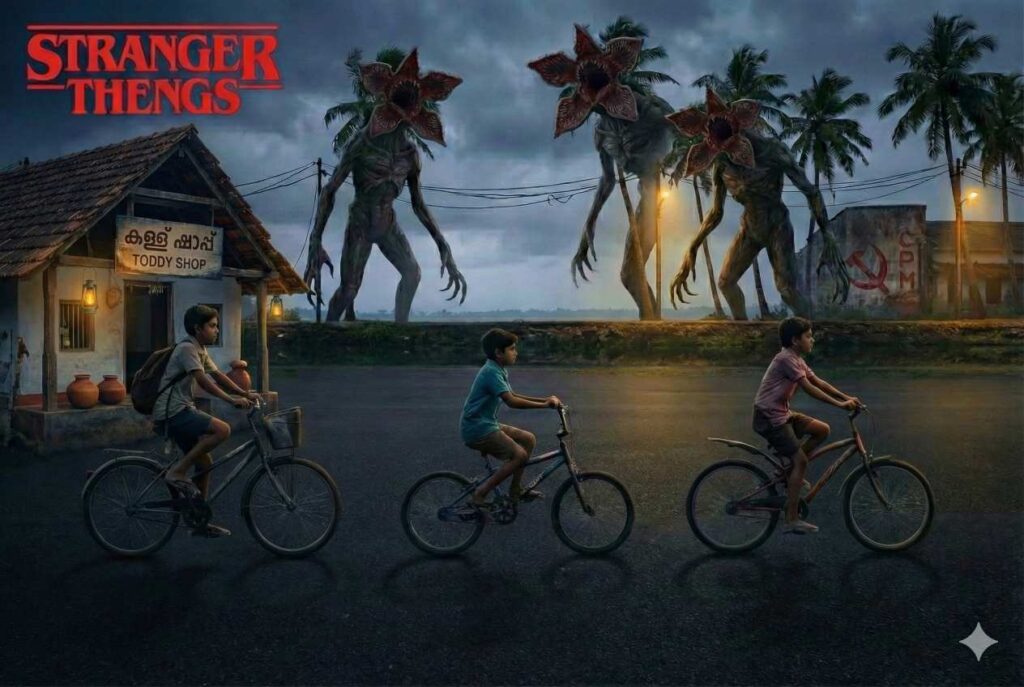
Made this poster a while back.

The predictability of the biannual trips to Kerala has been on the wane the last couple of years. To the extent that this year we have made only one visit, and it does seem the count will stop there! This year, our more extensive plan, which involved a cousins’ get together, was reasonably wrecked by the announcement of a nationwide bandh on 2nd September. A few of us though, decided to have ourselves a hartal holiday, and thus D and I found ourselves in the world’s first solar powered airport on the first day of September. The pre-arranged cab would take us to Kottayam, with a pit stop to pick up a cousin and his wife.
As we veered off NH 47 on to HMT Road, I realised I hadn’t been on this road in this millennium! NH 47 is apparently called NH 544 now, but I refuse, citing old age as an excuse! HMT stopped ticking earlier this year, I wonder how long the road will be a reminder – probably until local or national pride finds what they deem a worthy recipient. Meanwhile, the only landmark I could remember was at the beginning of the road – Food Craft Institute, which my mother used to visit for baking classes in the 80s. I looked around for the Toshiba Anand factory, remembering the replica of a giant Toshiba battery on a tower that could be seen from afar. Seems I was seeking a world that had been erased more than a decade ago. My last memory of the place was a staff quarters (I can’t be sure if it was KSEB or HMT itself) – we had relatives there and a kid, slightly older than me, had the only clockwork railway I had ever seen. Yes, it was a big deal in the 80s! I glanced around excitedly and then wearily, hoping for a few more tokens of the past, but the place had changed much, I really couldn’t remember anything more, and it was a painful reminder of how fickle, and out of one’s control memory is. After all, to quote Julian Barnes, “memory is what we thought we’d forgotten.” (more…)
Masala Republic is a Malayalam movie I watched recently. First, my sympathies with those who attempted the heroic task of watching it in a theatre, but to be fair, it did give me some food for thought. No, not about my choice of movies, but things slightly more important in the scheme of things. It talked, for instance, of issues that needed a voice – the changing socio-political and economic dynamics of Kerala caused by a huge influx of people, mostly low wage workers from Bengal and the North East.
The movie begins with the disruption brought about in the life of these folks by a ban imposed on Gutka, which apparently is part of their staple diet! This reminded me of the (real) scenario I witnessed when the liquor ban was announced in Kerala. Almost overnight, I saw an ecosystem disbanded – small shops around bars, auto-rickshaws that ferried drunk guys home, to name a few components.
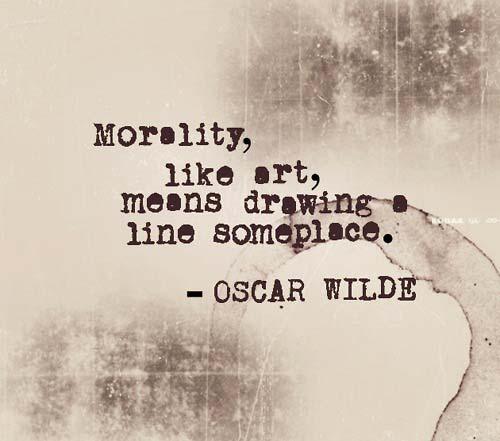
Notwithstanding the political play that brought about this ban, I was forced to ask – isn’t alcohol consumption an individual’s choice? One might cite domestic violence, decrease in productivity, drunken driving etc, but unlike say, smoking, it does not automatically cause damage to the larger society. Isn’t a blanket ban a bit like banning automobiles because of road accidents? If the justification is that individual choice must bow before collective progress, then can we really condemn Sanjay Gandhi for the infamous sterilisation programme? After all, population control would, at least arguably, have meant progress. What we are debating therefore, (I think) is the means. And means is exactly what an alcohol ban is. Does society really have the moral right to take such a decision? Who decides society’s collective moral compass and what can resist such selective applications of morality?
(via)
Who decides where the line is?
P.S. Would be glad if you could point out whether I am missing some relevant piece of information or logic here.
An overcast sky met us at the Alwaye railway station on June 1st. As I sat inside the bus to Kothamangalam, I wondered where the rains would meet us. I saw school kids waiting for their bus, but not as many as I had expected. It has been a tradition in Kerala – on June 1st, when the kids begin their academic year, the rains are the first to welcome them. I remembered umbrellas, raincoats, pants hitched up, new wet notebooks…. But it seemed that things weren’t so anymore. I wasn’t the only one surprised – the Gandhi in Perumbavoor stood open jawed. We reached our destination, dry. I learned later that most schools were opening on Jun 4th and the rains were scheduled on Jun 5th. On the way back to Cochin that night, starting from a near empty bus stand, I was able to relive the window seat. But I realised that just as the seer had changed, so had the scene.
****************************
There’s a wonderful quote that’s attributed to Bryan White – “We never really grow up, we only learn how to act in public.” So when one goes back to places which only hold childhood memories, maybe there’s a natural pull to rewind to a time without that learning, and just let loose. And just like in that age and time, many impulsive, harmless things then become capable of delivering an incredible amount of joy.
******************************
For a long time now, Nedumbassery had been my exit point from Kerala. And so I sat, after a wedding feast, on a journey from there to Palghat and beyond, watching a series of places I hadn’t seen in more than a decade. Familiar landmarks and new sights, and the Western Ghats that stood solidly in the background. Hello, Kuthiran. Dad was surprised I could remember the name of the towns. How many ever roads a man walks down, his first roads remain etched….
The occasion for which we had made the trip saw 3 generations – one that had been born and had spent all their childhood in that village, another (mine) in which the majority of the members had cities that they considered home but had spent many a wonderful vacation there, and a third which was probably making a few memories. There’s that favourite Garden State quote of mine – Maybe that’s all family really is. A group of people who miss the same imaginary place. In this version, ‘imaginary place’ is not a place that no longer exists physically, but one that exists in a certain state in the memories of many people. I wondered when a place would cease to exist at all – is it when it disappears physically, is it when all the people who have memories of the place cease to exist, or is it when the place changes so much that even memories cannot bring it back. You’ll see when you move out it just sort of happens one day and it’s just gone. And you can never get it back. When the seer and the scene let go of each other. And that was why this trip was special – memories had been added, and the disappearing had been delayed.
until next time, seen there, done that 🙂