
Category: Social Commentary

  • Relative rationality

    After a failed exchange plan, I gave our TV to the apartment security guy. I had thought it would be an upgrade for him, but it turned out he had no TV at home, and therefore no clue what to do with it. I suggested talking to the cable guy in his neighbourhood, but the next day he gleefully announced that his daughter had connected it to the mobile and they were now watching YouTube. I told him about data charges but overall, the issue was resolved.

    Them

    Around the same time, D got a call from a relative in Kerala about her daughter joining a college in Bangalore. She wanted to know if we knew about the college, and also check how far we were from it. We were especially far away, and I wondered why they didn’t use Google Maps since all relevant locations were known to them. Later, it turned out that they even visited Bangalore to get the hostel sorted and apparently went right back because classes had not begun and any stay in the hostel would involve extra charges! This time I wondered why they didn’t use the phone to call ahead and ask the college before setting out! I found it especially surprising because the girl’s brother claimed to regularly shop from Amazon! I automatically compared these two kids to the security guy’s daughter, roughly the same age. Did staying in Bangalore provide a kind of ‘tech privilege’, or was it a mindset?

    Us

    We also have a few friends in their 40s who have settled abroad. A conversation about waiting times for doctors in Europe led to a quality of life comparison. We have now spent close to two decades in Bangalore, and never really made any attempts to settle elsewhere. I remember how in my 20s, my mindset was that we’d be second class citizens anywhere else in the world. I also didn’t want to move far away from Kerala, though this was at a time when culture – food, movies etc – wasn’t as portable as it is today. Traffic notwithstanding, I really like Bangalore and wouldn’t trade places, but the 40s are when you face your “what ifs” head on, and ideally get some closure! But I digress.

    The discussion made me wonder how an objective observer would evaluate our decision to not move abroad. I think we could have easily done it in our 30s if we had decided to, especially given we had no procreation plans. And yet we didn’t really consider it or even have a serious discussion about it. Arguably, the quality of life in at least some parts of the West is better, and so, would that observer think of it as an opportunity wasted? And think of us the same way I thought of D’s relatives – not using the access they had to ‘unlock’ information and opportunities?

    Everyone

    The concept, of course, is bounded rationalitythe idea that rationality is limited when individuals make decisions, and under these limitations, rational individuals will select a decision that is satisfactory rather than optimal. Satisficing vs optimising. But what I am realising now are a couple of things. One, it is practically impossible to be objective about it. I continued to rationalise even as I wrote about our domicile non-decision! And it’s not just for the self after time has passed – it’s a moving target because one evolves. Not stepping into the same river twice and all that. It is also for others about whom one can be relatively more objective. Funny how I expect them to optimise when I don’t always do it in my personal life. Yet another reason to stay from being judgmental about others, and self! And two, the increasing levels of satisficing that happens as one grows older. Interestingly, I automatically compartmentalise work and life and am an optimiser in the former. But in personal contexts, it’s a struggle because there are two opposing mindsets – “growth happens at the end of your comfort zone” vs “you do you”. And I can’t even say do what you’re comfortable with because that’s clearly in the comfort zone. Maybe a better framing is “what makes me feel alive”.
  • A proxy life

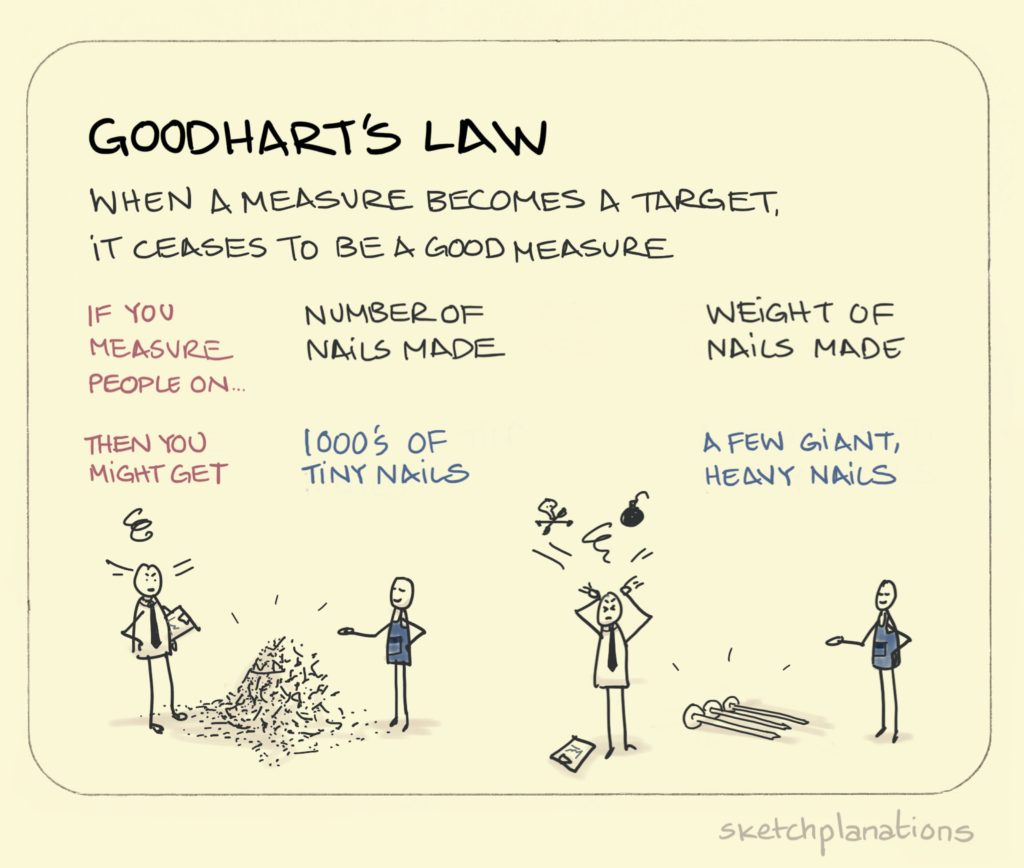
    I have forgotten where I first came across Goodhart’s Law. It was probably Farnam Street. It states that “when a measure becomes a target, it ceases to be a good measure.” An illustration should help.

    https://sketchplanations.com/goodharts-law

    In the organisational context, it serves as a great lens to evaluate strategy and progress. As the illustration above shows, the entire direction of a desired goal can be changed when measures become targets. But, and maybe it’s a Baader -Meinhof phenomenon, I am now seeing different versions of it everywhere.

    To set some context, as more and more things have been digitised, the volume of information has just exploded. For instance, before the advent of social media, there were limits to one’s “people like me” canvas, because even an awareness of them was constrained by physical distances and the limits of one’s social circle. It had to be in real life, and public spaces like a cinema or even a vacation spot were probably an extreme. Social media changed that scale massively. Many factors including this volume of information, the lack of a granular understanding of the lives of this new set of people whom you’d never meet, and the innate human desire to do better than neighbours meant that appearances became the norm. Since we are not wired to process such large volumes of information, we dug deeper into ‘measurement by proxy.’ Not that this mode of measurement is new. For instance, we have used material manifestations (apparel, cars etc) as a measure of wealth. The stock price is a single-number measure of everything about the company. But with abundance of choice and the limits of processing power, we started developing heuristics and measuring what was easy. Meta photos (FB/Insta/WhatsApp) became a measure of everything from the quality of life to the strength of relationships. Popularity as a measure of excellence, price as a measure of quality, fitness as a measure of health, #booksread as a measure of erudition and so on.

    How does this connect to Goodhart’s Law? We end up optimising our resources for the measure, not the end goal. Which means that though the goal is say, happiness and a good quality of life, we end up aiming for the measure. From the kind of photo that will get more likes to buying that thing/experience that will surely make us happy. And as we feed this more, the mind keeps on wanting. The happiness fades in a short span of time. And as the Buddha has wisely pointed out, that loss of happiness is what becomes suffering.

    In the AI risk narrative, there is the story of the paperclip maximiser, a seemingly trivial task of maximising paperclips that might lead to “first all of earth and then increasing portions of space into paperclip manufacturing facilities”. The corresponding human version that I wrote in Peak Abstraction was that maybe we will get to a state where, if we get enough likes on the couple photo on Insta, there would be relationship bliss! What a wonderful world.

  • Designing my desires

    A world of transactional efficiency

    It was a little over 4 years ago that I first brought up the increasingly transactional nature of our interactions and even existence in general. I was reminded of it while listening to Amit Varma’s podcast with Nirupama Rao. Interestingly, they brought up contexts similar to what I had used – mails and rails. I had used birthday greetings going from long mails/cards to a ‘Like’ on someone else wishing the person a birthday. Travel was the other context, and I liked Amit’s example of train journeys being a unique experience. In contrast to say, the flight from point A to B.

    Last year, around the same time, I had framed it as An Efficient Existence, and used the example of Taylor Pearson’s 4 minute songs – the timeframe he had mentioned for songs in the context of  certain rules that creators need to follow if they want their work to be consumed and appreciated. I had brought up an earlier era of Floyd, Springsteen, Fleetwood Mac etc whose songs didn’t follow that template. Demand or supply, what happened first, I asked. Does it have to do with the abundance of choice now, and the demands of instant gratification? While templated packages for all sorts of consumption are increasingly the norm, people also want to finish and move on to the next thing on their list. Transactions. (Generalising), there seems to be very less desire to have an immersive experience. Outside the screen, that is. As the Spotify ads show (unintentionally and literally) we’re usually in a bubble, oblivious to our surroundings.

    (more…)
  • An IG Story*

    *Cheap thrills: Instant Gratification Story sounded less cool

    More than half a dozen years ago, in a Guardian article with bullet points fired against Powerpoint, Andrew Smith astutely noted that ‘In this century, it seems to me, our greatest enemy will not be drones or Isis or perhaps even climate change: it will be convenience.‘ We are now so deep into the convenience era that this would be met with ‘What’s wrong with convenience?’ Dennis Perkins, in a Vox article on video stores, had provided the answer – ‘The victim of convenience is conscious choice.

    I was reminded of this by the venture capital funded ‘who can deliver grocery fastest?’ pi**ing contest happening on Indian roads. I don’t know about the rules of venture capital, but road rules are definitely being rewritten by the delivery boys. Wrong-side riding, simultaneous road-screen navigation and so on. But that’s a whole different story.

    This is not just an India phenomenon. In its 2022 Media trends report, Dentsu has at least two points covering it – Omnichannel Everything (p9) and the Bring-it-to-me economy (p11). From Netflix to grocery and every consumption in between, these two trends rule.

    As Kavi notes in It’s too soon to say, our priorities are increasingly immediate over long-term. In everything from company results (QoQ) to bulking up with steroids to climate change. In a subsequent post, he continues this line of thought of us over indexing speed and time, and notes that this comes at a cost (and provides a useful framework to evaluate this for self). Intentionality is key, and this aligns well with my thoughts in the context of freedom.

    In a previous post – Default in our stars – I had written on the journey from Netflix’s Shuffle Play to the surveillance capitalist creation and exploitation of our behaviours. On the way, there are effects at an individual and societal level, including the loss of learning and the faculty to create and debate shared understandings.

    Increasingly, the convenience-based thinking and decision-making wiring that powers instant grocery delivery has started manifesting everywhere else. Politics was something I had pointed out around 4 years ago – In Other Fake news. As nuance does a speed-walk towards extinction, everything from the side you choose on Kim vs Kanye to pro-vax or no-vax is an us-vs-them all-out war. This is the meta level play of what Farnam Street calls The Small Steps of Giant leaps. Small choices on small things gradually removing the ability to think independently, form a point of view, debate it out with those who offer a counter-opinion, and replacing it with easy heuristics on which side to choose. When I think about how our species has advanced because of planning, sharing ideas, and finding ways to work towards them, I wonder if these are in some way the Chesterton fences of the mind that we are systematically removing.

    A related effect is the increasing inability to even conceptually think in years and decades. This has a disproportionate impact on two of the most important areas in life – health and wealth, or rather Insta-slim and Insta-rich. The unfair advantage of being able to think in decades on both is unfortunately lost to vast swathes of people once the instant gratification wiring takes hold. To quote from Farnam Street again, we win the moment at the cost of the decade. What’s more, one of the main ways to get this perspective – acquiring knowledge if not wisdom from those who have spent the time and effort isn’t spared either – we have 15 minute book summaries too. Zooming out, I wonder how much of narrative control we have already ceded.* How will one ever know!

    While cause and effect are still hazy, in my mind there is indeed a correlation between this instant gratification and being on stage and under scrutiny all the while. The mirror has been replaced by a selfie camera, and you can imagine what that would do to reflections!

    *Related Read: Because your algorithm says so

  • The constraints on freedom

    The Dawn of Everything: A New History of Humanity by David Graeber & David Wengrow was in my long list of favourite reads in 2021. It would have been in the top 10 if it weren’t for my Arundhati Roy bias, because it gave me at least a couple of fundamental perspective shifts.

    The first is at an information level. The book is primarily a rebuttal of what now looks like a simplistic and linear way of looking at human history. The two Davids go up against the Goliath of the contemporary civilisation narrative that comes out in practically every book that even briefly touches upon the evolution of our species. This popular narrative can be (simplistically) summarised by three of my favourite books – Sapiens by Yuval Noah Harari and the two-part Political Order series by Francis Fukuyama. We were foragers until wheat domesticated us (as Harari would say), which led to societal hierarchies as we now see it. To massively paraphrase Fukuyama’s books, from various kinds of states (governance styles), we then evolved into preferring liberal democracy through the interplay of the state, rule of law, accountable government and social mobilisation, idea legitimacy, and economic development. Both Harari and Fukuyama have been instrumental in helping me understand what we could call ‘the system of the world’. (borrowed from a Neal Stephenson trilogy).

    But in this book, Graeber and Wengrow use archaeological evidence to show how these broad strokes don’t do justice to the experiments and trade-offs that many societies played with in farming, property, democracy and thus civilisation as we know it. It is far more nuanced, and in doing that, bring up the freedom that our ancestors had.

    Which brings me to the second shift. This insight, while was stated in a broad human context, also hit close to home. Has civilisation, they ask, caused us to lose what they see as our three basic freedoms – the freedom to disobey, the freedom to go somewhere else, and the freedom to create new social arrangements? It’s something to ponder over at a personal level. Liberal democracies might tom-tom freedom as a non-negotiable and enshrine it in their constitution, but ‘civil society’ and its economics would probably crumble if we actually had these freedoms. As I tweeted, The book made me realise even more that the freedom the individual needs and the structure that society wants will always be at odds. The differences are of degree not of kind.

    It’s when I think about it that I realise how much we have normalised the loss of these freedoms at a societal and an individual level. Why is anyone obliged to obey anyone else? I realise I’d be ok with an answer that has some emotion as the primary reason, but the most likely answer is power – physical or monetary. Between state and corporations, a duopoly exists on this. But the tyranny is rampant in daily lives too. House help, people being turned away from public parks, expectations of service staff everywhere. The list can go on.

    Why can’t we simply go anywhere else? Beyond money, the lines that we have drawn on paper get translated into checkposts and immigration counters, and crossing them is now a privilege. The lines aren’t natural, but try crossing them without the necessary paperwork. And even if you manage somehow, you will live in constant fear of being thrown out. It’s not that easy to go someplace else.

    Between these two losses, the freedom to change one’s social arrangements is pretty much taken out of play. Who one is (identity) and what one does and where, are very difficult to change. Wake up, go to work, get paid, use the money to add to cart, travel, entertainment. Rinse, repeat. Yes, we all have choices, but society’s choice architecture also bias our decision-making.

    How the hell did basic freedoms become a privilege? How did the ‘civil society’ we traded it for go rogue and become tyrannical? I hope to get a better understanding through the books I read this year. How does this manifest in my own life, and what can I do to help myself and at least a few others become a little more free? That’s a life’s work, and a different post!