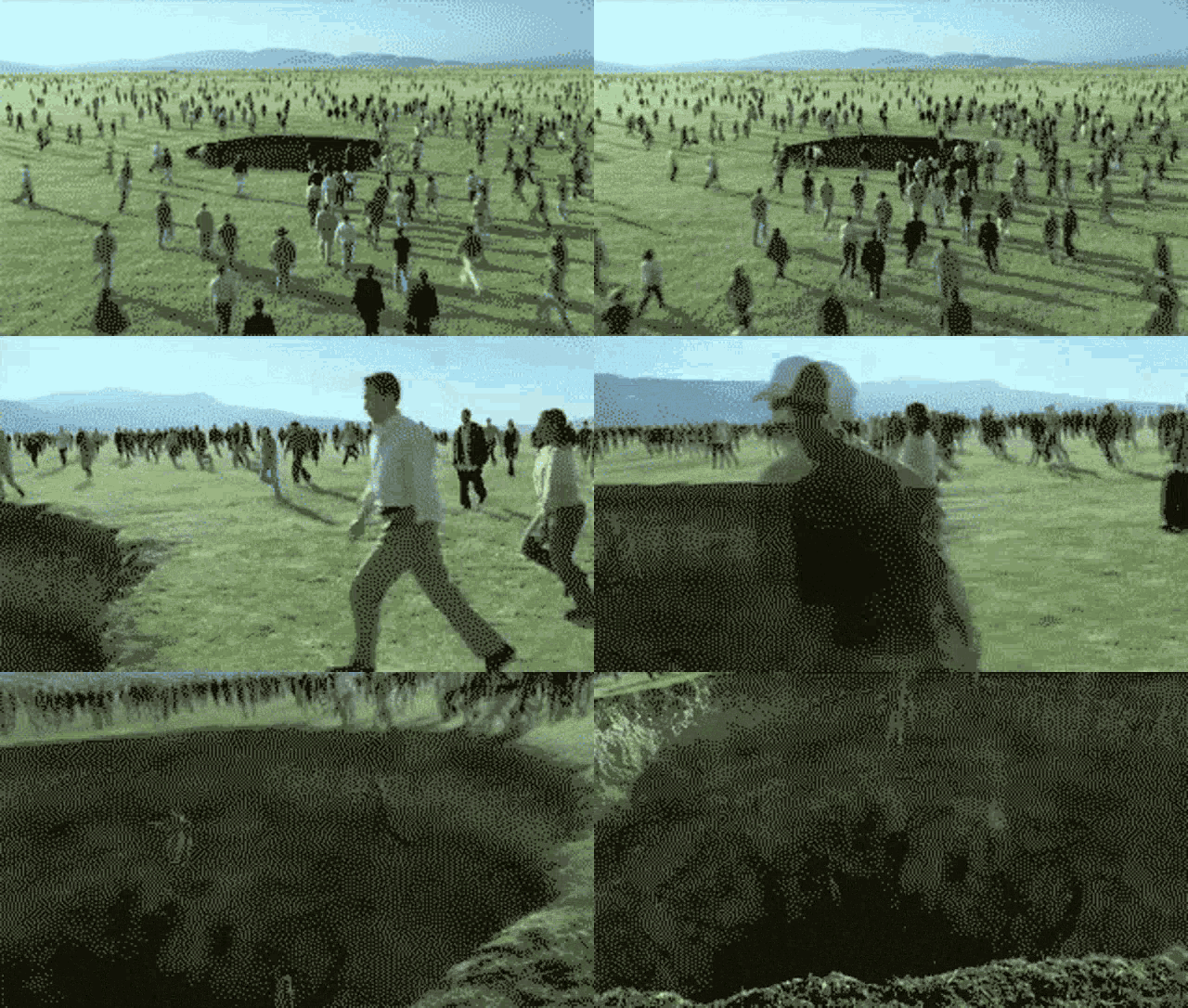
I chose pre-tirement a year and a half ago, in my mid-40s. Yep, it’s a thing – the space between full-time work and retirement – a reduced workload in return for $ that meet my needs and some wants. Monika Halan’s recent column reminded me of the real question I grappled with: “Will I outlive my money or will my money outlive me?”
I agree with her take on the learn-earn-burn model and sketchy finfluencers, but I don’t think the classic career peak-in-your-50s idea will last. Here’s why.
1. Short-termism is now baked into most companies. Layoffs, shrinking business cycles, and the fast pace of disruption mean you’re constantly solving new problems with new tools. That’s largely fluid intelligence, which peaks around 40. Until now, we’ve extended careers beyond 40 largely with crystallised intelligence (experience, wisdom), but AI is catching up with both. Soon, someone younger, faster, and AI-enabled might do the same work cheaper.
2. That also means even a decade-long career may be a stretch. Once humans turn knowledge into rules, rules become algorithms, automation happens and jobs disappear. Damn AI learns!
3. This shift is especially brutal for Gen X and Millennials who weren’t prepared for it. Add subpar savings, unhealthy lifestyles, and rising stress, and mental and physical health issues are inevitable. And no, companies won’t support you.
Since I’m aged enough to offer unsolicited advice: if you’re in your 30s/40s, aim for pre-tirement by 50. Think of it as a Pascal’s wager. Better to have financial freedom so you can grow on your terms, and are not forced to make money-driven choices.
The path? Good old compounding – of intelligence, wealth, health, and relationships.
1. Stay curious. Keep learning. Solve new problems to keep your mind sharp.
2. Spend and invest consciously. Don’t finance today’s wants at the cost of tomorrow’s needs.
3. Stay healthy, not just fit – body and mind. Saves you meds money and lets you enjoy your freedom.
4. Find people in whose company you can be yourself. It aids the above three too.
In the near and mid-term, AI’s quick evolution will question not just work’s efficacy as an income provider, but also its ability to deliver a sense of purpose. On an existential scale, I think the second will cause more damage.
Category: Social Commentary
-
A convenient path to extinction?
It has been almost exactly 4 years since I wrote Default in our Stars. I ended that post with
A question I asked myself while writing this was, when there is no agency, what happens to morality? My own first answer was worrying – maybe you just become numb to life’s deeper questions because there’s always an algorithm to give you something you didn’t know you wanted. And that’s the panacea that this age warrants. And hence default in our stars, and an artificial existence.
Sometime back, a comment on an advertisement I had shared on LinkedIn on World Suicide Prevention Day led me to think again on the subject. I had a bunch of thoughts, and after I had framed it myself, I took the help of everyone’s favourite assistant to break it into byte sized points.. Given my (lack of) expertise, it’s a reach, but I love my curiosity. 🙂 So here we go, picking up specifically from the point of societal impact – reduced interactions, as algos increasingly recommend everything.
1. Human Interaction Decline: Before the Industrial Revolution, getting things done required relatively more human interaction. Since then, it has been declining. From real marketplaces to supermarkets to telephone operators to a faceless internet and so on.
2. App-Driven World: Now, apps have taken over many tasks that previously required a human touch — answering a question, booking a cab, planning vacations, ordering a meal, buying from the local shop — are all done with increasingly reduced human involvement.
3. Command & Gratification: Apps obey without asking for explanations, giving us control and instant gratification. “Click to order”. In parallel, social media provides gratification through validation – likes, comments etc, again something that formerly happened only IRL
4. Centre of the Universe Mindset: This on-demand gratification makes us feel like the centre of our own universe, where every gratification is possible and tailored for us, fast and friction-free. A perception that everything is my way on the information highway.
5. Human Interaction = Tedious?: As human interactions inherently involve alternate perspectives and unpredictability, they can seem more ‘tedious’ in comparison to seamless app transactions.
6. Natural Selection’s Role: Here’s where natural selection comes in. Entropy is relentless, and the one force that is equally relentless in trying to stop it, is natural selection. Evolution thus tries to increase order in successive iterations. That’s also how humans got here.
7. Tech’s Push for Efficiency: In general, app interactions are more predictable than human ones, aligning with this drive for less entropy. For instance, Urban Company/Uber have automated much of this already, helping us choose predictability and efficiency over complexity in daily transactions.
8. Tech & Relationships: Something I missed in the original post is another connection between biology (nature) and tech. In their book The Molecule of More, Daniel Z. Lieberman and Michael E. Long describe two kinds of relationships. “Agentic” relationships orchestrated by dopamine – formed to accomplish goals, very purpose-driven, and in contrast, “affiliative” relationships – formed for connection and enjoyment, driven by oxytocin. We all know the connection between tech and dopamine, and that’s probably why we are increasingly pushed to transactional agentic relationships.
9. Blockchain’s Faceless Trust: So, where is this going? As D pointed out when I chatted with her on this, blockchain takes this further with its “faceless, trustless” system of certainty. It’s arguably the next step in reducing unpredictability.
10. AI and the Future: AI, despite its hallucinations, will likely bring even more predictability in both outputs and outcomes. But what does that mean for our place in this increasingly transactional world? Honestly, I’m still figuring that part out. 🤷♂️
The WEIRD mindset has moved beyond its original strongholds and is becoming increasingly dominant across the globe. Money, society’s favourite currency, demands it. Munger has famously said “Show me the incentives and I will show you the outcome“. It is ironic that at a species level, there might be a desire to survive, but that, at an individual level, the WEIRD penchant for autonomy and predictability is overriding it. Natural selection will have no qualms about its means of reducing entropy coming at the cost of an entire species.

-
Kaumpromise
There is nothing quite like death to shake a worldview. There is a reset that happens in one’s head, and the relationship or even lack of it, changes this only in degree, not kind. There is no immunity either, by now, I’d know.
This one took me out of my comfort zone, in terms of physical location. In the last year or so, especially since the previous time I encountered death, I’ve felt myself become a tad more dispassionate about Cochin as relationships seem a lot more fragile. I am myself much to blame, decades of muscle memory of holding others at arm’s length is hard to shake off. And this is beyond Cochin, and in a place where I have avoided staying for more than a night. Each time I have tried to tell myself that my creature comforts can be skipped for a few days, there has been a rebellion within and I’ve been forced to say “I can’t.”
I brace myself this time too, and stood in a corner, observing others. I think we all are capable of projecting an aura of “do not approach” when we so want. Mine is at full blast. And yet, one child (whom I first knew as literally a child, and is now about to become a CA) breaks through it, and asks me if I I am ok, if I need anything. Maybe it is that, maybe it is the death gut punch, or maybe it is my newfound willingness to look at (at least some of) the world without a ‘transaction alert’ warning, but the next evening, I am at the table for evening tea, doing stuff I do when I am comfortable with people – pulling their legs, except these are people I had never even said a decent hello to. The day after, I am pushing someone to accept something the family feels he should take, and he is reluctant. They’re all crying, I think I might have forgotten how to. Says a lot.
But the larger facade broke before that evening at the table, as I watch folks of all forms walk through the door to catch a last glimpse of the one who had passed. It strikes me that I didn’t know more than a few people who would care to drop in to see me before I went up in smoke. The image of an old man, barely able to move a few steps, break down in grief, is still alive in my mind. Sometimes, I realise, it takes death to understand the meaning of life.
A few days later, I am back in Bangalore. I see the unhindered adulteration in packaged food, in the things that restaurants do, and in general, the greed in every seller, I wonder if that is what has been lost when faceless people sell things to faceless others. It is easier to not care when you don’t see the people you harm. That is not an option in a smaller community or at least it gets punished faster.
I am also reminded of what else family and community can do when I read Milan Kundera’s brutal take (in Identity) on why friendship isn’t in vogue these days.
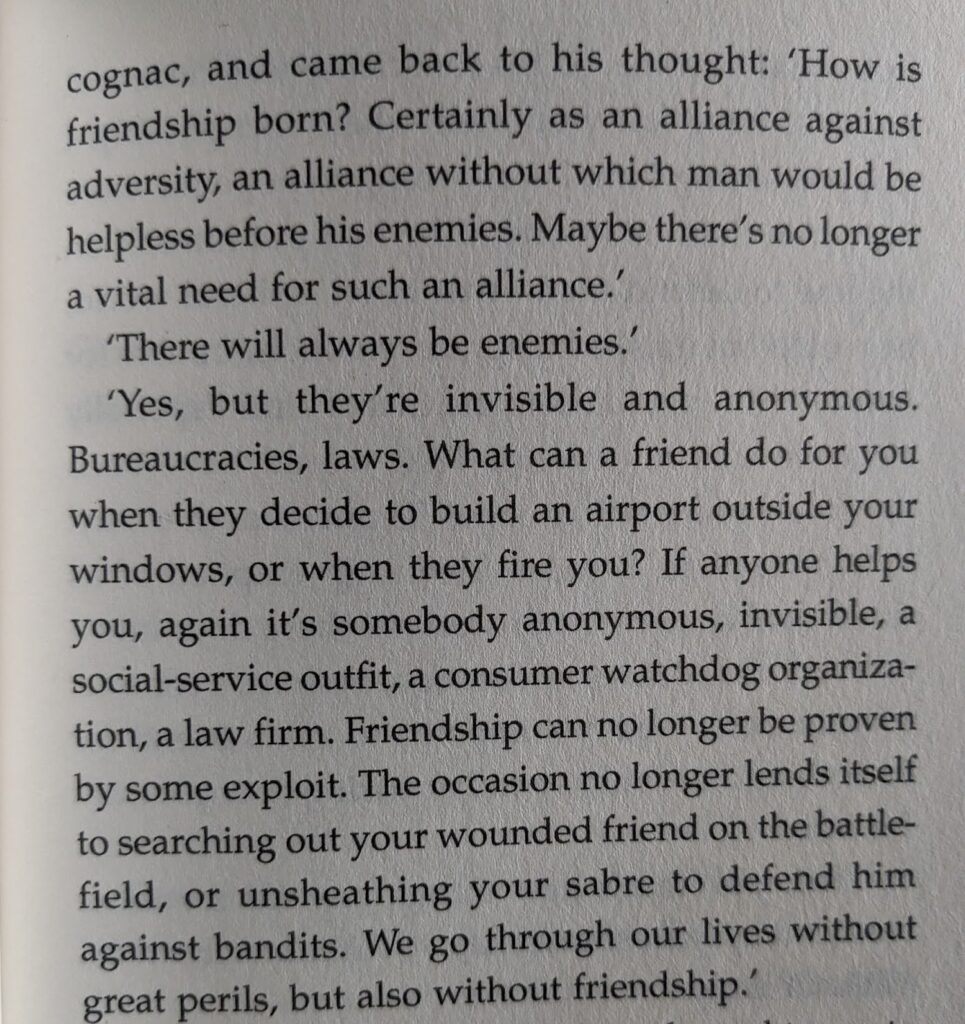
When I zoom out of my individualistic approach, I realise I had seen community the way it was meant to be. Life savings in cooperatives, because it’s a world in which everyone still knows everyone else or is just a degree of connection away. Local cable over OTT because births and deaths and important local news is covered in the former. It isn’t perfect, and I won’t romanticise it because I know I wouldn’t be able to tolerate the scrutiny beyond short bursts, but its manifestations are revelatory. As the insightful narrator in Gullak says, yeh trauma bhi hai aur therapy bhi. And I wonder what the proverbial middle path is.