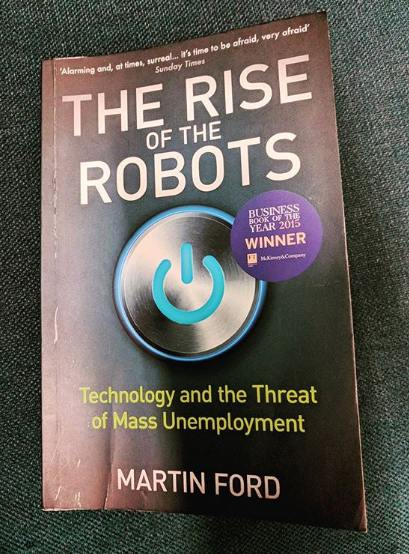
Martin Ford
The bad news – it would seem that the robocracy is inevitable. The good news – this is a very well written book!
In most robotics and AI narratives, what gets lost is the nuance as folks very firmly root themselves in polarising camps on the future of our species. The reason why this book worked for me was because its focus was less on the dramatic headline (what) and more on why it would happen. It is a very well researched book and sets about debunking popular schools of thought in a very clinical manner. The author is also wise enough to call out the things he is not sure of and mention alternate points of view, as well as objective enough to not fall for the hype of everything that’s new and supposedly disruptive.
Though he does begin with the now ascertained fact that the first wave of automation will take away the routine and predictable jobs, he also warns that it won’t stop there. Even what we would call the higher end jobs will be safe only for a while longer. He is clear that this is a wave of disruption different from what we have seen before because the cognitive abilities that get developed will be replicable and scalable. He also demolishes a couple of currently popular coping mechanisms – consistent re-skilling, and man-machine collaboration.
The second half of the book focuses on the economic and societal implications of the rise of the robots. He predicts the fall of middle class demand as well as economic mobility, as incomes stagnate or disappear completely, and warns that economic growth would not be sustainable since robots cannot be expected to be consumers, and the plutocracy (top 5% of the population) which has the money can only consume so much!
The solution he believes in is some version of a universal income which would ensure the participation of a larger segment of the population and give some semblance of prosperity to everyone. But he also sees several challenges in execution.
Beyond the broader narrative, there are some fascinating statistics and anecdotes – the development of Watson, the scarily increasing time it takes for employment to regain its original levels after a recession, the sale price of Internet behemoths (YouTube, Instagram, Whatsapp) framed as a cost/employee, and so on.
While the outcomes may not really be palatable to anyone who belongs to the species, it doesn’t take away from what a fascinating read this is!