Category: Future & Tech

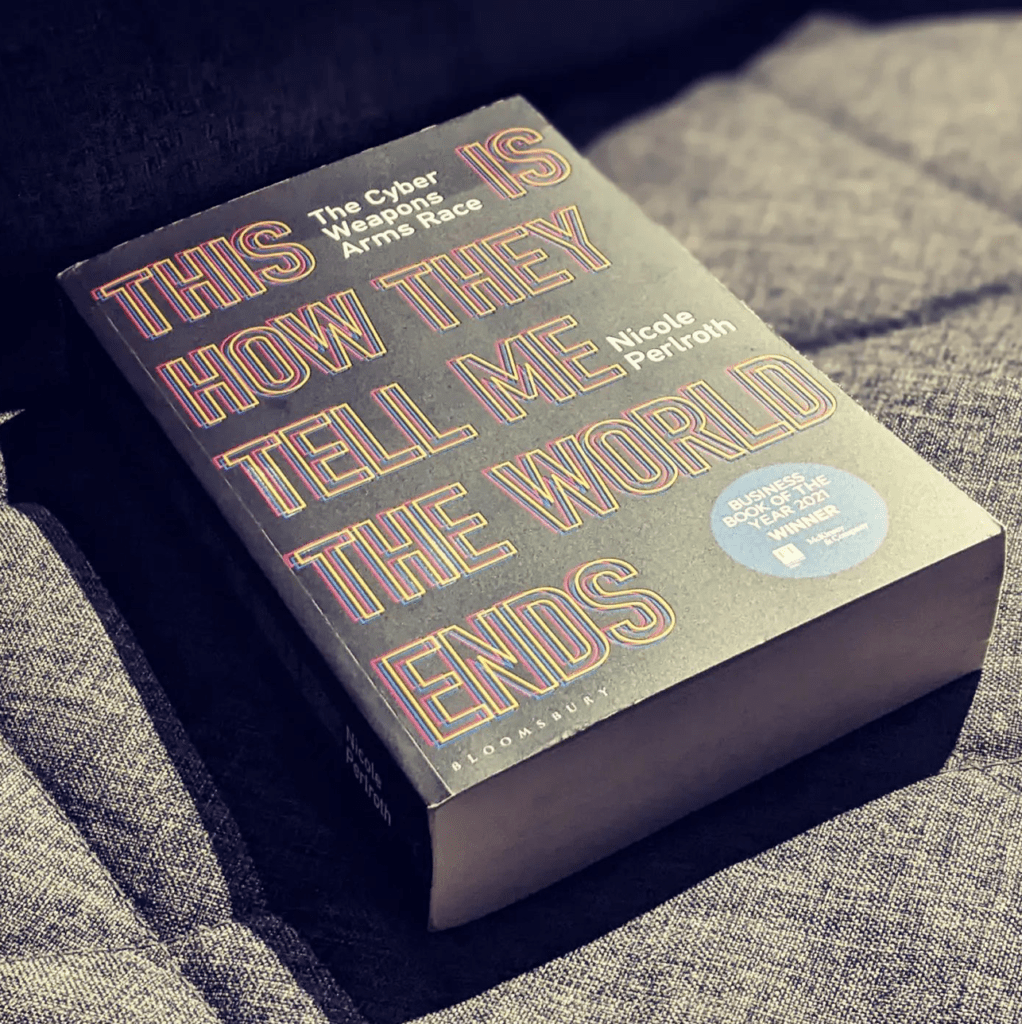
  • This Is How They Tell Me the World Ends: The Cyberweapons Arms Race

    Nicole Perlroth

    In the epilogue, Nicole Perlroth goes back in history to a summer afternoon in 1976, when in the parking lot of a biker bar, a team of scientists from SRI International (which had an office in Menlo Park) sent the first email over the internet to ARPANET, as a demo for Pentagon officials who had flown in for this. In the world then, national security was largely a function of things in the physical domain – hijacked planes, rogue nations with nukes, drug trafficking, terrorists and so on. (Almost) half a century later, the world is a different place. Forget rogue nations or terrorists, a single hacker can seize control of a plane in mid-air with nothing more than a play on the code in the software running the plane. Everything from election systems, power grids, nuclear power plants, gas pipelines to hospital systems can be held hostage with ransomware. Most of them have been, and every device we use – from mobiles and laptops to connected homes and cars – is vulnerable. This is the story of that transition. 

    Nicole begins the book in Ukraine, where she was surveying the aftermath of a devastating cyberattack, which included the Chernobyl radiation monitors going offline. The culmination of Russia’s revenge for the 2014 Ukrainian elections, which they unsuccessfully tried to hack. That the hack boomeranged and destroyed Russia’s own oil giant Rosneft’s data is a good example of how even those who unleash attacks cannot be sure of its speed and direction. 

    But the story begins in the Cold War era, back in 1945, when bugs were ‘microphones’ and the advanced exploits were through anything that was attached to a plug – typewriters, copiers, printers etc. There is an extraordinary story from 1984 of Project Gunman, and how a coil in an electric typewriter was ‘weaponised’ with a magnetometer and a recording device for spying! 

    And then came the computers. The first version of Linux had 176000 lines of code, now Microsoft’s Vista has 50 million. Each a potential vulnerability. Back in the day – from the late 90s, brokers started paying coders to purchase exploits in hardware/firmware/software – Sun, Cisco, Microsoft, HP, Oracle. They then sold it to these companies, sometimes having to show them proof of how it could be exploited. As the internet grew in size and became a global network, an underground market for exploits formed and the US government started building an arsenal including zero-days (a software/hardware flaw which doesn’t have a patch yet, called so because the ‘good guys’ have zero days to fix them). Some zero days are ‘ideal state’ – they require zero interaction from the target’s end, no mails or messages, and also ‘clean fail’ – they wouldn’t trigger an alert or crash a computer. But since the days of Stuxnet (2010), which had as many as seven zero-days and was used by the US to neutralise Iran’s Natanz nuclear facility), things changed. Just like Hiroshima, a weapon had been revealed and it would not go back into the box (Michael Hayden, former NSA director).

    Also, in 2007 came the iPhone, supercharging the era of government snooping, and an invasion of privacy with minimum effort! By 2015, the NSA was even snooping on their own First Lady! It is now a minefield with different governments including not just powers like Russia and China but Iran, North Korea, Israel their opponents within the country and outside, hacker groups, tech companies, and government agencies all in an arms race to win cyber wars in milliseconds. 

    The book has many interesting stories. The origins of Pegasus (by the NSO in Israel), named after the winged horse, and which could capture vast amounts of data from the air without leaving a trace. Aurora – the Chinese Legion Yankee attack on Google, and Brin’s strong response, though it was only for a short while. Argentina’s thriving hacker ecosystem, Iran’s ‘burning flag’ response to the US in its Aramco hack, Russia’s hacking of the DNC, WannaCry by Lazarus from North Korea, HeartBleed based on a widely used OpenSSL software, the linkage between the assassination of Jamal Khashoggi, the purchase of exploits by Emiratis, and the publishing of Bezos’ private photos (the source was actually the mistress’ brother, but the phone was simultaneously hacked too) are all signs of an escalating war. There is also a funny story on how, after Trump ordered Russia to close their San Francisco consulate, plumes of black smoke began pouring out of their building’s chimney. They were obviously burning something, and when a reporter asked an exiting man and woman about it, with acrid smoke billowing around them, they replied, “there is no burning.”

    The weapon will not go back into the box, and it is now capable of devastation in milliseconds. The world, while aware of this, is not willing to find alignment on things that will now start taking human lives. One excellent place to start is to stop taking buggy code to market. In an economy that rewards first-to-market and “move fast and break things”, this is not going to be easy. As usual, Scandinavia leads the pack for safety, but Japan offers an instructive lesson in making cyber hygiene a priority for everyone from government agencies to individuals. But this provides no comfort because it is really an arms race with seemingly no end. 

    The narrative is relentless and extremely accessible. It throws light on an area which we shouldn’t be ignoring, given how much is at stake. For me, it is also a validation on not going beyond the mobile phone in terms of tech hardware. But that really is small relative safety, nothing more. And just like Nicole, I wonder when we will see the ‘mushroom cloud’. 

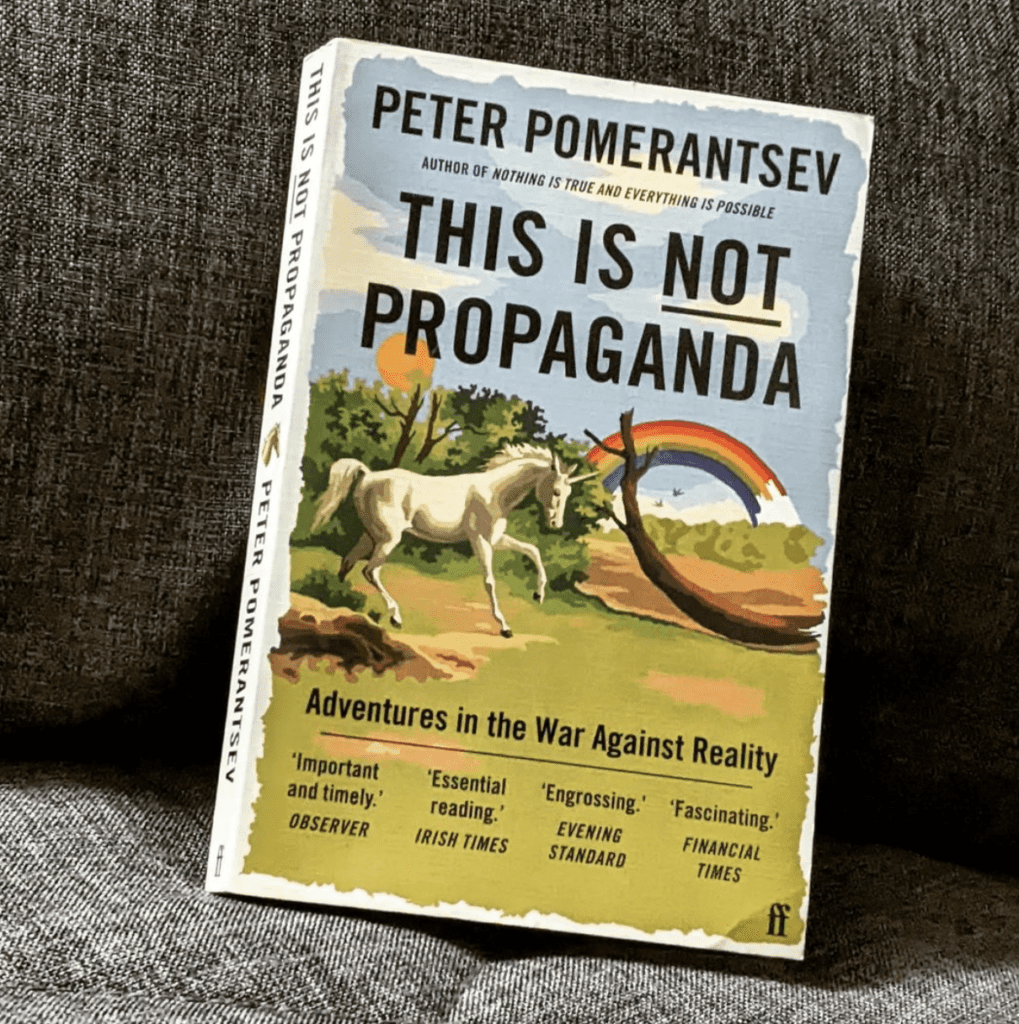
  • This is not Propaganda

    Peter Pomerantsev

    As the old joke goes, ‘Truth will prevail’, but no one said whose truth! I think if there is one book you should read to understand the sociopolitical information warfare on social media happening daily, this is it. From Mexico to Manila and London to Kiev, there is a playbook that is being followed to distort reality. The same tools that were originally used to create revolutions are now being used by autocrats to gain and hold power. More information was supposed to be more power, but it also provided new ways to silence dissent. Censorship through noise. And where did it all begin? In Russia. Peter Pomerantsev has a first-hand experience of how it all started. Forty years ago, his parents were forced out of Kiev (then part of the USSR), and their journey since then serves as a great narrative guide. 

    The book is divided into six parts. The first part uses examples like Rappler vs Duterte (Philippines’ version of Trump in the US and Bolsonaro in Brazil) and Lyudmilla Savchuk, who exposed Russia’s troll farms, to show how new instruments of information are being used to break people. Russia denies connection with the troll armies, like every other state – Turkey, Bahrain, Azerbaijan etc – that uses similar means. 

    The second moves to Latin America and EU to show how entire resistance movements have been dismantled. Clever rulers have found ways to remove the clarity around the ‘enemy’ by coopting the language and tactics as those who fight oppression. Srđa Popović knows a thing or two about the original playbook. A Serbian political activist, he was a leader of the student movement Otpor!, which was instrumental in toppling Serbian president Slobodan Milošević. He has since then trained activists in Georgia, Ukraine and Iran. It’s an irony that his manuals and courses are being used against the very purpose for which they were created, and it’s now come down to an arms race of tactics and technology between guys like Alberto Escorcia and Mexico’s corrupt politicians. Russia invaded Estonia in 2007 without setting foot in it by mimicking the entire playbook and using Estonia’s own pro-Russian citizens in protests. Another trick is to state that genuine protesters are being paid by the US. From Facebook to Discord there are people being recruited and systematic strategies being used to undermine pro-democracy efforts.

    The third part is on how one nation is able to ‘invade’ another without real contact by blurring the idea of war vs peace and domestic vs international. War is no longer in just physical space, it is hybrid, non-linear, full-spectrum (all terms used by experts) and is focused on decaying the opposing group/country from within. Information warfare is the first play and the military follows, if required. Russia’s attack on Ukraine in 2014 is the classic example. “Faced with wildly conflicting versions of reality, people selected the one that suited them.”

    The fourth explains how, without a tangible idea of the progress and future, anything goes! When Putin invaded Crimea, he first said there were no Russian soldiers there, and then later casually said there were. Replaced one reality with another. Another example – 76% of Trump’s statements in the election were mostly false or untrue! The case made for these distortions is that objectivity anyway doesn’t exist. Related to this is the glorification of the past. ‘The twentieth century began with utopia and ended with nostalgia. The twenty-first century is not characterised by the search for newness, but by the proliferation of nostalgias’. And in the era of ‘soft facts’, we can know everything happening in Aleppo and pretend to not see it.

    Pomerantsev sets a prelude for Chapter 5 with his own confused identity in childhood – British or Russian? When old notions of identity around demographics and religion get blurred, all politics now revolves around ‘identity’ they can create and use for their own ends. The story of Rashad, one of the founders of Hizb in the UK, who was early into this game but now works to dismantle it, is fascinating. This part also has the working of the Brexit campaign. Eighty types of targeted messages for 20 million people. Animal rights, environmentalism, gay rights, potholes all somehow made to connect with Brexit. And it all began in Russia. Starts by Pavlovsky for Yeltsin, but polished by Putin. 

    The final part is about the future – China, but begins with Nigel Oakes, founder of SCL, whose game was repurposed by one of its other founders to create Cambridge Analytica. China is well on its way to target people with demographic, psychographic and behavioural patterns. The book ends with a brilliant closure – of the subject as well as the personal history.

    While the wiring is clear, what remains to be seen is the second order consequences of this combination of trolls, psyops, dark ads, bots, soft facts etc. Not just at an individual or societal level, but at a species level. The book is extremely well-researched and has a narrative and language that is easily accessible. The interweaving of the personal narrative is at once sharp and seamless. This is a book I’ll hugely recommend. 

    P.S. I wish he had also covered India too, the playbook is being religiously followed here!

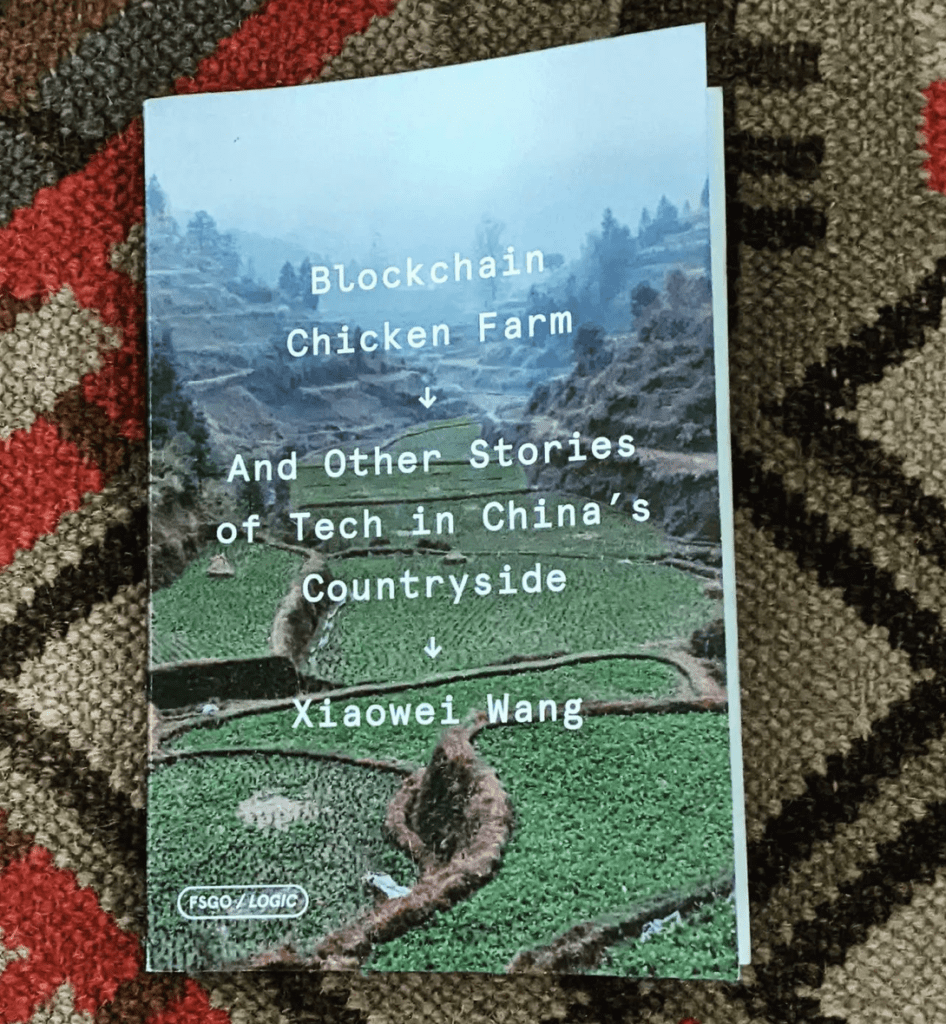
  • Blockchain Chicken Farm: And Other Stories of Tech in China’s Countryside

    Xiaowei Wang

    I bought the book because it had two keywords that interested me – blockchain and China. But as the ‘stories’ went from swine to finally pearls, I realised that the title probably doesn’t do justice to the multiple themes that surface in the book and makes it, a rich and nuanced read. 
    The introduction points us to ‘metronormativity’ – the idea that rural people and culture are ‘backward, conservative and intolerant, and that the only way to live with freedom is to leave the countryside for highly connected urban oases.’ Further, that internet, technology and media will educate and save them by allowing more experiences and chances of a better livelihood. The book is a challenge to all parts of this construct. It also pushes back on binary classifications we employ – digital/physical, natural/man-made and so on. 

    ‘Ghosts in the Machine’ sets the context as we read about how under Deng Xiaoping in the 1980’s, the country began imagining a uniquely Chinese future, and set the ball rolling for the rise of companies like Huawei and Alibaba. In parallel, there’s the rise of TVEs (Town and Village Enterprises) over the prevalent SOEs (State Owned Enterprises), and a potential ‘agrarian transition’ that would result in industrialised agriculture, which would need lesser manpower. This would have social, environmental and political ramifications. 

    ‘Blockchain farm in the middle of nowhere’ touches upon the surveillance state, non-explicit censorship, and ‘the shadowy unease that looms over public conversations.’. It begins with the foodsheds in Shanghai and moves to the contrast (or not) between the dangers of cost-cutting in the food industry, and the gloss of ‘blockchain chicken’ (Bubuji/GoGoChicken). The latter uses ‘a chicken Fitbit of sorts’ on the ankle of chicken which allows a buyer to know the provenance of a chicken, and even see streaming live footage that can be accesses via a QR code! But despite this, the future is uncertain because the tech is on hire, and overhead costs are high. Can blockchain make food safety records tamper-proof by creating a distributed system? Perhaps, but there are many challenges including legibility and thus, access. 

    In ‘When AI farms pigs’, we are introduced to Alibaba’s ET Agricultural Brain that aims to transform agriculture to ‘help create China’s pork miracle’. It brings out how, despite AI’s potential to radically help humans, the current economics of AI makes it a corporate AI model that is all about scale and efficiency. 

    ‘Buffet Life’ explores the alternate careers that Chinese youth are taking up. Case in point – drone operators. This is backed by a (state backed) system that is now bridging the gap between urban and rural education, creating the infrastructure for it and thereby also providing new means of livelihood.

    In ‘Made in China’, there is a very insightful take on what ‘innovation’ means and how it is predominantly evaluated through a Western lens. China is forging its own path in ‘innovation’, trying to break away from cheap products at industrialised scale. ‘Shanzai’ is changing its earlier connotation to an ecosystem that’s open source, and operating at hyper speed, steamrolling through the IP version favoured by the West, and forcing conversations on access and civility. The agricultural version of this approach is Rice Harmony, and its method of collective, organic rice farming. There is also the fascinating tale of Naomi Wu, a self-proclaimed cyborg, and an internet star. 

    ‘No one can predict the future’ is as much about policing as it is about community and identity, and the difference between ‘safety’ and ‘security’. It is interesting how many people working in the domain view surveillance as a technical problem to be solved without thinking of the related consequences. There is also a mention of ‘criminal villages’, the Chinese version of India’s Jamtara. 

    ‘Gone shopping in the mountain stronghold’ relates how ‘Rural Revitalisation’ relies on technology and the internet to build rural entrepreneurship ecosystems. The rural playbook of Taobao is a phenomenon, one that is transforming the rural landscape, literally and metaphorically. Others like JD.com and Pinduoduo are replicating this too. And thanks to this, there is a reverse migration to the village. But many of these platforms are unregulated, resulting in safety issues – everything from getting sick from food purchases to a cab driver raping and killing a passenger. 

    ‘Welcome to my pearl party’ is the one I found most poignant. While the story is about pearl farming in China leading to an MLM sales machinery in the US, the underlying socio-cultural dimension of it – the human need for belonging and care – is what makes it an affecting read. This also features a ‘subversive’ version of Peppa Pig, or rather it becoming a mascot for those who are rebelling against the part of society which has everything and sets the rules – shehui ren culture. 

    While these are all set in different parts of China, there are themes that I could see were universal – ‘…the plague of being old and lonely. As younger generations leave villages, hometowns and even the country to chase after careers and jobs, and the tightening noose of inequality squeezes leisure time, the elderly are left to their own devices.”

    Blockchain, and fantastic perspectives of China were indeed part of the mix, but Xiaowei Wang delivered far more. Travelogue, technology, culture and community, future and sometimes even a bit of contemplative philosophy, I really wouldn’t want to slot this book in any particular genre, and that’s probably what makes it a compelling and fulfilling read.

    P.S. In the penultimate page, the author, sitting in a HongKong bar, amidst the protests, writes about reports of a zootonic disease from mainland China causing flu-like symptoms in humans causing unease because the memory of SARS still being recent!

  • Uncharted

    Margaret Heffernan

    From the time imagination and projection became a part of our survival toolkit, our species has been finding more and more ways to be certain. But as the world becomes increasingly complex, certainty is more difficult to find. ‘We live in a world of irreducible uncertainty‘. So how does one think about the future, at not just the individual level, but at organisation, societal and civilisational levels? Margaret Heffernan moves through history, business narratives, science, and her own relationships to offer perspectives.

    The book is divided into three sections to take us through multiple concepts. The first section uses history to set the context for our ‘addiction to prediction’. We convert history into smooth flows of continuity and manifest destiny whereas events weren’t inevitable but a series of choices, complex and contingent. In addition to pointing out how even professional mathematicians find probability counterintuitive, she also shows how we quickly accept the propaganda of predictions and ‘leave ourselves open to those who profit by influencing our behaviour’. Even in our individual lives, everything from personality tests (MBTI) to genetic profiling is used to typecast despite humans being complex. The big danger is in confusing complex systems for a complicated process. The lessons in this section is that neither history nor genetics nor models can say with certainty how the future will unfold, and what we lose when we try to automate our way into efficiency is the system’s robustness. 

    The second section has a bunch of examples on how people, companies and societies have navigated the future. It brings out the importance of experiments, scenario planning, and creating a shared understanding. Scenarios ‘illuminate the contingencies, contradictions and trade-offs of the real world, where no one interest or single perspective is in control‘. At an individual level, there are some excellent examples of artists whose projects are defined by uncertainty. The Future Library was one I found very interesting – Katie Peterson has planted a thousand trees in a forest outside Oslo. Once a year, for a hundred years, authors will submit manuscripts commissioned for the book. It could be poems, stories, a novel, or even a sentence, but no one else can read it until a hundred years from now! This approach is in stark contrast to the ‘brand you’ concept of fixed positioning. At a broader level, there are examples of ‘cathedral projects’ like CERN, whose by-products have revolutionised multiple industries, and yes, given us the internet too! The Human Genome Project is another example. They are destined to last longer than a single human lifespan, and have to adapt to changing needs, tastes and technologies, relying on human imagination and the willingness to explore, to succeed. ‘They are voyages of discovery in uncharted territory.’ 

    The final section is all about the importance of being human, and coming full circle, how we can prepare ourselves better for the future. Using examples of individuals, companies like Nokia, and a civilisational crisis like AIDS, the author highlights how human relationships helps us solve problems which are uncertain even from a ‘where to begin’ perspective. Human ingenuity manages to create emergent solutions. The penultimate chapter is a fantastic presentation of death as a feature, not a bug, and treats it with dignity and respect. 

    This is a book that creates an excellent narrative for the times. While we extoll AI and its ability to make our lives better, the focus here is the human ability to ask better questions, share ideas, and find solutions. In our search for efficiency and metrics, we tend to forget the creativity and imagination prowess of the human mind that has brought us so far. There are no readymade solutions in the book to tackle an uncertain future, and that is the precise point it makes. It offers perspectives and possible approaches, and despite the tough and diverse subjects it deals in, is optimistic and very accessible.

  • Weapons of Math Destruction

    Cathy O’Neil

    Humans have had biases for the longest while. But they have come a long way from from the simplistic ones that helped the species band together and survive, or even the the heuristics we have applied and continue to use at an individual level. As search engines and social networks move from tools to utilities, we have now begun to see the dark side of “software is eating the world” – when biases and discrimination are being codified into systems, resulting in blind discrimination that widens inequality by preventing people from climbing out of poverty, unemployment, homelessness and all the things that we as society should be ashamed of. 

    The author, thanks to her education and experience, is well placed to write on the subject. She calls the mathematical models or algorithms WMDs – Weapons of Math Destruction. They have three common characteristics – scale, opacity and damage. To elaborate, they typically use data sets to create scoring systems that evaluates people in various ways. Most of these systems are proprietary. The scale at which these systems operate is really large, and therefore the damage they cause is also equally massive. Most of the people affected don’t even realise they’re being discriminated against and sent on a downward spiral. And most importantly, there is no feedback loop to make the system better. 

    The author frames it very well through examples across life stages – how teachers and students are evaluated in schools and universities, how employees – potential and existing – are screened, how online ads for predatory services like payday loans are targeted, how insurance premiums are decided, how law and order systems end up “creating” criminals simply based on location data, and perpetrates injustice, how scheduling software destroys any sense of work-life balance. These are not dry, statistical examples, but backed by stories of actual humans devastated by an unfeeling algorithm, with nearly no chance to work their way out of it.

    In the future, what really stops us reaching “Minority Report” scenarios? Arresting people because they could be potential criminals, screening applicants based on health issues they could have in the future, and so on. And since everything is based on users sharing data, it seems certain that privacy will come at a price. In the past, when greed and business “progress” began to have harmful effects on society, the government stepped in and put laws in place to safeguard us. But now governments themselves use these systems! We still have a chance to work our way out of this and bring back dignity. For instance, the European model, in which data collection must be approved by the user and is opt-in, and the reuse of data is prohibited. 

    But will we? In our efforts to remove biases, we have ended up creating systemic monstrosities that lack empathy, and only focus on efficiencies. Those who learn to game the system profit. Winners keep winning, losers keep losing, as fairness is forgotten because entire business models are built on them. As the author rightly points out, “The technology already exists. It’s only the will we’re lacking.” And that, really, is the problem, because “Algorithms are opinions embedded in code”. An important book for the times we live in, and the future.