Tag: Nokia

  • The new media owners

    A few days back, I read a very interesting piece by Jeff Jarvis on ‘The Great Restructuring’, in which he talked about fundamental changes happening in the economy and society. He also talked of an economy (at least in part) built on the abundance of knowledge, which then led to the subject of replanting business models.

    It took me back to a discussion I once had with a friend on the role of newspapers, and the new forms of media. The role of newspapers, and ‘tangible media’ in general was a hot topic of discussion then. Steve Rubel had the “The End of Tangible Media is Clearly in Sight” post which put 2014 as the year of demise (in the US), and got quite a few responses, including some folk who disagreed with it, and some who agreed a bit but disagreed mostly. There wasn’t much of disagreement on the subject of newspapers, and it was generally agreed that Digital was indeed a great disrupter. Newspapers have  been accused of trying to replant their offline model on their web. Perhaps rightly so, since it clearly doesn’t seem to be working.

    In that conversation, we’d used ‘new media’ a little differently from the platform based (internet and mobile) approach. We discussed three forms of ‘new media’ –

    • some entities about whom the media writes about – people and  organisations . The net population already shares a lot of the content they produce on the web platform – via blogs, social networks, platforms like YouTube, Flickr etc, and lots of organisations are using the web as a broadcast medium – Marketing as media
    • social networks and other services which consolidate a lot of the content generated above in one location, and web only news sites (anything from Rediff to Instablogs and niche news sites)
    • some entities who’re already in the communication/network business – these could be companies like Nokia (handset manufacturers who are an access point to the web), telecom operators like Vodafone (who also act as an access point), or even companies like Cisco, who I think will go further than just provide media solutions

    While there’ve been a few setbacks – Nokia shutting down Mosh, its content sharing service as a result of dubious content posted, Vodafone playing bully to opt-in-SMS service MyToday and various lawsuits against Google (YouTube) on copyrighted content, I’m hoping these are nothing more than teething problems of a radical overhaul.

    Depending on various factors, like socio economic conditions, technology penetration, to name a few, ‘The  Great Restructuring’ would happen differently in different places. Like other restructurings before, some parts of the population would remain unaffected.

    Meanwhile, as mentioned in the post, it indeed is a time of opportunity, and definitely for newspapers too, at least in this part of the world. It only depends on how much they’re willing to shed their old ways of doing business (especially when it isn’t making the revenue it used to be) and how willing they are to listen to the collective consciousness. Even with the ‘new media’ and the proliferation of content producers, newspapers could still find ways of delivering value. (excellent debate happening here)

    Earlier, everyone read a newspaper and therefore it was the place for a product to be seen by its potential consumers. Since the first part changed, the second has too. If increasing media fragmentation is the future, then what newspapers could be doing wrong is seeing their product/s as the only media/destination. Instead, they should perhaps (at least) listen to the Chaos Scenarioexplore a few options, utilise their resources to be preferred content choices in as many fragments as possible, irrespective of the platform, and fight battles in each fragment separately. This would also mean that basis the dynamics of each fragment, different revenue models might evolve for each fragment.

    until next time, for now its Calvinball rules 🙂

    PS. Must Read – IBM’s study – Beyond Advertising
  • Electronic Social Responsibility

    Late last year, I remember reading this article that talked about a study by Havas Media, which “looks at the impact of climate change on business from the point of view of consumer”. From the study,

    With respect to India, the survey claims that 86% of Indians would rather buy from companies that are trying to reduce their contribution to global warming. Further, 50% of Indian respondents would be more likely to buy environmentally-friendly goods in the next 12 months, if they were at the same price and standard as their usual brands. 43% would be willing to pay a little extra for those goods.

    Somebody has been listening, or more likely, had been listening for quite a while, for earlier this month, I read about Nokia India’s efforts though its ‘Take Back’ campaign, which aims to educate consumers about the recycling and re-use of old handsets and accessories. In addition to this contribution, Nokia will also plant a tree for every handset dropped at the recycling bins. I was extremely impressed by Nokia’s official notes on their efforts. As a market leader, Nokia has done a great job.

    Meanwhile, another key player has also been doing its bit for a better planet. I remember writing about Motorola last year – the Motopower project, that has 55 solar powered kiosks in Uganda offering free mobile charging to consumers. Motorola also has its share of recycling efforts, and I found its latest effort – the W233 Renew, very refreshing. This handset is the world’s first mobile phone made with plastics comprised of recycled water bottles., and is also the world’s first Carbonfree cell phone on the market.  The site also says that through an alliance with Carbonfund.org, Motorola offsets the energy used to manufacture, distribute and operate of the phone. (through investments in renewable energy sources and reforestation, courtesy Wild Blue Skies) The unfortunate bit, hopefully for now, is that this is not an India phenomenon now. Judging by the Havas Media report, Motorola is missing out on a huge opportunity in India.

    It is indeed good to see genuine efforts from major global players to make the world a better place, sustainable efforts  because they also make buiness sense, and are not spur-of-the-moment CSR initiatives.There can never be enough efforts, and in an increasingly connected world, which thrives on transparency, there’s nothing like a genuine effort to build on brand equity.

    until next time, (as a Springfield tee says) Respect Green Rules

  • Local Social Networks

    I’m guessing most of you reading this use GTalk. Recently, a new service called GTalk Profile was launched. While, so far, you could add people only via their email ids, GTalk Profile helps you find other people using your location as a common point. (via RWW) For example, Bangalore, (though claimed to be in Andhra Pradesh) has about 63 profiles.

    I wonder if this kind of a network has scope, since people are very finicky about who they add, but yes, I do agree that Twitter is an exception, and this could be broadly comparable. Also, this service allows you to create profile pages, which allow descriptions, photos etc. The fun part is that Google has its own Profiles, and even a verification process, though this is used for a completely different purpose now. But I wonder if GTalk Profile will inspire Google to officially proceed along similar lines with their Profiles. A better integration of Google Talk in Orkut, with a facility for local profile search, would provide the same result. Perhaps better results, since Orkut profiles are very detailed, and users could invite others to GTalk, and provide their Orkut profile as a ‘verification’.

    While the net has seen several local social networks popping up, the mobile seems to be an equally (if not better) platform for this purpose. This is perhaps the reason we’re seeing a lot of apps that aggregate IM services on the mobile – Xumii is one such I read about recently. There are also GPS based social networks like iPoki that are being developed.

    In India, I’ve come across mobile specific social network apps, like Qeep. I’m still a little unclear about whether Trackut is into location based social networking. Meanwhile, mobile services, as well as manufacturers, are adding/preloading social networking apps. At&T ‘s My Communities, and LG’s association with Rocketalk, in India, are examples.

    Of course, the regular social networks we’re used to like Facebook, My Space happen to be the ones with the strongest internet presence. Understandable, since there’s a familiarity factor, after all, its only the platform that changes. But they’d do well to add apps that help localise the experience a bit. I wonder, though, whether this trend will replicate itself in India, or whether the disparity between mobile and internet penetration will reflect in this too. I’m thinking about a Big Adda app being preloaded into Reliance mobiles.

    Sometime back, I read about a service called belysio, a social mapping service that uses location based technologies, which notifies you when your contact is near. Now Nokia has come out with Friend View, an experimental location and micro-blogging service. After the recent Orkut-Talk integration, I wonder if Google has plans of moving into local social networking. With the mobile versions of (originally) net based social networks, mobile based social networks, manufacturers’ preloaded apps, this should be an interesting space. What I’d really love to see though is our very dear micro blogging service, Twitter make some rapid advances in local social networking.

    until next time, and then, location based dating? 🙂

  • Social Branding (3 of 3)

    I’d mentioned in my last post on the subject, about a study which showed that 93% of online Americans wanted companies to have a social media presence, and believed these companies also should be interacting with consumers through social media, with one third of the younger set saying that companies should actively market to them on social media. 

    Of course, we have a different scene here in India, from what I read in WATBlog’s report on the IAMAI Digital Marketing summit, with marketers hesitating to go beyond the performance based model . I personally believe both the performance based model as well as a more ‘social’ model have their uses. To put it simply, the former is tactical, and the latter is strategic. But, I agree that it is difficult to sell the latter.

    Like I mentioned once, the measurability of the net as a medium is a double edged sword. I mean, which marketer can measure how many people saw a particular billboard, a particular ad (print or television) or heard a radio spot. The first is at best a judgment, and the rest, an approximation based on reach figures. There is zilch accountability in all cases, but the net has to be measured, even if the spend is 1% of the other media. Perhaps the fundamental love for quick, short term results that envelops the rest of marketing is prevalent here too. But yes, in the end, the intent/objective of the activity should decide the strategy in any medium.

    The best part about social media is that it allows the marketer the flexibility to do both kinds of activities. On one hand, you could be having twitter conversations, interacting on Facebook groups/profiles, and building communities ( a good how to note here)  keeping the brand strategy in view, and on the other hand, you could be running interesting promos on say, YouTube. Here is another study by iPerceptions that shows customer online ad preferences. (via Wild Blue Skies) There are independent tools being developed that measure the efficacy of  video campaigns – Visible Measures is an example, so its about time more companies got viral. I saw a few good digital promos that I’d like to share. (all US based)

    Chevrolet offered up to 10 free rides a day to college students on six campuses in a Chevy Aveo5 hatchback and filming the experience. They are then loaded on a special site, from where it can be shared on other platforms. Finalists are chosen from each college and then one grand winner will get a car. Read all about it here.  

    For their product ‘Dragon’, HP did a promo called 31 days of the Dragon. As part of this, they contacted 31influential tech bloggers to give away 31 laptops in 31 days. Each blogger ran a contest according to his rules, but also publicised others running the contest. With 3,80,000 links and 25000 entries, I would count it a success. (via Marketing Pilgrim)

    And these days the biggest marketer online is after all Obama. He’s got himself an iPhone app, which enables you to call your friends prioritized by their location in battleground states. That nothing works better than peer recommendation is a smart understanding. Read about it here.

    Nokia has a new and interesting promo running at somebody else’s phone. I wonder if its a new phone or something else altogether. The Facebook profiles of the characters don’t offer me any clue. Anyway, we’ll know in about 4 days.

    I read a post here, about an agency Modernista, that does not have a website. Big deal, you would say, most agencies here don’t have one, but the twist here is that its website is a ‘Wikipedia’ page that uses the resources of the web (Flickr, YouTube etc) to showcase its work. Its a great and radical thought, which definitely breaks the clutter.

    Lastly, take a look at this article, which talks about branded iGoogle themes. And here’s a superb compilation of companies that have used social media, but while in social media, beware of the cliches in digital marketing, especially social media. After all, Gartner has projected that over 75 percent of Fortune 1000 companies with Web sites will have undertaken some kind of online social-networking initiative for marketing or customer relations purposes. But, he added in an interview with CNET News, 50 percent of those campaigns will be classified as failures. (via a must read article) A similar small but useful note on Twitter usage can be found here

    As Chris Brogan has rightly written, social media is like phones, its a new (possibly better) tool, but the most important part is how it is used to reach consumers in a better way.

    The sad part is that there is still a tendency to choose easier ways of getting this job done, than getting a clear understanding of the medium and using it to the brand’s advantage. Here’s an article that talks about ways of ‘handling’ online reputation. The CEO of one such company that does this job for brands talked about cribbing sites like Mouthshut!! I wonder when these ‘practitioners’ would understand a few things – one, usually customers write negative things because they feel strongly; two, you cannot control the conversations on the web; and lastly, if companies made good products and provided good service, the same customers would write good things!! 

    until next time, be the change you want to see?

  • Trust they’re connecting people

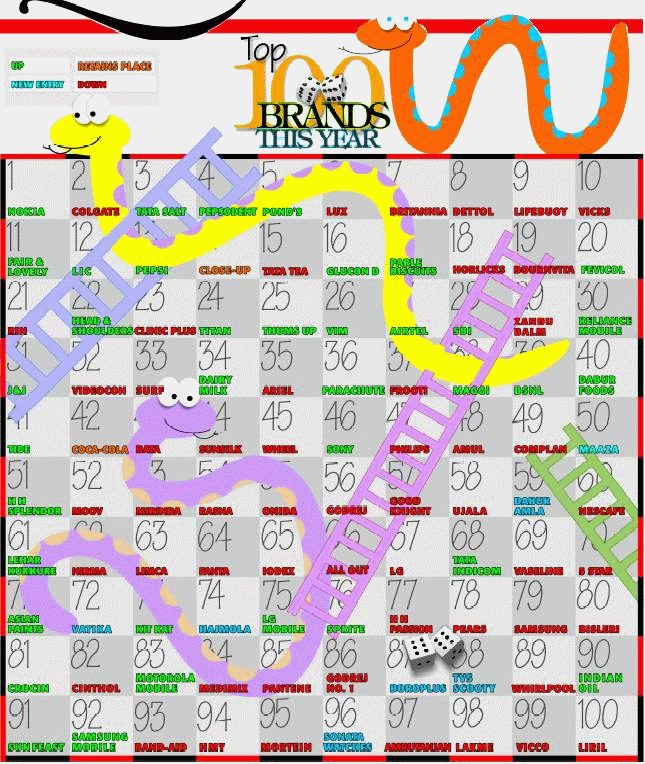
    I just realised that I totally missed this one – The Brand Equity Most Trusted Brands Survey, at least writing about it. Unforgivable, but let me try to redeem myself by attempting a post now. Bottomline, Colgate has been dislodged from the numero uno position by Nokia, no mean task, that, and it is a testament to the inevitability of this medium (not the brand)  reaching the top of the media chain in a future that’s closer than it appears now.

    Since I have been lax on the topic and enough has been debated on it, I did some epaper reading and have focused on a few things I thought would make an interesting read. For those who missed the entire top 100 list, here it is

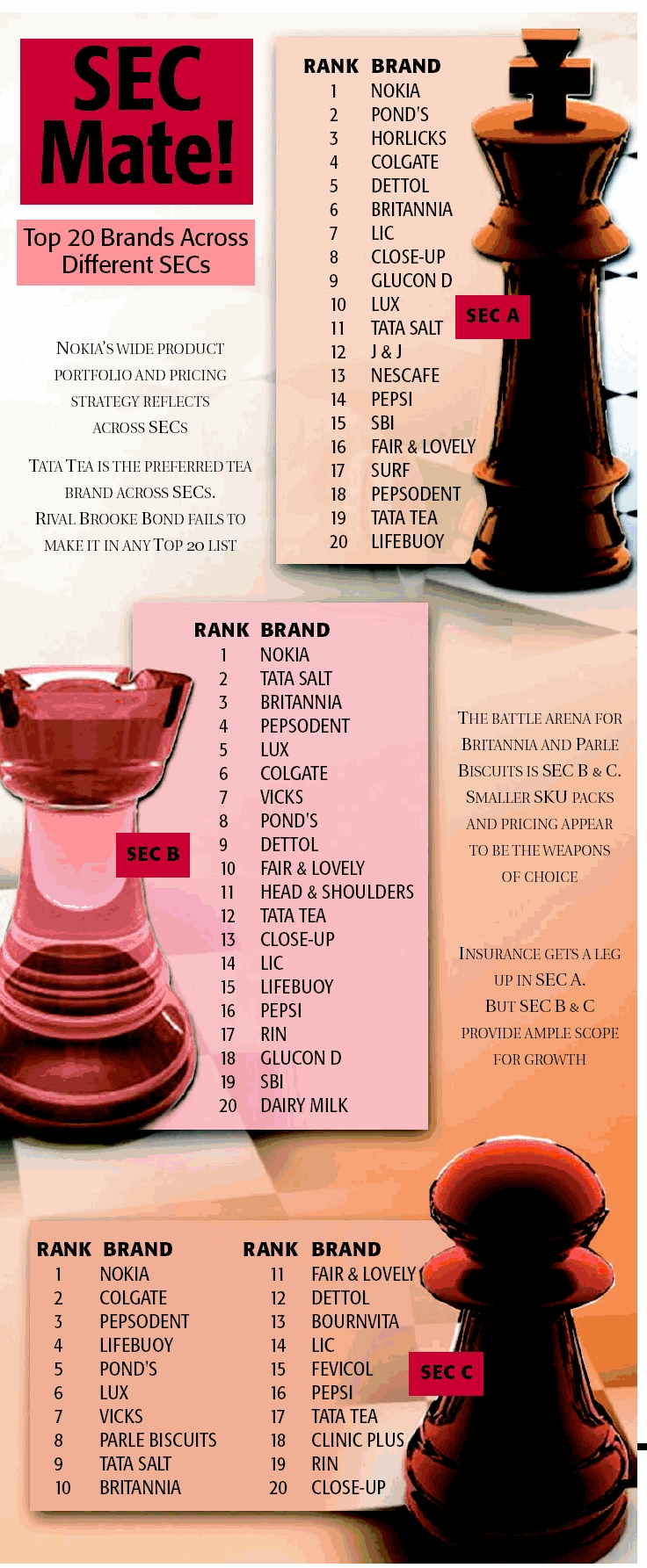
    I think Nokia’s climb to the top has been mainly because unlike the poor toothpaste, its not a single product or even single service/utility (oh come on, it easily transcends  a pure play communication device, its also a camera, a music player and so on). This not only heps it give different USPs to different kinds of people, but also helps them in communication (to appeal to different kinds of audiences across SEC categories).

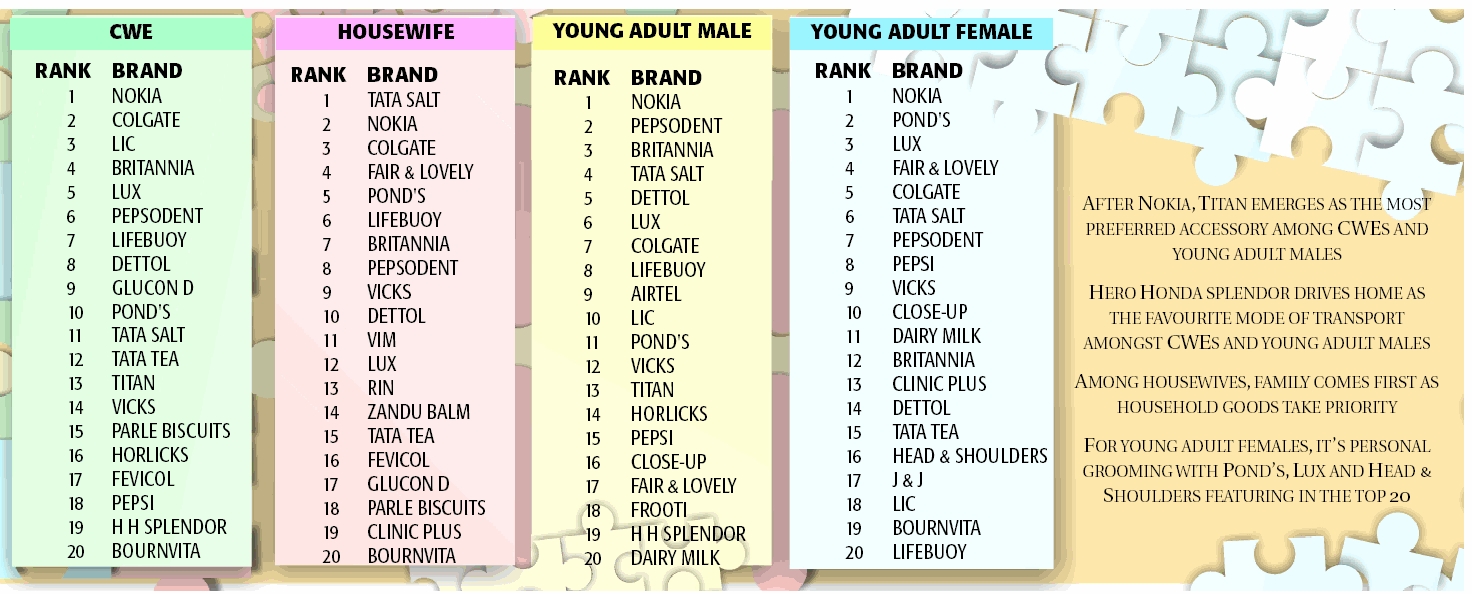
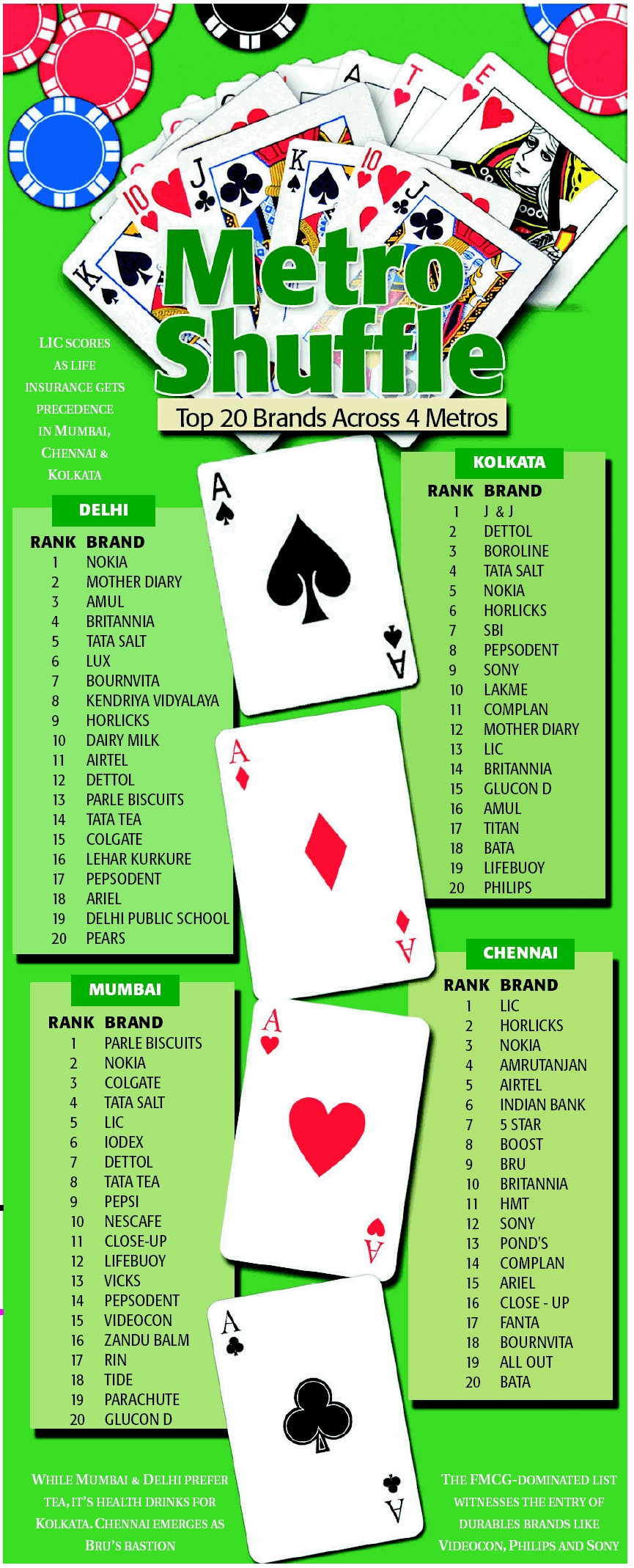
    Speaking of SECs, here are the results based on income, SEC and respondent type, and by metros

    Other than trivia like the fact that Fevicol doesnt have a mazboot jod with SEC A and the ones mentioned in the image itself, the lists in the SEC split seem to be just a reworking of the top 100 order. As far as the income split goes, quite understandingly the income class below Rs.2500 are in a lot of pain. What else explains Crocin’s jump from #81 in the top 100 list to #10 (okay, bad one 🙂 ) You know, these lists would make one think that this is one of the most hygienic and healthy countries in the world, look at the number of personal care and cleaning products and health+ food brands out there. Sigh, now if only trust would lead to usage 😉 In the ‘respondent type’ list, its amusing to see ‘Fair and Lovely’ at #17 in the young adult male list. 🙂

    Its interesting to see education occupying two spots in the Delhi list, the top three brands in Kolkata having something to do with the skin, Mumbai having a cleanliness fetish, and Chennai not having it (must be the water problems). Yes, I am glossing over, but a detailed look will take time 🙂

    Meanwhile, Brand Equity has also given the methodology in selecting brands. A couple of thoughts on this. Considering that we’re hunting for the most trusted brands, shouldn’t we also have a media category (all media, or is it a problem because of possible bias allegations?) When do things like retail chains (CCD, Big Bazaar, FoodWorld), familiar brands like say, Levis and gang, India Post, Indian Railways, IRCTC etc make an entry? And i know this won’t happen any time now, but will computer (hardware manufacturers as well as things like Windows/Linux and entities like rediff) make it into the top 100 list in at least 5 years?

    Meanwhile, I really don’t see anyone being able to challenge Nokia, unless simultaneously, a telecom brand (service) really becomes a pan india player (is already there) with excellent service and other mobile manufacturers give Nokia some really tough competition. The other possibility is when public utilities like power, water supply etc start having private players (not in an infrastructure capacity, but as a branded utility). Whatcha think?

    until next time, in brands we trust

    All images are courtesy Brand Equity, the Economic Times dated 11th June 08

    Update: Guess who makes it to the top in the US.