We’re nearing the day since the last time I stared at mortality – 3 years ago. And almost 5 years since I faced my own. To be honest, while I was going through it, I really didn’t think of it that way. From advising D on picking cabs from a certain direction (because of roadwork) to calming down the cab driver when he realised what was happening, to ‘checking in’ on Foursquare before the procedure, I still felt it wasn’t time. I think only idiocy or youth makes one capable of that, and given my age, it was clearly the former.
Cut to today. As if the daily exercise regimen wasn’t reminder enough, the quarterly medical checks drive home the point of how much extra work one needs to do to live even a semblance of life as one wants it. It’s not much really – a little bit of red meat, a little bit of alcohol, dessert once in a while. It shouldn’t be this difficult before hitting 50!
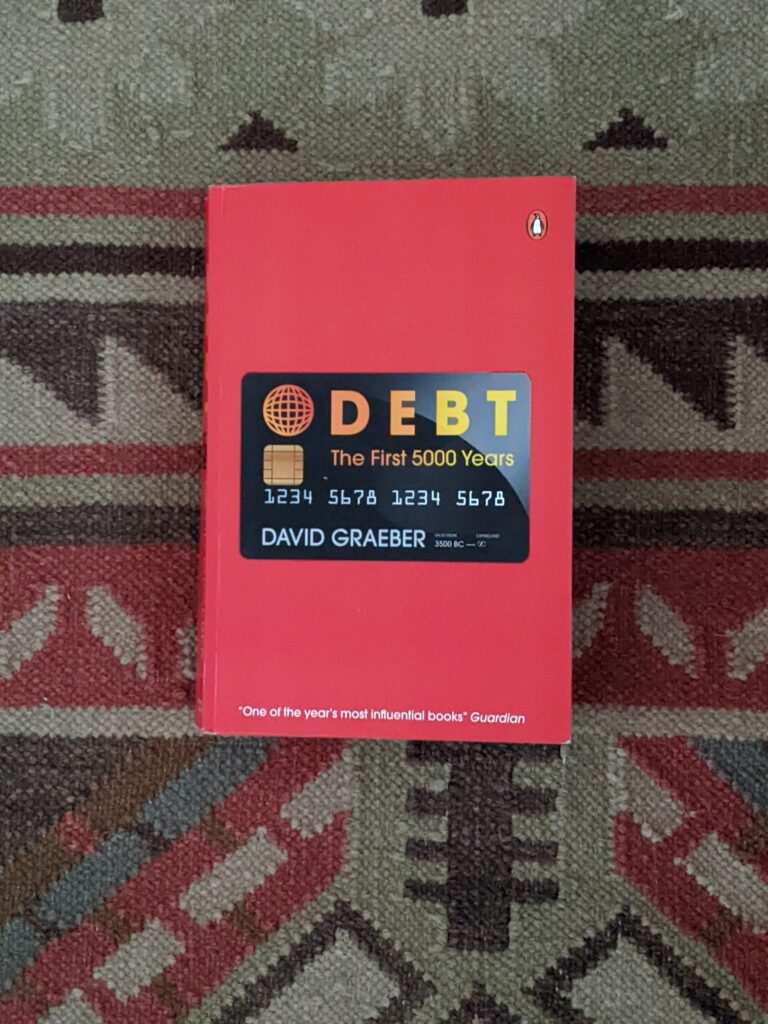
If it doesn’t upend deeply held beliefs and origin stories, it isn’t really a Graeber book! The story goes that from money came debit and credit, but in Debt, he argues, with excellent evidence as always, that long before money came into the picture, we had ‘human economies’ which were imprecise, informal, and had a community-focused and shared ecosystem approach. An ‘everyday communism’ in which people owed favours to each other. And then the favour was converted into a mathematically precise entity, mostly thanks to the machinations of war, and sponsored by the state. Cash, barter, and every other method of financial transaction came later, and began exclusively for scenarios where there was low trust. Debts cannot be stolen, gold and silver can. Favours are relationships. Debt is a transaction. And thus ‘the history of debt is also the history of money’.
He begins with the morality of debt and the paradox of two popular views – paying back what one owes is moral, and lending money as a habit/profession is evil. In the fantastic section on ‘primordial debt’, he traces the cultural narrative of humans owing debts to the God who created them, and how sacrifices were a means to try and pay a debt that could never be repaid. People also owed a debt to society in general, and governments became the custodian of it.
Using evidence (or the lack of it) he shows how the common story of barter leading to a common currency is a myth and that it stemmed from a narrative of ‘the economy’ that was ‘separate from moral or political life’. Barter is a very recent phenomenon, and the correct order is actually credit systems (‘virtual money’ – not to be confused with digital!) – money – barter. And when money came into the picture, it served as a yardstick – of debt. A coin was an IOU. And one that the state was interested in because they wanted uniform systems of weights and measures across their kingdom. He proposes that there are three moral principles on which all economic relations are founded – communism (or love if you don’t want to sound political), hierarchy, and exchange. The first was based on expectations and responsibilities from/to each other. Then there is exchange based on equality and reciprocity (these don’t lead to a ‘market’). The hierarchies, over a period of time, formalised inequalities into castes and related customs and behaviour.
In early civilisations – India, Sumer – there were ‘primitive money’ mechanisms, such as the ones which were used to arrange marriages, resolve blood feuds ans other social interactions where there was a debt, but which was not easy to quantify. It was common for people to get into levels of debt that forced them/their family to get into ‘peon service’, which resulted in slavery. But they could work their way out of debt. Also, early kings did a reset on a regular basis by canceling all debts. But when violence got into the picture, things changed. War converted ‘human economies’ into ‘market economies’. In war, a person ‘owes’ his/her conqueror his/her life, and the conqueror can extract anything he wants. Humans became slaves, a commodity that could be bought and sold. To be a slave was to be ‘not free’ and in debt, forever.
All of this last part began in the Axial Age (800BC to 600AD) when markets first started appearing as a side effect of government administration. But this soon got mixed up with war. When wars abounded, being a soldier became a profession. Coinage was a way to pay these soldiers/mercenaries. Gold and silver were mined by slaves and/or acquired during a war, and states started insisting that they serve as legal tender for all payments. A sort of ‘military-coinage-slave’ complex. This was the time that coinage was invented. First by private citizens and then appropriated by the state. Alexander was apparently responsible for killing the old credit systems. Precious metals, owned by temples and rich people thus far, started making its way into the life of common folks.
In parallel, historic all-time greats such as Pythagoras, Confucius and Buddha co-existed (with little knowledge of each other) and humans started reasoned enquiry into the nature of things, and practically every major religion in the world was born, trying to find new ways of thinking about ethics and morality. They rejected the violence of politics, and tried using the knowledge from impersonal markets to create a new sense of morality. But except in China, religion and market couldn’t stay together for long. In the Middle Ages (600-1450 AD), when old empires collapsed and new ones began to form, hard currency began to be less commonly used, but the system of accounts and credit continued to be used. Even Europe did not revert to barter. And elsewhere in the world, new financial systems and instruments began to emerge – promissory notes and paper money (China, where the empire survived), and letters of credit and cheques (in the Islamic world). The roots of most of the worldview in finance can be traced back here. First, China’s less-than-appreciative view of capitalism. ‘Merchants were greedy and immoral’ and ‘if kept under careful administrative supervision, they could be made to serve the public good.’ There is a very interesting part about Buddhism turning to high-interest loans and altering debt-contracts to fuel its expansion! In the Islamic world, the merchant was a respected figure, pursuing honourable adventures in far lands, sealing transactions with ‘a handshake and a glance at heaven’. Despite this capitalism in its current form didn’t emerge there because the government was kept away from the markets, and the merchants ensured profits were the reward for risk. Guaranteed returns (fixed rates of interest) were a concept frowned upon in Islam. Interestingly, over in Europe, this was when Roman law was revived and ‘interest’ began to be seen as ‘a compensation for losses suffered due to delayed payment’. It was also when the Jews started getting a bad rep for charging high interest rates. Interesting side journeys include the Crusades as a way to create new markets, and Shakespeare’s ‘Merchant of Venice’ being a guilty projection of terrors directed the other way around.
We finally get to the Age of the Great Capitalistic Empires (1450-1971 AD) – the Atlantic slave trade and the mining of gold and silver in the Americas, which was mostly used to trade in China, India and the Far East. This prompted the return of the bullion economy and the emergence of Italian city-states which ignored the Catholic Church’s ban on usury and ultimately led to the current age of great capitalist empires. Also, a reemergence of military endeavours – ‘when Vasco da Game entered the Indian Ocean in 1498, the principle that the seas should be a zone of peaceful trade came to an immediate end’. In the Axial Age, money was a tool of the empire. When the latter collapsed, the former went with it. But now, money was autonomy and political and military powers were reorganised around it. Municipal bonds were first introduced by the Venetian government as a way to levy a compulsory loan on taxpaying citizens to fund a military campaign. It promised 5% annual interest and these bonds were negotiable, creating a market for government debt. The beginning of paper money in the Western world. But it was the creation of the Bank of England in 1694 and its bank notes that truly made paper money mainstream.
In 1971, Nixon announced that foreign-held US dollars would no longer be convertible to gold. And that was the end of the gold standard. Since then, American imperial power is based on a perpetual debt – a promise to its own people and nations across the world! Fiat money backed by public trust. When it needs money, it prints it! And the premise that some of us have to pay our debts and some of us don’t.
Thus, a book that has world history, religion, the state and the military, and yes, the origin of money. It isn’t as though I can absorb or understand all the contexts and perspectives that Graeber offers in his books. But I read it for three things – one is that he provides view that is starkly original, different and thought-provoking as compared to prevalent narratives, the second is that his research quality is so good that even though I may not comprehend everything, there are bits that are amazing information/insights, and the third is that is that he is incredibly empathetic and earnest about how things should be better for everyone.
For a while now – since 2010, I have felt that the nation state (or notion state really) is a shared mental model which is nearing its expiry date. But like other intersubjective realities (money, god), we are reluctant to let go of it. That’s why I found it interesting when Aakar Patel spoke about how nation states are quite inefficient.
It’s quite true. All you need to do is think about the movement of people and objects and you’ll figure it out for yourself. And while the state has begun using things like Aadhaar to increase legibility about its citizens , and thereby increase efficiency (and further nefarious interests), it is advancing at incremental levels, while the world is moving exponentially.
Not to mention that the nation state is an instigator and participant in one of the most net-negative things humanity has been continuing – wars! And these days, it’s not just the ‘simple’ human conflicts any more. In the digital space that we spend a lot of time in, and in which we have created identities, state surveillance and deliberate offences using things like ‘zero days’ against its own citizens and enemy states are all contributing to equal if not greater retaliation. In fact, this can actually lead to physical losses too thanks to hacking of power grids, nuclear facilities, healthcare systems and so on.
So how is this glorified middleman holding on? I think a big reason for the popularity of the nation state is the sense of identity it fosters. Along with religion, nationalism continues to be a superpower. The line on paper is strong even if culture ignores it. Think Delhi and Lahore vs Delhi and Chennai.
However along came the internet, which has a way of disposing inefficient middlemen. It has massively accelerated the geographical movement of ideas, and increasingly that now includes identity. As Fukuyama points out in Identity, as we moved away from agrarian societies with a strict hierarchy to technology-driven societies with multiple social classes, pluralism, diversity, and choice emerged and identity started becoming increasingly complex. By early nineteenth century, there was a fork – universal recognition of individual rights, and collective recognition. Arguably, Fortnite and LGBTQ rights can increasingly unite people more than a national flag does.
However, given that the internet has destroyed many things without finding a remotely appropriate replacement, I also began to think of a ‘for’ case. One other relevant intersubjective reality we can learn from is money. In the case of money, once upon a time, different geographies had different systems. Vulnerability in one was of less concern to another. But now, it’s all interconnected, and thus fragile. Even in a nation state dominated system, covid just took over the globe and in addition to lives, had a telling effect on the economy. No country was really spared. So it’s important to ask what would happen if no barriers existed. Is it always good to completely remove friction? There is more. Money is also dependent on the rule of law, and its enforcement by physical force – one of the tasks of the nation state. A big concern with crypto is this enforcement.
And to now expand this line of thought, what happens to governance? Many evils are kept on a leash because of regulation. Who is accountable for rights and duties of citizens? Minorities might not be in a great place now but without the pretence of the state that pretends to care for them, what happens? What becomes of those who are economically not contributing to the system – the old, the infirm, the less-educated and so on?
One thought is that there will be a replacement and it won’t be all binary. It will move in stages. For instance, money seeks efficiency too. And it is interesting that money itself, at least in form to begin with, is being challenged by the blockchain. On a related note, our lives are increasing moving into the digital domain, where the nation state’s borders are mostly irrelevant. This means the state’s playbook for regulation cannot be deployed automatically. The worry though is that all this might end up breaking things faster than we can find a replacement, even if it is a notional one!
When everything becomes image rather than action, you can’t judge the value of any act. You can only judge what it “looks like”. But when all of society is doing that, it means that you’re being judged on everything. After all, you may not always be acting, but you are always appearing. When it’s your appearance that determines worth, there is no moment to rest. There’s a social invasion.
Remember the early days of the pandemic, when we played alphabet soup with economic recovery? One has to be extremely optimistic to consider the much-touted “V” now, and there’s increasing consensus around “K”. There’s something subliminal about the former sounding like “we”, and the latter sounding like, well, K, signalling that we don’t care. And that’s why I began thinking of how those in the upper part of “K” are utilising their wealth. In addition to using it to create more wealth, that is.
I think there are at least two expansion narratives at play. One is seeking new “real” frontiers. This is a centuries-old pattern – the Americas, Silicon Valley – until geography has been tamed. We’re now on to “colonising” Mars. The metaphor is clear. The other is digital frontiers, where our time and mind space is being increasingly spent. Both are about escaping the confines of reality as we know it now.