
Tag: convenience

  • A convenient path to extinction?

    It has been almost exactly 4 years since I wrote Default in our Stars. I ended that post with

    A question I asked myself while writing this was, when there is no agency, what happens to morality? My own first answer was worrying – maybe you just become numb to life’s deeper questions because there’s always an algorithm to give you something you didn’t know you wanted. And that’s the panacea that this age warrants. And hence default in our stars, and an artificial existence.

    Sometime back, a comment on an advertisement I had shared on LinkedIn on World Suicide Prevention Day led me to think again on the subject. I had a bunch of thoughts, and after I had framed it myself, I took the help of everyone’s favourite assistant to break it into byte sized points.. Given my (lack of) expertise, it’s a reach, but I love my curiosity. 🙂 So here we go, picking up specifically from the point of societal impact – reduced interactions, as algos increasingly recommend everything.

    1.  Human Interaction Decline: Before the Industrial Revolution, getting things done required relatively more human interaction. Since then, it has been declining. From real marketplaces to supermarkets to telephone operators to a faceless internet and so on. 

    2. App-Driven World: Now, apps have taken over many tasks that previously required a human touch — answering a question, booking a cab, planning vacations, ordering a meal, buying from the local shop — are all done with increasingly reduced human involvement.

    3. Command & Gratification: Apps obey without asking for explanations, giving us control and instant gratification. “Click to order”. In parallel, social media provides gratification through validation – likes, comments etc, again something that formerly happened only IRL

    4. Centre of the Universe Mindset: This on-demand gratification makes us feel like the centre of our own universe, where every gratification is possible and tailored for us, fast and friction-free. A perception that everything is my way on the information highway.

    5. Human Interaction = Tedious?: As human interactions inherently involve alternate perspectives and unpredictability, they can seem more ‘tedious’ in comparison to seamless app transactions.

    6. Natural Selection’s Role: Here’s where natural selection comes in. Entropy is relentless, and the one force that is equally relentless in trying to stop it, is natural selection. Evolution thus tries to increase order in successive iterations. That’s also how humans got here.

    7. Tech’s Push for Efficiency: In general, app interactions are more predictable than human ones, aligning with this drive for less entropy. For instance, Urban Company/Uber have automated much of this already, helping us choose predictability and efficiency over complexity in daily transactions. 

    8. Tech & Relationships: Something I missed in the original post is another connection between biology (nature) and tech. In their book The Molecule of More, Daniel Z. Lieberman and Michael E. Long describe two kinds of relationships. “Agentic” relationships orchestrated by dopamine – formed to accomplish goals, very purpose-driven, and in contrast, “affiliative” relationships – formed for connection and enjoyment, driven by oxytocin. We all know the connection between tech and dopamine, and that’s probably why we are increasingly pushed to transactional agentic relationships.

    9. Blockchain’s Faceless Trust: So, where is this going? As D pointed out when I chatted with her on this, blockchain takes this further with its “faceless, trustless” system of certainty. It’s arguably the next step in reducing unpredictability.

    10. AI and the Future: AI, despite its hallucinations, will likely bring even more predictability in both outputs and outcomes. But what does that mean for our place in this increasingly transactional world? Honestly, I’m still figuring that part out. 🤷‍♂️

    The WEIRD mindset has moved beyond its original strongholds and is becoming increasingly dominant across the globe. Money, society’s favourite currency, demands it. Munger has famously said “Show me the incentives and I will show you the outcome“. It is ironic that at a species level, there might be a desire to survive, but that, at an individual level, the WEIRD penchant for autonomy and predictability is overriding it. Natural selection will have no qualms about its means of reducing entropy coming at the cost of an entire species.
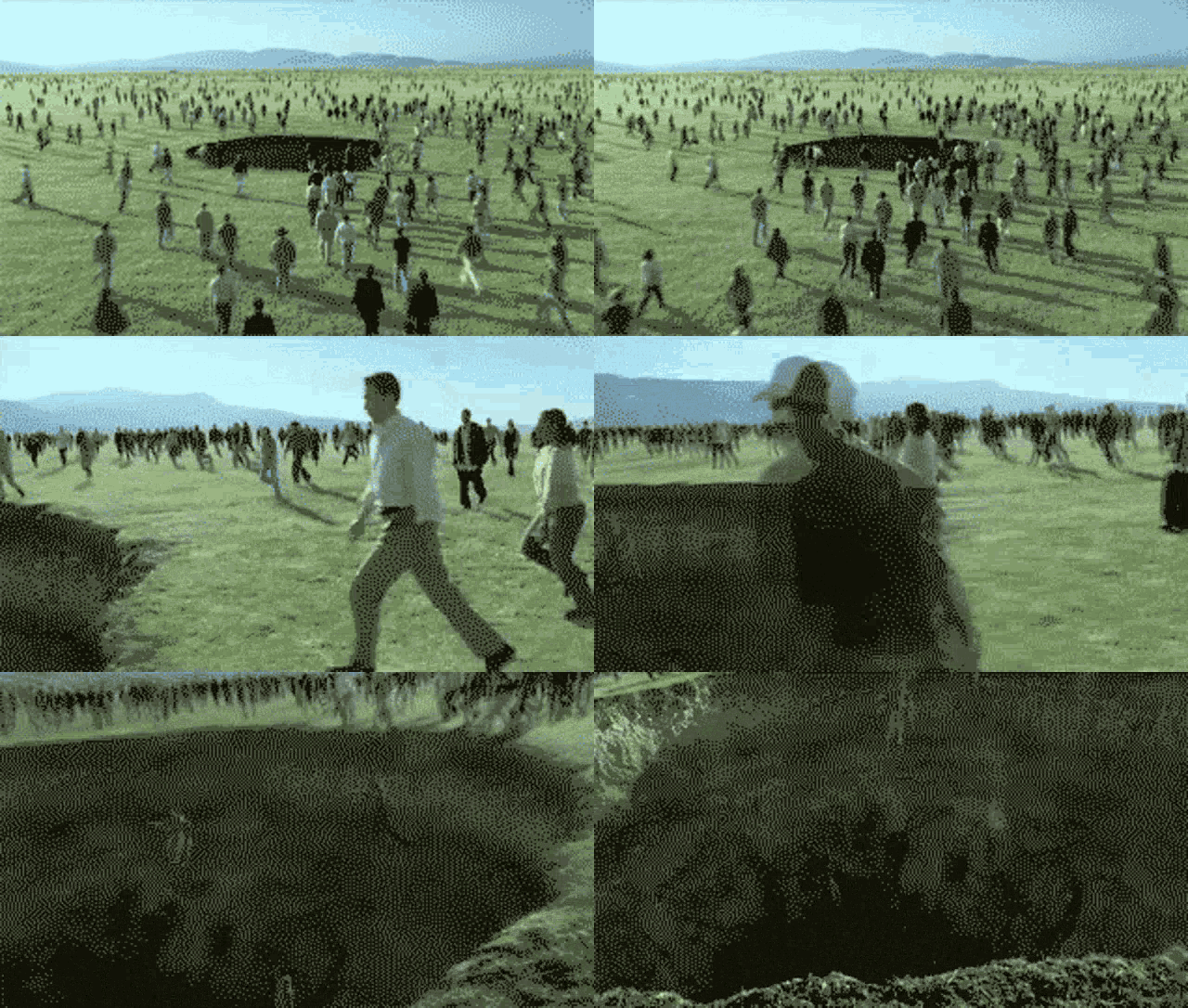
  • An IG Story*

    *Cheap thrills: Instant Gratification Story sounded less cool

    More than half a dozen years ago, in a Guardian article with bullet points fired against Powerpoint, Andrew Smith astutely noted that ‘In this century, it seems to me, our greatest enemy will not be drones or Isis or perhaps even climate change: it will be convenience.‘ We are now so deep into the convenience era that this would be met with ‘What’s wrong with convenience?’ Dennis Perkins, in a Vox article on video stores, had provided the answer – ‘The victim of convenience is conscious choice.

    I was reminded of this by the venture capital funded ‘who can deliver grocery fastest?’ pi**ing contest happening on Indian roads. I don’t know about the rules of venture capital, but road rules are definitely being rewritten by the delivery boys. Wrong-side riding, simultaneous road-screen navigation and so on. But that’s a whole different story.

    This is not just an India phenomenon. In its 2022 Media trends report, Dentsu has at least two points covering it – Omnichannel Everything (p9) and the Bring-it-to-me economy (p11). From Netflix to grocery and every consumption in between, these two trends rule.

    As Kavi notes in It’s too soon to say, our priorities are increasingly immediate over long-term. In everything from company results (QoQ) to bulking up with steroids to climate change. In a subsequent post, he continues this line of thought of us over indexing speed and time, and notes that this comes at a cost (and provides a useful framework to evaluate this for self). Intentionality is key, and this aligns well with my thoughts in the context of freedom.

    In a previous post – Default in our stars – I had written on the journey from Netflix’s Shuffle Play to the surveillance capitalist creation and exploitation of our behaviours. On the way, there are effects at an individual and societal level, including the loss of learning and the faculty to create and debate shared understandings.

    Increasingly, the convenience-based thinking and decision-making wiring that powers instant grocery delivery has started manifesting everywhere else. Politics was something I had pointed out around 4 years ago – In Other Fake news. As nuance does a speed-walk towards extinction, everything from the side you choose on Kim vs Kanye to pro-vax or no-vax is an us-vs-them all-out war. This is the meta level play of what Farnam Street calls The Small Steps of Giant leaps. Small choices on small things gradually removing the ability to think independently, form a point of view, debate it out with those who offer a counter-opinion, and replacing it with easy heuristics on which side to choose. When I think about how our species has advanced because of planning, sharing ideas, and finding ways to work towards them, I wonder if these are in some way the Chesterton fences of the mind that we are systematically removing.

    A related effect is the increasing inability to even conceptually think in years and decades. This has a disproportionate impact on two of the most important areas in life – health and wealth, or rather Insta-slim and Insta-rich. The unfair advantage of being able to think in decades on both is unfortunately lost to vast swathes of people once the instant gratification wiring takes hold. To quote from Farnam Street again, we win the moment at the cost of the decade. What’s more, one of the main ways to get this perspective – acquiring knowledge if not wisdom from those who have spent the time and effort isn’t spared either – we have 15 minute book summaries too. Zooming out, I wonder how much of narrative control we have already ceded.* How will one ever know!

    While cause and effect are still hazy, in my mind there is indeed a correlation between this instant gratification and being on stage and under scrutiny all the while. The mirror has been replaced by a selfie camera, and you can imagine what that would do to reflections!

    *Related Read: Because your algorithm says so

  • Default in our stars

    The thought first occurred to me a couple of years ago, when I realised that thanks to outsourcing and automation, we would struggle today to do many things that were once life skills. We also lost a little more than that – learning.

    Sometimes directly, and sometimes, through the interactions with the world, they facilitated a learning experience that taught one how to navigate the world and the different kinds of folks that made up its systems. 

    Regression Planning

    It was continued with a bit more specificity in a subsequent post.

    Instagram, Facebook, Tinder, Spotify, Netflix, Amazon – everything is a feed of recommendations, whether it be social interactions, music, content or shopping! Once upon a time, these were conscious choices we made. These choices, new discoveries, their outcomes, the feedback loop, and the memories we store of them, all worked towards developing intuition. 

    Intelligence, intuition and instincts. The journeys in the first two are what have gotten the third hardwired into our biology and chemistry. When we cut off the pipeline to the first two, what happens to the third, and where does it leave our species?

    AI: Artificial Instincts
    (more…)
  • In other fake news..

    Went by the title, did you? Ha! This is less about fake news, and more about what could be called its second order effect. In Against Empathy, Paul Bloom writes about how many beliefs are not the products of reasoning, and gives sports teams fans and even political support as examples. He also brings up the point that these views don’t really matter because of the minimal impact one person’s belief has on the world at large. The contrast offered is one’s everyday morality that affects those around. He goes on to say that because of this minimal impact, we should look at people’s views on global warming, health care etc in the same light. The difference between truth and their views does not really matter because it doesn’t really cause a huge impact. To be fair, he is not happy writing this. I wasn’t really happy reading it either, because I saw at least one horrible exception – think personal hygiene values (“I won’t use a deodorant because.. global warming”) and you’ll get the picture. That definitely has an impact!

    But moving on, he also explains how people are capable of rational thinking on things that matter. This is where I differ. I am not denying that people are capable. They probably begin that way, but I think the capacity is lost over time. Why do I think so? (more…)

  • No help for it

    No, not the help. A different kind of noun.

    Reflecting on a few recent events, I realised that we are capable of providing different kinds of help.

    There’s the help that we think we can give. It’s the story we tell ourselves so as not to make ourselves seem unkind or miserly with respect to our self image. It’s convenient, and we don’t really lose much on this, except..

    There’s the help we want to give. A part of our mind knows we should probably be doing more. We tell ourselves a story to make up for the deficit – “but that other thing we want for ourselves is something we really need“. Besides… (more…)