• The Future of Owned Media?

    Tech Crunch had a rather funny take on why Bezos bought the Washington Post, but the more thought provoking piece was on the Post itself. (via @nixxin) Its premise was that the predictive analytics perfected by Amazon could be used to provide Post subscribers with personalized news feeds based on where they live and what they have read before. People browsing The Post’s Web site or tablet app could be served ads tailored to their past purchases, and then could buy products with a single click. Ironically, the last paragraph actually ends up validating the TC post. 🙂

    It reminded of an earlier post of mine, in which I had wondered about the future of media in a social era, and though I did not use the words, asked whether a ‘marketplace’ kind of model for news creators and curators was possible. To be honest, I was still skeptical whether a business model could be worked out on this line of thought. But the entire WaPo purchase by Bezos, the subsequent discussions on the web, and this fantastic article at Forbes that brings out the radical shifts in management required for a firm to thrive in ‘the creative economy’, set me out on a new direction.

    Media and advertising, like I mentioned in the earlier post, have had an intertwined life. What if media cannot now exist as a business on its own – the primary reason being that the value it provides -news -is being disrupted by technological innovations including self publishing tools? Does it mean that  its role now has to be seen within the context of a larger business? We’re already well into the paid-earned-owned media cycle, and while paid is arguably on a decline, earned is now increasingly being controlled by the platforms. (FB’s Edgerank, for example) Does it not make sense for a firm to make relevant news part of its product offering, or part of a sales process? Of course, the dynamics would work different from a merchandise marketplace, but if news is a commodity, can’t its vendors be on a marketplace? Media corporations might not be able to sustain a business model with high overhead costs, but journalists could build a reputation and thrive, and the marketplace would decide their price!

    The WaPo purchase is probably just another kind of vertical integration. Much like an e-com company India would build its own logistics or payment gateway and then even white label it, the far-sighted Bezos might have just taken the first step in evolving owned media in a scale and direction no one has ever thought of before. Journalism has mostly been subsidised by commerce – I’d say this is just another evolutionary necessity.

    until next time, to each his own media..
  • Fenny’s

    This review first appeared in Bangalore Mirror.

    Fenny’s is almost opposite Raheja Arcade in Koramangala, on the third floor of the building next to Food World. They have valet parking, and those with a more modest and lesser set of wheels can park in one of the many side lanes and walk it up. The map and menu are at Zomato.

    The word ‘Fenny’ (though usually spelt feni) can mean different things to different people depending on what happened after they consumed it, but there would definitely be a Goa connection. So it is a bit funny that a restaurant named Fenny’s does not serve Goan food. But the owners clarified that the name symbolised a connection in spirit to Goa, further emphasised by a tagline “Happiness Everyday”. This was my third visit here, and I can confirm that the lift is most definitely a slice of Goa. It moves at its own pace, rocks, (though more in an effort to mimic waves) is mostly crowded, and starts and stops exactly when it wants to. But much like Goa, the niggles take a backseat as soon as you enter the place. The menu is a mix of Mediterranean and European, and is backed superbly by an ambiance and décor that’s probably one of the best around, and manages to easily transport you way out of Koramangala.

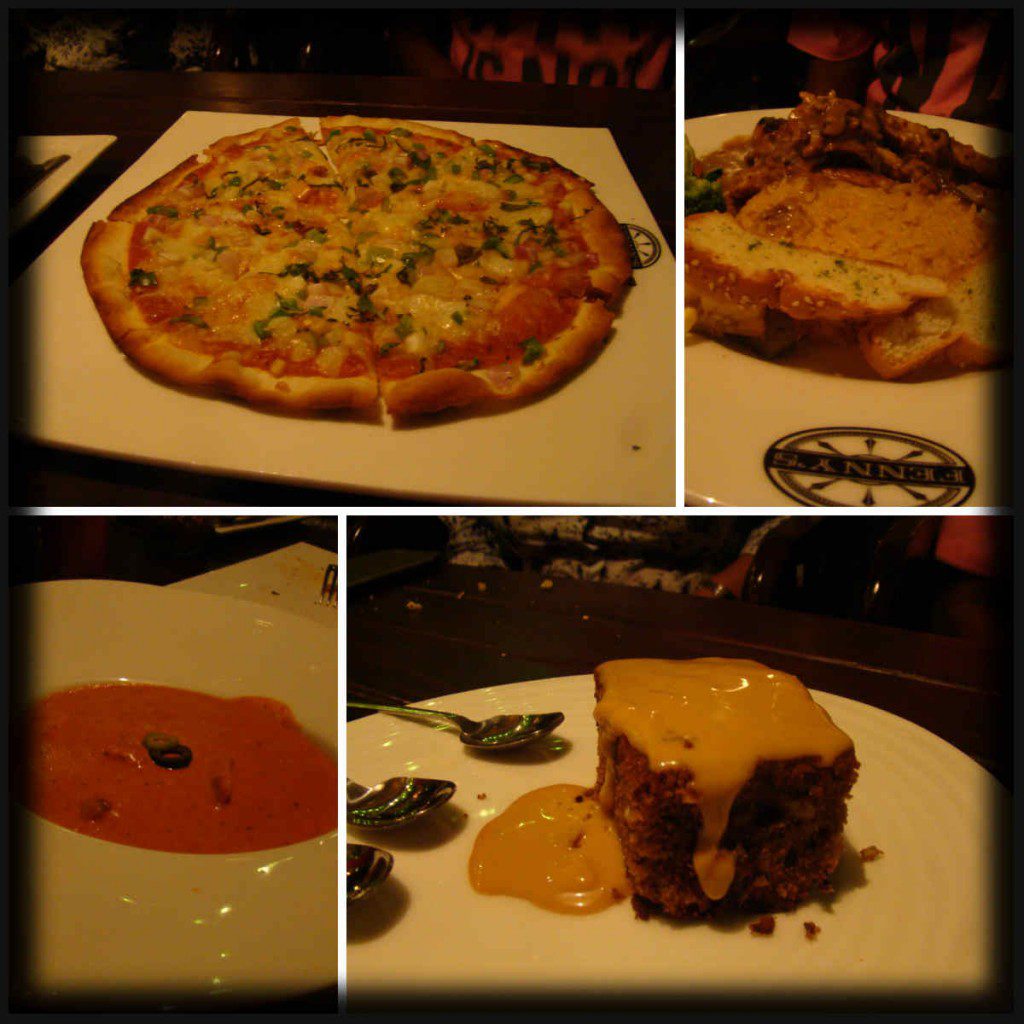
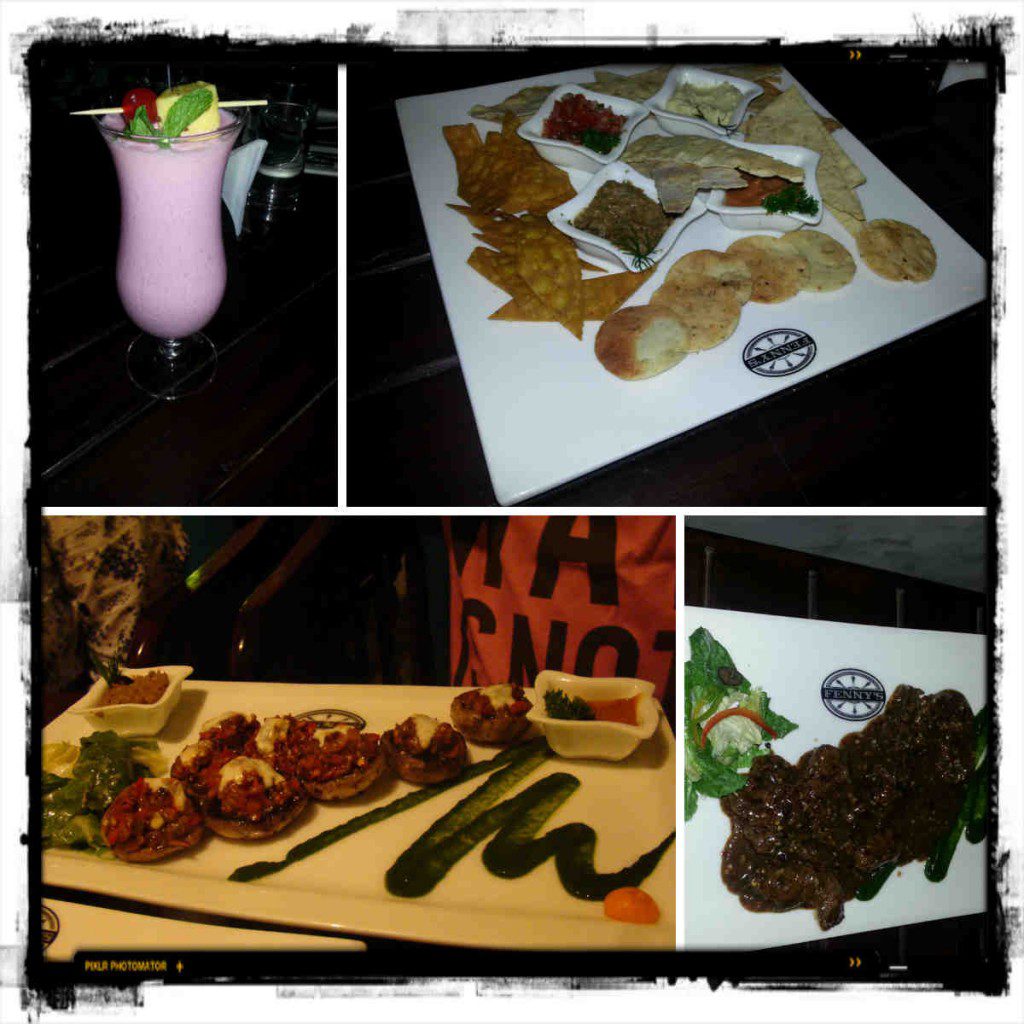
    We began with the Basil Bell Pepper Soup – the tomato overshadowed the bell pepper, but we enjoyed it courtesy the spicy flavour and a dash of tang. The Crispy Ola Breads with Fenny’s signature dip turned out to be four standard and largely unimpressive dips including salsa, Baba Ghanoush, and Hummus. The Peri Peri Mushroom was easily a better veg starter – grilled mushrooms with a vegetable stuffing and mildly spicy Peri Peri sauce. The Devil Beef Chunks had tender meat with a spicy sauce that also had chilli flakes in it. We also found this sauce’s cousin in Fenny’s Paprika Chicken, but it was spicier, fairer in complexion, and tastier as well. From the drinks section, we tried the ‘Dom’my Gun, which was unfortunately dominated by a guava flavour that mercilessly gunned down any taste of the vodka or the Fenny’s Special Mix that might have existed. You are more likely to have a better chance of success with ‘Vicky Donor’ -the other cocktail we tried – with its good mix of lime juice, vodka and spicy green chilli. But the winner proved to be the mocktail – the creamy Strawberry Delight, which also had pineapple, orange and cinnamon playing support.

    In the main course, the Fiery Hot Vegetable Pizza arrived first, and despite the double adjective, needed some assistance from chilli flakes to make it truly worthy of its name. But that didn’t take away from its awesomeness – crisp onion, bell pepper, chilli and mozzarella cheese proved to be a great combination. The Supreme Chicken with Mushroom Sauce gave us a sense of déjà vu – except for the abundance of mushroom, it was a near replica of the sauce in the starters. The rice that came with it was boiled a little more than it should have, and the dish was soon neglected. Another dose of déjà vu – though a milder one – appeared in the form of the Fish Grand Milano. But though it was reminiscent of the soup, its spicy, creamy nature soon stopped comparisons.

    We didn’t have much of a choice in desserts – the only options were a Chocolate Mousse, a Brownie and a Sticky Toffee Cake with Butterscotch sauce. The last one screamed for attention and got it! Richly deserved, I must add. It was moist, with an excellent texture and the rich butterscotch sauce complemented it beautifully. If it wasn’t closing time, I think we might have ordered one more!

    Fenny’s has managed to create a fantastic setting in the middle of Koramangala. The food is quite good, though in some cases, the portions are arguably small. They also have an interesting bar menu; all of this explains the increasing buzz about, and in the place. You’re better off reserving a place, especially on weekends.The music was a little louder than we’d have liked but is not really a conversation stopper. The service was prompt and helpful. The person who took our orders was really good, and the only spoilsport was another member of the staff who almost dropped our main course all over us and didn’t even bother to apologise! With a cuisine that’s not very common in this part of Bangalore, and an amazing ambiance, it’s probably only the lift that holds it back from reaching greater heights! (As you might have guessed, I did get stuck in it!)

    Fenny’s, 3rd Floor, 115, 7th Block, Koramangala, Opp Raheja Arcade, Ph: 080 65658000

  • The narratives of our lives

    This wonderful post at Ribbonfarm got me thinking about places as narratives. Specifically, it reminded of something I wrote a few years ago on the subject – Watermark. The conclusion of the post that got me thinking was this – The space we inhabit is more topological than ever as we locate our positions within networks instead of maps and this may be the most true narrative about the present age: No matter where in the networked world we’re coming from or traveling to, we’re already there.

    Indeed, places were probably the earliest narrative that existed – in our early days as a species, we probably didn’t move away much from the place we were born. As civilisation evolved, I think many more institutional narratives were added – religion, nation, culture, and so on. In the era of consumption, even brands (media and otherwise) have attempted to invade the space. For example, in our own lives, there are many narratives that we consciously or otherwise become part of – the kind of books we read, the music we listen to, the movies we watch – in short, popular culture. Each generation has its own set – from Ramayan on TV to Facebook.

    Sometime back, I had written about the internet being the zeroth place – the one that supersedes all the other places, including the physical ones, in our life. Especially with a social layer, it has the capability to accommodate all our narratives – individual and societal. The Ribbonfarm post talks about how the default nature of the digitised era is to store, and no matter how much data our society manages to produce, we’re even better at finding places to keep it. In that sense, it isn’t just geography that the internet seems to have removed as a driver, but time itself. The other day, when I was reading The Confusion, I happened to read a post from 2005 which summed up how I felt about The Baroque Cycle in general. Yes, I tweeted about it. 🙂 But I still can’t be sure about the evolution, and wonder if the abundance of storage might drive us to consciously seek out ways where the information will not be stored. eg. the rise of Snapchat.

    I have always felt that narratives are a way to fulfill our sense of belonging. Across time, this role has been played by several entities. The internet has made it possible for even the smallest of niches to have its own narrative. Where does it go from here?

    until next time, comment on the narration? 🙂

  • This Time Of Morning

    Nayantara Sahgal 

    The books set in the era after independence (that I have read) have mostly dealt with partition and its aftermath. This one is different because it is set in a later period, but one that captures the challenges before a nation and its people. People who have had to change from being freedom fighters to bureaucrats, politicians and ordinary, but free citizens who all have to play a part in nation building. People who know they’re being watched by others across the world as they set about laying the foundations of a country.

    As a member of India’s first family in politics, Nayantara Sahgal is very well suited to write this tale. The anecdotes on Gandhi, the notes on Nehru’s room, all add to the authenticity of the narratives. Though we begin to see India through the eyes of Rakesh, a foreign service officer who returns to the country after six years, a long list of characters soon appear – bureaucrats, politicians, and their families, all of whom have to cope with the changing landscape.

    The book offers a view of the early stages of corruption that’s now an epidemic in India – when industry meets bureaucracy and politics, and a new generation of politicians, who have had little role in the freedom struggle, suddenly get their taste of power. An older set is forced to watch vested interests take precedence over morality and integrity. Power struggles and manipulations among them are interspersed with cultural clashes between generations and outlooks, providing a wholesome snapshot of an era.

    With so many unique characters, whom the author uses to provide perspectives on various facets of life and mindsets in that period, I did feel that a longer story was needed to do justice. The narrative of a few characters seemed to have been cut short purely for some kind of closure before the book ended, and the hasty conclusions sometimes worked against the hard work done thus far. But yet, it is quite a good read, especially because it is set in an era which is rarely talked about, or understood.

  • That’s the plan for now

    This ‘what could have been’ post on FB Platform and the broader theme of ‘move fast, break things’ made me think about planning – brand as well as business, how technology is reshaping it, and the fine balance that is required to ensure business growth goes hand in hand with retaining the trust of the ecosystem.

    Brand planning has always been an interest area, and I’ve had the good fortune of knowing a few brilliant planners, and learning what I could from them. Still continue to. A simple search would throw up a number of planning frameworks, and many of the fundamentals would still hold.  However, technology is throwing open more options in terms of manifestation/output. I found some good perspectives in this article which is about that CMOs can learn from technologists. The fundamental theme is dynamism. But such are the challenges that they remind me of We are trapped in our inadequate mental models ~ John Edwarrd Huth (via)

    I’d think that brand narratives are (also) shaped by the story telling devices at their disposal. As Mitch Joel points out here, the nuances of marketing vs advertising need to be understood as brands struggle to transition from the mass advertising era. One-way media allowed a linear flow, but current platforms demand flexibility, and customised rendition across contexts and platforms. If consumers are the new media, the stories should be ones that they can identify with, fit into their personal narratives, and therefore inclined to share.

    Many of the familiar narrative devices have focused on getting attention, but that is increasingly difficult. It’s not that ‘awareness’ can be ignored, but not only is it not enough, but attention for the sake of itself cannot work. I really liked this post (again by Paul Isakson) where he encapsulates the thought in the title itself Adding Value > Getting Attention. The > works not just as ‘greater than’ but also as ‘leads to’. Or, in other words, Be the Company Customers can’t Live Without.

    In a highly fragmented media and consumption scenario, how does a brand/business know what to focus on and when to shift from it?A wonderful blog I have discovered recently is that of Paul Isakson. This post, for instance, throws light on the need for the brand to stay true to its own story, and therefore focus on specific audiences. Another of my favourite posts focuses on something that I have always believed in and liked – the back story, and its relevance for brands. What we are today comes from our thoughts of yesterday, and our present thoughts build our life of tomorrow ~ Buddha

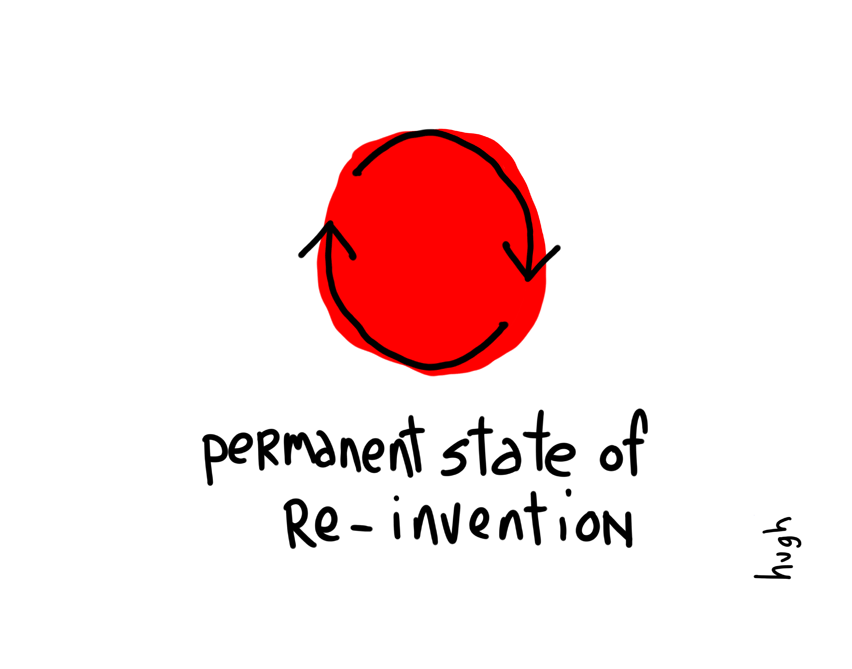
    To get there involves a cultural change, and tectonic shifts. I also think that this will force brands to think about scale. In a mass media world, a brand could get ‘reach’ by throwing money. That can still be done, even on social platforms, but when attention is not the only thing that matters, the challenge is to build relevancy and scale it – across time. That requires new planning frameworks, and possibly means a

    permanent_state

    (via)

    We started with FB, so let’s go full circle. Even as late as last year, there was massive skepticism around Facebook’s ability to adapt and thrive in the mobile space. In the last earnings call, they reported that mobile had contributed 41% to revenue. (read) It would seem that Facebook knew its story, what to focus on,  and stuck to it.

    until next time, refresh