
• Holmes Of The Raj

    Vithal Rajan 

    Similar to the other Holmes fan fiction I read earlier, (The Curious case of 221B –http://www.goodreads.com/review/show/…) this book is also set up on the premise of the author receiving hitherto forgotten papers of Sir Arthur Conan Doyle.

    The setting is late 19th century India, a crucial arena where ‘The Great Game’ was being played out. Holmes and Watson get involved in 5 cases set in various parts of India – Madras, Hyderabad, Delhi, Bombay, Nainital to name a few, and then return 25 years later for a swansong adventure. What is interesting about the book is the way the author weaves in historical characters and events, and shows a different perspective to discoveries and personalities associated with them – Ronald Ross, Ramanujan, to name a couple. And it’s not just science, but literature (Kipling, his character Kim and another that would serve an inspiration for Mowgli; Rabindranath Tagore) and sports (Dhyan Chand). The same trend continues for political events too, with Motilal Nehru, Lala Lajpat Rai, Lord Ripon all featuring in various storylines.

    What didn’t work for me was the narration and mystery moving away from the original Holmes adventures. Very often, the focus is on how Holmes and Watson had played crucial parts in actual historical events, and many a time, these seem a laboured fit. The book concentrates more on the cultural and political aspects of the colonial rule (with the Notes section providing enough evidence that the author has done a lot of homework) and tries to draw our attention to the kind of thinking and behaviour that laid the framework for everything that has happened since. Unfortunately, that means that Holmes and Watson are relegated to being props in a larger canvas. So, it would be good to set your expectations clearly before you start out. This is a commentary, and a very interesting one, on the socio-cultural ethos of the Raj. Regard Holmes and Watson as just another couple of characters, and you’ll do just fine.

  • Manufacturer, Market, Media

    Sometime last year at Myntra, we were having a planning meeting and everyone was asked for their take on the future of (fashion) e-commerce in a 5 year time frame. I confessed that I had no idea, and asked the group whether they had heard of 3D printing. Since this was before the hype machine went into overdrive, none had. My perspective was that if I could print branded merchandise on my own, what would be the role of an intermediary? (interestingly, I read something on a similar note more recently)   I have no idea how mainstream this phenomenon will become, but 3D printers are already being sold online by Staples and Amazon. eBay also has an app that allows users to buy custom goods from three of the top 3D printing companies. (via)

    There are multiple themes which we can explore from here – the augmented human, the collaborative economy and social commerce – to name a couple. But since these are fairly obvious and have at least been kickstarted on the blog, I thought of connecting this to my post from last week – the future of owned media – in which I explored the possibility of a media marketplace which is tapped by businesses to create, curate and possibly even market content that is relevant to them. The journalism that brands want subsidising the journalism that society needs. I hypothesised whether Bezos’ purchase of WaPo was a vague start to this, given Amazon’s presence in multiple domains.

    It’s interesting that Bezos had invested in MakerBot, probably the original poster boy of 3D printer manufacturing, (via) but thinks the digitisation of physical goods is a while away. It becomes even more interesting when WaPo publishes a story on the business case for 3D printing in the context of e-com players’ need to minimise delivery time. The long tail would explode even more! The article also mentions how “Amazon’s giant fulfillment centers could be another place where just-in-time manufacturing and delivery come together.

    What role does media play in this? IMO, we’re increasingly moving towards interest based communities and our consumption of media is influenced by this. With Kindle, WaPo and several other components in the mix, Amazon could indeed be well placed to aggregate the long tail of not just creators and consumers of physical goods, but information (media) as well.

    until next time, the Amazon of news

  • Blimey

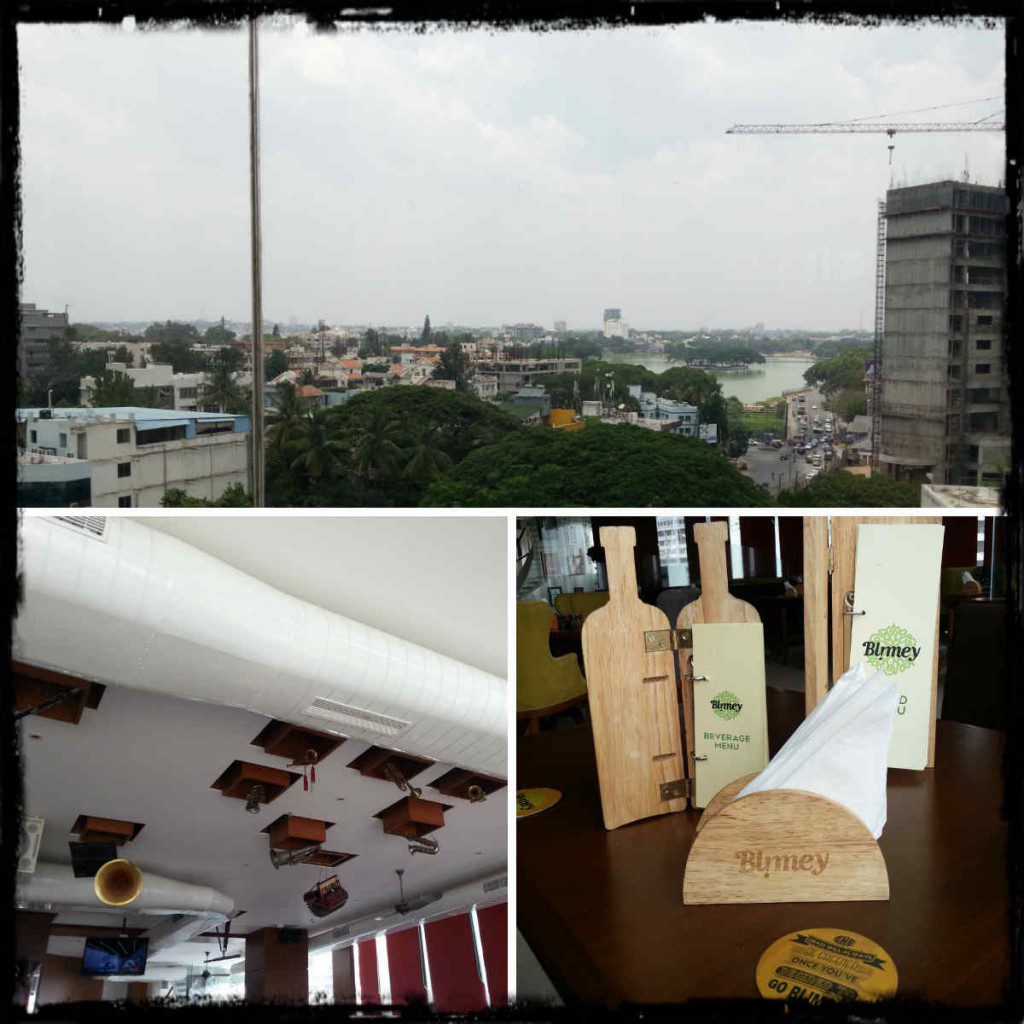
    Blimey had been making quite a few appearances on Facebook and outside and that meant that we chose a lazy Sunday afternoon to drop in. For those not yet aware, Blimey is an Irish Gastro Pub on the 5th floor of 1, MG. (map) The mall has parking at rates that would make you go ‘Blimey’ in a not-so-positive way. It also has these strange escalators that allow you to see alternate floors (2,4) like stations where the train doesn’t stop! Thankfully, Blimey is on the 5th floor along with a few other restaurants, and can be reached without a step-by-step instruction guide. 🙂

    It’s spread over 2 floors, including a rooftop (I’m told) but we were fascinated enough by the view from the lower floor to not even explore further. The place has quite a funky ambiance – musical instruments hung from the roof, trunks and posters, coaster-text, bar games, and of course, a fantastic view of Ulsoor Lake and surroundings!

    collage1

    We decided to start with an Irish Dublin, and an 1886, and from the food menu, a Sausage Four Ways. The Irish Dublin was the relatively better drink, with its banana flavour. The 1886 was spicy enough, but it didn’t really work for me. My biggest problem was with the glasses which seemed to have a default fish flavour! (smell) The sausages were the meal’s saving grace, and in a rare show of unity, the combined German, Irish and English forces gave us something to really cheer about. This one is highly recommended! For the main course, I asked for a Chicken Crock Pot, and D took a Shrimp & Scallop Pasta. The pasta arrived first and though it wasn’t really bad, the marinara sauce had a very feeble presence and the shrimp wasn’t as cooked as D would’ve liked. The chicken came with a complimentary bread basket and a superb gravy. But it was actually made for two, I’m sure, and after a while, I found it too tiresome to finish! That also meant that we had to skip dessert. 🙁

    collage2

    The service was quite prompt and cheerful. The bill came to more than Rs.2600 and I checked to see if we were also sponsoring some Irish cause! We weren’t, and I felt it was quite a lot, despite the location!

    Blimey, The New Irish Gastro Pub, 5th Floor, 1 MG Road. Ph: 08022086777, 9886587930

  • The narratives that we drive

    It probably started with the ‘narrative’ post, but a few things I read later made me wonder about our choices of narratives and where this could be leading to. Some narratives happen to us depending on our circumstances – time, geography etc, and some we choose of our own volition, or so it seems. Continuing from the earlier post, I think it’d be safe to say that with a more connected world, our ability to choose narratives has been heightened. Abundance of creation, and consumption. I think this was the related fantastic little piece of content that triggered this entire line of thought. It has some thoughts on material consumption, and though delivered differently, it has some profound insights as well.

    Partly thanks to that abundance, the noise around us has also increased, and has found better ways of being amplified. To quote Clay Shirky,

    It is our misfortune, as a historical generation, to live through the largest expansion in expressive capability in human history, a misfortune because abundance breaks more things than scarcity.

    In fact, one could argue that compulsive consumption (material, and otherwise) is one of the reasons for our ‘emptying out‘. (do read) As I was writing this, I had a sense of deja vu, and some searching pointed me to this, written 3 years back, in which I tried to figure out whether there was a middle path between a self that was driven by others’ perceptions and one that was driven by a moral compass dictated by few external stimuli. In that post, I had quoted from Paul Graham’s ‘addiction’ post,“we will increasingly be defined by what we say no to” I think that still holds true.

    In this era of abundance, what narratives should we choose to be part of? How can one be objective, is one even right by being objective? An excellent post whose advice I hope to implement more is this. I really couldn’t disagree with any of the 30 things mentioned, it just seemed intuitively right. But I think this would serve as an excellent first lesson..

    (via)

    until next time, an open and shut existence

  • The Indian Clerk

    David Leavitt 

    The Indian Clerk is a historic novel based on real events and real characters, but mixes actual history with a bit of fiction. It begins with a lecture given by the great British mathematician GH Hardy in Harvard in 1936, quickly zooming back to 1913 when Hardy was working on the Riemann hypothesis. He receives a letter from Ramanujan, a clerk in the Madras Post Office, who seems to have come close to a solution to the problem.

    Soon Ramanujan arrives in England, and the genius of the ‘Hindoo calculator’is quickly acknowledged. The narrative is then shown through different perspectives – Hardy’s, Alice Neville’s and though Ramanujan plays a key role, it also brings into focus the various other events, people and even attitudes in the timeframe that Ramanujan lived in England – World War I, the collaboration between Hardy and Littlewood, Bertrand Russell’s antiwar activities, the Apostles’ meetings and so on. It is interesting to note that though his genius is acknowledged, both Alice and Hardy have conflicting views on how Ramanujan can be given the perfect conditions to flourish and both have sexual undertones in their relationship with him.

    The thing that didn’t work for the book was that in the middle, it meandered away from the central theme – Ramanujan and his mathematics – into the politics of the era. Where it does work wonderfully is in bringing out the person in Ramanujan – a normal person with his own set of problems, desires, insecurities and even a capacity to feel insulted at what some would consider the pettiest of things. It is quite heart rending to see a man trying to cope with conditions completely alien to him, separated from a wife from whom he craves attention (if only through letters) even as he understands that it is a better stage for him to shine. It is difficult not to feel for the man. What it also does is show mathematics in a new light “…mathematics had tantalized us with a pattern, only to snatch it away. Really, it was rather like dealing with God”

    So if you don’t have some kind of natural aversion to mathematics and don’t mind wading through the politics of the time, this is quite a good read, especially towards the end, when the focus is on the person within the greatest mathematician of his time.