• Awesomeness is homemade

    Three weekends and three Malayalam movies – different genres, different directorial approaches and a largely non-overlapping cast. But all of them underlying that this is indeed becoming a glorious age for Malayalam cinema! New stories, novel thoughts, fresh perspectives – this is a wonderful time to be a viewer. I decided to write this post, because as I’d mentioned earlier while on the subject, movies are a representation of an era, and years later, I’d like to read this and remember what a great time we had!

    On the first weekend, we saw ABCD, (trailer) starring Dulquer Salmaan, who with each outing impresses further, seems destined to be an actor and a star, and might not have to wait for years like his father (Mammootty) to attain either. Our decision to see it in the theatre was also heavily influenced by the presence of Jacob Gregory, whom we were fans of thanks to Akkara Kazchakal. The movie was not meant for intellectual stimulation and delivered its promise of entertainment quite easily. What it also did was look at contemporary issues in a non-preachy way. Despite a few niggles – the editing could have been better, Gregory’s accent could’ve been worked on and he could have been better utilised in the first half – Martin Prakkat has ensured that his success continues after his debut film Best Actor. Extra points for not trying to force fit a love story that could have spoiled the superb essaying of a script-backed character by Aparna Gopinath, the very anti-thesis of a traditional Malayalam movie heroine.

    The second weekend saw us in PVR for 5 Sundarikal – an anthology with stories of 5 different women in various life stages. 5 directors, with one of them making a debut. My favourite was Aashiq Abu’s Gowri, (despite not being a fan of Kavya Madhavan) thanks to the really sensitive story of a couple whose life goes through a drastic change after a seemingly casual remark by a visiting friend. Kullante Bharya was an equally strong contender, and quite unchacteristic of Amal Neerad, I might add. I place it second only because the story is an adaptation. Dulquer takes on the narrator role with ease and does a splendid job of making sure the nuances are caught just right. Shyju Khalid’s Sethulakshmi, based on a story by M Mukundan, is poignant and very disturbing! Fantastic treatment of the story in terms of catching expressions, and portraying scenarios. Anwar Rasheed’s Aami does not fail only because of the superb portrayal of the protagonist by Fahadh Fasil, who captures the flitting gray shade nuances of his character with ease, and the riddle based flow of the story. Sameer Thahir’s Eesha, starring Isha Sharvani and Nivin Pauly reminded me of a short story (not sure if it’s Archer) and was probably the only one which only worked marginally for me. But in all, it was an excellent compilation.

    The best was saved for the last – Murali Gopy teaming up with Arun Kumar Aravind after Ee Adutha Kaalathu – Left Right Left. The title of this post is inspired by its tagline – revolution is homemade. Fantastic casting, with Hareesh Peradi, (what was he doing in Red Chillies?!)  Murali Gopy and Indrajith making each character easily believable. So strong is the script that you feel the angst and pain that each of them have within – and that even goes for the ruthless character played by Hareesh Peradi. The political overtones are more than obvious, but yet manage not to take over the film. There is an immense amount of realism in the movie, and that is not because one could easily associate it with real life personalities, but because even the secondary characters have a clear DNA – why they are the way they are, what drives them, what is their rationale for doing the things they do. It is really difficult to choose between the three protagonists and that’s because of the strong script as well as the brilliant portrayals. Like I mentioned in a tweet, it was awesome to see the sons of gifted actors – Murali Gopi, Indrajith Sukumaran, Sudhir Karamana, and Vijayaraghavan in a single movie! If that isn’t new generation Malayalam movies, what is? 🙂 A powerful, hard hitting movie, and kudos to the director for delivering the script just right! For now, watch the back story of the characters in the movie’s potent anthem

    until next time, malayalam cinema #ftw
  • Revolution 2020: Love, Corruption, Ambition

    Chetan Bhagat 

    As usual, Chetan Bhagat sucks the reader into the story from the first page. The narrator speaking to CB has become quite the signature prologue now, though he played it slightly differently in the last book.

    The overall concept of the book reminded me of several books/movies, and the one that came specifically to mind when I read the ‘summary’ on the jacket was Hazaaron Khwaishein Aisi. That actually made me think of the author’s themes across his books. For me, the first three were unique because the story itself was new. (though FPS could be seen as a rendition of “poor hero – rich heroine – evil father” set in an IIT. But there was something refreshing enough in it for it to spawn a cottage industry) The last book seemed to be inspired by the author’s own life (it’s probably marketing) and to me, seemed like a nadir in the author’s imagination and storytelling capability. This one is a clawing back, and though the theme itself is jaded, CB manages to bring life into it with the storytelling. At least, it didn’t annoy me like 2 States.

    Gopal Mishra is a protagonist who you can easily root for, even as his ‘grey shades’ continue to darken as the book progresses. Despite being quite stereotypical, it’s probably this that holds the book together, as all the other characters are quite cardboard. The climax itself is quite predictable, especially if you’ve watched a typical love triangle in 80s/90s Bollywood. But the pace is relentless, and despite the predictability, the narrative was reasonably interesting to hold my attention.

    The mentions of CCD in every tenth page made me wonder if this is part of the author’s ‘special friend’ deal with the coffee chain. And that also made me wonder about the Taj and Ramada hotels as well. But hey, the book costs all of Rs.140 (maybe a hat tip to Twitter), I think that makes it all fair, even if the conjecture is true.

  • Revisiting Social Commerce

    It’s been more than 2 years since I wrote about social commerce on afaqs, and since then, there have been massive changes right from the definitions to the operations of social commerce. Karthik’s recent post on the subject led me to think about it again.

    I’ve always felt that most of the popular definitions of social commerce have constrained its actual scope. Back in 2011, facebook stores accounted for most of the social commerce discussions. These days, it is mostly referral traffic and sales from social, and that too, in terms of last-touch attribution, as the Ecommerce quarterly (that Karthik cites) would suggest. While I’d not contest EQ’s methodology or assessment, I think it’s only fair to point out that there have been a great number of exceptions. (read; Disclosure: that list includes Myntra where I work) I’m not a fan of how Facebook has throttled what we used to call organic reach, but if you want to read about how Facebook helps target users at different levels of the funnel, Zappos serves as a good example. Facebook’s Custom Audiences and FB Exchange products allow different ways of targeting consumers. Twitter is a bit late to the party, but their products also have excellent potential from what I’ve seen, and they’re moving quickly! (already into retargeting)  YouTube is already a big bet for advertisers, and Pinterest is already being used by scores of Etsy users! (read) From small experiments, I also suspect that Google+ is a potential top rung player. Even if you’d like to leave the $ out and consider (for example) only organic (eg. Open Graph actions) there are case studies evolving. (example)

    tumblr_lteusu0d0K1r54seio1_500

    So, can commerce be driven through social channels – advertising as well as organic? An emphatic yes would be my answer. Yes, it might score low if one considers only last-touch attribution, but hey, many of Facebook’s strategic PMDs are getting a handle on multi-touch attribution. (Kenshoo is an example) One should also consider that other traffic channels like search, affiliates etc have been around for longer and have tried and tested models. The point is rather simple – if we judge social’s contribution on the basis of models created for an earlier version of the web, it would not measure up. We’re at a stage where both technology and tools are still evolving to help measure social on terms that balance its uniqueness with the needs of the business. The good news is that the little that I have seen of Facebook’s strategic PMDs has been inspiring!

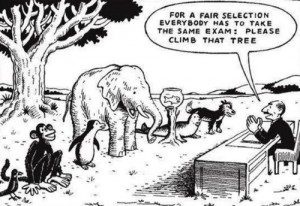
    (Image via)

    But I think using social channels as sources of traffic/revenue for commerce is still not capturing ‘social commerce’ in its entirety. Though arguable and reducing in favour, I’d still label many group buying options as social commerce. (example) But to me, the elephant in the room is  p2p commerce. Though the collaborative economy is more vast in scope, I’d put it in the same bucket in this context. (do read Jeremiah Owyang on the subject) From Airbnb to RelayRides to Loosecubes to TaskRabbit to even KickStarter, commerce is now happening between individuals with everyone playing creator, buyer and seller as per context. While the $ is inevitable, trust and one’s network itself are becoming currencies. Yes, these also use social platforms for extended reach, but this is inherently more social than the pure commerce play of brands.

    It is interesting to see social platforms working on these lines as well. Facebook’s Marketplace was probably a bit ahead of its time, but nothing stops them from bringing it back. I read recently that Google is planning to release Mine – a service integrated with G+ that allows users to keep track of “belongings” and then share those with friends in different circles. (via) Yes, there will obviously an Android App. It’s not just these platforms, I’d think that Amazon is slowly approaching it from a different direction as well. (read)

    To sum it up, commerce has always been social, it’s only the dynamics that keep changing.

    until next time, commercial breaks

  • Arbor Brewing Company

    Ever since Arbor opened, and I saw them on twitter, I’d been pestering them on when they’d open the microbrewery. On my birthday, we’d wanted to visit Windmills Craftworks, but they had an event and were booked out. I casually looked up Arbor’s menu on Zomato and found that the microbrewery had finally opened!

    We went there once more later, and on both occasions, we realised that having a reservation really helped, though the first time we had asked for a table outside, but had to make do with one inside. I missed the passive smoking! 😉 Follow the map to get there, and make use of their valet parking.  I loved the way the building encapsulates Bangalore – Nalli Silks, a restaurant named 4 States, (not sure if it’s open yet, can’t find it on the web) and then Arbor, a microbrewery. The place is quite huge, with various kinds of seating options spread across its space. The music is rather loud, but I liked the playlists, so won’t complain!

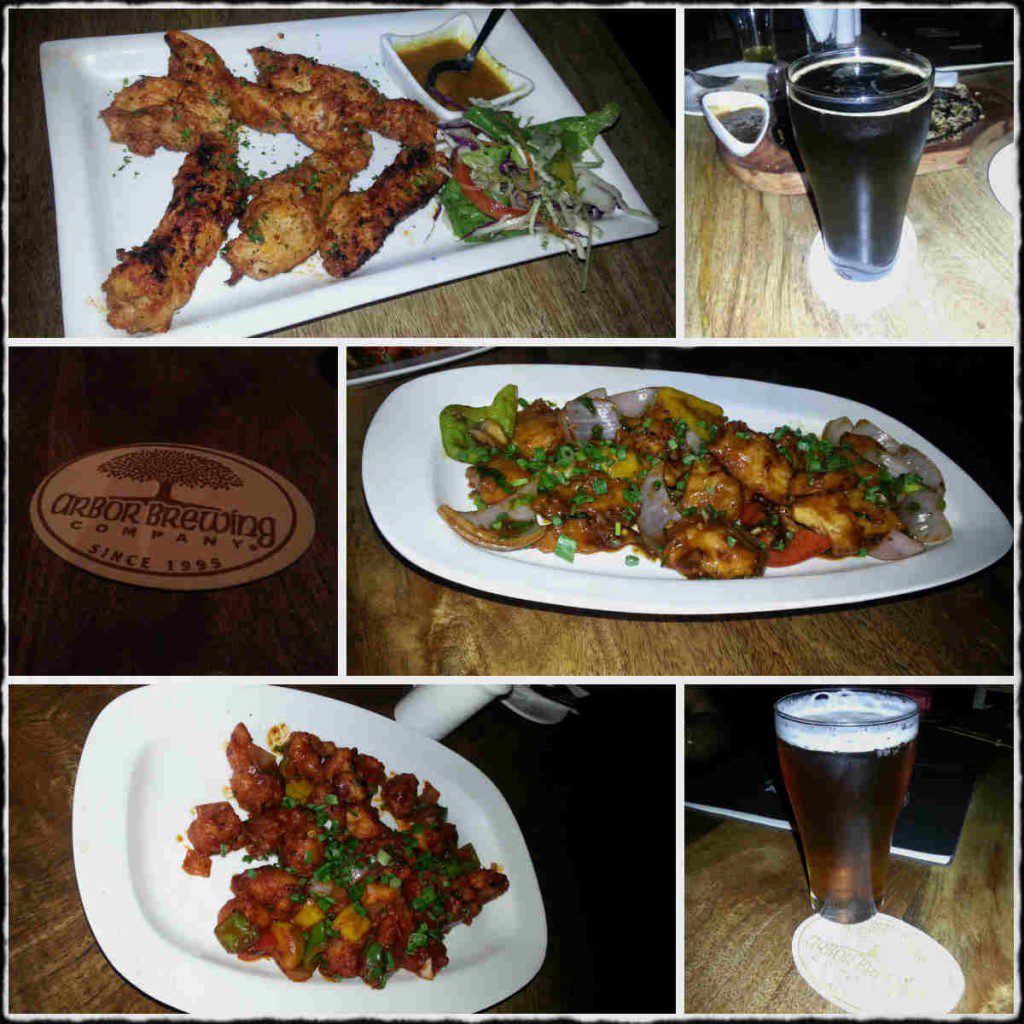
    Over two visits, we tried the Brasserie Blonde, Bangalore Bliss, Big Ben and the Cold War. I loved the theme of the last one, but the coffee flavour was a little too strong and the drink too bitter for my taste. The Blonde was my favourite, and Bangalore Bliss a close second. D preferred the latter though. Big Ben was not bad either. I liked the way they have explained the drinks with trivia, notes and food pairing.

    The Flaming Chicken was our favourite starter – chilli sauce and an assortment of flavours like lemon, pepper etc. Quite spicy and extremely tasty. The Chilli Fish was also reasonably good – the sauce being quite spicy again. We didn’t care much for the Drunken Chicken or the Bourbon barbeque sauce it featured.

    In the main course, we tried a couple of pizzas – ‘I Like to Party’ and ‘Buffalo Soldier’. The former featured superstars like bacon, pepperoni, sausage, ham and cheese, but it was the latter’s fiery buffalo sauce that won us over. We also tried The Fleetwood – chicken sausage fried rice with garlic pepper sauce and a fried egg on top. This was just about ok. The dish we really liked was the Fiery Chicken Alfredo – creamy sauce and spicy red chilli paste came together very well indeed. But the star, as on most occasions, was a dessert – the gigantic Long Lasting Vertigo. Three layers of chocolate sponge cake with chocolate mousse oozing through! So awesome that we didn’t bother to try another dessert on our second visit!

    Our bill on both occasions came to around Rs.2500 – for a couple of beers, a starter, a main course dish, a pizza, and a dessert. Reasonable, I’d think. There’s a distinct buzz about the place, and I think it has a character that will develop well over a period of time.

    Arbor Brewing Company, 8, 3rd Floor, Allied Grande Plaza, Opposite Home Stop, Magrath Road. Ph: 080 67 921222

  • Future Tensed

    Thanks to Neal Stephenson’s The Confusion, (Vol 2 of The Baroque Cycle) I’ve had to do something that I haven’t done since I started reading – read two books in parallel. Every 200 pages of The Confusion, I take a break and read a volume of The Hunger Games. Neal Stephenson, to me, is genius, and I’ve been a fan since I first read Snowcrash. I could speed read The Confusion, but I really want to pay attention and understand the nuances, the humour, the larger thought and so on. I cannot do that for 800 odd pages, hence this shift.

    I only understood the ‘connection’ after I started reading The Hunger Games. The Baroque Cycle is set in late 17th-early 18th centuries, and uses an excellent mix of historical and fictional characters to cover a whole variety of themes. In some ways, it uses the past to understand the present. The Hunger Games, on the other hand, is set in a dystopian future, and shows a potential fate of humanity. It uses cues from the present to predict the future. The connection ends there, almost. Though at massively different levels, both require imagination, the former at a much more larger scale.

    That’s what led me to think about imagination in the present. We’re in the midst of probably the biggest upheavals in the history of humanity – new technologies emerging at a rapid pace, institutional realignment, socio-cultural changes, behaviour alteration and so on. All of this means, that collectively, we’re having to run really fast just to cope. Where does that leave time for imagination? In fact, such is the assault on senses that I wonder if anything really disruptive is being written in the science fiction genre these days (I hope to be proven wrong and pointed in the right direction) because except for things like teleportation and time travel, pretty much everything that was science fiction is getting played out now, and so busy are we – trying to keep abreast – that science fiction is merely extrapolating the present (read) or giving alternate versions.

    There is a term in psychology called Functional Fixedness, wiki-defined as “a cognitive bias that limits a person to using an object only in the way it is traditionally used.” With my limited knowledge, I wonder if that’s the dystopian future of the human imagination.

    until next time, the end of collective imagination