Category: Flawsophy

  • A different kind of more

    (image via)

    Sometime back, I read this excellent post titled “Your Lifestyle Has Already Been Designed“. A colleague shared it with me because he felt I’d like it. And right he was, because it echoed my own thoughts on how our consumption these days have little to do with our needs. The author in fact, goes a step further to say that the typical 40 hour work week (actually it’s way more) manufactured by big business has reduced our free time to such an extent that whatever we do get is spent less in meaningful, healthy activities and more in drowning ourselves in wanton consumption. While that may or may not be true, I think we have a choice, but one that involves winning a battle within. When we lose the battle, we begin indulging ourselves covering it up with the ‘deserve it/earned it’ argument, and the culture of random consumption lives to fight another day. The author sums it up rather well with “We buy stuff to cheer ourselves up, to keep up with the Joneses, to fulfill our childhood vision of what our adulthood would be like, to broadcast our status to the world, and for a lot of other psychological reasons that have very little to do with how useful the product really is.”

    In a larger sense, we tend to live a life that’s not really ours. I cannot help but remember the words of a near-immortal “Your time is limited, so don’t waste it living someone else’s life. Don’t be trapped by dogma – which is living with the results of other people’s thinking. Don’t let the noise of other’s opinions drown out your own inner voice. And most important, have the courage to follow your heart and intuition. They somehow already know what you truly want to become. Everything else is secondary.

    In essence, what we consider as motivation from our own self is actually not. I found an amazing/bizarre manifestation of this in the truly unique story of Mike Merrill, who divided himself into 100000 shares and ‘sold’ himself. Known as the IPO man, his investors would earn a profit out of activities he did outside of his job. In fact, his intent behind the entire activity was to raise funds for things he wanted to do, and felt he would make a profit from. What followed is a fascinating story that has resulted in the investors even getting to have a say in Mike’s personal relationships and sleep patterns!

    I couldn’t help but think of how similar it was to an ordinary person’s life. It is an extreme case, but when we’re driven by wants and motivations that have little relation to needs, the only difference is that Mike is conscious of his lack of control, while we are smug in our belief that we’re in control. I most definitely am not saying we should be living like ascetics, but the balance does lie in consciously separating needs and wants. That, I believe, is the way to a fuller life. A different kind of more from a different set of mores. I wonder if it’s a coincidence that the term ‘Utopia’ was coined by a person named Sir Thomas More. 🙂

    until next time, more or less over

    P.S. The good news is that increasingly these days, I see people making conscious choices across the board – lifestyle, media, time, relationships. The more the merrier 🙂

  • Live Empty

    old tree and new tree stories

    (via)

    Such is the pace of life now that I can easily identify with the opening paragraph here. As I read on, I completely loved the part about the graveyard being the most valuable land in the world, “because with all of those people are buried unfulfilled dreams, unwritten novels, masterpieces not created, businesses not started, relationships not reconciled.” The rest of the article is about dying empty – to complete every task, thought, action, to leave nothing unspoken, uncreated, unwritten. 

    Later, I read on Brain Picking, “Henry Miller on Creative Death“, in which Henry Miller, defining art, says, “Strange as it may seem today to say, the aim of life is to live, and to live means to be aware joyously, drunkenly, serenely, divinely aware. In this state of god-like awareness one sings; in this realm the world exists as poem. No why or wherefore, no direction, no goal, no striving, no evolving…. This is the sublime, the a-moral state of the artist, he who lives only in the moment, the visionary moment of utter, far-seeing lucidity…. in the sense that any moment, every moment, may be the all; for the artist there is nothing but the present, the eternal here and now, the expanding infinite moment which is flame and song.” And later in the article “On the contrary, his zest for life is so powerful, so voracious that it forces him to kill himself over and over. He dies many times in order to live innumerable lives.

    I read a pattern in these. Of dying every day and being reborn the next day. A new life. I faintly understand and relate to this, but within me is another side that plans, that likes stability, and saves for a rainy day. I am unsure of how these two can co-exist. And I can’t help but be drawn to the lines at the beginning of the Miller post ““One aspect of our nature cannot be exalted above another, except and the expense of one or the other.” 

    If so, I already know the winner, and as the first post points out, that would create an angst, or a perpetual state of discontent. It would seem as though the opposite of ‘die empty’ can only be ‘live empty’. There can be no middle path, and that’s scary and sad.

    until next time, empty vessels and a lot of noise

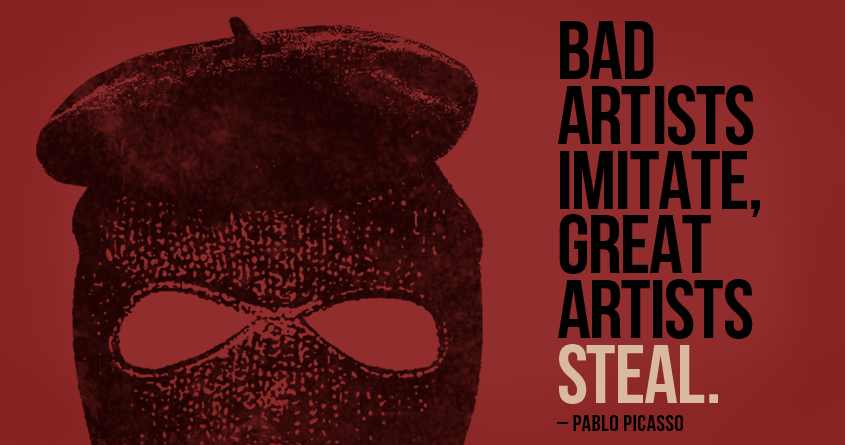
  • All ideas are equal, some more equal than others…

    (via Threadless)

    A conversation in office on an unrelated topic led me to ask this question on Twitter.

    ..and @atulkarmakar gave me his perspectives


    Just like Atul mentioned, I had first considered whether it was because creative ideas were considered more personal  and a business idea/model an impersonal, corporate entity. But my starting point had been advertising, to which this does not really apply. Compare the reactions of Company A replicating Company B’s business model/idea versus them being ‘inspired’ by their advertising. In the case of advertising, both agencies might get paid and both clients might benefit. But in the case of a business, the second player could benefit from the mistakes (strategy/execution) of the pioneer and build a more successful business. That would be really unfair to the first guy whose business idea might have been a really creative solution to some need. And yet, it’s more likely that the aping of ads would spark a larger debate and the business cloning would be ignored. Am I missing something? Any perspectives you want to share?

    until next time, game of clones

  • Food for the soul

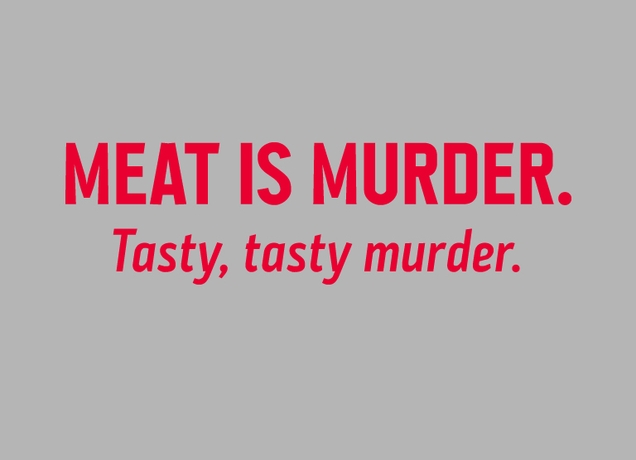
    Thanks to Zomato, I got to spend some bak bak time with Mayur back in February. Along with Rocky, this guy gets to do the two things I’d rather do always – eat and travel. While it was a fun meet up, it was impossible to agree on the subject of meat. Most of the others around were fanatical carnivores – like myself (and I was wearing a tee with the message above) – so we traded insults with him for the first few minutes before the man silenced us with “food is like religion, and you should not piss on other people’s temples”.

    After that the conversation quickly moved to life philosophy. I (along with at least one other person) was curious to know how he kept himself interested in the food + travel routine. Wouldn’t it get monotonous? We talked of retaining child-like levels of curiosity and wonder, an openness to experiences, of starting the day asking what newness can be done today and realised that as we grow older, we look for reasons not to do things, as opposed to the reverse.

    After taking my trip with a food quote, (and underlining his instant wit) he went off to talk to other folks, and the rest of discussed how this also translates to how we interact with other people. Earlier, we used to trust others until they gave us a reason not to, and these days, it’s exactly the reverse. I wondered if this is probably related to the ‘openness to experiences’ we had talked of earlier.  (more…)

  • Friendship grants

    In Rediff’s review of Kai Po Che, there’s a line that goes “Quoting from Bollywood, impromptu excursions and taking each other for granted without guilt is the prerogative of buddy-dom,…” That’s probably arguable, but if it is right, I now understand why my buddy count has been low since inception.

    The first – excursions – I think, can be handled. That’s despite my obsession with planning. 🙂 The second is a completely different story though. I hate taking people for granted and if I end up doing it and realising it later, I get guilt pangs even after apologising. It probably comes from the premise that I hate being taken for granted and thus the “Do unto others as you would have them do to you” gets applied. (more…)