Category: Flawsophy

  • Friendship grants

    In Rediff’s review of Kai Po Che, there’s a line that goes “Quoting from Bollywood, impromptu excursions and taking each other for granted without guilt is the prerogative of buddy-dom,…” That’s probably arguable, but if it is right, I now understand why my buddy count has been low since inception.

    The first – excursions – I think, can be handled. That’s despite my obsession with planning. šŸ™‚ The second is a completely different story though. I hate taking people for granted and if I end up doing it and realising it later, I get guilt pangs even after apologising. It probably comes from the premise that I hate being taken for granted and thus the “Do unto othersĀ as you would have them do to you”Ā gets applied. (more…)

  • Movie magic

    There’s a new wave of movies in Malayalam which have now gotten a genre all to themselves – they are being called ‘new generation’. This has as much to do with the new breed of filmmakers/actors/technicians who’ve begun to make their mark as it is to do with the themes that are portrayed in these films and the mindset that a viewer has to probably adopt – this mindset being radically different from the one reserved for the standard potboiler fare that viewers were used to. I stress the last two because it isn’t as though these kind of movies had never been made before. It was just that they were very few in number. Simply put, the maker and viewer generations are now showing a radical shift from even say, 2-3 years back – in terms of approach, outlook, perspectives, perceptions and expectations.

    Movies being a medium of expression, I have always been intrigued by the subtexts, though I have not had the liberty of time to actually spend thoughts on the subject. Ā This article, for instance, does a good analysis on Mani Ratnam’s movies and the influence of various narratives. These days, when I watch (malayalam) movies from the 80s and 90s, Ā I try to identify the themes that have been used in/inspired them. Earlier than that would be difficult since I have no primary experience of the era.

    I saw Thoovanathumbikal again recently, a fantastic movie which deserves a ‘new generation’ tag even if it were made now, especially because of its sensibilities. It is very much what I call a mood movie – requires the viewer to succumb to the mood to truly enjoy it, especially the current day viewer who expects something to happen every second, and nuances are not counted. (probably why Annayum Rasoolum was not appreciated much – it’s less to do with the theme and its twists and more about the way it’s been dealt with – the sophistication and the aesthetic) Timeless asĀ Thoovanathumbikal might be, I wonder how much one would appreciate it more if one had experienced first hand the societal values, mindset Ā and the ethosĀ of the time. The rain, for example, which plays such an important part, do we view it in that light anymore? At the same time, the maturity of the person is also a factor. I was nine when it released and would have slept through it! šŸ™‚

    And that’s probably why cinema is indeed magical – not only is it a representation of an era, or a part of it, but at any point in time, there’d be someone who’d be able to relate to it, across the passage of years.

    until next time, moving pictures

  • Lovestrong

    Slightly dated in the context of real time, but I thought this was a pertinent read in the Armstrong era. It’s titled “Honesty of the long-distance runner” and is about a Spanish runnerĀ IvĆ”n FernĆ”ndez Anaya. He was running second in a race he had no chance of winning when he saw race leaderĀ Abel MutaiĀ pull up about 10 meters before the finish, thinking he had already crossed the line. Instead of exploiting the situation, he let the Kenyan win using gestures to communicate. He thought it was the fair thing to do. He also candidly said that if a Eur/World medal was at stake, he’d probably have done things differently.

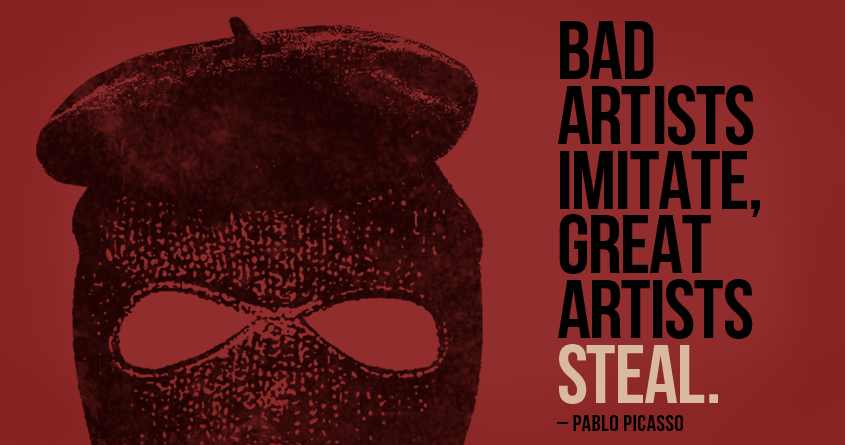
    I saw this poster at gaping void, related to Ā purpose, but twisted it a bit in this context. It isn’t as though there aren’t things we love to do. As we move further in life, we learn more about the way life works. Sometimes these things we love make business sense, sometimes they don’t or requires either stellar talent or more hard work than we are willing to put in. Some of us work at it, some of us lock the love away and some of us decide to find an easy way out. And thus it is that even things which involve love and passion – sports and arts – have been converted into competitions and ruthless economically viable phenomena. So really, where does the corruption begin?

    until next time, strong-armed

  • Fence sitting

    It’s easy to guess the book from where this has been taken. I started reading it only recently. (yes, yes, give me a painful death) “Others dwelt here before… and others will dwell here again…” is pretty timeless, but I was more fascinated by the line after that “The wide world is all about you: you can fence yourselves in, but you cannot forever fence it out.

    To an almost ‘asocial’ like me, fencing myself in has been an escape route that I use more often than not. It’s also why this is one of my favourite songs

    But of late, I am not sure how much fencing oneself in works, especially since the world will find a way to intrude. Probably a sign that I’m getting old, or at least older! In fact, attempts at it become a struggle, one that serves no purpose. That’s probably why most people don’t treat it as black & white, and get by with occasional forays into their fenced-in world.

    until next time, keep fencing

  • Of fame and purpose

    I completely missed Bigg Boss 6. Except for knowing that the arrested-for-sedition cartoonist and Sapna Bhavnani were participants, my exposure to it was limited to lunch conversations at office, where two of my friends seemed to be avid followers. šŸ™‚ I thought my ignorance was only fair, since they are usually clueless when I mention the names of micro-celebrities on Twitter.

    Increasingly, I am realising that popular culture is going through massive fragmentation. The above was an example. I think this generation is connected with more people than any before it. It has always been so, with better means of communication, but this time, it has been an explosion. We’re still coping with the overload, or filter-failure, as Clay Shirky calls it. Despite social networks, or probably because of them and their algorithms, we miss out on many things.

    I was thinking of all this in the context of fame. Fame, to me, has some connection with my favourite subject these days – purpose. Fame can serve as a means, or end, or a by product of purpose. The thing is, with the fragmentation I mentioned earlier, fame probably has to be redefined, also because its shelf life has been drastically reduced. Once upon a time, a name/photo appearing in a newspaper was an achievement. (let’s ignore the notoriety piece šŸ™‚ ) Later, before channels mushroomed, it was television. But now….

    One of the things that might happen because of all this is the gradual de-linking of fame and purpose, if it does exist. I’m still trying to figure out how that will shift our perspectives on purpose.

    until next time, being famous ain’t what it used to be…