Category: Flawsophy

  • Guided by fear

    live1

    I have this habit of adding a bookmark fold at the bottom of the page when I want to refer to it again. It is quite a task when I have to figure out much later what line in the page I’d originally bookmarked for! These days, Instagram solves it. At some point, I’m sure I can search my feed with a #quote hashtag and retrieve all the ‘bookmarks’ easily. Yay!

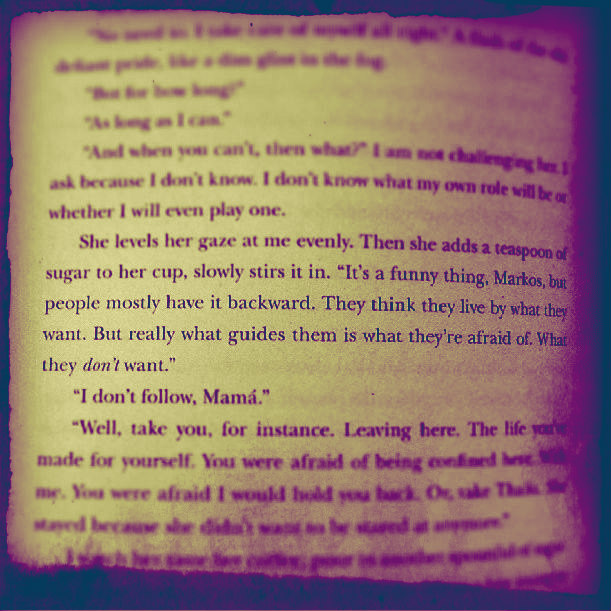
    “And the Mountains Echoed” had many such bookmarks. (still an unconscious habit despite the Instagram method) But this one has to be my favourite – “..but most people have it backward. They think they live by what they want. But really what guides them is what they are afraid of. What they don’t want.” I can easily confess that a large share of my actions is to preclude some dystopian version of my old age. (one) Many a time, this leads me to choose cautious paths over (what I think might be) more emotionally fulfilling ones, and even ones that I think might be leading me to my purpose.

    But when I thought about it a bit more, I realised that it can be read positively too – after all I am afraid of being switched off without knowing why I was here, and that’s what makes it an obsession! Also, the ‘afraid-don’t want’ factor often drives me to do things that are out of my comfort zone, so it’s possibly even pushing me towards my purpose, albeit from a different direction. Just a form of reduction? šŸ™‚ It’s probably not a coincidence that my second favourite quote from the book is “When you have lived as long as I have, you find that cruelty and benevolence are but shades of the same colour

    until next time, fear off

  • ..the question remains

    It has been more than a couple of years since I wrote on the subject of planning – the acceptance of destiny vs free will inĀ The Uncertainty Principles and the balance between change and stasis in its follow up. In my mind, the debate continues to rage, with flash points on a regular basis, thanks to various life scenarios and the things I read. I also realised that the recent narrative posts (1,2) are also a different way of framing this debate. Like I wrote in the posts, some narratives are already chosen for us, and some we choose, but these are all our attempts to fulfill our sense of belonging. In other words, our endeavour to find the reason for our existence – our purpose. Does one find it by working towards something or by dealing with life on a real time basis?

    A few days back, I read an article in HBR titled “It takes purpose to be a billionaire“, in which the author classifies ‘purpose’ into three buckets. Not that everyone’s idea of ‘purpose’ is to become a billionaire, but this is very clearly a planned path to achieve something that contributes to the sense of purpose. While the article does not mention it, the category I have always wondered about consists of people who have followed their passion – sports people, artists etc who have worked on a skill and honed it to near perfection. A very interesting perspective I read on that premise is the Scott Adams’ “Practice and Genes“, which takes a look at the theories on the subject and finally states that the critical element is luck.Ā The most important skill involved in success is knowing how and when to switch to a game with better odds for you.

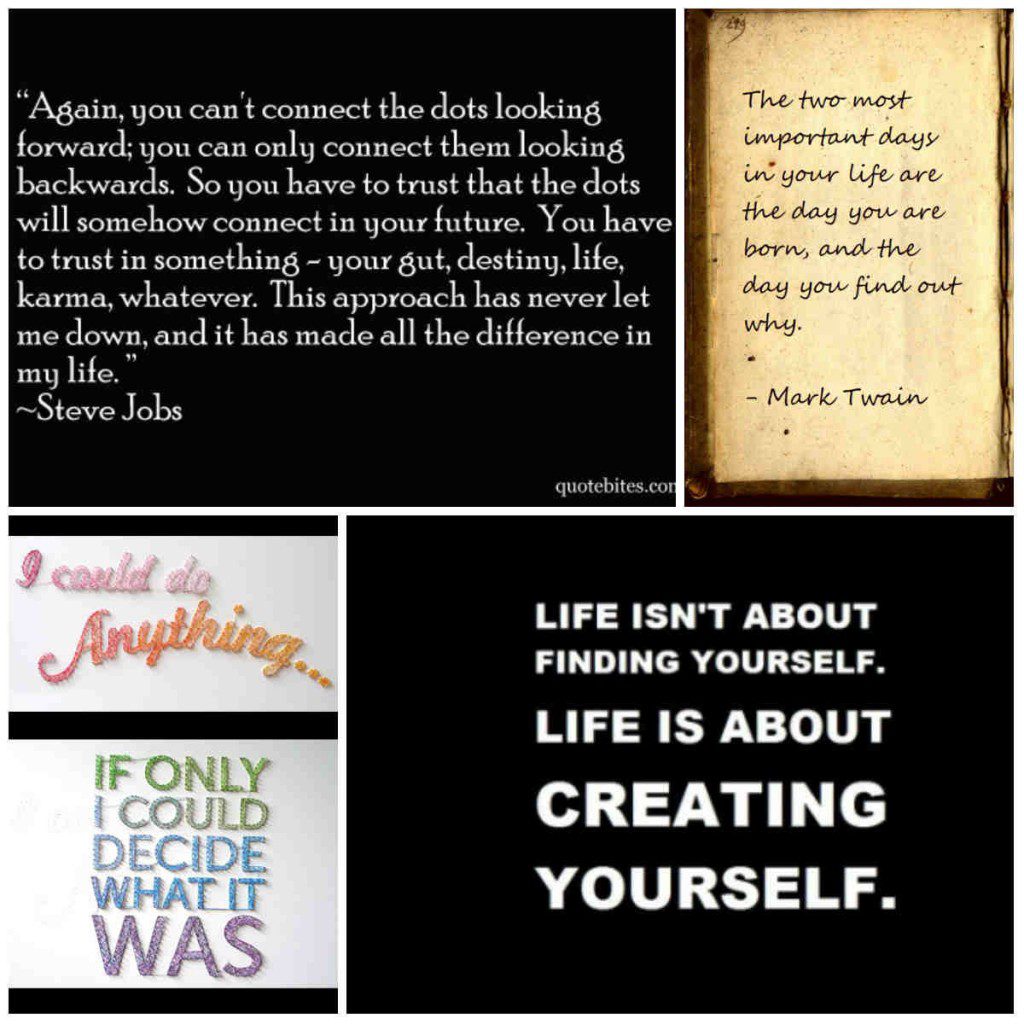
    Which brings me back to purpose and how we find it, and my introspection. “Who looks outside, dreams; who looks inside, awakes” ~ Carl Jung. (via) I thought about the ‘living in the moment’ perspective that finds a place in Buddhism texts and several other works of wisdom. At first, I thought it supported the destiny and real time approach, specially because it is difficult not to have baggage associated with the plans one makes. (literally and otherwise!) But then I realised that it was less to do with the planning aspect and more to do with how we deal with scenarios. Even if one works on a plan, how one deals with a setback to it is where the advice has value. In essence, that won’t help solve the debate.

    collage

    There are profound statements that support both ways of looking at it. I continue to rack my brains to find the path that will fit me, or make it. I think there is an element of subjectivity involved. That does not make the job easier, in fact, it probably makes it tougher. After all,Ā ā€œHe who knows others is wise. He who knows himself is enlightened.ā€Ā Lao Tzu

    until next time, the clock ticks away in real time

  • The narratives that we drive

    It probably started with the ‘narrative’ post, but a few things I read later made me wonder about our choices of narratives and where this could be leading to. Some narratives happen to us depending on our circumstances – time, geography etc, and some we choose of our own volition, or so it seems.Ā Continuing from the earlier post, I think it’d be safe to say that with a more connected world, our ability to choose narratives has been heightened. Abundance of creation, and consumption. I think this was the related fantastic littleĀ piece of contentĀ that triggered this entire line of thought. It has some thoughts on material consumption, and though delivered differently, it has some profound insights as well.

    Partly thanks to that abundance, the noise around us has also increased, and has found better ways of being amplified. To quote Clay Shirky,

    It is our misfortune, as a historical generation, to live through the largest expansion in expressive capability in human history, a misfortune because abundance breaks more things than scarcity.

    In fact, one could argue that compulsive consumption (material, and otherwise) is one of the reasons for our ‘emptying out‘. (do read) As I was writing this, I had a sense of deja vu, and some searching pointed me to this, written 3 years back, in which I tried to figure out whether there was a middle path between a self that was driven by others’ perceptions and one that was driven by a moral compass dictated by few external stimuli. In that post, I had quoted from Paul Graham’s ‘addiction’ post,ā€œwe will increasingly be defined by what we say no toā€ I think that still holds true.

    In this era of abundance, what narratives should we choose to be part of? How can one be objective, is one even right by being objective? An excellent post whose advice I hope to implement more is this. I really couldn’t disagree with any of the 30 things mentioned, it just seemed intuitively right. But I think this would serve as an excellent first lesson..

    (via)

    until next time, an open and shut existence

  • The narratives of our lives

    This wonderful post at Ribbonfarm got me thinking about places as narratives. Specifically, it reminded of something I wrote a few years ago on the subject – Watermark. The conclusion of the post that got me thinking was this –Ā The space we inhabit is more topological than ever as we locate our positions within networks instead of maps and this may be the most true narrative about the present age: No matter where in the networked world we’re coming from or traveling to, we’re already there.

    Indeed, places were probably the earliest narrative that existed – in our early days as a species, we probably didn’t move away much from the place we were born. As civilisation evolved, I think many more institutional narratives were added – religion, nation, culture, and so on. In the era of consumption, even brands (media and otherwise) have attempted to invade the space. For example, in our own lives, there are many narratives that we consciously or otherwise become part of – the kind of books we read, the music we listen to, the movies we watch – in short, popular culture. Each generation has its own set – from Ramayan on TV to Facebook.

    Sometime back, I had written about the internet beingĀ the zeroth placeĀ – the one that supersedes all the other places, including the physical ones, in our life. Especially with a social layer, it has the capability to accommodate all our narratives – individual and societal.Ā The Ribbonfarm post talks about how the default nature of the digitised era is to store, and no matter how much data our society manages to produce, we’re even better at finding places to keep it. In that sense, it isn’t just geography that the internet seems to have removed as a driver, but time itself. The other day, when I was reading The Confusion, I happened to read a post from 2005 which summed up how I felt about The Baroque Cycle in general. Yes, I tweeted about it. šŸ™‚ But I still can’t be sure about the evolution, and wonder if the abundance of storage might drive us to consciously seek out ways where the information will not be stored. eg. the rise of Snapchat.

    I have always felt that narratives are a way to fulfill our sense of belonging. Across time, this role has been played by several entities. The internet has made it possible for even the smallest of niches to have its own narrative. Where does it go from here?

    until next time, comment on the narration? šŸ™‚

  • Future Tensed

    Thanks to Neal Stephenson’s The Confusion, (Vol 2 of The Baroque Cycle) I’ve had to do something that I haven’t done since I started reading – read two books in parallel. Every 200 pages of The Confusion, I take a break and read a volume of The Hunger Games. Neal Stephenson, to me, is genius, and I’ve been a fan since I first read Snowcrash. I could speed read The Confusion, but I really want to pay attention and understand the nuances, the humour, the larger thought and so on. I cannot do that for 800 odd pages, hence this shift.

    I only understood the ‘connection’ after I started reading The Hunger Games. The Baroque Cycle is set in late 17th-early 18th centuries, and uses an excellent mix of historical and fictional characters to cover a whole variety of themes. In some ways, it uses the past to understand the present. The Hunger Games, on the other hand, is set in a dystopian future, and shows a potential fate of humanity. It uses cues from the present to predict the future. The connection ends there, almost. Though at massively different levels, both require imagination, the former at a much more larger scale.

    That’s what led me to think about imagination in the present. We’re in the midst of probably the biggest upheavals in the history of humanity – new technologies emerging at a rapid pace,Ā institutional realignment, socio-cultural changes, behaviour alteration and so on. All of this means, that collectively, we’re having to run really fast just to cope. Where does that leave time for imagination? In fact, such is the assault on senses that I wonder if anything really disruptive is being written in the science fiction genre these days (I hope to be proven wrong and pointed in the right direction) because except for things like teleportation and time travel, pretty much everything that was science fiction is getting played out now, and so busy are we – trying to keep abreast – that science fiction is merely extrapolating the present (read) or giving alternate versions.

    There is a term in psychology called Functional Fixedness, wiki-defined as “a cognitive bias that limits a person to using an object only in the way it is traditionally used.” With my limited knowledge, I wonder if that’s the dystopian future of the human imagination.

    until next time, the end of collective imagination