Category: Choices

  • Linking learning & labour

    I’m a huge Asimov fan, and am constantly amazed at how he was able to have a perspective of the future on multiple fronts. I was reminded of two of those recently thanks to their application (of sorts) in contemporary scenarios.

    First, Hari Seldon‘s (pretty much the foundation of Asimov’s Foundation series) psychohistory, which was able to make general predictions on the future behaviour of large populations using history, sociology and statistics. The easy contemporary connection is big data and predictive analytics.

    Second, a short story written by him called ‘Profession‘, (do read) in which every person’s profession is based on an analysis of his/her brain, and no choice is given to the person in this matter! In India, we seem to be already there even without the analysis!

    Collectively, these two made me think of employment, and on a related note, education. The thought was that with so much of data available on education and employment, we should be able to create ‘tests’ to compute the interest and aptitude of individuals at a very early age. What this would aim to do is to eliminate the herd education that currently exists. Instead, children would learn things that help them in a profession for which they have the intent and interest, using say, a combination of traditional classrooms and MOOCs. Also, this would no longer be one part of a life cycle, but a continuous process – helping the individual thrive in a dynamic environment.

    If you remember, LinkedIn was my representative for ‘L’ in the ‘change imperative‘ deck. That was because I felt that it had the data and the vision to be the catalyst for this kind of a change. I was very happy when it underscored this faith with the fantastic ‘future self‘ experiment, in which they identified the future professional self (5 year time frame) of LinkedIn user Kurt Wagner – another user Mussarat Bata – using various data points!

    LinkedIn hasn’t really built this as a public tool, but just imagine the possibilities! A platform that shows people the possibilities which take them closer to their ‘purpose’. (remember ‘The Evolution of Work and the Workplace‘?) I sincerely hope to see this in my lifetime. 🙂

    until next time, live and learn
    Clipboard01

  • One off a kind rating

    (‘off’ is intentional. Thanks)

    A while back, in ‘The Currency of Relationships‘, I’d written this – But there is no standard currency in relationships, and my lesson from this experience is to not to take for granted that my approach is the one that works for people at the receiving end. I should spend some time first in understanding expectations, and then meeting them. Recently, a little incident on Facebook reminded me of this. But first, a step back.

    Don’t laugh, but I think of myself as a kind person. This is a recent phenomenon, and one that finds a parallel in my struggles with being judgmental, though I have had more success on that front. Together, a reasonable (and sarcastic) wit, a tendency to see things from a skewed perspective and more often than not, the propensity to see humour in the worst of (others’) circumstances, have made being kind a very difficult task.  I rib people all the while, and am probably the poster guy for “People who don’t know me think I’m quiet, people who do wish I was.” It is very rarely that my intent is to hurt, I try to be mindful of all my words and actions, and that is what has probably created my own perception of the self as a kind one.

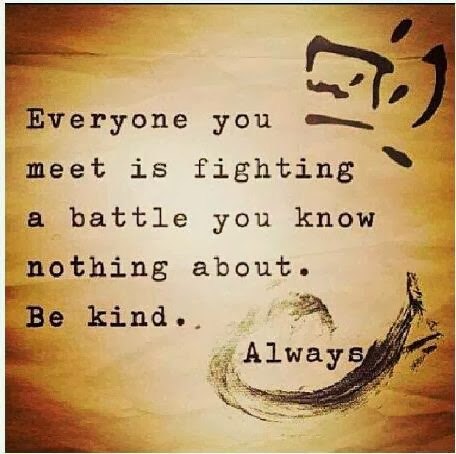
    kindnessAs with all perceptions, this one too built on itself. Maybe that is why I was quite surprised when a share on Facebook (the message being the same as what you see on the left – via)  – something I believe in and try to practice – elicited one response that I was in no place to ‘preach’ this. It made me think about my self perception, and reminded me of currencies. I also gained a few perspectives – common, yet usually forgotten. (Thanks N)

    One is that my words and actions have effects that I might be completely unaware of. This is not a new understanding. In fact, for a while – a couple of years ago probably- when I became aware that my words could hurt, I willfully restrained myself from saying a lot of things I came up with! I realised that it might get laughs and LOLs but I might hurt someone too. (even if that may not have been my intent) But then I realised I was just being miserable and at least with friends, I let go, thinking that I didn’t have to prove the lack of malice. The fact that I was ribbed back by many only reinforced this. My credo since then has been based on “how would I feel if I were at the receiving end?”  But maybe that is a flawed approach. After all, what gives me the right to say when a person should feel hurt and when not. I plan to be a little more careful, and if you’re a friend and reading this, give me a heads up when you think I’m going overboard. 🙂

    The second perspective was that it is probably my ego that wants others to perceive me as kind. If I trust the objectivity of my own moral compass, I wouldn’t need a reinforcement. I should also maybe realise that I can’t have the laughs and the label.

    The third perspective came from looking at kindness itself. You might say it’s semantics but I noticed that there is a difference between kindness and compassion. Arguably, compassion is about how you feel, and kindness is about what you do. I can instinctively see that on a relative scale, I am more compassionate than kind. No, this is not me asking for a new label. Both deal with empathy and understanding, but maybe compassion is only the first step to kindness.

    Meanwhile, my new ‘social’ plaything ‘Secret‘ is a good reminder. Its prompt when I have to comment on a post is ‘Say something kind’. Sometimes I can, and at other times, I keep quiet. 🙂

    until next time, a different kind

  • I won’t be the judge of that!

    A few days ago, S wrote to me that she was going through my old posts and was delighted to find lower caps for ‘i’ , font change for each blog and heavy and careless use of ellipses after every three sentences. The background is that in my professional life I am a stickler for error-free content. Even until a few months ago, I’d have been irritated at myself for this and despite the painful process, would have gone ahead and corrected each post! In fact, as I told her, I had even considered this once. I occasionally refer to my own posts when I’m writing new ones and once, sometime last year, I happened to read one from 2008, with all of the things that S mentioned and more! That’s probably one of the first times that I implemented something I’d been wanting to for quite a while – stop being judgmental and to be comfortable with myself – past and present.

    There’s a back story to that as well. My judgmental nature had been on an ascendant for quite a while, and coupled with a temper and wit/sarcasm, I realised that I was hurting people. As is my wont, I analysed a bit and figured that at the base of it was the fact that I was extremely unforgiving of myself. Since I drove myself to those levels, I took a higher ground and berated others when they didn’t live by those standards, across various life situations. I also understood that the work had to begin internally before I could manifest it to/on others. It wasn’t easy to forgive myself in the beginning, but I got the hang of it gradually.

    KR

    (The Kite Runner)

    This was, and continues to be, a bit tricky. How does one maintain objectivity when being kind on oneself? When does it slide into laziness? The way I deal with it is to try and understand the relative importance of an incident in the larger scheme of things. Carrying it forward to other people was a much easier task, especially when I paused for a moment and made myself understand that behind every behaviour there is a story. The challenge here is to make sure others don’t take advantage of the new found benevolence! If you’ve gotten thus far, you’d be able to handle it.

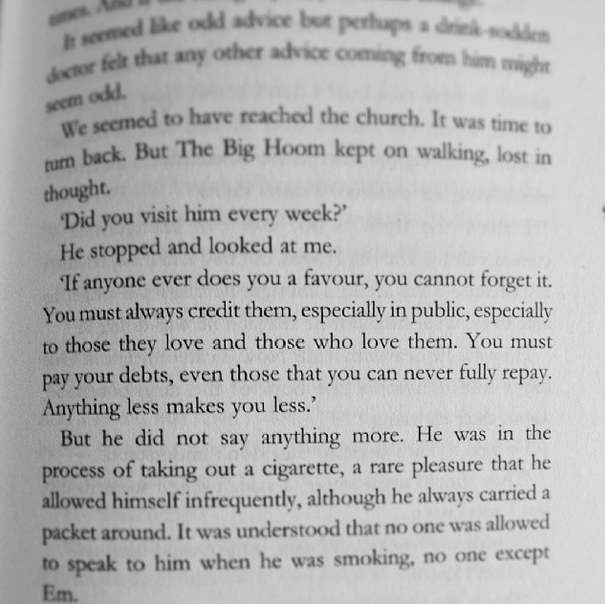
    During a recent offsite, my current boss said I was one of the most unflappable people he knew. Huge compliment, and one I totally cherished, not only because of my history in this context and therefore my progress, but also because I actually think he is one of the most composed people I’ve come across! This also allows me to bring up a related subject – praising others. One of the side effects of being harsh on myself was that I became stingy with praise. I think it was Surekha who first pointed this out to me. In Em and the Big Hoom, I saw some lovely words, and have tried to live by them.

    EATBH

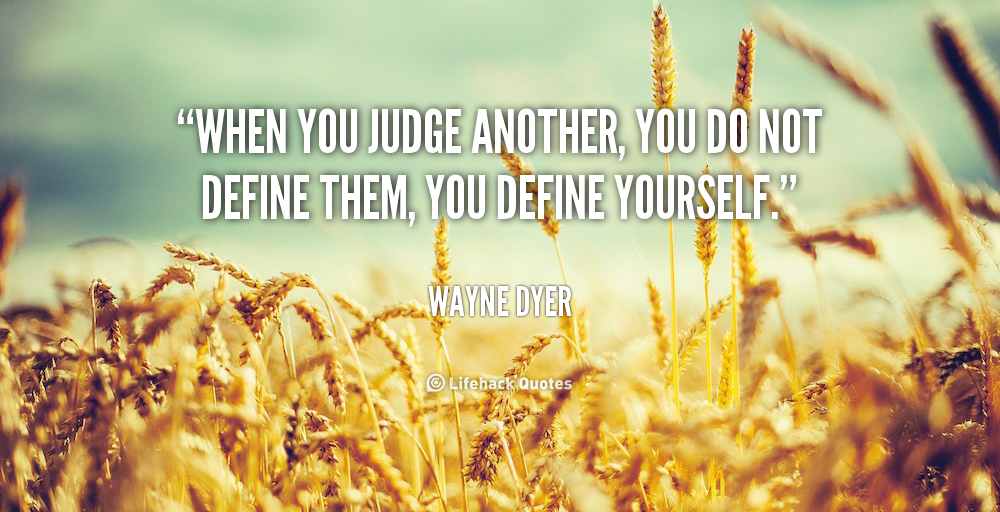
    Anything else makes you less.” That’s probably a judgment right there, but we’ll let it pass. These days, I try to praise – not for the sake of it, but by being a little more open to it. I also try not to judge. Even if I do, I keep it to myself, and make it as transient as possible. In the era of Twitter, this does become quite challenging! It is still a work in progress, and most likely will remain that way always, but I like to think that I have gained some ground. The mantra these days is

    quote-Wayne-Dyer-when-you-judge-another-you-do-not-42355

    until next time, judge dread!

  • A measure of helplessness

    A while back, I’d seen a Malayalam movie titled Pigman. Not really a typical movie by any standards, and that explains the poor performance at the box office. It is the story of a young man whose life pretty much becomes an abyss. (spoiler) The movie starts with him pursuing a doctorate in linguistics but failing to get it because of his research guide, who is miffed at him rejecting her advances. He sees no point in continuing and thanks to his family’s dire financial circumstances, is forced to take a job. He gets a clerical job at a pig farm courtesy a friend. A series of altercations with the corrupt management gets him demoted to the lowest job in the system – that of a pigman. He continues his protestations and the movie ends with him losing his mental faculties after being given electric shocks.

    It is a depressing story, and one can really feel his helplessness as his life spirals downwards degree by degree. In fact, the entire theme of the movie is failures in life, and it is as though, the intent is to drive home the point that some lives are meant to be lived in a continued state of helplessness.

    I think we have all felt helpless at some points in time, in varying degrees. Helpless in traffic (probably tactical helplessness, for the lack of a better word) at one end to probably the other extreme of watching a loved one die and not being able to do anything to prevent it or alleviate the suffering. I couldn’t help but compare it against what I’d call (again for the lack of a better word) chronic helplessness -a life consistently going down in quality (defined in this context as standard of living) – like the life of Pigman’s protagonist. In turn, I also couldn’t help but compare this to someone who has never had a decent standard of life. I wondered whether, among the last two, the last was better – if one hadn’t really experienced a higher standard of living, one wouldn’t know what one was missing, and therefore the suffering would be lesser than someone who had experienced it earlier, but could no longer do so because of circumstances.

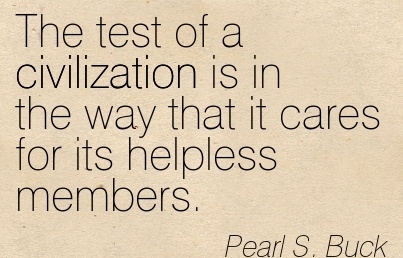
    And that is the really enigmatic thing about this business of living – there is no objective measure of mental anguish. If there were, probably we’d be better at helping those less fortunate than us. That would at least be a step up from feeling helpless at the injustice of it all. Help more, to feel less helpless. Sounds like a plan?

    until next time,

    Clipboard02

  • A different kind of prosperity

    A couple of months back, there was a very heated debate (mild term) based on an article that was titled “Why Generation Y Yuppies Are Unhappy” and (also) dealt with something that has occupied my thoughts for a while now – the sense of entitlement. It had a very simplistic formula on happiness : Happiness = Reality – Expectations, and the author’s take was that a sense of entitlement/being special heightened expectations and when that collided with reality, Gen Y’s happiness suffered. Another key factor in this was they are also regularly ‘taunted’ by people who are doing better – simply because the latter share their successes much more.

    I must say that my observations on the sense of entitlement have led me to believe that it’s not totally an age thing. I do agree that societal and lifestyle changes have led to parents becoming more indulgent, but I think the larger culprit is mass publishing platforms –  the ability to broadcast one’s thoughts to large number of people. It is enhanced when the publisher realises he/she has an audience. It does seem higher in younger groups but that’s only because they have been exposed to these platforms much earlier in their life than an earlier generation and therefore do not have the alternate perspectives and experiences of the latter. But the entitlement discussion is for another day.

    An interesting point made in the article was that Gen Y wanted fulfilling careers. What does not come out though is what defines ‘fulfilling’. Is it the emotional satisfaction of working towards a shared purpose, or is it the perks that come with a high-flying career? I suspect that fulfilling at this point swings more towards the material success that the latter provides. Umair Haque has an interesting take called ‘Growthism‘, a devolved form of capitalism, whose dogma is to achieve growth at all costs and according to the author prevents us from developing a sophisticated conception of what prosperity is. It does seem fluffy but that’s probably because we have been conditioned by various institutions for a long while now.

    But I sense a change is on its way. For instance, thanks to this post, I came to know of The Prosperity Index, which goes beyond the GDP and economic success based models of measuring prosperity of nations. While this is indeed a positive step, I think true change will happen when constituents like the Gen Y mentioned earlier begin to look at currencies beyond money for a sense of fulfillment, and happiness. In this must-read article titled “Who Will Prosper in the New World“, the author mentions “People who don’t need money” – people who have the incomes of the lower middle class and the cultural habits of the wealthy or upper middle class.

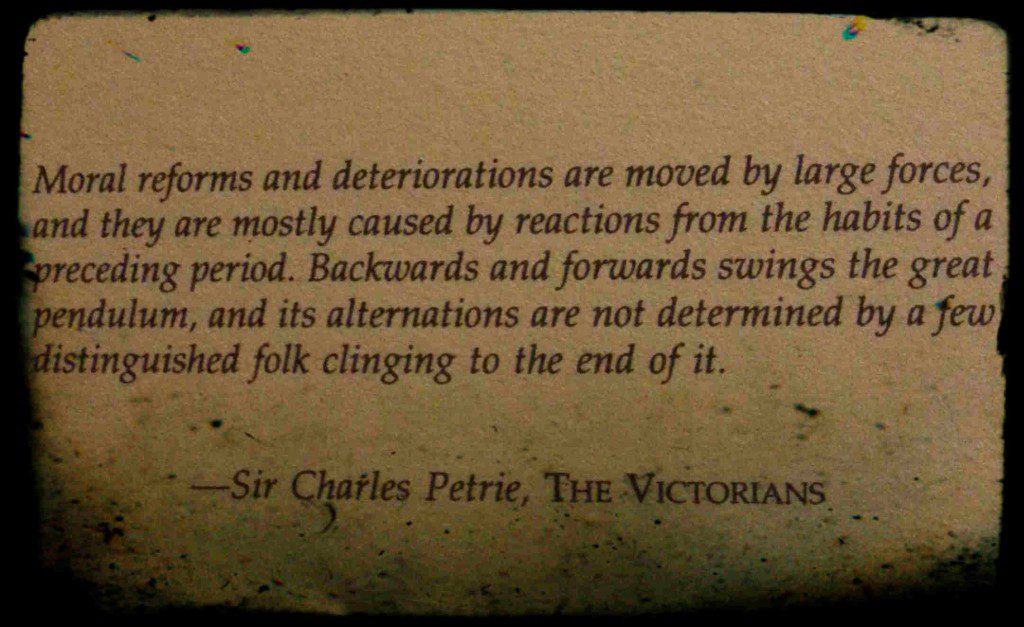
    I think we’re at the beginning of a new cycle – a generation will start ignoring the paradigms of success and fulfillment set by its predecessors and their institutions, and use the fabulous technologies that are evolving to craft its new narrative of happiness. I also think that my generation might be the casualty of two large concepts at war with each other, but maybe that’s what it takes for a civilisation to be entitled to its prosperity….

    moral

    until next time, changelings

    P.S. On a related note, do read ‘On Lifestyle Rigidity