Category: Choices

  • A different kind of prosperity

    A couple of months back, there was a very heated debate (mild term) based on an article that was titled “Why Generation Y Yuppies Are Unhappy” and (also) dealt with something that has occupied my thoughts for a while now – the sense of entitlement. It had a very simplistic formula on happiness : Happiness = Reality – Expectations, and the author’s take was that a sense of entitlement/being special heightened expectations and when that collided with reality, Gen Y’s happiness suffered. Another key factor in this was they are also regularly ‘taunted’ by people who are doing better – simply because the latter share their successes much more.

    I must say that my observations on the sense of entitlement have led me to believe that it’s not totally an age thing. I do agree that societal and lifestyle changes have led to parents becoming more indulgent, but I think the larger culprit is mass publishing platforms –  the ability to broadcast one’s thoughts to large number of people. It is enhanced when the publisher realises he/she has an audience. It does seem higher in younger groups but that’s only because they have been exposed to these platforms much earlier in their life than an earlier generation and therefore do not have the alternate perspectives and experiences of the latter. But the entitlement discussion is for another day.

    An interesting point made in the article was that Gen Y wanted fulfilling careers. What does not come out though is what defines ‘fulfilling’. Is it the emotional satisfaction of working towards a shared purpose, or is it the perks that come with a high-flying career? I suspect that fulfilling at this point swings more towards the material success that the latter provides. Umair Haque has an interesting take called ‘Growthism‘, a devolved form of capitalism, whose dogma is to achieve growth at all costs and according to the author prevents us from developing a sophisticated conception of what prosperity is. It does seem fluffy but that’s probably because we have been conditioned by various institutions for a long while now.

    But I sense a change is on its way. For instance, thanks to this post, I came to know of The Prosperity Index, which goes beyond the GDP and economic success based models of measuring prosperity of nations. While this is indeed a positive step, I think true change will happen when constituents like the Gen Y mentioned earlier begin to look at currencies beyond money for a sense of fulfillment, and happiness. In this must-read article titled “Who Will Prosper in the New World“, the author mentions “People who don’t need money” – people who have the incomes of the lower middle class and the cultural habits of the wealthy or upper middle class.

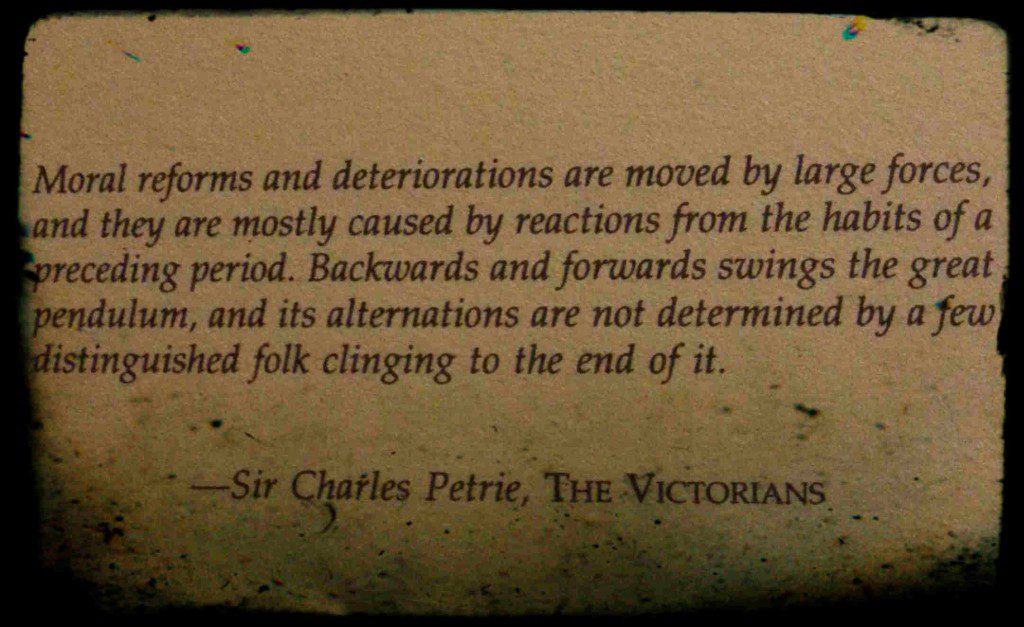
    I think we’re at the beginning of a new cycle – a generation will start ignoring the paradigms of success and fulfillment set by its predecessors and their institutions, and use the fabulous technologies that are evolving to craft its new narrative of happiness. I also think that my generation might be the casualty of two large concepts at war with each other, but maybe that’s what it takes for a civilisation to be entitled to its prosperity….
    moral

    until next time, changelings

    P.S. On a related note, do read ‘On Lifestyle Rigidity

  • A different kind of more

    (image via)

    Sometime back, I read this excellent post titled “Your Lifestyle Has Already Been Designed“. A colleague shared it with me because he felt I’d like it. And right he was, because it echoed my own thoughts on how our consumption these days have little to do with our needs. The author in fact, goes a step further to say that the typical 40 hour work week (actually it’s way more) manufactured by big business has reduced our free time to such an extent that whatever we do get is spent less in meaningful, healthy activities and more in drowning ourselves in wanton consumption. While that may or may not be true, I think we have a choice, but one that involves winning a battle within. When we lose the battle, we begin indulging ourselves covering it up with the ‘deserve it/earned it’ argument, and the culture of random consumption lives to fight another day. The author sums it up rather well with “We buy stuff to cheer ourselves up, to keep up with the Joneses, to fulfill our childhood vision of what our adulthood would be like, to broadcast our status to the world, and for a lot of other psychological reasons that have very little to do with how useful the product really is.”

    In a larger sense, we tend to live a life that’s not really ours. I cannot help but remember the words of a near-immortal “Your time is limited, so don’t waste it living someone else’s life. Don’t be trapped by dogma – which is living with the results of other people’s thinking. Don’t let the noise of other’s opinions drown out your own inner voice. And most important, have the courage to follow your heart and intuition. They somehow already know what you truly want to become. Everything else is secondary.

    In essence, what we consider as motivation from our own self is actually not. I found an amazing/bizarre manifestation of this in the truly unique story of Mike Merrill, who divided himself into 100000 shares and ‘sold’ himself. Known as the IPO man, his investors would earn a profit out of activities he did outside of his job. In fact, his intent behind the entire activity was to raise funds for things he wanted to do, and felt he would make a profit from. What followed is a fascinating story that has resulted in the investors even getting to have a say in Mike’s personal relationships and sleep patterns!

    I couldn’t help but think of how similar it was to an ordinary person’s life. It is an extreme case, but when we’re driven by wants and motivations that have little relation to needs, the only difference is that Mike is conscious of his lack of control, while we are smug in our belief that we’re in control. I most definitely am not saying we should be living like ascetics, but the balance does lie in consciously separating needs and wants. That, I believe, is the way to a fuller life. A different kind of more from a different set of mores. I wonder if it’s a coincidence that the term ‘Utopia’ was coined by a person named Sir Thomas More. 🙂

    until next time, more or less over

    P.S. The good news is that increasingly these days, I see people making conscious choices across the board – lifestyle, media, time, relationships. The more the merrier 🙂

  • Plan C

    This post has been pending for a while, the date of publishing of the article that inspired the post is evidence enough. It is about people who leave their jobs to follow their passion, but instead of the success stories we are used to, it focuses on the difficulties on that path. Even if you’ve not taken that path already, it’s quite possible that you have contemplated it. It’s romantic – the freedom, being your own boss and doing the thing you like – Plan B. But it’s not easy, and it begins as early as even identifying one’s passion. (must read)

    Interestingly, NYT themselves had an article almost a year later that asked “What Work is Really For” and answered that with an Aristotle quote “we work to have leisure, on which happiness depends.” Though I didn’t know about this quote until recently, this is a perspective that I have often used to debate with people who say those who do not like their jobs should quit. There are many reasons why people don’t, and one of them is consciously making a choice to work (possibly on things they don’t enjoy) for the 2 days (and vacations) when they are able to spend their resources – money, effort and time – on things they enjoy.

    The reasons people don’t scale up those 2 days could be many, including the difficulties involved in the early stages of setting up, and then maintaining a positive balance – of money and life. Money is after all an essential resource. It buys things, it opens doors. But when your passion becomes your work and your principal source of money, does it feel the same? Or does it become a job?

    I liked the second NYT article also for its last 3 paragraphs. It addresses the money conundrum. It talks about how right from when we are born, we are taught to be consumers, thanks to capitalism, which though calls itself an open market where we have the freedom to buy is actually a system unto itself.  The choices are not really independent. It points out that education should be meant to make us self determining agents. True freedom requires that we take part in the market as fully formed agents, with life goals determined not by advertising campaigns but by our own experience of and reflection on the various possibilities of human fulfillment. But that’s not an easy path either. It calls for independent thinking and a subjective view of fulfillment and happiness. And that brings us to the familiar “to each his own”

    until next time, work it out 🙂

    Bonus Read: Six Rules to guide your career

  • Halve nots

    During N’s last visit to Bangalore, the final minutes of our conversation was around rights and wrongs. Zeros and ones. Black and white. At some point in our evolution, we created halves – half rights, grays. Who’s to say your gray is grayer than mine? It becomes subjective, contextual. For argument’s sake, we could say that rights and wrongs themselves are such. But each time we make that gray decision, we know, and we pretend not to notice that little voice.

    Many years ago, as I sat eating an ice cream at the Cream & Fudge Factory in Koramangala (it no longer exists) an old man’s eyes met mine for a few seconds. He probably didn’t mean it, but as I took in his frayed but neat clothes, and his gaze that somehow conveyed that he couldn’t afford what I was having, I was suddenly struck by the unfairness of it all. These days, I wonder if I just imagined it all, and it was just my sub conscious conveying something to me. In any case, it’s like that subtext that once is known, is impossible to clear.

    We have to live, and make a living, N said. He was kind, and gave me various ways to assuage my feelings of guilt. But every time I make a choice – across life’s various scenarios – an extravagant meal, a new pair of jeans, a movie – I know I’m watching myself, and judging. It is easy to allow myself things, but who’s to say where the allowance ends. How objective can I be about myself? Every time I ignore that little voice, I add to the imbalance, blur the lines in my own eyes. A life has to be lived after all.

    until next time, live long and proper..

  • The masks we wear

    In TDKR, there is an interesting conversation between John Blake and Bruce Wayne, during which the former says that he knows Bruce is the Batman. He then talks of how he does not remember his mother’s death, but remembers his father’s murder well, and that the anger stayed with him. People understand, he says, but they don’t really know. They understand for a while, and they expected him to move on, to let go of the anger.  But he couldn’t do it, and when people realised that, he was sent to therapy and foster homes.

    He realised in time that for people to accept him, he would need to wear a mask that would hide his anger. He reveals that when Bruce visited the boys’ home he lived at years back, he immediately recognised that Bruce was Batman, because he himself wore a mask.

    Thanks to various experiences, I think all of us wear masks. Some of them are not because of experience, but for acceptance among others. Either ways, it works as a coping mechanism, and depending on our skills, at various levels of invisibility to those around us. Sometimes we are conscious of the mask and try to reach a place where we can live without them, by becoming strong enough to either face the past or deal with ‘acceptance’ on our own terms. Yet, despite those efforts, many a time, circumstances are such that the mask becomes the man, consciously or unconsciously. Whether or not that is a good thing is completely context dependent.

    But sometimes we are able to move on, just as Bruce was, embracing aspects of the Batman mask into his own personality. Or maybe it’s the other way – Bruce being a mask that the ‘true’ Batman personality wore. 🙂

    until next time, masker aid