Category: Future

  • Womankind

    Invisible Women, which I discovered thanks to D, is a book that I have been recommending to as many people as I can because of how enlightening it was. Though the extension of the book title is “exposing data bias in a world designed for men”, it actually goes well beyond that and brilliantly articulates the challenges that women face at the workplace, in public spaces, their everyday lives, and how the world works differently for them in the many, many things that men take for granted.

    In another powerful book that I read recently, The Age of Surveillance Capitalism, Shoshana Zuboff eloquently explains how the latest form of capitalism has gone rogue and is now well on its way to influencing human behaviour and actions at industrial scale. By extension, this is a systematic assault on the concept of free will, all part of a relentless bid for more money, power and control. While industrial capitalism exploited nature, surveillance capitalism is doing the same to human nature. (more…)

  • AI: Artificial Instincts

    In Regression Planning, I wrote on whether we could re-learn the skills we have outsourced if events force us to. I read The Book of M recently, and it led me in a different direction on the same subject. The book is fiction set in a dangerous future, where people lose their shadows. What starts as a curiosity takes a dangerous turn when they realise that with the shadow goes memories. All kinds of memories – from their life thus far to the knowledge that they have to eat to survive. The extreme case is forgetting how to breathe. Imagine feeling suffocated and ultimately dying when all that’s needed is to draw a breath. Yes, it’s extreme and yes, it’s fiction. And isn’t that just instinct, you would ask. Yes, again.

    Yuval Noah Harari writes in”21 lessons from the 21st century” about how in March 2012, three Japanese tourists in Australia drove their car into the Pacific Ocean, thanks to their unwavering trust in the GPS. Apparently it kept saying it would navigate them to a road! You could shake your head and quote Einstein on the infiniteness of human stupidity, but I don’t think it’s that simple. A better question to ask would be why they didn’t trust their intuition.

    We all have intuitions and intelligence that we develop over a period of time. We become smart, or that’s how it’s supposed to work! But is that really so now? The smartphone was only the first step. Devices and even ambient environments are becoming smart. In a few decades we have moved from machines that help in physical tasks to systems that are taking over cognitive tasks, something Kevin Kelly has written about in The Inevitable. We’re increasingly outsourcing intelligence. The silver lining is that we’re at least trying to ensure it stays comprehensible to us!

    Instagram, Facebook, Tinder, Spotify, Netflix, Amazon – everything is a feed of recommendations, whether it be social interactions, music, content or shopping! Once upon a time, these were conscious choices we made. These choices, new discoveries, their outcomes, the feedback loop, and the memories we store of them, all worked towards developing intuition. Beneath the cognitive skills we display externally is the wiring, and as the saying goes, Neurons that fire together, wire together. I think we’re now in the process of firing intuition and outsourcing it to algorithms. I don’t know what will happen first – advances in cognitive neuroscience, or the outsourcing. The hope is that they will happen in parallel and we will make choices about them after conscious reasoning.

    Intelligence, intuition and instincts. The journeys in the first two are what have gotten the third hardwired into our biology and chemistry. When we cut off the pipeline to the first two, what happens to the third, and where does it leave our species? What is the organism that has artificial instincts?

  • Regression planning

    During our reindeer sledding tour in Tromso last year, our guide, who was a Sámi, gave us a glimpse of their way of living. A semi-nomadic life, built around their reindeer herds, which involved them traveling for several days twice a year across hundreds of kilometres. She told us how the capture and nurture of reindeers, and the lifestyle itself, has changed from a means of livelihood to a tradition that only very few are interested in.

    In Fahadh’s movie Njan Prakashan, there is a hilarious, yet poignant moment, when he is asked to help the other workers plant rice seedlings in a field in Kerala. The workers immediately start off and are soon singing in gusto. Fahadh, who has never done any of this before, stands with his mouth agape, and then asks what the language is! His boss explains how most of the paddy field workers in Kerala now are Bengalis, and they’re singing their customary song. “We’ve forgotten our job, we’ve forgotten our song“, he says (roughly translated). (more…)

  • Evolving against entropy

    ​In the last fortnight, I had two interactions with customer care teams. The first was Kotak, for a bank account. There were failures at multiple levels, but the biggest takeaway was how difficult it was to get through to a human. Chatbots have their uses but this was extreme! Twitter DMs weren’t a help either. The second was Amazon, and that surprisingly included being put on hold for about 15 minutes and transferred 5 times! Thankfully, the problem was resolved in 30. But given the famed Amazon customer-centricity, this was a disappointment, and I wondered if at scale, it was inevitable. 

    What causes it? The best frame I have seen is entropy. (via) Yes, that physics and thermodynamics thing – the degree of disorder/randomness in the system. Though the meaning remains the same, the application changes. In the context of a business, it is the tax applied by the system between input and output. Just imagine the effort that is required to get things done in a corporate structure as against a startup. While it is theoretically possible for a complex system to have lesser entropy than a simple system, I have not seen it in practice. I can imagine why it is so – the randomness that can be generated by different touchpoints, and their optimization for following rules as opposed to providing solutions. What happened to me with Kotak and Amazon were examples of that.   (more…)

  • Choices & Automation

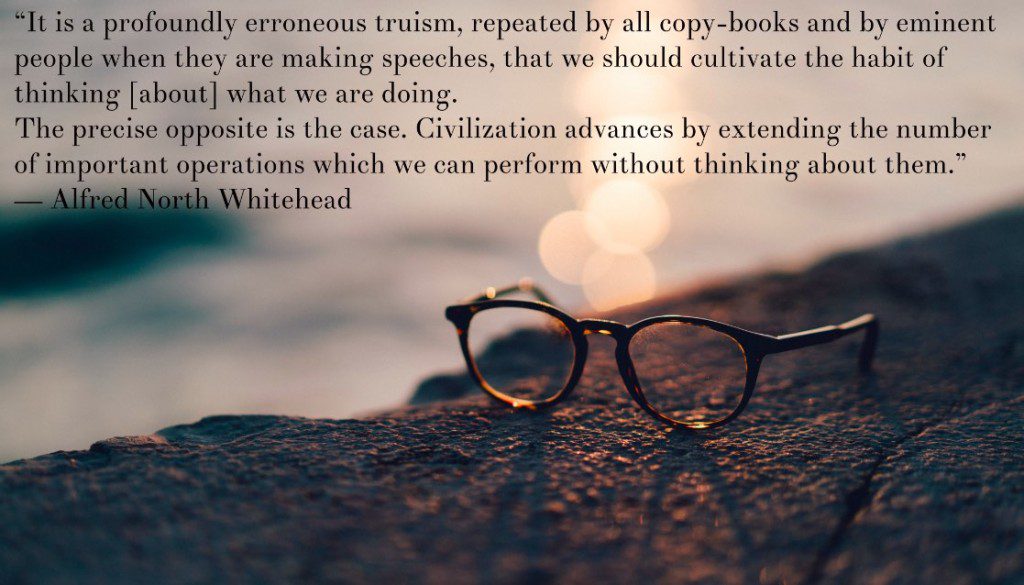
    Taylor Pearson wrote an excellent primer on blockchain a while ago. While explaining why blockchain matters, he quoted something by Alfred North Whitehead

    Untitled 1

    Photo by Joshua Newton on Unsplash

    (more…)