
Category: Future

  • Evolving against entropy

    ​In the last fortnight, I had two interactions with customer care teams. The first was Kotak, for a bank account. There were failures at multiple levels, but the biggest takeaway was how difficult it was to get through to a human. Chatbots have their uses but this was extreme! Twitter DMs weren’t a help either. The second was Amazon, and that surprisingly included being put on hold for about 15 minutes and transferred 5 times! Thankfully, the problem was resolved in 30. But given the famed Amazon customer-centricity, this was a disappointment, and I wondered if at scale, it was inevitable. 

    What causes it? The best frame I have seen is entropy. (via) Yes, that physics and thermodynamics thing – the degree of disorder/randomness in the system. Though the meaning remains the same, the application changes. In the context of a business, it is the tax applied by the system between input and output. Just imagine the effort that is required to get things done in a corporate structure as against a startup. While it is theoretically possible for a complex system to have lesser entropy than a simple system, I have not seen it in practice. I can imagine why it is so – the randomness that can be generated by different touchpoints, and their optimization for following rules as opposed to providing solutions. What happened to me with Kotak and Amazon were examples of that.   (more…)
  • Choices & Automation

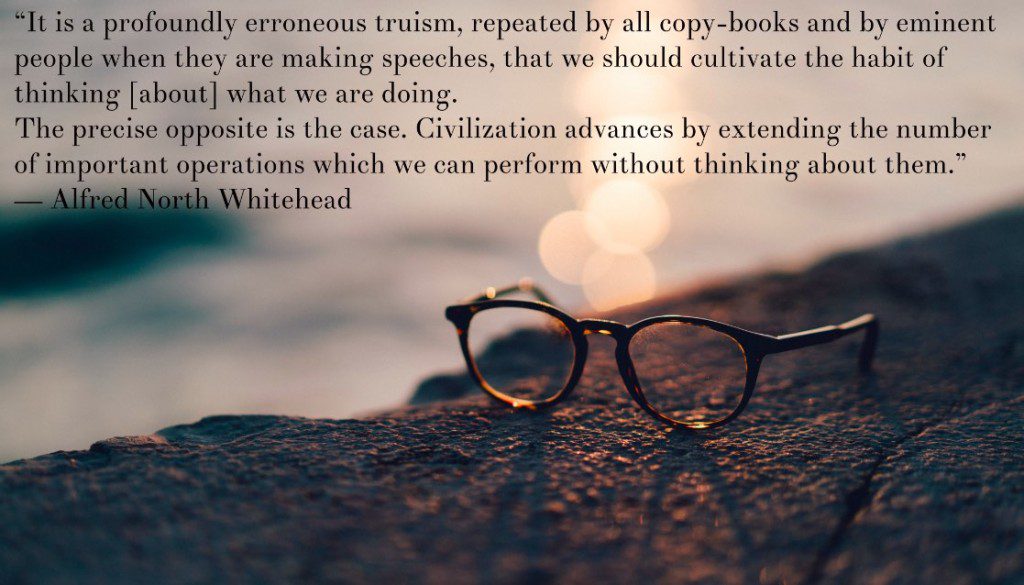
    Taylor Pearson wrote an excellent primer on blockchain a while ago. While explaining why blockchain matters, he quoted something by Alfred North Whitehead

    Untitled 1

    Photo by Joshua Newton on Unsplash

    (more…)

  • Peak Abstraction

    Saturday mornings are sometimes spent at the lake nearby – walking/jogging around it. A few weeks ago, I saw a few dressed-for-exercise folks spending the entire time doing an intense “exercise” – posing for selfies! To be fair, the lake is pretty, but..

    It led me to an interesting line of thought. Before I let you in on that, some context setting, or you might close the tab at the ridiculousness of it. Given that the species has lacked telepathy, we have been abstracting for a very long time. Sensations, emotions and thoughts that make up our subjective reality needed to be conveyed. We converted them into everything from facial expressions and actions to drawings to language – spoken, written and then published soon as we entered the machine age. You are now reading what I am thinking.  (more…)

  • The abstraction of trust

    Usually, I use evolution. But that indicates a forward movement, and in this case, I am not so sure now! I had a thought on how the notion of trust in transactions has changed, and felt that I should document it, even if it’s in a super simplistic way!

    1. It began with a producer/consumer – consumer/producer relationship in the form of barter.

    2. A central currency suddenly opened up trade and now it could just be producer – consumer

    3. That also meant that a middleman could enter the system, hence a producer – seller – consumer (more…)

  • In other fake news..

    Went by the title, did you? Ha! This is less about fake news, and more about what could be called its second order effect. In Against Empathy, Paul Bloom writes about how many beliefs are not the products of reasoning, and gives sports teams fans and even political support as examples. He also brings up the point that these views don’t really matter because of the minimal impact one person’s belief has on the world at large. The contrast offered is one’s everyday morality that affects those around. He goes on to say that because of this minimal impact, we should look at people’s views on global warming, health care etc in the same light. The difference between truth and their views does not really matter because it doesn’t really cause a huge impact. To be fair, he is not happy writing this. I wasn’t really happy reading it either, because I saw at least one horrible exception – think personal hygiene values (“I won’t use a deodorant because.. global warming”) and you’ll get the picture. That definitely has an impact!

    But moving on, he also explains how people are capable of rational thinking on things that matter. This is where I differ. I am not denying that people are capable. They probably begin that way, but I think the capacity is lost over time. Why do I think so? (more…)