
Category: Future

  • A proxy life

    I have forgotten where I first came across Goodhart’s Law. It was probably Farnam Street. It states that “when a measure becomes a target, it ceases to be a good measure.” An illustration should help.
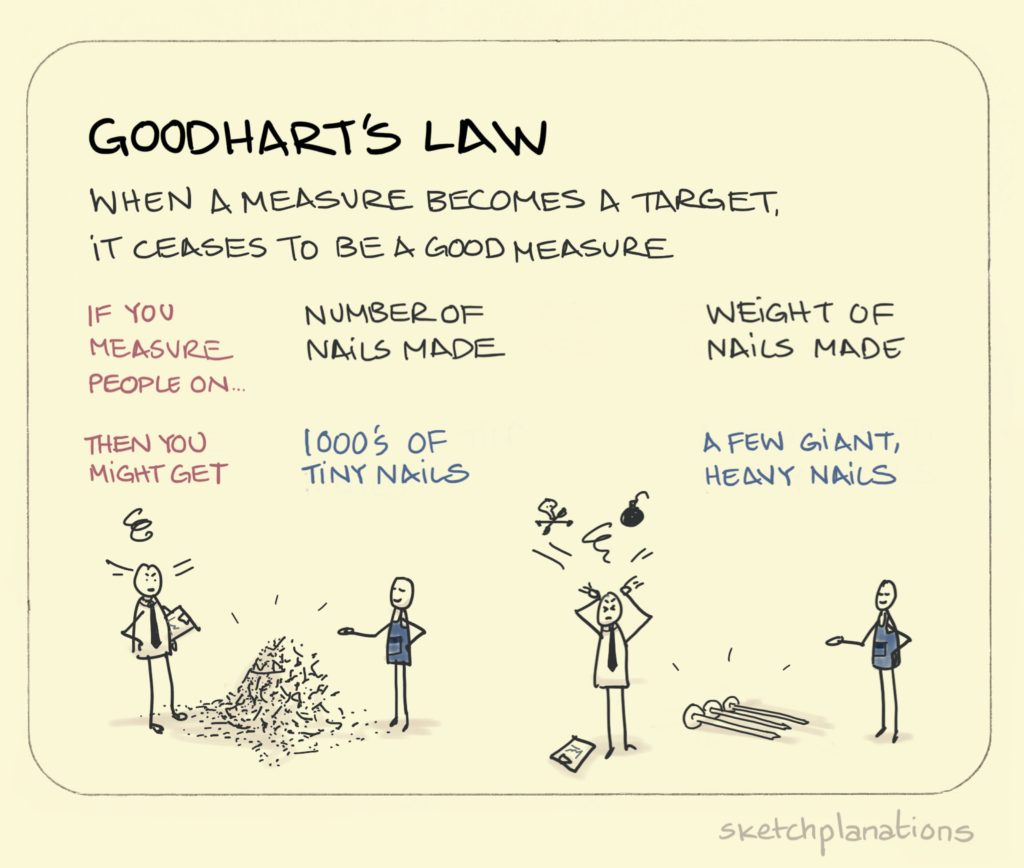
    https://sketchplanations.com/goodharts-law

    In the organisational context, it serves as a great lens to evaluate strategy and progress. As the illustration above shows, the entire direction of a desired goal can be changed when measures become targets. But, and maybe it’s a Baader -Meinhof phenomenon, I am now seeing different versions of it everywhere.

    To set some context, as more and more things have been digitised, the volume of information has just exploded. For instance, before the advent of social media, there were limits to one’s “people like me” canvas, because even an awareness of them was constrained by physical distances and the limits of one’s social circle. It had to be in real life, and public spaces like a cinema or even a vacation spot were probably an extreme. Social media changed that scale massively. Many factors including this volume of information, the lack of a granular understanding of the lives of this new set of people whom you’d never meet, and the innate human desire to do better than neighbours meant that appearances became the norm. Since we are not wired to process such large volumes of information, we dug deeper into ‘measurement by proxy.’ Not that this mode of measurement is new. For instance, we have used material manifestations (apparel, cars etc) as a measure of wealth. The stock price is a single-number measure of everything about the company. But with abundance of choice and the limits of processing power, we started developing heuristics and measuring what was easy. Meta photos (FB/Insta/WhatsApp) became a measure of everything from the quality of life to the strength of relationships. Popularity as a measure of excellence, price as a measure of quality, fitness as a measure of health, #booksread as a measure of erudition and so on.

    How does this connect to Goodhart’s Law? We end up optimising our resources for the measure, not the end goal. Which means that though the goal is say, happiness and a good quality of life, we end up aiming for the measure. From the kind of photo that will get more likes to buying that thing/experience that will surely make us happy. And as we feed this more, the mind keeps on wanting. The happiness fades in a short span of time. And as the Buddha has wisely pointed out, that loss of happiness is what becomes suffering.

    In the AI risk narrative, there is the story of the paperclip maximiser, a seemingly trivial task of maximising paperclips that might lead to “first all of earth and then increasing portions of space into paperclip manufacturing facilities”. The corresponding human version that I wrote in Peak Abstraction was that maybe we will get to a state where, if we get enough likes on the couple photo on Insta, there would be relationship bliss! What a wonderful world.
  • Artificial Culture

    It’s almost a year and a half since I wrote In Code we Trust. More recently, Tim Ferriss had Eric Schmidt on his podcast (transcript). In what I thought was a fascinating discussion based on the latter’s recent book  The Age of AI: And Our Human Future, (coauthored with Henry A. Kissinger and Daniel Huttenlocher), they also brought up AlphaGo. Go was a game that humans had been playing for 2,500 years, and it was thought to be incomputable until DeepMind’s AlphaGo beat world champions. As Schmidt explained, some of its moves and strategies were the kind no one had thought of before. In Kissinger’s words, we’re entering a new epoch, similar to the Renaissance, this age of artificial intelligence, because humanity has never had a competitive intelligence, similar to itself, but not human. To note, a more recent version – AlphaGo Zero self-taught itself without learning from human games, and surpassed its predecessor in 40 days!

    (more…)
  • .bio

    D heard a podcast recently, in which a “patient”, after going through an entire treatment procedure, realised that she had been misdiagnosed – there was no illness! This could be an isolated case, but even then, how could it happen?

    Based on my recent experience with the doctor community, I realised that at least one facet of it was like any other profession. Some doctors keep themselves updated and bring a nuanced understanding. On the other hand, some still stick to what they have been told a decade or more ago, despite advances in procedures and medicines. For instance, several doctors in top hospitals for years had claimed I had a sinus problem. Dr. A finally diagnosed and treated it as a migraine, that too through a tele-consultation, and just like that those irritating headaches disappeared. In another instance, I probably became the first patient to ask for an endoscopy because the idiot gastro I consulted only because of an operational exigency, had no clue! To top that, the ‘counselling’ he did after that was practically the equivalent of asking me to take the next flight to the nearest temple town because the rest of my life would be devoid of meat, alcohol, spice and pretty much anything worth eating! Luckily, a different doctor with a slightly unorthodox approach cured me. I thankfully had my doctor-cousin J to whom I could turn to for perspectives each time I lost my mind, but not everyone has that luxury!

    All of this made me think about the profession and how things have changed. In my childhood, we had trusted doctors, who knew the family and were practically friends. They asked questions, took time to diagnose and were wary of indiscriminately throwing medicine and scalpels at every problem they saw. Of course, that can be taken to the extreme too. A few years ago, my dad’s doc in Cochin was responsible for his month-long hospital stay and pretty much a downhill after, because his response to a cough for over a month was broadly ‘this too shall pass’! But barring exceptions, these days before you say hello, there are 10 tests and a hundred forms (and insurance, of course) when you have a health incident. While the earlier lot of doctors probably relied on first principles and sheer experience to train their gut and create hypotheses, which could be validated with tests, we now ironically have abstract numbers and parameters.

    What has also changed is how we select doctors. References aren’t easy, so we now choose doctors much like movies and restaurants – crowdsourced reviews, notorious for being gamed, or the ‘safety’ of a hospital chain, whose revenue models are infamous. Do doctors there optimise for pleasing people or treating them? Make sure the hospital keeps getting revenue, or ensure the patient doesn’t have to visit again?

    Which brings us to the nefarious component of practically everything in life now, even in a profession which was about saving lives. Money. Maybe it starts with the kind of money they have paid for their education, just as it is with a lot of other professions. They have to ensure they get return on their investments. Or maybe, as D pointed out, it isn’t even that nefarious, it is just conformity – this is what other doctors are doing. We are famous for that at a species level.* Or resistance to new ideas – after all, it was only a century and a half ago that the doctor fraternity resisted washing hands, and the poor doctor who proposed it lost his job and died in a psychiatric institution!**

    It made me wonder about the future of healthcare – at least two aspects of it. One of the big reasons we considered Kerala for retirement is the quality of government health care. Not that it’s perfect. In a town just over 50km from Cochin, where my in-laws live, the healthcare is borderline negligent! But from the little I have read, it seems other states are worse. I don’t see this improving, PM-JAY or any other Modiware notwithstanding. The taxes we pay, which are supposed to be used for things such as this, are probably being siphoned off to shell companies or for fighting the next election.

    On another front, what will the march of AI mean for all of this? Assuming we are able to program out the biases, will we have to worry less about medical costs because R&D can be potentially cheaper? Or maybe the arms race between microbes and us will become more intense. Will an increase in efficiency by the automation of tasks lead to more empathy? Will we have better diagnostics whose error rates are lower?

    At the ground level, from cancer and (potential) cardiac events via eye tests or sound and more accurately, to vaccines for the pandemic, there have been a lot of advances. Getting the genome sequenced, understanding genetic risks of specific diseases, collecting data via sensors and converting them into information and insight, and even creating rule-based programs to optimise for results ranging from aesthetic to cognitive are all possible now. After we have enough data, it should be (theoretically) possible to create a rule-based AI that works with sensors connected to the body and outside, to do everything from sleep structuring (mattress, temperature control, meditation apps, timing etc) to diets (recipe suggestion to ingredient ordering and even cooking – thanks to robot chefs) to an extremely optimised version of preventive health procedures right from the time of conception! And that’s probably a personalised step 1 of immortality!

    When health and healthcare change, how will the role of doctors evolve, and how (and how fast) will they adapt?

    P.S. Broadly related read on education – Why we stopped making Einsteins

    *Asch conformity experiments

    ** Keep it clean: The surprising 130-year history of handwashing

  • A digital multiverse

    It was towards the end of 2020 that I came across Roblox and wrote Metaverse : Get a second life. Since that post, Mathew Ball has written the definitive primer on the Metaverse1, and if you’re interested in the subject, it’s a must-read. The word “metaverse”, ICYMI, was coined by Neal Stephenson in Snow Crash, and the book is being referenced in many recent conversations. In fact, Stephenson has been quizzed for years, each time we seem to take a step in this direction, and his comments continue to be prescient, insightful and hugely creative. This one, from 2017, in Vanity Fair, is a favourite, and contains, among other succinct gems

    The purpose of VR is to take you to a completely made-up place, and the purpose of AR is to change your experience of the place that you’re in.

    Neal Stephenson
    (more…)
  • $ocial Validation

    The presentation of selfie in everyday life is all around us, and the words I always refer to paraphrase this are

    When everything becomes image rather than action, you can’t judge the value of any act. You can only judge what it “looks like”. But when all of society is doing that, it means that you’re being judged on everything. After all, you may not always be acting, but you are always appearing. When it’s your appearance that determines worth, there is no moment to rest. There’s a social invasion.

    The Uruk Machine
    (more…)