Category: Future

  • Brands and the Personal API

    Lifestreaming and I go way back, at least 5 years. 2008 was when I wrote about it first, though the experiments had started earlier. Most of the services I’ve mentioned in the post are now defunct, but my interest in the subject never waned. From the perspectives of memories mentioned in that post to speciation to brands using their lifestreams to build communities around it, I have had several thoughts on the subject. That’s why I found this post at GigaOm, which was about Foursquare co-founder Naveen Selvadurai sharing data logs from his life (weight, sleep, activities) and hoping developers would hack his ‘personal API‘, very very interesting. There have been stories about people and the tons of lifestreaming data they have amassed, but I had never heard of an API, and therefore consider it pioneering work.

    Pioneering, less because of the novelty, and more because I think it has the potential to become mainstream, and even, the default paradigm of creation and consumption. Since the engagement @ scale framework refuses to let go of me, I immediately thought of the personal API in that context. With technological advances, I think it’ll become easier to create one’s own APIs and you can see several companies mentioned in the GigaOm post that are working on it. So I’d hope that its evolution is as fast as (or faster than) that of self publishing (on the web) which about a decade back was a relatively complex thing to do. So, in essence, we’re talking about huge amounts of data that are being generated and captured by individual users, and this is only going to be accelerated thanks to phenomena like wearable technology.

    The current way of looking at Big Data is to synthesise actionable insights from processed and unprocessed information from touch points related or unrelated to the enterprise. As I’d mentioned in my presentation (on engagement @ scale) this is then used to target users better or drive more efficiencies.  They don’t really operate at the higher levels of community/meaning/purpose. Now think of the personal API and the data it holds. What if we looked at this individual streams of ‘Big Data’ not from the enterprise’ perspective but from the user perspective? What if brands created platforms that  would allow people to upload data that they choose to so that the brands could solve their needs better? Like I wrote in my ‘maker’ post, with massive technology leaps happening in areas like 3 D printing, there are tremendous opportunities for co-creation. Brands could even aggregate data from these individual streams to find need gaps and package that for a larger market. In fact, I’d say that this is probably what Nike+ is doing already.

    But the real story is that these personal APIs could give great insights into the individual’s purpose in life, his priorities – in short, his life’s narrative. It gives brands the window to latch on to the narrative that they can identify with, and create value and meaning in the individual’s life. I think that’s what brands originally strove to do!

    Update: Thanks MJ, for pointing me to the Nike+ Accelerator!

    until next time, AP”I”

    PS: Over at Soylent, they’re creating the nutritional equivalent of water, an ubiquitous ‘meal’ that is customised for body types. Funding? Kickstarter of course! 🙂

  • Work from….

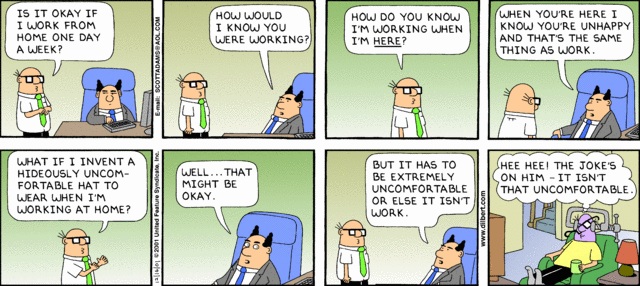
    (image courtesy: Dilbert)

    Sometime back, Marissa Mayer [disclosure: I’m a giggles fan 😉 ] created quite a flutter with her decision to get Yahoos to stop their work-from-home arrangements. This seems a performance linked decision and across the web, you will find various perspectives on it. This mix of perspectives continue on the employee side as well. Working-from-home brings its own set of pros and cons, and one can debate it from both sides.

    As with most everything, there can hardly be a single solution that fits all, and there are various subjective elements on the employee and employer sides that need to be considered. This is especially so in the social era, when corporations will be compelled to align business objectives with a purpose that consumers and employees can identify with, and work cohesively towards.  (more…)

  • A larger plan

    Most of everyone who knows me would agree that I am a compulsive planner. This habit has been reinforced on several occasions when I have been better prepared than others in situations. However, I also believe that it is quite a trade-off – between the safety of knowing in advance what to expect and the thrill and joy of leaving oneself open to an experience. The middle path is quite difficult to achieve in this case.

    That was why I was very intrigued by the phrase – Negative Capabilitythe willingness to embrace uncertainty, live with mystery, and make peace with ambiguity. From experience, it is forced upon us too. The best laid plans can go awry often because even the best of minds cannot sometimes envision every possible scenario. That’s not the only time I have been humbled by the limitations of the human mind. From something as simple as understanding what’s really going on in another person’s mind (not to mention my own understanding of my mind) even as they tell you things to larger questions on purpose and destiny, we’d be fools to think that we can know the mechanism of everything around us.

    But as humanity progresses, is there a tendency to convert everything to science, or a skill/process that anyone so inclined can master? As we discover more, I wonder if there is a collective ego that develops and one that says we can understand and control everything around us. As a race, are we becoming increasingly intolerant towards uncertainty?

    But as this post says, the idea that the current version of our mind is only one step in evolution is very compelling. I wonder if, by increasingly closing our mind to uncertainty, we are moving in a direction opposite the one that will help us solve the greatest puzzle of it all – why are we here?

    until next time, what’s your plan?

  • Remember the feeling?

    The subject of Augmented Humans has come up regularly on the blog. (see) Sometime back, I saw this short film (via) which featured a dystopian version, in a world where augmentation was the norm. The range of ideas that have been shown in the movie is amazing.

    TRUE SKIN from H1 on Vimeo.

    <spoiler> The most fascinating portion for me was the ‘memory insurance’ concept at the end, which would “implant your memories into a new you” if something happened to your physical self. Essentially, your ‘self’ would be immortal. Can you imagine living for thousands of years, with your memories intact? I have always wondered what it would be like to have memories, and not feel them.

    until next time, brain vs mind?

  • Glimpse into the future.. and the present

    Fans of Star Trek : The Next Generation would easily remember Geordi La Forge and his VISOR. For those not familiar, the VISOR is “a device used by the blind to artificially provide them with a sense of sight.” It does so by scanning a scene and transmitting it directly to the brain via optic nerves. Science fiction? Yes.

    But when I read about Google’s Augmented Reality glasses and the potential – from the glasses that could act as a guide for tourists at popular destinations to the more complex “consensual imaging among belief circles” for sharing ideas and to “overlay a trusted source’s view of a given scene on mine”, I wonder how far we really are from what would have been, until recently, tagged science fiction. In response to another related post shared on Google+, I commented, “I have this thought of the glasses capturing information even when the eyes are closed and the brain processing it by the time we’re awake.” I wonder if it is not far off when the ability of our natural sense organs will be negligible compared to the technology we create. No, we’re not getting into the augmented human debate or an eye vs camera one. 🙂

    I tweeted that I had expected Google to give me a view of parallel universes. (my alternate reality) 🙂 That’s probably still science fiction, until we really master time. But I did see something (awesome) on those lines too – The Quantum Parallelograph, a device that allows you to get a glimpse of your life in parallel universes.  Maybe there will indeed be a time, when a human species can make choices with all the data of not just its current reality, but alternate realities too. Would you really want it? Would the whimsical concept of an alternate reality make sense at all then?

    until next time, sight vs vision