Category: Future

  • The Future of Owned Media?

    Tech Crunch had a rather funny take on why Bezos bought the Washington Post, but the more thought provoking piece was on the Post itself. (via @nixxin) Its premise was that the predictive analytics perfected by Amazon could be used to provide Post subscribers with personalized news feeds based on where they live and what they have read before. People browsing The Post’s Web site or tablet app could be served ads tailored to their past purchases, and then could buy products with a single click. Ironically, the last paragraph actually ends up validating the TC post. 🙂

    It reminded of an earlier post of mine, in which I had wondered about the future of media in a social era, and though I did not use the words, asked whether a ‘marketplace’ kind of model for news creators and curators was possible. To be honest, I was still skeptical whether a business model could be worked out on this line of thought. But the entire WaPo purchase by Bezos, the subsequent discussions on the web, and this fantastic article at Forbes that brings out the radical shifts in management required for a firm to thrive in ‘the creative economy’, set me out on a new direction.

    Media and advertising, like I mentioned in the earlier post, have had an intertwined life. What if media cannot now exist as a business on its own – the primary reason being that the value it provides -news -is being disrupted by technological innovations including self publishing tools? Does it mean that  its role now has to be seen within the context of a larger business? We’re already well into the paid-earned-owned media cycle, and while paid is arguably on a decline, earned is now increasingly being controlled by the platforms. (FB’s Edgerank, for example) Does it not make sense for a firm to make relevant news part of its product offering, or part of a sales process? Of course, the dynamics would work different from a merchandise marketplace, but if news is a commodity, can’t its vendors be on a marketplace? Media corporations might not be able to sustain a business model with high overhead costs, but journalists could build a reputation and thrive, and the marketplace would decide their price!

    The WaPo purchase is probably just another kind of vertical integration. Much like an e-com company India would build its own logistics or payment gateway and then even white label it, the far-sighted Bezos might have just taken the first step in evolving owned media in a scale and direction no one has ever thought of before. Journalism has mostly been subsidised by commerce – I’d say this is just another evolutionary necessity.

    until next time, to each his own media..

  • The questions in Big Data

    In my last post that touched upon Big Data, I had mentioned how the seeming intent of Big Data is to synthesise actionable insights from processed and unprocessed information at touch points related or unrelated to the enterprise, and then use it to target consumers better. While this is probably true for the short-medium term, I read a wonderful perspective at GigaOm by Beau Cronin on its true potential – the path to building the equivalent of global-scale nervous systems. As I tweeted after I read it, it reminded me of something I’d written a couple of years back before I’d heard of #BigData – if we could actually use data to go beyond that to answer life’s profound questions. Before we go into the subject, here’s a nice video by OgilvyOne titled “Big Data for smarter customer experiences” (via) though it’s skewed more towards the experience rather than the data.

    Beau Cronin has mentioned several possibilities this would give rise to, and the post made me think if something like the hive mind concept would mesh into it as well – a sort of hybrid neural network. He has also pointed out the hurdles we would face while we get there – gathering, processing and conversion into actionable insights, and how phenomena such as priming,expectations, and framing matter so much in how we perceive our physical and social environments. In essence, a fascinating read.

    I was particularly intrigued by framing, and began thinking about it in the context of the unstructured data – tweets, posts, mails, videos – that is a major component of Big Data. The fundamental question being – is it unstructured because we’re framing it ‘wrong’? Based on the enterprise’ intent and not the users’? Ironically, I couldn’t frame the questions right until I met the ever-brilliant S, who has always maintained that the answer is easy to find once the question has been framed right. He has developed (Tulpa -to build or construct in Tibetan – is the concept he enlightened me on while we were discussing semantics) something that at a rough level mashes the MECE principle with Frame Semantics and the entity-relationship model. There’s IPR involved, so no more beans shall be spilled, but as always, I learned much from the conversation.

    In essence, structure can definitely be derived from what we currently call unstructured data, provided we frame the queries right. I can intuitively begin to understand that in the era of data abundance, the only way we can make sense of all of it is by focusing on an intent that is derived from a common purpose, so that the sources of data (users) will be more open to help solve the challenges of data collection. The processing and inferences that follow would yield the best results when the right questions are asked. I have a feeling that the questions asked by a business in an earlier era might not cut it.

    until next time, role models

  • Future Tensed

    Thanks to Neal Stephenson’s The Confusion, (Vol 2 of The Baroque Cycle) I’ve had to do something that I haven’t done since I started reading – read two books in parallel. Every 200 pages of The Confusion, I take a break and read a volume of The Hunger Games. Neal Stephenson, to me, is genius, and I’ve been a fan since I first read Snowcrash. I could speed read The Confusion, but I really want to pay attention and understand the nuances, the humour, the larger thought and so on. I cannot do that for 800 odd pages, hence this shift.

    I only understood the ‘connection’ after I started reading The Hunger Games. The Baroque Cycle is set in late 17th-early 18th centuries, and uses an excellent mix of historical and fictional characters to cover a whole variety of themes. In some ways, it uses the past to understand the present. The Hunger Games, on the other hand, is set in a dystopian future, and shows a potential fate of humanity. It uses cues from the present to predict the future. The connection ends there, almost. Though at massively different levels, both require imagination, the former at a much more larger scale.

    That’s what led me to think about imagination in the present. We’re in the midst of probably the biggest upheavals in the history of humanity – new technologies emerging at a rapid pace, institutional realignment, socio-cultural changes, behaviour alteration and so on. All of this means, that collectively, we’re having to run really fast just to cope. Where does that leave time for imagination? In fact, such is the assault on senses that I wonder if anything really disruptive is being written in the science fiction genre these days (I hope to be proven wrong and pointed in the right direction) because except for things like teleportation and time travel, pretty much everything that was science fiction is getting played out now, and so busy are we – trying to keep abreast – that science fiction is merely extrapolating the present (read) or giving alternate versions.

    There is a term in psychology called Functional Fixedness, wiki-defined as “a cognitive bias that limits a person to using an object only in the way it is traditionally used.” With my limited knowledge, I wonder if that’s the dystopian future of the human imagination.

    until next time, the end of collective imagination

  • Can media become social enough?

    A few days back, it was reported that Facebook now had a million active advertisers, and that LinkedIn has 3 million company pages. I’ll let that sink in, in case you hadn’t heard. Despite all the social-ness, I realised it’s impossible not to call it media. The wiki definition for media is “tools used to store and deliver information or data” That, for me, is a smartphone now! I also wondered how many media behemoths could boast of a million active advertisers. And that’s when it really struck me how much the traditional media we were used to have been sidelined – yes, they still get advertising revenue, but from a sheer reach perspective. Google, Facebook, YouTube and many more platforms get anywhere between a few million to a few hundred million visitors every day.  To put it all in perspective, TOI – the world’s largest English daily has a readership of over 7 million.

    Media and advertising have had a very intertwined life, unless of course the publication/channel has been on solely a subscription based model. I think the magic of Facebook (and Google, before it) and those that followed is that they have democratised advertising by not just making it something any small business could spend on according to their means, but also giving them the ability to advertise according to contexts – intent, interest, social etc.  Though Google, Facebook etc are still intermediaries, they never flashed their powers, though the latter has begun to, recently. As brands move away from a one-size-fits-all mode of advertising, these platforms give them more options of form and function, and changing the face of advertising. (Google’s exploits are known, here’s a pertinent read on Facebook)

    In such a scenario, what really does a traditional media channel have to offer to its consumers and clients? I’m not saying that they’re all going bankrupt next Sunday, but it’s clear which way the wind is blowing. One way, of course, is to use their brand value, and replicate (and grow) their audience on devices and platforms which better serve advertising interests. They can hone their value offerings by offering various contexts and their combinations – local, social, interests, and so on, and build business models for each. The early movers are already making big deals. But that is the red ocean that everyone is fighting for. How really can a player differentiate?

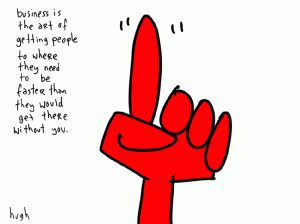
    Biz_Is_The_ArtI had a vague thought. Media’s original strength was its relationship with users and the trust involved. In the social media era, how can that be leveraged? Flipboard has already allowed users to become curators and create their own magazines. Is that the future, along with shared revenue on advertising? What if users can also curate the advertising their ‘subscribers’ can see? After all advertising is also news/information and has a certain value depending on the source. Traditionally, media  has been the middle man between advertisers and users, but what happens when everyone is media? Can media start aggregating influencers in every domain, including niches, provide them the material for curation, negotiate on their behalf to relevant advertisers, and share the revenue? Perhaps the next  disruption will be the platform that can handle the complexities involved. What do you think?

    until next time, mediator

  • Humachines and the role reversal

    In his post ‘Virtual People‘, Scott Adams writes that his generation would be the last of the ‘pure humans’  raised with no personal technology. Someday historians will mark the smartphone era as the beginning of the Cyborg Age. From this day on, most kids in developed countries will be part human and part machine. As technology improves, we will keep adding it to our bodies.

    Singularity has appeared on this blog in various forms, and in at least a couple of posts, I have written about the augmented human, and like the proverbial frog in the slowly-boiling water, we wouldn’t know when it happened. (check this post for a fantastic short film on the subject) In fact, medical applications of 3D Printing are already accepted and on the rise. Not just ‘accessories like hearing aids or dental braces, we have moved on to a lower jaw, (previous link) 75% of the skullan ear, and yes, ‘cyborg flesh‘! It’s obvious that the applications are improving the lives of many. My question though remains – as we replace more and more of ourselves, possibly the brain itself within my lifetime, what happens to the essence of us that makes us human – the feelings, the emotions, the zillion unique reactions to various physical and mental stimuli?

    In this wonderful post titled “How not to be alone“, in which the author writes about how we have begun to prefer (diminished) technological substitutes to face-to-face communication, (I couldn’t help but remember this)  he quotes Simone Weil, “Attention is the rarest and purest form of generosity.” And from that statement I realised how the the narrative might come full circle – I remembered this post I had read a few months back. It mentions bots that have passed the Turing test (“test of a machine’s ability to exhibit intelligent behaviour equivalent to, or indistinguishable from, that of an actual human”) and has a compelling argument that while we’re singular entities with a complex design, we’re still just blueprints –  with many similarities. This also  entails that we’re building machines that can mimic, and evoke, our emotions. Thus, he writes, the era of artificial emotional intelligence is not far.

    Perhaps, in the future we will outsource our humanity and reverse roles – half-machine former humans who deal with each other in mechanical ways and go back home to a humanoid bot that will give it all the empathy and emotional anchoring needed. Or would it need it at all? 🙂

    until next time, be human, comment 😀