Category: Future

  • Rose-tinted wearables

    (a version of something I wrote on LinkedIn)

    Now that I think of it, there are at least four ‘spiritual predecessors’ for this post on the blog. It began with ‘In a world of abstractions‘ (2017), followed by Peak Abstraction (2018), The Presentation of Selfie in Everyday Life (2020), and A Proxy Life (2022). Each of them are continuing explorations of how we have abstracted a bunch of real things, and created proxies by which we measure them.

    Going by the story so far, it’d be fair to say that the more things we consume, the less time we have to get into details, and the more we rely on proxies. And across time, our consumption has only increased. And so our proxies have also multiplied.

    Material accumulations as a proxy for wealth

    Stock price/funding for a company’s health

    Popularity for excellence

    Price for quality

    Fitness for health

    Books Read (including that 5 min YouTube video) for intellect

    (more…)
  • Decoding the rise of millennial investors, with ET Now

    From being part of the BTS Army to getting nostalgic about Backstreet Boys, millennials are a diverse cohort, and have many sub-segments. Based on the recent CAMS report, ET Now gave me an opportunity to chat about the investing patterns of millennials.

    The transcript.

  • Notion States 2

    For a while now – since 2010, I have felt that the nation state (or notion state really) is a shared mental model which is nearing its expiry date. But like other intersubjective realities (money, god), we are reluctant to let go of it. That’s why I found it interesting when Aakar Patel spoke about how nation states are quite inefficient.

    It’s quite true. All you need to do is think about the movement of people and objects and you’ll figure it out for yourself. And while the state has begun using things like Aadhaar to increase legibility about its citizens , and thereby increase efficiency (and further nefarious interests), it is advancing at incremental levels, while the world is moving exponentially.

    Not to mention that the nation state is an instigator and participant in one of the most net-negative things humanity has been continuing – wars! And these days, it’s not just the ‘simple’ human conflicts any more. In the digital space that we spend a lot of time in, and in which we have created identities, state surveillance and deliberate offences using things like ‘zero days’ against its own citizens and enemy states are all contributing to equal if not greater retaliation. In fact, this can actually lead to physical losses too thanks to hacking of power grids, nuclear facilities, healthcare systems and so on.

    So how is this glorified middleman holding on? I think a big reason for the popularity of the nation state is the sense of identity it fosters. Along with religion, nationalism continues to be a superpower. The line on paper is strong even if culture ignores it. Think Delhi and Lahore vs Delhi and Chennai.

    However along came the internet, which has a way of disposing inefficient middlemen. It has massively accelerated the geographical movement of ideas, and increasingly that now includes identity. As Fukuyama points out in Identity, as we moved away from agrarian societies with a strict hierarchy to technology-driven societies with multiple social classes, pluralism, diversity, and choice emerged and identity started becoming increasingly complex. By early nineteenth century, there was a fork – universal recognition of individual rights, and collective recognition. Arguably, Fortnite and LGBTQ rights can increasingly unite people more than a national flag does.

    However, given that the internet has destroyed many things without finding a remotely appropriate replacement, I also began to think of a ‘for’ case. One other relevant intersubjective reality we can learn from is money. In the case of money, once upon a time, different geographies had different systems. Vulnerability in one was of less concern to another. But now, it’s all interconnected, and thus fragile. Even in a nation state dominated system, covid just took over the globe and in addition to lives, had a telling effect on the economy. No country was really spared. So it’s important to ask what would happen if no barriers existed. Is it always good to completely remove friction? There is more. Money is also dependent on the rule of law, and its enforcement by physical force – one of the tasks of the nation state. A big concern with crypto is this enforcement.

    And to now expand this line of thought, what happens to governance? Many evils are kept on a leash because of regulation. Who is accountable for rights and duties of citizens? Minorities might not be in a great place now but without the pretence of the state that pretends to care for them, what happens? What becomes of those who are economically not contributing to the system – the old, the infirm, the less-educated and so on?

    One thought is that there will be a replacement and it won’t be all binary. It will move in stages. For instance, money seeks efficiency too. And it is interesting that money itself, at least in form to begin with, is being challenged by the blockchain. On a related note, our lives are increasing moving into the digital domain, where the nation state’s borders are mostly irrelevant. This means the state’s playbook for regulation cannot be deployed automatically. The worry though is that all this might end up breaking things faster than we can find a replacement, even if it is a notional one!

  • A proxy life

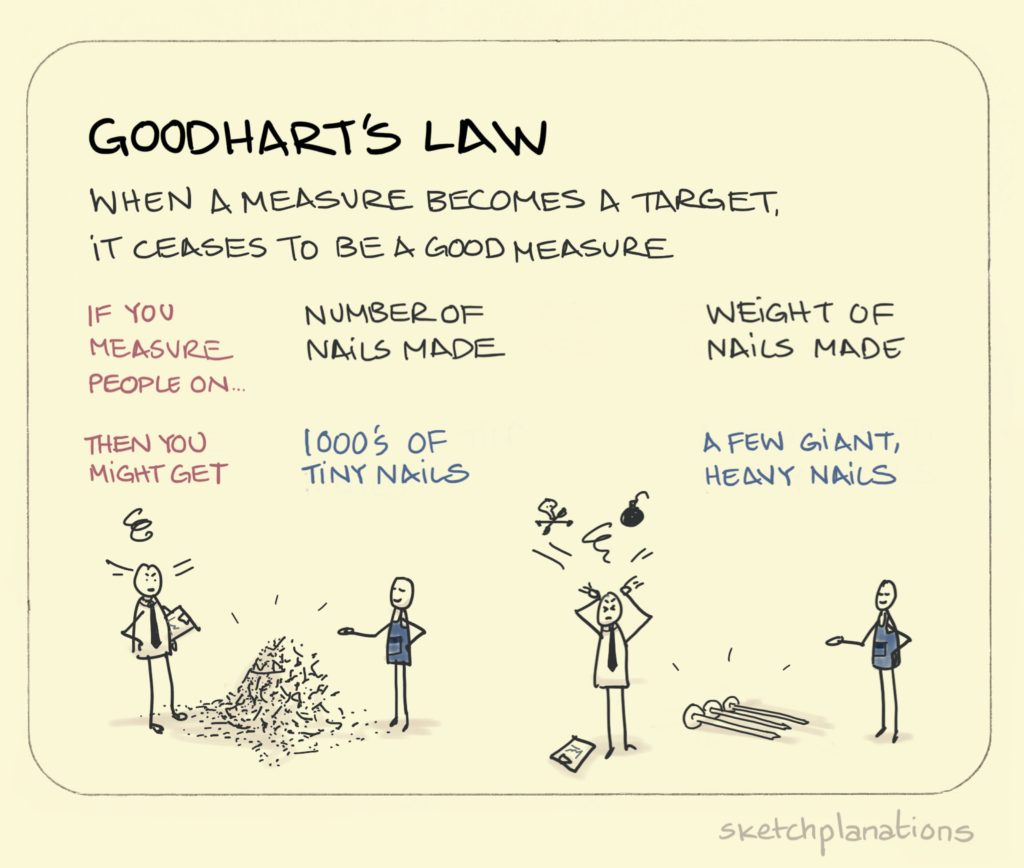
    I have forgotten where I first came across Goodhart’s Law. It was probably Farnam Street. It states that “when a measure becomes a target, it ceases to be a good measure.” An illustration should help.

    https://sketchplanations.com/goodharts-law

    In the organisational context, it serves as a great lens to evaluate strategy and progress. As the illustration above shows, the entire direction of a desired goal can be changed when measures become targets. But, and maybe it’s a Baader -Meinhof phenomenon, I am now seeing different versions of it everywhere.

    To set some context, as more and more things have been digitised, the volume of information has just exploded. For instance, before the advent of social media, there were limits to one’s “people like me” canvas, because even an awareness of them was constrained by physical distances and the limits of one’s social circle. It had to be in real life, and public spaces like a cinema or even a vacation spot were probably an extreme. Social media changed that scale massively. Many factors including this volume of information, the lack of a granular understanding of the lives of this new set of people whom you’d never meet, and the innate human desire to do better than neighbours meant that appearances became the norm. Since we are not wired to process such large volumes of information, we dug deeper into ‘measurement by proxy.’ Not that this mode of measurement is new. For instance, we have used material manifestations (apparel, cars etc) as a measure of wealth. The stock price is a single-number measure of everything about the company. But with abundance of choice and the limits of processing power, we started developing heuristics and measuring what was easy. Meta photos (FB/Insta/WhatsApp) became a measure of everything from the quality of life to the strength of relationships. Popularity as a measure of excellence, price as a measure of quality, fitness as a measure of health, #booksread as a measure of erudition and so on.

    How does this connect to Goodhart’s Law? We end up optimising our resources for the measure, not the end goal. Which means that though the goal is say, happiness and a good quality of life, we end up aiming for the measure. From the kind of photo that will get more likes to buying that thing/experience that will surely make us happy. And as we feed this more, the mind keeps on wanting. The happiness fades in a short span of time. And as the Buddha has wisely pointed out, that loss of happiness is what becomes suffering.

    In the AI risk narrative, there is the story of the paperclip maximiser, a seemingly trivial task of maximising paperclips that might lead to “first all of earth and then increasing portions of space into paperclip manufacturing facilities”. The corresponding human version that I wrote in Peak Abstraction was that maybe we will get to a state where, if we get enough likes on the couple photo on Insta, there would be relationship bliss! What a wonderful world.

  • Artificial Culture

    It’s almost a year and a half since I wrote In Code we Trust. More recently, Tim Ferriss had Eric Schmidt on his podcast (transcript). In what I thought was a fascinating discussion based on the latter’s recent book  The Age of AI: And Our Human Future, (coauthored with Henry A. Kissinger and Daniel Huttenlocher), they also brought up AlphaGo. Go was a game that humans had been playing for 2,500 years, and it was thought to be incomputable until DeepMind’s AlphaGo beat world champions. As Schmidt explained, some of its moves and strategies were the kind no one had thought of before. In Kissinger’s words, we’re entering a new epoch, similar to the Renaissance, this age of artificial intelligence, because humanity has never had a competitive intelligence, similar to itself, but not human. To note, a more recent version – AlphaGo Zero self-taught itself without learning from human games, and surpassed its predecessor in 40 days!

    (more…)