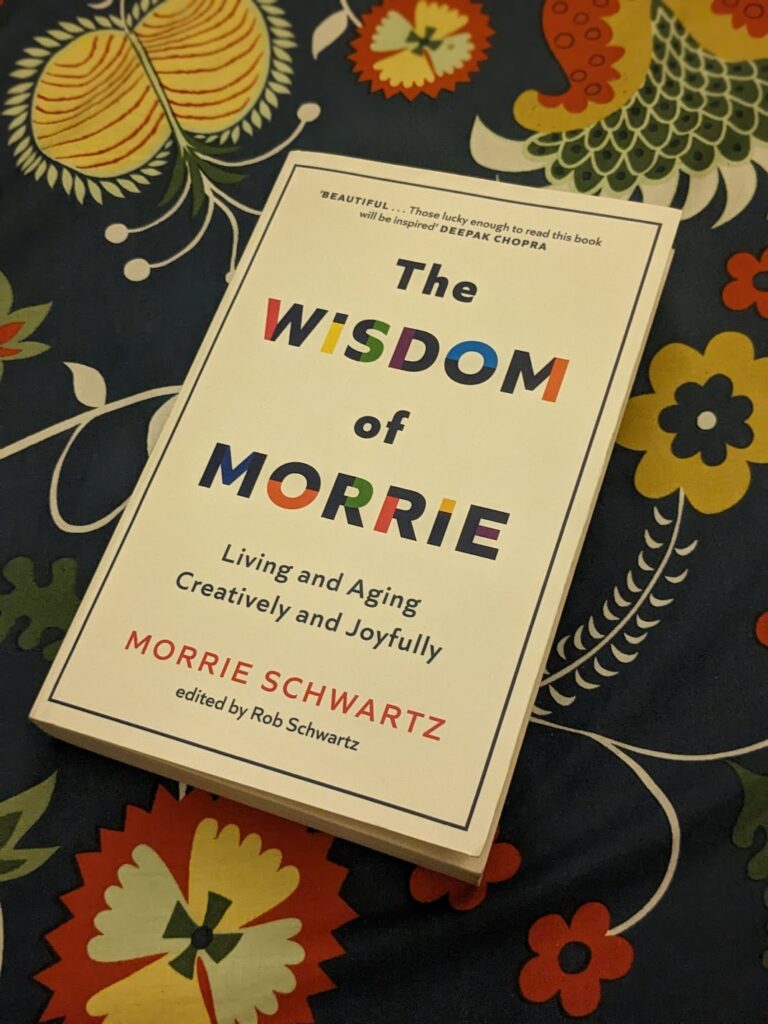
Such is the impression left by Mitch Albom’s “Tuesdays with Morrie” that more than a decade later, the moment I realised it was the same Morrie, I had to buy The Wisdom of Morrie. Rob Schwartz, son of Morrie Schwartz discovered the manuscript, written during 1988-92, in the early 2000s and with the help of his mother, edited it.
While the book is full of insights that are useful at any stage of life, by the author’s own admission, it speaks to the sixty five year old and beyond. But I am glad I read it now. One of the things that I have complained about is the way mid life almost blindsided me, with the physical, mental, and emotional changes it brought. This book is a great primer for the next stage, and I will most definitely read it again in another 15-20 years.
The book is divided into nine chapters, each of which delves into a specific domain. It begins with one’s own awareness of aging and impending death, and the contradictions one faces at later stages in life – some things become easier, and some more difficult, you want some things (solitude) and their opposite (company) – and how one can find an emotional balance.
It then moves on to how we can expand our awareness, which according to Morrie is the summation of the many tools one requires to age well and become the best version of oneself. He also calls out ageism and agecasting, and notes how one can do it to self as well.
The next chapter is where the book gets into great detail on the actual issues people face as they age, and how to handle them. This is the longest chapter, and rightfully so. The following chapter continues this theme – how to come to terms with all the baggage we have accumulated thus far. The last two chapters are perspectives on how to age well, and become the best version of oneself.
Morrie not only uses the knowledge he had amassed from his work as a psychologist and teacher, but effectively channels the empathy and reassurance of someone who is himself living through it, and knows many others who do. This puts him in perfect position to not only understand the challenges, but also provide ways to overcome them. Not in theory, but in actual practice. He delivers this with sensitivity and compassion, using logic as well as anecdotal examples.
In the Hindu ashrama concept, we have vanaprastha and sanyasa. This is a great resource for anyone in these stages. And for those others who want a sneak preview.
Insight Fear is often the mirror image of need. For example, our need for self-preservation is the other side of our fear of physical injury.
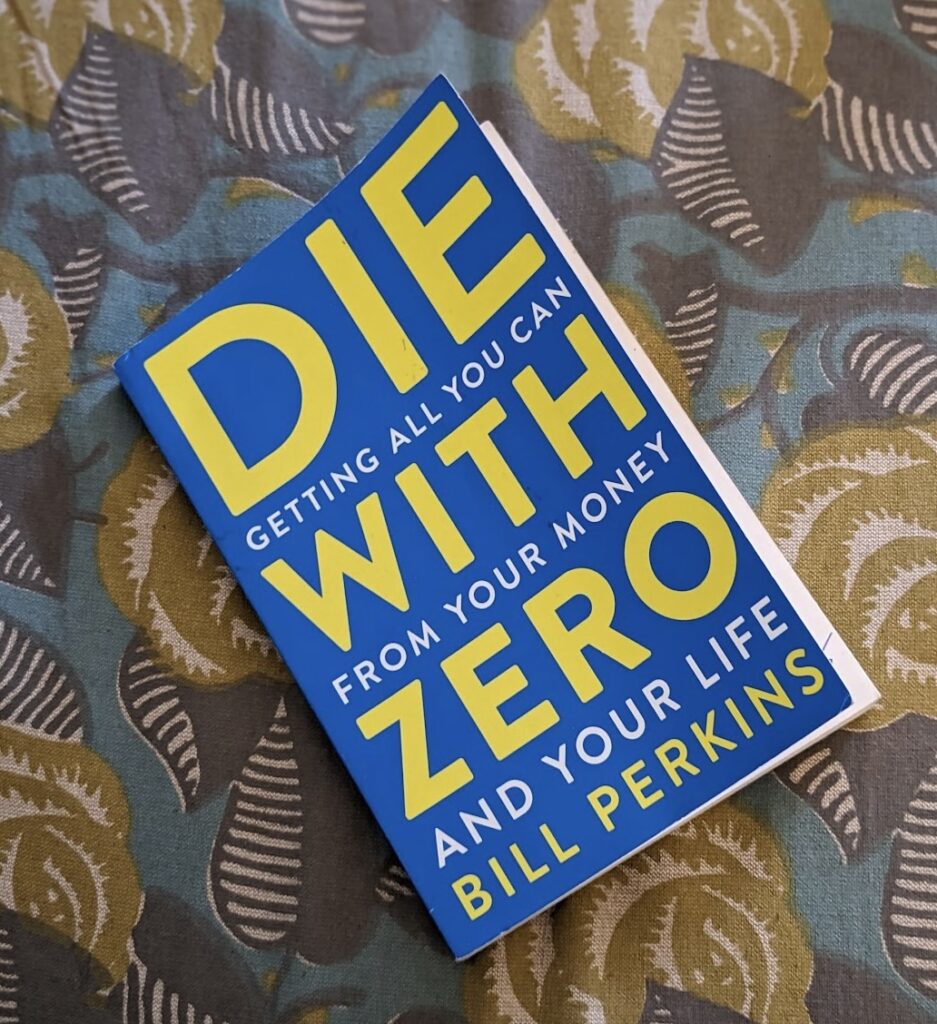
Remember Aesop’s The Ant & the Grasshopper? The one that is told to teach us the virtues of hard work and the importance of saving for a rainy day. Given the values still hold, most books that have anything to do with money are written for ‘grasshoppers’, but Die with Zero is more for the ants, or in the author’s words, to drag the ant towards the grasshopper.
The basic premise of the book is that we should make full use of our money when we have the capability to enjoy what it brings us. As we age, that capability diminishes, a function of our desires, as well as deteriorating health. While we could still enjoy many things, the yield or utility per dollar goes down with age.
A part of the book is devoted to elaborating on this perspective and proving it with data and anecdotes. Data shows that a lot of people end up over-saving and underspending during retirement and die with a large sum of money still left. Hence the need to temper delayed gratification. Concepts like consumption smoothing – one’s spending not mirroring the variations of income, and transferring money from years of abundance to leaner years. In other words, spend more than your income, if required, early in life for experiences that will give you memories to cherish in your old age, because you can repay it as income increases. To be fair, the author obviously discourages reckless spending.
This also goes for money you wish to give to your near and dear, as well as charity. For instance, better to give the kid money when you’re 65 and he/she is 35, rather than 80 and 50 respectively. The peak utility of money is highest between 35 and 50, when people have the health and the desire. Even within retirement, there are go-go years, slow-go years, and no-go years, and one should bulk up the spending at the top. He also recommends getting a sense of your life expectancy using calculators so you can plan accordingly.
Another useful concept is that of time buckets. Take a duration, say 10 years, and look at 40-50, 50-60 and so on. Now slot the things you want to do, and when you’re best placed to do it. Usually the control variable is money, here it is health and desire. This will help you figure that some things are better when done at certain ages. It’s a perspective shift. The other related shift is seeing your peak as a date (related to biological age) and not a number.
The book also addresses the ‘how’ of implementing this, and overcoming the mental barriers that people commonly have towards this approach, including the not-so-common “I love my job”.
The book does offer a reasonably unique perspective, and at its core, it urges thinking on first principles and making conscious decisions, both of which I support. But I felt that the author underestimates the scarcity mindset, or probably lacks the empathy required for it. The other aspect I didn’t like is the tendency to quantify aspects of life that have multiple dimensions of quality. And finally, the ‘inefficiency’ comment on Sylvia Bloom, who worked as a legal secretary for 67 years, and when she died at 96, bequeathed $8.2m to charity. According to the author, she should have done this earlier while she was alive. Absolute tone-deafness.
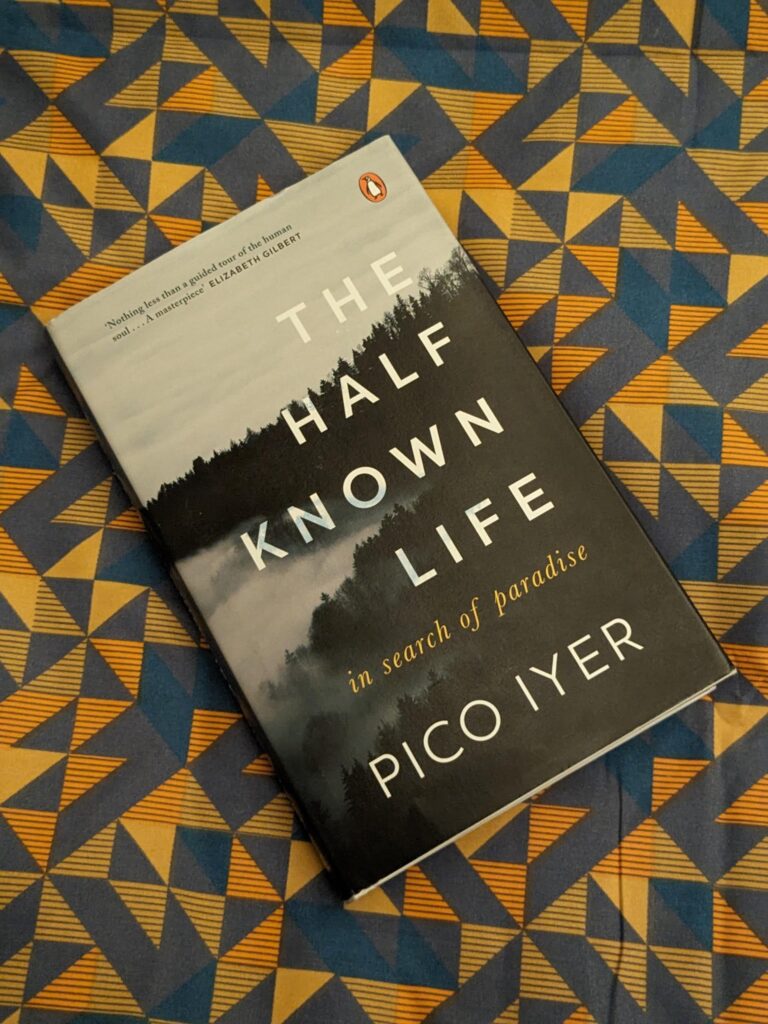
I always have a bias for Pico Iyer’s writing, and many a time I end up reading his books at times when I need an alternate perspective. In The Half Known Life: In Search of Paradise, the search is for what different people define as paradise – a place with no worry or anxiety. Except, for some it is a particular place, for others a moment in time and something that can be accessed if we put our mind to it, and for some others it can only be enjoyed after death.
From Jerusalem to Benaras, and Japan to Ladakh, Pico explores these concepts and the people who believe in the different definitions. As is usually the case with his writing, it is as much introspection as it is travel, and written in wonderful prose. He blends his personal experiences with philosophical musings seamlessly. Through the people he meets, and his encounters with those from varied backgrounds, he reflects on the nature of life, and its many meanings.
In solitude and contemplation, he reaches out to thinkers before him- from the Stoics to William James to Henry David Thoreau, in an effort to decipher the complexities of our existence. Each essay is a meditation, and amidst the noise and chaos of this busy world, I’ll probably pick it up again later in life to get a different rendition of the half-known truths that lie deep inside all of us.
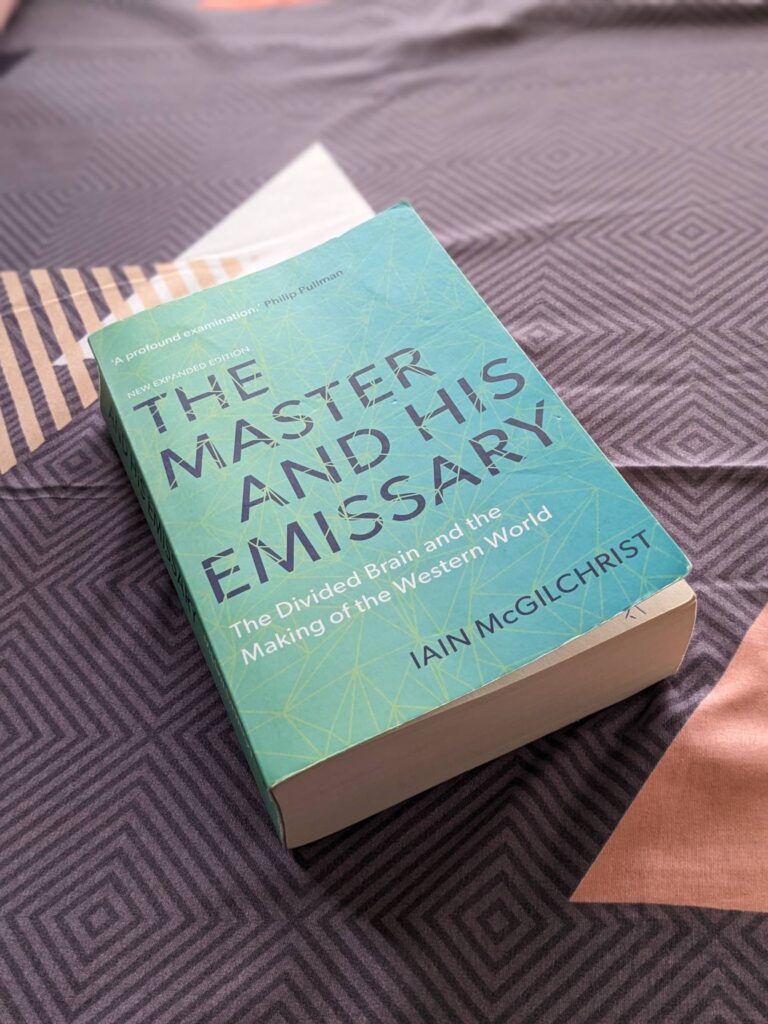
As is the case most of the time these days, I discovered The Master and His Emissary thanks to a podcast. Iain McGilchrist’s concepts seemed extremely intriguing, and now I have to admit (as he mentions early in the book) maybe intuitively consistent with my lived experience, and I had to read the book soon. Turns out that it goes directly to my all-time favourites, and was in my Bibliofiles 2023 list.
As the subtitle suggests, the book is divided into two parts – the divided brain, and the making of the Western World, each with half a dozen chapters. The first part deals with the brain itself – the asymmetry of the right and left hemispheres, their collective and individual roles, how their functioning actually leads to different perspectives, how this affected the evolution of music and then language (which can be seen as a key component in the progression of the species), the primacy of the right hemisphere, and how its emissary – the left hemisphere – has now usurped control.
The heuristic ways of looking at the hemispheres, e.g. left analytical, right creative etc, is replaced by a nuanced view. The differences between them are less about what they do and more about how they approach something. The left’s utilitarian ability to ‘grasp’ (look at how the metaphor applies to thoughts), its ability to provide simple answers and articulate them well, have all enabled it to grab control at an accelerated pace since the Industrial Revolution, and create a world where it prizes precisely these capabilities in individuals, institutions, and culture at large.
This is in many ways opposed to the right, which takes more holistic views, understands ideas and metaphors, perceives emotions better, specialises in non-verbal communication, and is humble about what it knows. The right deals with whatever is implicit, the left is tied to more explicit and more conscious processing. The right is present and pays attention to the world outside, the left re-presents. We need both hemispheres, and the right knows it, but the left thinks it knows everything. The left creates a world, and when it stops communications with the right, will not even accept reality if it counters the ‘truth’ of the world it has created. Its role was to provide a map of reality, it now thinks the map is reality, and if not, it will remake reality to fit the map.
The second part then digs into how this has manifested in the world around. It begins with the concept of mimesis (my favourite part) and how it was the crux of our leap into what we now call culture. The meta-skill that enables all other skills – imitation – possibly explains the rapid expansion of the brain in early hominids. Through the next five chapters, Iain takes us through history – from the early Greeks to the post-modern world, and how, though history has seen a see-saw in terms of the dominance of the hemispheres – Renaissance, Reformation, Enlightenment, Romanticism, and the Industrial Revolution – the impact of the last one was such that we are now in a world where a swing towards the right seems near impossible. Much like an addict, who is not even conscious that his next dose is not just another dose. ‘There is a vicious cycle between feelings of boredom, emptiness and restlessness, on the one hand, and gross stimulation and sensationalism on the other’.
The research is deep, in both sections, as evidenced by over a hundred pages of notes and bibliography. I especially appreciated the decision of not having same-page notes – it really does help the flow of reading. Iain has painstakingly tried to make a large number of diverse topics as accessible as possible. The first half is based on conclusions from scientific research and experiments across history, and various domains. The second half is itself an accordion of topics across centuries – arts, music, politics, language, and everything we call culture.
I think my bias for this book and its argument is based on my own experience. As a person and a professional who has to balance both hemispheres, I have been pulled to the left for the longest while. And in many workshops, the recommendation to me has been to let my right side ‘play’. It is only very recently that I have been able to start doing that, and I have to say that I am much happier. The Master and His Emissaryis a book I hugely recommend. It is not the easiest of reads, and I deliberately slowed down my reading speed so as to not gloss over it (though I still did in some of the arts discussions!) but it will open up how you think – the narrative you have made about yourself, and the world around you.
Quotes and ideas from The Master and His Emissary There are four main pathways to truth – science, reason, intuition, and imagination “The question is not what you look at, but what you see” ~ Henry Thoreau Attention changes what kind of thing comes into being for us : in that way it changes the world. Whether they are humans (say, employer vs friend) or things – a mountain is landmark to a navigator, a source of wealth to the prospector, and a dwelling place of gods for another. There is no ‘real’ mountain which can be distinguished from these, no one way of thinking which reveals the true mountain. Manipulospatial abilities may have provided the basis for primitive language. Function gestures become manipulative, syntax developed to form language, expression of our will. (p 111) Even in left handers, grasping actions controlled by left hemisphere, thus right hand. Language’s origin in music. Language originates as an embodied expression of emotion, that is communicated by one individual ‘inhabiting’ the emotional world of the other. A process that could have been derived from music. Grooming – music – language, all picked up by imitation. (p 123) Adam Zeman’s three principal meanings of consciousness – as a waking state, as experience, as mind (p 187) The river is not only passing across the landscape, but entering into it and changing it too, as the landscape has ‘changed’ and yet not changed the water. The landscape cannot make the river. It does not try to put a river together. It does not even say ‘yes’ to the river. It merely says ‘no’ to the water – or does not say ‘no’ to the water, whatever that it is that it does so, it allows the river to come into being. The river does not exist before the encounter. Only water exists before the encounter, and the river actually comes into benign the process of encountering the landscape, with its power to say ‘no’ or not to say ‘no’. The idea that the ‘separation’ of the two hemispheres took place in Homeric Greece. (voices of gods) (p260 -275) Gnothi seauton – know thyself In sooth I know not why I am so sad, It wearies me, you say it wearies you; But how I caught it, found it, or came by it, What stuff ’tis made of, whereof it is born, I am to learn. ~ Shakespeare, The Merchant of Venice The difference between reason and rationality. The former depends on seeing in things in context – right hemisphere. Latter is left, context-independent. Kant described marriage as an agreement between two people as to the ‘reciprocal use of each others’ sexual organs’ ‘Life is a progress from want to want, not from enjoyment to enjoyment’ ~ Sam Johnson Modern consumers everywhere are in a ‘permanent state of unfulfilled desire’ Certainty is the greatest of all illusions: whatever kind of a fundamentalism it may underwrite, that of religion or of science, it is what the ancients meant by hubris.
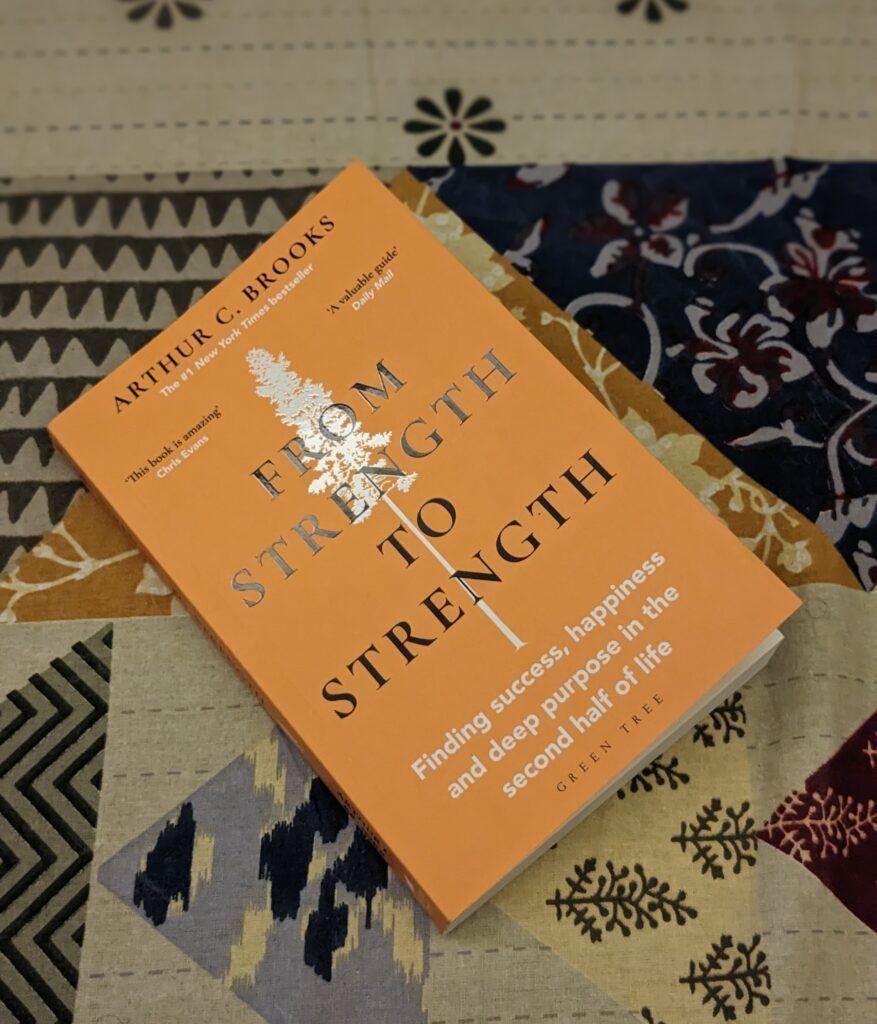
Quite a few of Arthur C. Brooks’ columns have resonated with me and also been thought-starters for some of my blog posts, so I was looking forward to ‘From Strength to Strength’. The premise is that in the first half of their lives, (most) people single-mindedly strive to be successful, often at the cost of health, relationships etc. But with age, many of the abilities that made them successful start to decline. They resent and resist this, leading to frustration and dissatisfaction. The book is about navigating the second half of one’s life when there are changes in mind and body, and the rules by which one worked and lived no longer seem to make sense. How does one get through this liminality, and thrive?
The book begins with one of his articles I had particularly liked – Your Professional Decline is Coming. I found this chapter very interesting thanks to the concepts that appear in it. For instance, “the principle of psychoprofessional gravitation”, the idea that the agony of decline is directly related to prestige previously achieved, and to one’s emotional attachment to that prestige. Also, the two kinds of intelligence – fluid intelligence, defined as the ability to reason, think flexibly, and solve novel problems, and crystallised intelligence, the ability to use a stock of knowledge learned in the past. The former is high in early adulthood, and starts to diminish in the thirties and forties. The latter starts growing from then on. Simplistically put, intelligence, and wisdom. The trick is to jump off from the first curve and on to the second in the later stages of life.
The book then moves on to how we objectify ourselves at work, and are addicted to the success it brings, making the jump to the second curve difficult. Many things are involved – pride, fear, social comparison, and a loss aversion that focuses on well, losing things like wealth, power, and fame one has amassed through hard work.
The rest of the book offers perspectives on how to get off the treadmill – mindfulness, finding friends and meaningful relationships, focusing on companionate love in marriage (rather than passionate love), facing one’s fear of death, distinguishing between intrinsic and extrinsic goals and focusing on the former, starting vanaprastha and understanding how to detach, finding a faith. I found this part not entirely different from things I have read in other books. I think I expected a bit more, but on hindsight, that’s an unfair expectation, since this is something one has to figure out independently, books and other people can only offer perspectives.
Having said that, ‘From Strength to Strength’ is a great start if you’re feeling the waves of midlife hit you. It provides context and perspectives to help you start framing the second half of life.
Notes Fear of death: “thanatophobia.”Whether paralyzing or mild, the fear of death has eight distinct dimensions: fear of being destroyed, fear of the dying process, fear of the dead, fear for significant others, fear of the unknown, fear of conscious death, fear for body after death. and fear of premature death. Edsel problem: The famous car that Ford executives loved, but consumers hated. They sell what *they* like, instead of what the consumers wants and needs. (in the context of helping people at our convenience and in our way) “The worst thing about death is the fact that when a man is dead it is impossible any longer to undo the harm you have done him, or to do the good you haven’t done him.They say: live in such a way as to be always ready to die. I would say: live in such a way that anyone can die without you having anything to regret.” Leo Tolstoy