Category: History & Politics

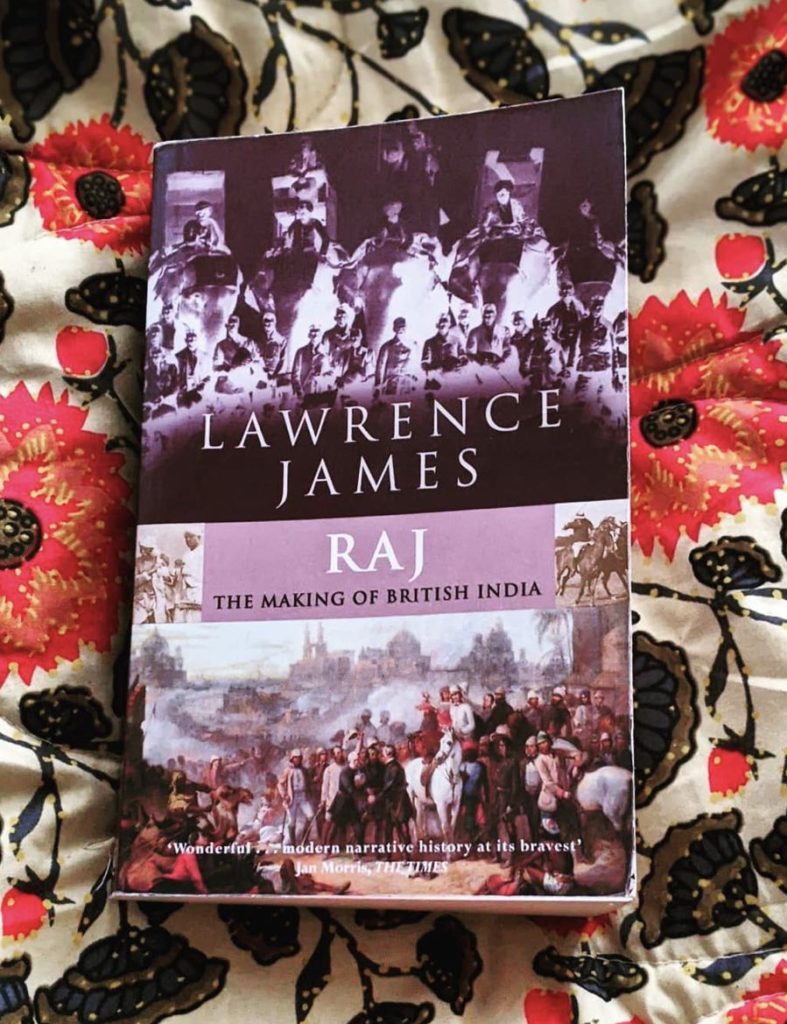
  • Raj: The Making of British India

    Lawrence James

    Well, well, history isn’t what it used to be! At least not when I juxtapose this book against what I was taught in schools. As Lawrence James notes in the Epilogue, a past shaped by foreigners reminds a nation of its submission, and doesn’t really bode well for pride or self-confidence. So we lionise our own efforts and heroes and shape a new narrative. And that is what goes into the history books.

    The good news is that India did become free from British rule on August 15th 1947. The original deadline was June 1948, but as with most everything else in India, the astrologers had the final say. But everything else, from the time the British first arrived on Indian shores, to this event, more than a couple of centuries later, is seen through a lens that tries hard to be objective, but is also inevitably tinted a bit by the bias of the author, who is an English historian. But at least, his bibliography is extensive enough to support it. 

    The book begins with the ideal prologue – the sunset years of the Mughal empire, and then covers the first century of British presence in the first 250 pages. This includes not just the skirmishes with the French down south, but also the East India Company’s battles in Bengal, and Clive’s victory in Plassey, which apparently assumed a supernatural significance and was seen by some Hindus as the starting point of a predestined historical cycle that would last a century. No coincidence that rumours of this was in full flow in 1857, right before the mutiny. Between Plassey and the Mutiny, there was the gradual expansion of the Company’s land assets, helped to a large extent by the infighting and lack of unity among Indian rulers. The Company wanted the freedom to trade, and everything else that happened seems to be a byproduct!

    The mutiny itself seems to have been a throughly disorganised series of skirmishes and battles, with every move by the sepoys being led more by circumstances than by design. At some point, the last Mughal Emperor was seen as a good idea to rally around, and he was forced to play his part reluctantly. The leaders whom our version of history has designated as the first freedom fighters – notably the Rani of Jhansi and Nana Saheb – were at best tactical leaders more interested in the sovereignty of their kingdoms, since they were the losers in the prevalent Raj system. And there was very little impact down South, or even the West for that matter. Having said that, it did give the British a fright. 

    From then until World War 1, there are interesting sections around The Great Game, the main theatre being the frontier and Afghanistan. This was also the time when Anglo Indians started organising themselves, and Indians too began understanding, and thus demanding Home Rule. A Russian invasion was on the minds of folks on both sides, and largely that was only where it was. But this did lead to a lot of intrigue and the Afghan wars. Also interesting is how many of these incidents made its way into popular culture via books, and then movies.

    1919 was a decisive year, and it is fascinating to read about the granular circumstances that drove men to take certain actions. Case in point – Dyer, his chronic discomfort and pain from old war injuries, the hype that a huge uprising was in the offing, and finally the Jallianwala Bagh. Gandhi first rose to prominence in 1919, just after the Spanish Flu hit Indian shores, and specifically thanks to the Rowlatt Act in March 1919, against which he first experimented with the satyagraha. The book isn’t very flattering to him, and talks about his numerous failures in organising mass movements, which got away from his control very fast. “Gandhi was also a consummate showman and a shrewd politician, with a knack of projecting himself in such a way to attract the greatest possible attention in India and abroad”. In essence, very good at political stagecraft, but the cult of Gandhi was so popular that it was sufficient to give the Congress, which had its tentacles everywhere but didn’t really have a plan, a dominant status in the provincial assembly elections. Some villagers actually sent messages to Gandhi in the ballot box!

    By the 1930s, the Hindu-Muslim rifts were growing wider, and the cult of Jinnah was becoming popular. Another rising personality was Bose, whom Gandhi did not trust. Bose considered Gandhi’s moves against the British mild, and it finally took him away from the Congress, and then a ricochet across alliances which finally led to very little. The story is depressing every time I come across it. 

    The final years of the Raj actually highlights the in-fighting and intrigue among the country’s top politicians. To note that if the Labour party hadn’t come to power after the Second World War, and Churchill was still in power, the story of India would have been very different. Attlee, and his party, were more supportive of India’s self-governance. The winding up job was left to Lord Mountbatten, even though the book portrays his predecessor The Viscount Wavell as being the more capable man. In fact, Mountbatten is shown to be everything but impartial and detached. Edwina’s flirtation with Nehru didn’t help either. His lack of understanding on how princely states were coerced into accepting Indian suzerainty also led him to buckle under Nehru’s pressure. 

    In essence, the book shows everyone involved in a completely new light from what I (as an Indian) had seen thanks to my history lessons. I think we tend to regard our leaders as men with clear and objective plans, but it seems there were just ordinary men sometimes tossed into extraordinary events and trying to do what they thought was right. Strange, but historical figures are people too. 🙂

    If you’re interested in history, this is a must read. It meanders a bit, but persist and you will be rewarded with a very different picture from what you know.

  • The Origins of Political Order

    Francis Fukuyama

    Once upon a time, humans moved around in bands. Then there were tribes, and then there were states. States and the societies that make up its population have developed a bunch of institutions (defined as “stable, valued, recurring patterns of behaviour”), some of which are uniformly present across the globe, and some not. How did this variation happen?

    Why is every country not a democracy, which is largely accepted as the best trade-off for all concerned? How did different countries reach their current form? That’s what this book is all about – how did different countries develop institutions that currently make up their current society and state?

    (more…)
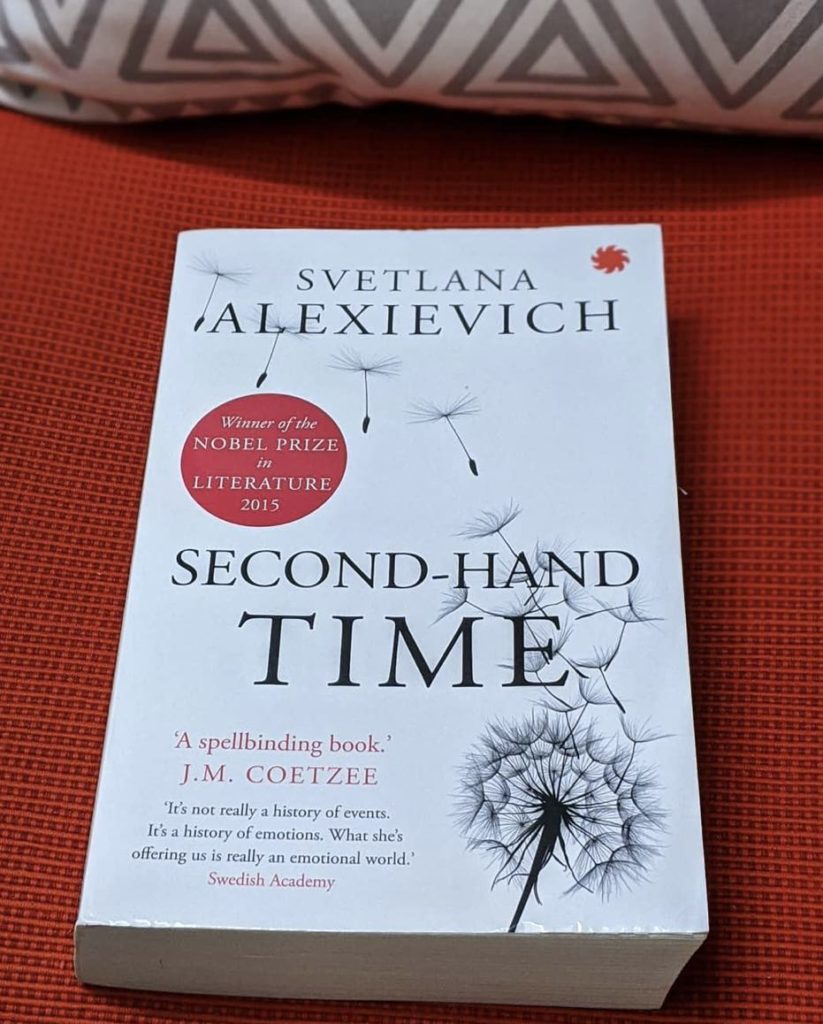
  • Second Hand time

    Svetlana Alexievich

    As I was reading the book, I wished it were fiction. But unfortunately, it’s contemporary history – lives lived by people, and events that impacted their life. To think that millions of lives have been spent in ways that one could not even endure for days – conditions that are not just physically gruelling, but mentally debilitating. Ordinary citizens of the former USSR and current Russia, whose belief systems, values and hopes went through upheavals as the country’s political system experienced two decades of turmoil after the fall of the USSR.

    Different generations whose worldview has been shaped by leaders from Stalin to Putin. Housewives, small traders, ordinary soldiers, students and staunch party workers, no one was really spared as the political, economic and social systems went through multiple changes upending millions of lives. Savings, livelihoods, lives, all lost, thanks to the whims and fancies of the powers that be. At an individual level, relationships with parents, siblings and friends were affected as the state created paranoia. Everyone was a potential informant, after all. 

    The author documents the atrocities of Stalin as told by folks who lived before, during, and after the era. Many acknowledge that the system could not have been this ruthless if there weren’t people to operationalise it. Was it by choice? Between making great history, and leading a banal existence. Many also believe that the Soviet became great because of him, and what he did was justified. Khrushchev opened up the system, and people even started making jokes about Communism (“A communist is someone who’s read Marx, and anti-communist is someone who’s understood him”).

    Brezhnev brought in stability, and some success in foreign policy, but corruption, inefficiency and a widening technological gap with the West was the trade-off. It was hoped that Gorbachev would bring in the “happily ever after”, but glasnost and perestroika didn’t lead to better socialism, it paved the way for capitalism. The dissatisfaction and a foiled coup led to Yeltsin, and the rise of oligarchy. And then came Putin, in whose regime, there are confrontations between different ethnic factions. And at full circle, there are now many voices who hope for a return to Stalinism. 
    In all of this, even as ordinary people suffered hardships, the pride for the purity of thought, and belief in the power of a united country persisted for many. Ideas and idealism stayed alive. But for most others, the only desire was to escape the system. 

    It is quite a brutal read, and I found it depressing, but these are stories that must be told.

  • Collapse

    Jared Diamond

    Jared Diamond’s Guns, Germs & Steel ranks among my favourites. Insightful and full of perspectives. While that book was about how and why civilisations unfolded differently around the globe, this one is on why many of them collapsed. The author defines collapse as a”a drastic decrease in human population size and/or political/economic/social complexity, over a considerable area, for an extended time.” He then uses a five point framework to analyse multiple examples, spanning time and geography. The five points are environmental changes, climate changes, hostile neighbours, decrease in trading partners, and finally, society’s response to the above. 

    The author starts with contemporary farms in Montana and then moves on to the Mayans in South America, the Easter Islands natives, the various Viking communities across continents, and the Native American Anasazi to apply the five point framework and understand the causes of their downfall, and sometimes survival. He then examines modern societies and their challenges – Rwanda, China, Australia, and the interesting case of neighbouring countries that went in opposite directions – The Dominican Republic and Haiti. Strangely, this is despite both countries having a history of dictators. 

    The last portion of the book delves into what caused societies to make disastrous decisions, and the impact of big businesses on the environment. The latter is not always a negative, and there are some excellent examples of large corporations realising that doing good can actually help the bottomline. There is also a very interesting section on the responsibility of individual consumers.

    While we still may not know exactly what happened, there is a fair amount of convincing logic in the author’s hypotheses on how and why civilisations collapsed. And it gets more interesting when we look at the problems we are facing now. On one hand, the scale of the problems are indeed much higher. But on the other, there have been technological advances that can aid us. How much of a counterbalance is one for the other? And as one of his students asks, what was the islander who cut down the last tree on Easter Island thinking as he was doing it? Are we too, frogs in boiling water? Do we have landscape amnesia which prevents us from seeing the changes around us? 

    The book is not easy though, and sometimes one wonders whether the depth of research shared in the book takes away from the narrative flow. However, if the subject is interesting to you, it’s a read that will enlighten.

  • Dark Money

    Jane Mayer

    Across the world, the gap between the 1% and the remaining continues to widen, and the US is arguably the best example of this. How is society at large allowing this to happen, why aren’t politicians doing something about it? After all, elected representatives of common folks are supposed to work for their welfare, how is that structure failing? 

    In Dark Money, Jane Mayer provides an insightful and well researched analysis of how libertarian industrialists like the Koch brothers are systematically undermining the effectiveness of the US electoral system by flooding it with what they have in abundance – money! Hundreds of millions of dollars spent to impose their worldview on how government should be run. The “simple” worldview being that government oversight of business is an encroachment of freedom! In this world, social welfare and labour protection are unnecessary expenditure, while taxes on wealth should be minimal. Not that I am a theist, but Godless America! 

    The narrative starts in the late 40s, during the formative years of the Koch brothers. Influenced by LeFevre’s “government is a disease masquerading as its own cure”, Charles Koch’s political evolution began early, and with help from like-minded and wealthy others, it led to a well oiled machinery that operated outside the world facing political establishment, and yet has now managed to practically take over the Republican Party. 

    From the 70s, when the rich got a sense that they were being over-regulated, they had started a privately financed war to ensure their philosophy won. A big a-ha moment was the result of an understanding of how to use their riches to preserve their elite status, beyond the obvious means. This was the weaponisation of philanthropy, and the book provides the background on some prominent players like Richard Mellon Scaife, Joh M. Olin and the Bradley Brothers. The steady formation of the Kochtopus machinery is a fascinating read, and one has to admire the strategic brilliance that is at work here. 

    It’s not just ensuring the preferred candidates win, or even that only preferred candidates would stand for election. It goes well beyond, and starts at the grassroots. Using the anonymity of charitable organisations, they went systematically to the bottom of the value chain and thereby started funding online high school education, academia, think tanks, influencing public policy, lawmaking (including the judiciary via seminars and junkets), creating and stoking political activism – Tea Party agitations for instance, spreading alt truth like “climate change is a myth” by spending millions on media and micro-targeting, changing regulation on candidate funding and thus creating the phenomenon of superPACs, and finally even pushing out moderate Republicans, and in the words of one Republican, “supplanting the party”. Using money, coercion, and every means possible.
    Essentially they created institutions and networks that would manufactur ideas that follow their philosophy, converted that into action points through think tanks and academia, and got them executed through activist groups, lawmakers and politicians. A system that feeds itself and creates a world in its own image. 

    The irony of it all? Donald Trump. Firstly, though the machinery was successful in making Obama a lame duck president in his second term, ensuring the Republicans controlled the Congress, and thereby laying the base, he was not their choice of President. In fact, he tweeted in contempt about those Republican candidates who went to the Kochs for assistance. Secondly, he used their exact methods to win the election. However, it isn’t called a system for no reason – it controls the people surrounding him, and is thus, pretty much in charge.

    The book is superb in terms of research and pacing of the narrative, with details and context setting that make it a fantastic, absorbing read. It’s not just American politics, I think this will be the narrative of politics and society in many places. A must read, in our own selfish interest!