Once upon a time, humans moved around in bands. Then there were tribes, and then there were states. States and the societies that make up its population have developed a bunch of institutions (defined as “stable, valued, recurring patterns of behaviour”), some of which are uniformly present across the globe, and some not. How did this variation happen?
Why is every country not a democracy, which is largely accepted as the best trade-off for all concerned? How did different countries reach their current form? That’s what this book is all about – how did different countries develop institutions that currently make up their current society and state?
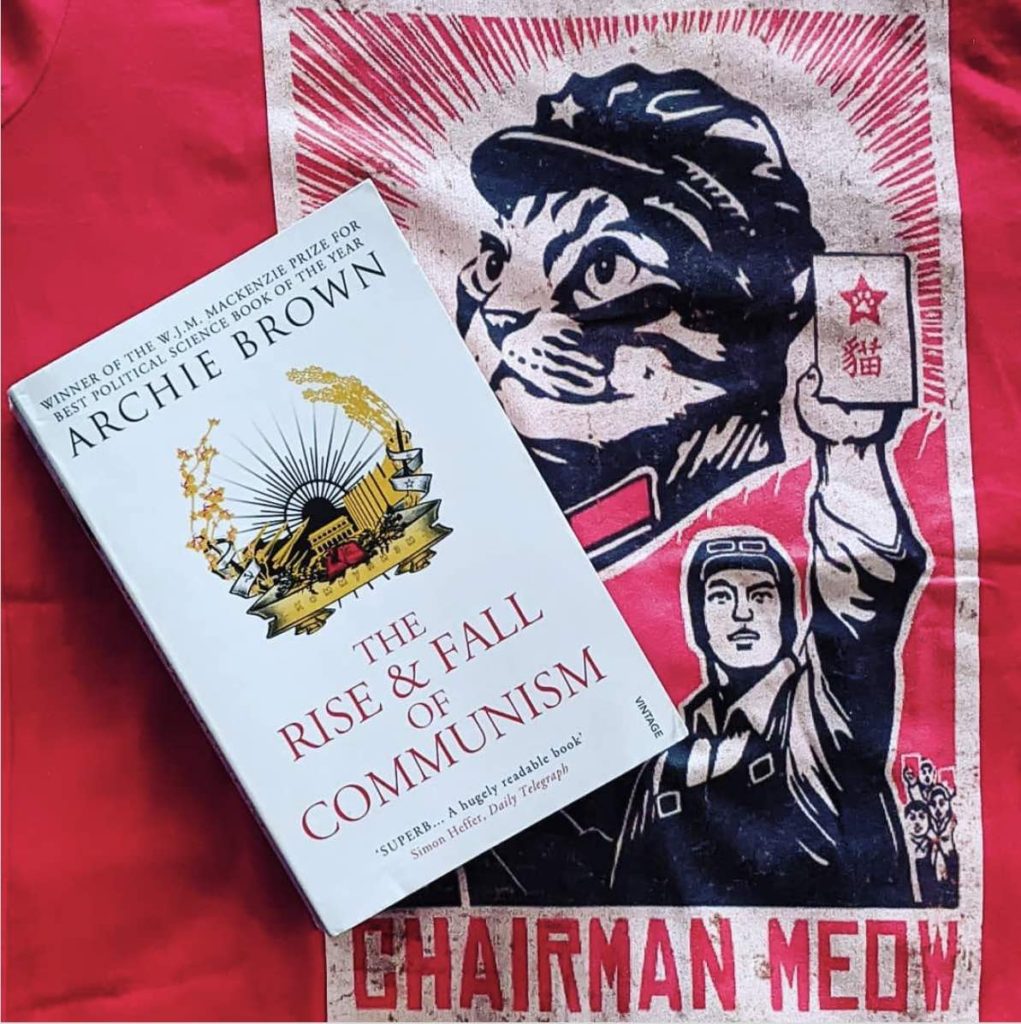
As I was reading the book, I wished it were fiction. But unfortunately, it’s contemporary history – lives lived by people, and events that impacted their life. To think that millions of lives have been spent in ways that one could not even endure for days – conditions that are not just physically gruelling, but mentally debilitating. Ordinary citizens of the former USSR and current Russia, whose belief systems, values and hopes went through upheavals as the country’s political system experienced two decades of turmoil after the fall of the USSR.
Different generations whose worldview has been shaped by leaders from Stalin to Putin. Housewives, small traders, ordinary soldiers, students and staunch party workers, no one was really spared as the political, economic and social systems went through multiple changes upending millions of lives. Savings, livelihoods, lives, all lost, thanks to the whims and fancies of the powers that be. At an individual level, relationships with parents, siblings and friends were affected as the state created paranoia. Everyone was a potential informant, after all.
The author documents the atrocities of Stalin as told by folks who lived before, during, and after the era. Many acknowledge that the system could not have been this ruthless if there weren’t people to operationalise it. Was it by choice? Between making great history, and leading a banal existence. Many also believe that the Soviet became great because of him, and what he did was justified. Khrushchev opened up the system, and people even started making jokes about Communism (“A communist is someone who’s read Marx, and anti-communist is someone who’s understood him”).
Brezhnev brought in stability, and some success in foreign policy, but corruption, inefficiency and a widening technological gap with the West was the trade-off. It was hoped that Gorbachev would bring in the “happily ever after”, but glasnost and perestroika didn’t lead to better socialism, it paved the way for capitalism. The dissatisfaction and a foiled coup led to Yeltsin, and the rise of oligarchy. And then came Putin, in whose regime, there are confrontations between different ethnic factions. And at full circle, there are now many voices who hope for a return to Stalinism. In all of this, even as ordinary people suffered hardships, the pride for the purity of thought, and belief in the power of a united country persisted for many. Ideas and idealism stayed alive. But for most others, the only desire was to escape the system.
It is quite a brutal read, and I found it depressing, but these are stories that must be told.
Jared Diamond’s Guns, Germs & Steel ranks among my favourites. Insightful and full of perspectives. While that book was about how and why civilisations unfolded differently around the globe, this one is on why many of them collapsed. The author defines collapse as a”a drastic decrease in human population size and/or political/economic/social complexity, over a considerable area, for an extended time.” He then uses a five point framework to analyse multiple examples, spanning time and geography. The five points are environmental changes, climate changes, hostile neighbours, decrease in trading partners, and finally, society’s response to the above.
The author starts with contemporary farms in Montana and then moves on to the Mayans in South America, the Easter Islands natives, the various Viking communities across continents, and the Native American Anasazi to apply the five point framework and understand the causes of their downfall, and sometimes survival. He then examines modern societies and their challenges – Rwanda, China, Australia, and the interesting case of neighbouring countries that went in opposite directions – The Dominican Republic and Haiti. Strangely, this is despite both countries having a history of dictators.
The last portion of the book delves into what caused societies to make disastrous decisions, and the impact of big businesses on the environment. The latter is not always a negative, and there are some excellent examples of large corporations realising that doing good can actually help the bottomline. There is also a very interesting section on the responsibility of individual consumers.
While we still may not know exactly what happened, there is a fair amount of convincing logic in the author’s hypotheses on how and why civilisations collapsed. And it gets more interesting when we look at the problems we are facing now. On one hand, the scale of the problems are indeed much higher. But on the other, there have been technological advances that can aid us. How much of a counterbalance is one for the other? And as one of his students asks, what was the islander who cut down the last tree on Easter Island thinking as he was doing it? Are we too, frogs in boiling water? Do we have landscape amnesia which prevents us from seeing the changes around us?
The book is not easy though, and sometimes one wonders whether the depth of research shared in the book takes away from the narrative flow. However, if the subject is interesting to you, it’s a read that will enlighten.
Across the world, the gap between the 1% and the remaining continues to widen, and the US is arguably the best example of this. How is society at large allowing this to happen, why aren’t politicians doing something about it? After all, elected representatives of common folks are supposed to work for their welfare, how is that structure failing?
In Dark Money, Jane Mayer provides an insightful and well researched analysis of how libertarian industrialists like the Koch brothers are systematically undermining the effectiveness of the US electoral system by flooding it with what they have in abundance – money! Hundreds of millions of dollars spent to impose their worldview on how government should be run. The “simple” worldview being that government oversight of business is an encroachment of freedom! In this world, social welfare and labour protection are unnecessary expenditure, while taxes on wealth should be minimal. Not that I am a theist, but Godless America!
The narrative starts in the late 40s, during the formative years of the Koch brothers. Influenced by LeFevre’s “government is a disease masquerading as its own cure”, Charles Koch’s political evolution began early, and with help from like-minded and wealthy others, it led to a well oiled machinery that operated outside the world facing political establishment, and yet has now managed to practically take over the Republican Party.
From the 70s, when the rich got a sense that they were being over-regulated, they had started a privately financed war to ensure their philosophy won. A big a-ha moment was the result of an understanding of how to use their riches to preserve their elite status, beyond the obvious means. This was the weaponisation of philanthropy, and the book provides the background on some prominent players like Richard Mellon Scaife, Joh M. Olin and the Bradley Brothers. The steady formation of the Kochtopus machinery is a fascinating read, and one has to admire the strategic brilliance that is at work here.
It’s not just ensuring the preferred candidates win, or even that only preferred candidates would stand for election. It goes well beyond, and starts at the grassroots. Using the anonymity of charitable organisations, they went systematically to the bottom of the value chain and thereby started funding online high school education, academia, think tanks, influencing public policy, lawmaking (including the judiciary via seminars and junkets), creating and stoking political activism – Tea Party agitations for instance, spreading alt truth like “climate change is a myth” by spending millions on media and micro-targeting, changing regulation on candidate funding and thus creating the phenomenon of superPACs, and finally even pushing out moderate Republicans, and in the words of one Republican, “supplanting the party”. Using money, coercion, and every means possible. Essentially they created institutions and networks that would manufactur ideas that follow their philosophy, converted that into action points through think tanks and academia, and got them executed through activist groups, lawmakers and politicians. A system that feeds itself and creates a world in its own image.
The irony of it all? Donald Trump. Firstly, though the machinery was successful in making Obama a lame duck president in his second term, ensuring the Republicans controlled the Congress, and thereby laying the base, he was not their choice of President. In fact, he tweeted in contempt about those Republican candidates who went to the Kochs for assistance. Secondly, he used their exact methods to win the election. However, it isn’t called a system for no reason – it controls the people surrounding him, and is thus, pretty much in charge.
The book is superb in terms of research and pacing of the narrative, with details and context setting that make it a fantastic, absorbing read. It’s not just American politics, I think this will be the narrative of politics and society in many places. A must read, in our own selfish interest!
There was so much money in India – that’s one of my biggest takeaways from this book! Every other page has a note at the bottom that shows the current value of the money that was paid to a local mercenary or the Company as protection money, or a deal as simple as crossing the river safely! I am exaggerating only a little bit. It reminded me of the inane charging for random things by modern airlines, and corporations in general trying to squeeze out every bit of revenue from the average user. And the story of the East India Company is exactly that – a corporation that arrived in India for trade, and ended up pillaging the country and finally giving it to the Crown on a platter.
Dalrymple begins from where it all started – London, 1599, when the idea of the company was first discussed seriously by a diverse set of individuals. Though not an original idea, the joint stock process allowed the Company to raise resources efficiently in the beginning, and until things went south, provide handsome profits to its investors. The book traces the Company’s trailblazing journey in India, one that features not just its own principals like Clive, Hastings and Wellesley but the local rulers and power brokers as well – from the Mughal emperor (in name) Shah Alam, and Tipu Sultan to mercenaries like Benoît de Boigne who helped shape the Maratha army into one that matched the Company’s own fighting force, and interesting characters like Begum Samru, a feisty courtesan who became a mini-ruler in her own right! Some familiar from history, and others from the author’s own earlier works (like James Skinner from White Mughals). A word on Shah Alam – he is a far cry from his glorious predecessors, but in an age when living till 50 was a luxury, the man survived every tribulation that was thrown at him and lived into his late 70s even as his enemies perished around him.
It is amazing how, from an inconspicuous office in far away England, with less than a hundred employees, a corporation controlled the destiny of a land as large and diverse as India. It was in 1600 that the Company received the charter from the Queen, and by the early 1800s, they had defeated the last credible threat – the Marathas. These two centuries are full of intrigue, and there are multiple occasions when a single different decision or event (e.g. if Nelson had not sunk Napoleon’s navy and the latter had been able to give Tipu an assist) might have resulted in an entirely different contemporary history. Politics – the English replicated the Roman divide et impera, and economics – many of their moves would have been impossible without local financing – went hand in hand in what was the first hostile takeover of a nation by a business entity. That’s not the only first – abuse of corporate power, lobbying, unfair trade practices, the Company pioneered all this. And finally, in another first, it had to be bailed out by the government because it was too big to fail!
If you’re a history enthusiast, this is obviously a must-read, and even if you’re not, this is a fascinating piece of history that you’ll enjoy.