Category: History & Politics

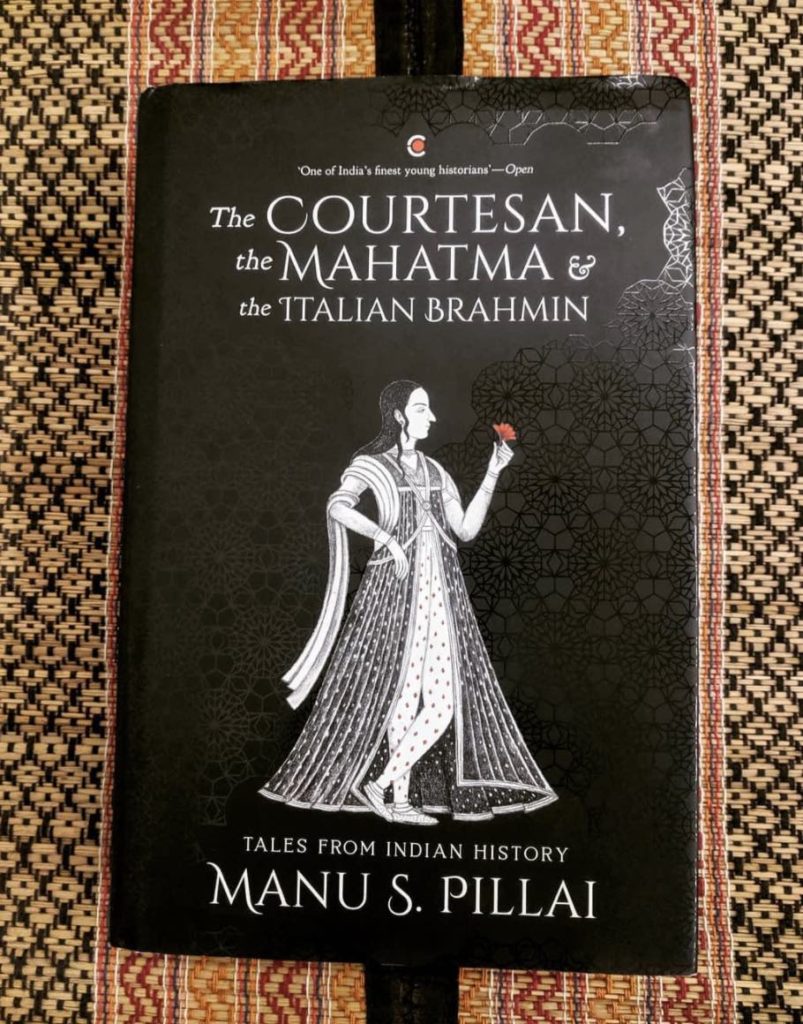
  • The Courtesan, the Mahatma and the Italian Brahmin: Tales from Indian History

    Manu S. Pillai

    I had really liked the author’s earlier work – The Ivory Throne – and particularly the last 100 or so pages where he brought out the humans from behind the aura of regality. I began seeing them in a different perspective and my engagement with the book was much richer. I think the author has repeated this in The Courtesan the Mahatma and the Italian Brahmin as well.

    The book is divided into three parts. The first part is set before the Raj, and the second, during. We’ll come to the third in a bit. All the essays are around 6 pages and I initially found this a little annoying. But it became easier once I got used to the format. The good thing is that many of them generate enough interest to make you go through the sources and that’s a lot of future reading!

    The first section definitely has the shadow of the Mughal empire looming, but barring a couple of essays, the focus is not on them. Through a collection of very interesting characters, the author illustrates the multicultural diversity of India. This section also shows how history itself changes from the time the event happens to now, and how they it lends itself to various narratives that suit a particular social context.

    The second section is relatively more contemporary, and in addition to well-known figures like Annie Besant, Veer Savarkar, V.K Krishna Menon, Vivekananda etc, it brings out those who occupy the by-lanes of history and some whom history too has left behind. I liked this more than the first section, probably because of the poignancy of stories like The Champion of Tuticorin and The Seamstress & The Mathematician. This section also offers a couple of interesting what-ifs – what would India have looked liked without the Raj, and what if the Mahatma had lived to 125 (the life span he preferred)?

    The final section is an afterword – an essay for our times, and makes excellent points on why our multiplicity is our strength, and the complicated fabric that holds us together is not something that hyper-nationalism should try to tear.

    The writing is lucid and the past does come alive. The tales are interesting in many ways – one features a Mappila Ramayana with Ravana as a sultan and Surpanakha seeking sanction from the Sharia, another one has Wajid Ali Shah trying to divorce twenty seven wives in one shot, there are a few with the East India Company’s honchos in India, and from the Italian brahmin to kamasutra to football, it covers vast tracts of history. Highly recommended if you have an interest in history, and especially off the beaten path journeys into the past.
    P.S. A few hundred more pages would have been welcome though!

  • Kochiites

    Bony Thomas

    I have always loved history, especially in the context of a particular city. But despite Kochi being my hometown, I must admit to complete ignorance on the place’s history. That’s why I was very excited about this book.

    In about 4.5 sq km in Fort Kochi and Mattancherry, there are around 30 communities! This small area is also host to the social and religious institutions of these various communities. The variety of people and the origin stories are simply astounding. From Portugal and Yemen to Kutch and the Indus Valley, and many places in between, there have been migrations that happened decades and in some cases, even centuries ago, creating a mosaic of different cultures. A lot of credit goes to the traditional kings of Kochi who were generous with their grants to migrants. It has to be said that this has been repaid manifold by the benefits to trade and the economy in general. (more…)

  • The Rise and Fall of the Third Reich

    William L. Shirer

    What a fascinating read! The second world war was one of the most defining events of the contemporary era, and The Rise and Fall of the Third Reich provides a fantastic view of what happened in Germany between 1930 and 1945, chronicling the ascendance of Hitler and the Nazi Party and its eventual demise.

    Hitler’s dream was to establish a Reich that would last a thousand years, though it finally managed just about a dozen. But in those few years, he managed to give the world the kind of shock it had probably never experienced before.

    The book actually begins much earlier, and traces Hitler’s early life, his disenchantment with the socio-political environment prevalent in Austria and Germany, and his entry into regional politics. Through smart thinking, astute use of the economic depression, a lot of outmaneuvering of politicians far bigger in stature than him, and quite some luck, he took himself to a position where the nation was practically begging him to seize control. It is amazing to see the number of instances long before he gained power when a small change would have led to a different history than the one we are familiar with.

    His baby steps into expanding Germany’s borders through cunning and then brute force, his affection for the largely ineffectual Mussolini, the poor judgment and horrendous miscalculations exhibited by the European powers, Stalin’s greed, all led to a state of affairs that made war inevitable. Germany dominated the early period, the Blitzkrieg tore through defenses, and it is astonishing to see how close they came to taking over all of Western Europe early in the war, in addition to Scandinavia and Eastern Europe. Through the mid to late 30s, what is also evident is Hitler’s own iron will, determination and political astuteness using which he outplayed his opponents over and over. But in Stalin, he met his match, and he underestimated the man and his country’s military strength. A costly mistake.

    At some point, Hitler’s megalomania took over, and his downfall began. His allies, the Japanese, didn’t help the cause much by drawing the US into the war. He repeated history by disastrously opening two fronts in battle. He also misread the importance of North Africa and the Suez. But it is chilling to note that with a little patience and by sticking to strategic alliances, he might not have lost the war at all. The Rise and Fall of the Third Reich also covers the role played by several inept leaders of the German armed forces in bringing and keeping Hitler in power, and their inability to stand up to the dictator, even as they realised that he was leading their country into disaster. Also described in detail are the several plots that were hatched to assassinate Hitler, including Operation Valkyrie.

    This is a commendable piece of work – not just for chronicling an important piece of history, but for the painstaking research that must have gone into it, and the control on a narrative with so many moving parts, all of which are important.

    At 1100+ pages and the smallest possible font, The Rise and Fall of the Third Reich is not an easy read. But if you have any interest in history, and the war that shaped the modern world, this is a book you should definitely invest in.

    The Rise and Fall of the Third Reich

  • Things That Can and Cannot Be Said

    Arundhati Roy, John Cusack

    Given that Ms.Roy is one of the authors, it is only fair to expect a fair amount of radical thought in the book. In just over a hundred pages, it does just that, helped by John Cusack, Edward Snowden and Daniel Ellsberg, who is described as the Snowden of the 60s.

    The content is in the form of observations and conversations with one another. Arundhati Roy is in great form as she articulates thoughts that are not only profound but also vastly out of line with the propaganda that we are so familiar with. After all, even the resistance, as she says, has been quite domesticated. I found some of her observations quite astute. e.g. how “non violence is radical political theatre” and effective only when there is an audience. Or how “human rights are fundamental rights” and should be our minimum expectation, but they have become the maximum, whereas the goal really should be justice! My favourite though was on patriotism – how a country is just really an administrative unit but we end up giving it an esoteric meaning and protecting it with nuclear bombs!  (more…)

  • Ivory Throne: Chronicles of the House of Travancore

    Manu S Pillai

    Absolutely fantastic, and the strange thing is, if you had asked me when I was even at about page 400 (out of 555) I probably would have used milder adjectives. I also wouldn’t have thought (at that point) that I was likely to change my opinion later because knowing the direction, I didn’t think the last 100 or so pages would even be interesting to me. But while they’re not really the focus of the book, and more an inevitable ending, it (to me) is what delivered the texture that mattered most.

    But let’s begin at the beginning. The focus of the book is definitely Maharani Sethu Lakshmi Bayi, who was the Regent of Travancore from 1924-31, but the author spends the first section of the book in setting the context. The canvas is vaster than Travancore itself and everything from the fall of the Zamorin and the entry of Europeans to the evolution of the intricacies that decide the ruler of the land and the prevalent socio cultural setting sets the stage for the reign of the Senior Maharani.  (more…)