Sometime back, during a college reunion, D’s friend mentioned how she was shocked when she realised that she (and therefore us) were ‘those people’ who were being referred to as ‘middle aged’. A couple of years ago, I had written a blog post on entering the second half of my life, which I was hoping would not be a “mountain’s downhill, but instead, a series of small hills, gracefully undulating until the end.” So yes, I have been thinking of old age, and this book, though written back in 1970, is a great exploration of what it means to be old.
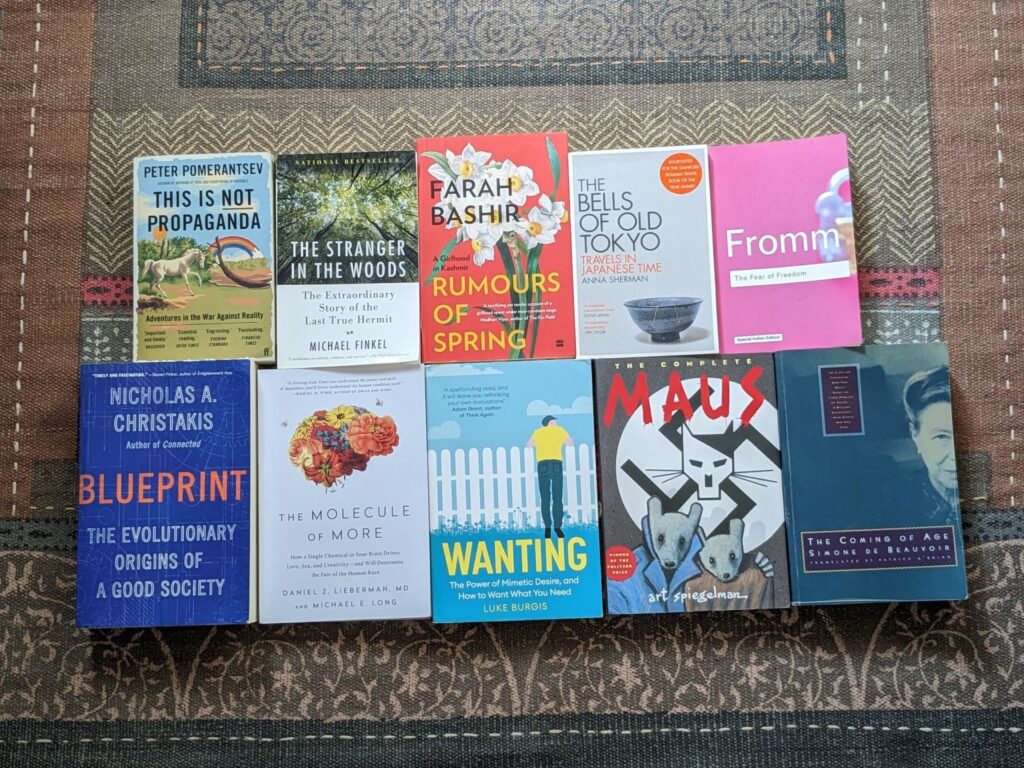
As I was telling D one day, books are probably the only constant in my life. The earliest ones I have is from the 80s – Amar Chitra Katha. The books I read and the person I am have a correlation, though it’s difficult to establish the direction of causation. And so, continuing from 2019, 2020, and 2021, we have this year’s list. The shortlisting gets tougher as the years go by, so I will add my other favourites on the theme in [these]! From the 56 books I read this year…
Nearly five years ago, when I wrote about the closure of my second (and probably final, given the zero usage now) book of accounts, I had ended it with how the days of our lives have found a rhythm, a familiarity. They actually point to the habits that have become a part of my life. Earlier this year, when I wrote The building blocks of freedom, the ending was again a commentary on habits. As I quoted in it (from a splendid post Routine Maintenance), while habits are indeed a way to off-load cognitive overhead… at their most extreme, habits can slide into addictions and compulsions, patterns that resist our conscious efforts to break them… Ritual dissolved into routine.
Habits, as I wrote, are possibly a micro-version of intentionality. They are are physical, mental and even emotional. But when we don’t review them, it is almost as though they hijack our intentions and make them subservient! It’s almost like the new Batman’s point about scars – Our scars can destroy us, even after the physical wounds have healed. But if we survive them, they can transform us. They can give us the power to endure, and the strength to fight. As I have realised many times recently, it is extremely difficult to be objective about my habits. It is only when I am deeply mindful that I observe some of my habits, and sometimes laugh at their absurdity. But when I go back and understand where it came from, I also give a mental hug to my earlier self. 🙂
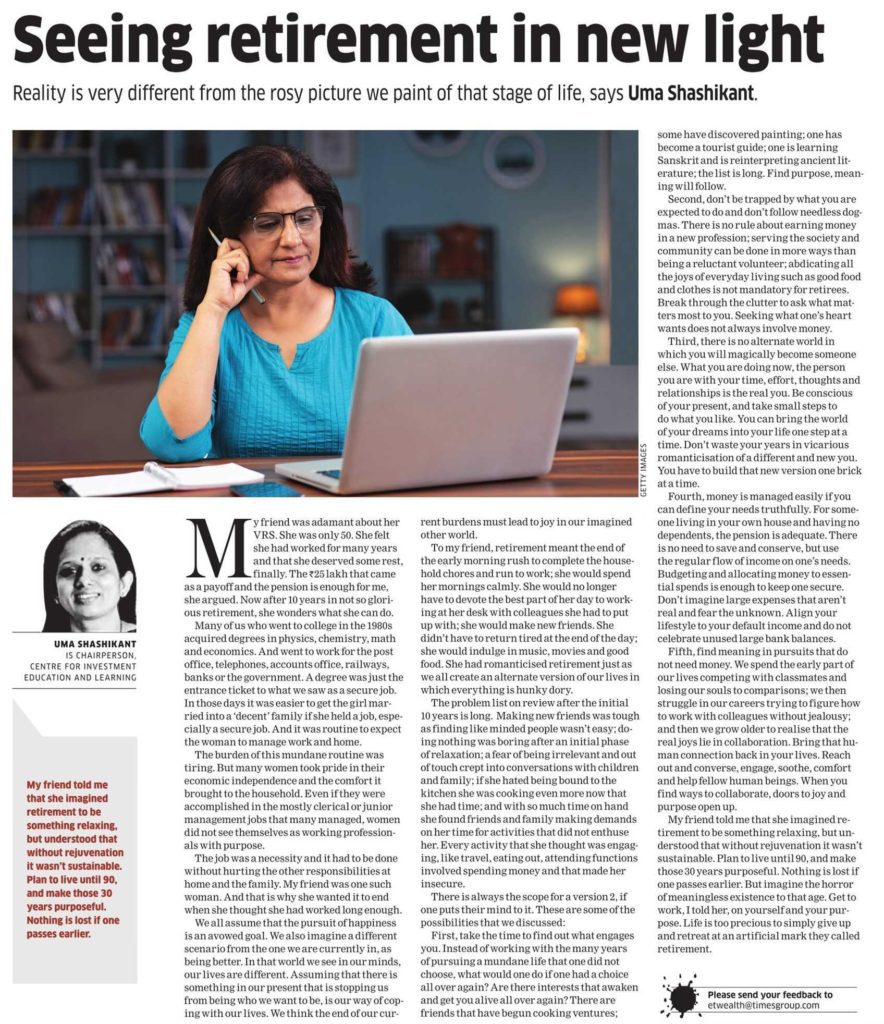
Very recently, it also made me review my deep-set approach to retirement. I had mentioned that in my previous post – the third point in Uma Shashikant’s excellent article (below).
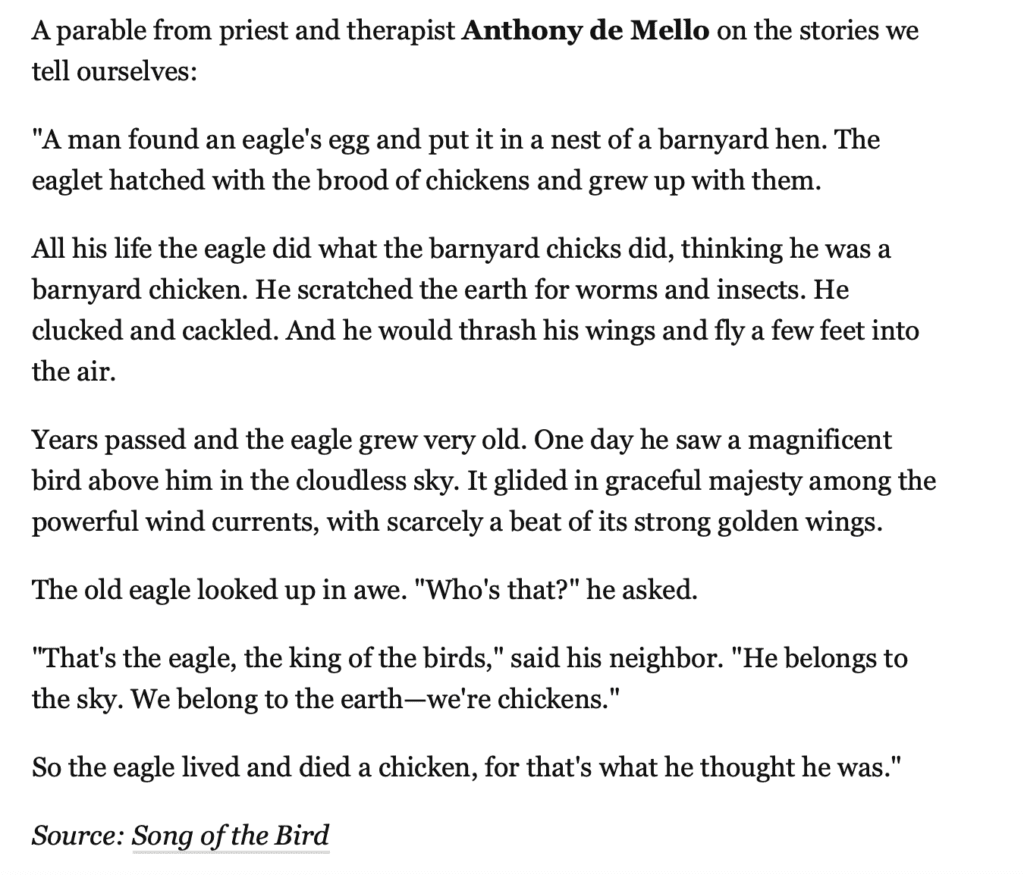
I always assumed that the day I stopped working for a living, I could switch into a ‘different me’. I now see how it’s quite impossible. I will have to start looking at the ‘difference’ right now, and build new habits and junk old ones that can help me move in the direction of the ‘new’ me. The idea is that it won’t seem new. Turns out this isn’t a problem that only I encountered. In a couple of books and articles that I read recently, I came across some very insightful perspectives.
Familiarity and habit impoverishes the way they look at things. They are mostly unable to break away from the past and see things in a fresh way. It doesn’t help that breaking away might mean losing everything that made them great/admired. Lack of interest and curiosity are aggravated by biological conditions, and this intellectual and emotional indifference may cause inertia.
Simone de Beauvoir, The Coming of Age
…Marcel wrote of the human tendency to become stuck in habits, received ideas, and a narrow-minded attachment to possessions and familiar scenes. Instead he urged his readers to develop a capacity for remaining “available” to situations as they arise. Similar ideas of disponibilité or availability had been explored by other writers, notably André Gide, but Marcel made it his essential existential imperative. He was aware of how rare and difficult it was. Most people fall into what he calls “crispation”: a tensed, encrusted shape in life — “as though each one of us secreted a kind of shell which gradually hardened and imprisoned him.”
“On the Ontological Mystery,” Gabriel Marcel, via At the Existentialist Café
And while being too lazy to type out the one above, I found someone had already written about ‘crispation’. And found this (below) there. It reminded me of the converging life Amor Towles wrote about.
“We all end up as packaged goods,” Westbrook Pegler remarked a little while before he died. The dreary road to the wrapping and bundling counter is probably inescapable: there is the hunt for the discovery of what works, then the erosion of curiosity about what else might work, then the disappearance of all curiosity about anything unfamiliar, and at last the prison of the safety of one’s own accepted manner. Yeats was a little way off the mark; the peril for the artisan no less than for the artist is not that his circus animals may desert him but that he will let slip past the time when he ought to turn them back to the forest.
Srinivas Rao drives me to work on a Monday morning in his WagonR. He is probably in his 50s, there seems to be many more older cab drivers these days. At work, we are busy with the survey we run at this time of the year. We have been doing this for the last three years – asking our customers what financial freedom means to them. Retiring without worries is a common theme, and unfortunately, not something many are prepared for. Mr.Rao would have probably given me a sardonic smile if I had asked for his take. He is the dystopian future my scarcity mindset throws at me – me lasting longer than my money, and thus being forced to work even in old age.
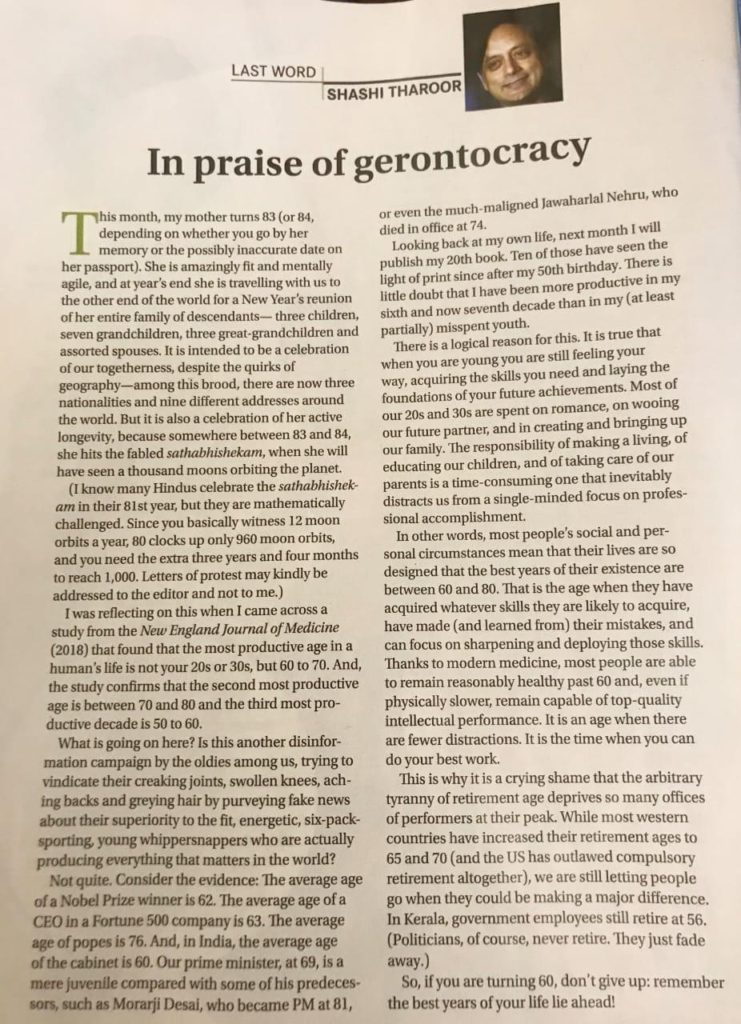
Later in the week, a friend sends me a Shashi Tharoor column from a few years ago, titled “In Praise of Gerontocracy“, in which he makes a case for the years after 60 being the most productive in one’s life.
D immediately and rightly pointed out how the privilege is so deeply embedded that it’s not even an afterthought. I also wondered whether the massive changes in physical (diet, exercise, pollution), as well as mental and emotional (social media, work stress) changes that separate the earlier generations from the current ones, have been factored in. There is a limit to what science and medicine can currently accomplish. In real life, we see our own elderly relatives sometimes struggling to even comprehend what is happening to the one person they thought they knew – themselves.
I have been reading Maus, which has had quite an effect on me. It wasn’t just the Holocaust and its horrors, it was also what happened to Vladek, the author’s father, a survivor, on whom the book is based. Old age with all of the baggage of what he had gone through, and no one around who could really understand his mindset and behaviour.
It took me back to something I had read earlier – The Coming of Age (1970). Simone de Beauvoir writes how old age exposes the failure of our entire civilisation. “The sadness of old people is not caused by any particular event or set of circumstances: it merges with their consuming boredom, with their bitter and humiliating sense of uselessness, and their loneliness in the midst of a world that has nothing but indifference for them.” The loss of standing, the fear of illnesses and injury, jealousy, and the resulting seeming selfishness, the grief of losing others whom they considered part of their future, are all poignantly captured in the book. They thus turn back to themes that are emotionally valuable to them, and replay them constantly, they ‘escape from the present and dream of former happiness, exorcise past misfortunes.’
What is in our hands is how we prepare for it – mentally, physically, emotionally, and financially. Uma Shashikant sums that up quite well in her recent article.
There is really no freedom from old age, and I acutely realise that at some point, we will all end up saying “in my time” – about the time we looked upon ourselves as first-class individuals, doing our best work, feeling like we belonged in this world. It is indeed a great time, but that window is bound to close, and those who live long will ‘have that melancholy privilege of remaining alone in a new world‘. (Ninon de Lenclos)