
Tag: social media marketing

  • The evolution of Content Marketing

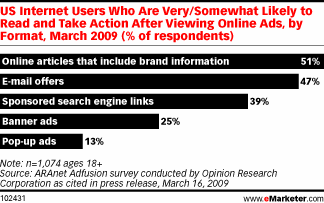
    A few weeks back, the eMarketer released some statistics about the kind of web advertisements that elicit reactions from readers.
    emarketer

    Clearly, the crowd likes to see ‘advertisements’ within content – I think advertorials would be a subset of that. This trend is all the more prominent in the younger audience, when the demographic profiles of the respondents are considered. (check out the statistics here)

    The graph shows that advertising in content is also ahead of sponsored search links, perhaps because the human writer would obviously have a larger sense of context than the ad serving Google. More importantly, there is a trust factor involved when the ‘advertising’ comes from a ‘known’ blogger/writer. There have always been debates about bloggers ‘selling out’ and plugging products/services, but sponsored posts are a reality, and so long as the disclaimers and the disclosures are in place, I am quite okay with that. I’m quite sure that if the concerned blogger gets greedy, the crowd will straighten him out in time.

    Content marketing is definitely different from traditional marketing/PR and raises interesting scenarios for all three parties involved – advertisers, publishers and consumers. Before you go further, I’d suggest reading up Chris Brogan’s (slightly old but) informative post about content marketing.

    The advertisers could range from large brands – products or services, to those serving niche sections. Trendwatching had written recently about sellsumers

    SELLSUMERS: Whether it’s selling their insights to corporations, hawking their creative output to fellow consumers, or renting out unused assets, consumers will increasingly become SELLSUMERS, too. Made possible by the online revolution’s great democratization of demand and supply, and further fueled by a global recession that leaves consumers strapped for cash, the SELLSUMERS phenomenon is yet another manifestation of the mega-trend that is ‘consumer participation’.

    Advertisers would have to figure out if they want to establish and maintain their own content marketing platform, or rely on on a network of entities like sellsumers – that could be individuals or a content marketing service that aggregates independent websites/bloggers, or encourage their regular consumers (/prosumers) to speak about a brand they use, or just support activities/communities and hope for good word of mouth. Perhaps it could be a combination of any or all of the above, with a different objective (a brand goal or a sales goal),  and different measurement criteria for each. In any case, this could prove a great way for brands to explore their long tails of products/services and communication too. It would also mean that brands would have to work harder to ensure that they reach the desired audience in the desired way, in an increasingly fragmented media landscape.

    Publishers, as mentioned above, could be the brands themselves or sellsumers  – individuals or a network. Perhaps newspapers could explore this as a revenue stream, since they’ve always been content aggregators with specialist columnists. The existing social networks are trying to evolve a revenue model out of this. Celebrities could build up an audience across social networks and create an endorsement 2.0 version. For any of the above, the key would be to establish and maintain a set of users, with whom they have an equity- a social capital, to whom they can provide a value, even when they’re doing content marketing. In essence, while the old publishers used their reach for any advertiser who could pay the required price, the new publishers would have to be focused and would have to live with the involvement of consumers in who they sell the reach to, and how.

    The end consumers will seek out networks they can trust, ones which can provides non intrusive ways of connecting them to the product/service they might have an interest in. They would play an active role in creating and maintaining relevant publishers and networks, by ensuring that they are trustworthy sources of information.

    Going forward, it is possible that all the entities we see on the web now, including us, will play all these roles at various times. Unlike the clearly demarcated advertiser-publisher-consumer system we have now, the new systems would be more fluid, with flexible options for all parties. The standards and norms of content marketing need to evolve. Perhaps the disruption we are seeing now, with the decline of traditional media and rise of social web is a prelude to this flexible system.

    until next time, role play

  • Conversations in social media

    The Facebook redesign and the possible redefining of brands’ interaction with users on the service would perhaps make organisations dwell a little more on their new media strategy. I say this, mostly considering the reach of Facebook, and the importance and influence that conversations there, are acquiring in people’s lives. The growing reach of Twitter cannot be ignored either. So it does seem a good time to reflect on creating a digital footprint, getting to know the platforms – be it Facebook (via Vijay Sankaran), Twitter, (links point to good ‘How to’ resources) or any other service, and how they could benefit the brand, looking at what has/hasn’t worked for other brands, thinking about a long term social media strategy,  and then figuring out the measurement criteria that could be adopted for the strategy that is adopted.

    Amidst all the hoopla surrounding Facebook’s new design, and Twitter’s integrated search, Paul Worthington wrote a very interesting post on Mashable reminding brands not to lose their focus. From the post

    The initial challenge is not to better understand and respond to the customer. The challenge is to start with better understanding who you are, what you truly believe in, and what you can realistically offer to your customer.

    Because if all you focus on are what customers are telling you, you risk losing sight of who you are, what you believe in and what drives you forwards.

    A purpose that is first bought into by their employees, before being presented to the consumer in a way that brings a natural self-confidence to that conversation.

    While crowdsourcing has many advantages, and now has various platforms including Facebook, Twitter and more focused services like Get Satisfaction, and consumers also benefit from having big brands on these platforms, I completely agree with the thoughts shared above. This is what I’d consider as the middle path between adhering strictly to brand manuals only and plunging into social media without a clear objective/strategy and trying to please everyone in the crowd.

    So, perhaps what brands should do first is search themselves (yes, without Google), understand what’s the real value that they offer to their consumers – potential and current, figure out whether the entire organisation is in aligned on this, then consider how new media can play a part in sharing and collaborating with the users as well as communicating to them what the brand stands for and what value it can deliver, ensure that they continue providing this value, keep listening to users to find what more they expect from the brand, figure out the feasibility of these expectations, tweak it further by bringing in the internal factors, and continue this process. For many organisations, internal democracy as well as complete internal transparency would themselves be a significant steps. But these are a must before aiming to engage with consumers, because in social media brand custodians are not the only ‘broadcast’ source, every employee is a potential source.(a wonderful presentation on the micro sociology of networks)

    In essence, its not just a brand strategy shift, its an organisational culture transformation. As a brand, and as an organisation, it is important to be clear about the levels of transparency you can work with. The challenge then becomes that of creating and maintaining a harmonized balance between user needs and brand deliverables.

    until next time, drawing the line and walking it

    PS: A great story on how two fans made Coke the second most popular fanpage on Facebook, and Coke’s reaction.

  • Change is here, hard cash?

    The question I posed on the Digital Marketing India group in LinkedIn, on whether advertisers would consider Facebook a better place to spend than Twitter, post the FB redesign, yielded a good discussion. Inevitably, the discussion entered the territory of whether the redesign would alter the status of the differentiated audience that each provides, and therefore the monetisation opportunities that both could develop.

    My post last week dealt more with my usage patterns on both services. I think that usage patterns would drive the kind of conversations and the context, and therefore be a major factor in deciding revenue streams. While on Facebook, we start with known friends, and then add layers to the relationship, the opposite happens on Twitter – you discover people with common interests and then the conversations evolve. It makes me wonder what really is the magic of Twitter – real time interactions, the discovery of people, or the ability to have conversations without revealing a lot of one’s profile. While most of the Facebook redesign conversation is happening around real time, and upgraded fan pages, the upgraded privacy settings which allow ‘follow’ without friending could be the feature that  gives FB the most commonality with Twitter.

    Mark Zuck had this to say about real time  – “the pace of updates accelerates. This creates a continuous stream of information that delivers a deeper understanding for everyone participating in it. As this happens, people will no longer come to Facebook to consume a particular piece or type of content, but to consume and participate in the stream itself.” Facebook might be trying to equalise Twitter’s advantages, and as per Erick Schonfeld on TechCrunch. “Facebook doesn’t want Twitter to become the way large companies and public figures connect to fans.”. (via Adage)

    But I have a few concerns on this. Will the crowd be able to handle the deluge of items on their newsfeed, even with the filters being provided? In Twitter, the stream is everyone’s base (it differs based on the people one is following, but there is a public stream too) When conversations happen simultaneously in various ‘crowds’, they are connected by devices such as hashtags and RTs. In Facebook, the individual’s profile/home page is the base, so how does the connection of conversations happen? On the fan page, but there seem to be a few issues there? Groups could help in providing this base for a lot of conversations, but there are no updates as far as groups go. Lastly, as a user of both networks, I wonder if I can have the impromptu conversations that I have on Twitter, on Facebook. The third party clients that have been developed for Twitter have made sure that users have a wide array of options for their interface. Is that a major factor in boosting these conversations. Perhaps. (via Sampad)

    During the discussion, Sanjay pointed out that Facebook provides multiple engagement spots , and with the redesign, it could integrate the large user profile it already has with the real time stream to offer more accurate brands/ads placement. I’d like to add one more data component in this mix- Facebook Connect. According  to TechCrunch, work is already happening on the “Facebook ads + Facebook Connect = Social Ad Network” concept.

    Facebook has, as part of the new design also brought in location and language based targeting capabilities for advertisers. RWW also notes that, thanks to the Facebook Connect integration with Brightkite (a mobile social networking service), there are possibilities of hyperlocal targeting in the near future. The other market that would open up in the future could be based on the language versions. (Facebook is working on five Indian languages, for example) While Facebook has been making changes, basis features from Twitter and Friendfeed, it might also be to their benefit to look at an old adversary – MySpace. Though, at 236 million users, Facebook is rapidly leaving MySpace behind, the latter seems to have pipped Facebook as far as time spent on the site goes. It needs to be seen whether the new design will change that statistic too. Mashable has a post on the challenges and opportunities that the Facebook redesign throws up for brands. A consolidation, like streamlining the search function to aid easy tracking of conversations, might have to be done soon, to enable brands to utilise the service’s redesign better.

    In the discussion at LinkedIn, I had also brought up Stuart’s very interesting post on Twitter emerging as a personal advertising medium, which led me to wonder if large brands would gravitate towards Facebook, since they give a more structured way of interaction and small brands/individuals would use Twitter for promotions/advertising. But as Sanjay pointed out, Twitter would then, still have a revenue problem. 🙂

    Twitter is growing..and fast. Going forward, Twitter would need to watch Facebook carefully and choose a course that uses a different set of parameters for clustering users, and so deliver a differentiated audience, by usage or some other criterion, to create revenue streams. This could mean buying out a few services that complement the simple proposition that Twitter offers or helps measure brands’ activity on the service. Though I had mentioned that the big brands might want to look at Facebook because of the more structured approach,there are several brands already active on twitter. Like I said earlier, different user behaviour and contexts might mean that brands have different uses for Facebook and Twitter. While on the subject, check out Mashable’s cool sociable ads concept, and the debate about paying to be in the list of  suggested accounts to follow. (a list of 100 provided by Twitter to new users to start them off on the service)  It opens up a new line of thought. What if Twitter could find a way to serve real time contextual tweets on blogs, websites etc, perhaps as a (Twitter combination version of Google Search + Sponsored ads- if a brand wishes to be seen in a particular keyword context, for starters) widget. Let me think a bit more on that.

    Meanwhile, what brands should think about, is that in all this real time information overload on various services, they should not lose focus of what they are, and what their objectives are. Like I’ve said earlier, tools cannot replace strategy.

    until next time, some real time comments? 🙂

    PS. Must Read: A great Twitter FAQ list from Jeremiah

  • Brands & Media Metrics

    Rajesh Lalwani raised an interesting point in his post a few days back, on how the performance of a social media campaign should not be judged solely by the buzz it generates, since a lot of conversations flow ‘below the surface’ i.e. emails, telecons and face-to-face. I’d also add Chat (the GTalk type) and DM.

    My reply consisted of several parts, and some of it got me thinking on the concept of ‘measurement’.  Among other things,  I felt that, relatively speaking, it is more convenient to measure buzz (a social media search or even a Google search) than the ‘below the surface’ versions. You really can’t track what I speak with someone else on GTalk. But more importantly I felt that this love for measurement stems from a need for control.

    So I looked back at the brand campaigns around, the media used and the measurement. Following is a rant.(and is quite India specific) Though its extremely relevant, I shall, for now, ignore brands’ following a ‘campaign strategy’ at the cost of brand strategy. Generally, the campaign would consist of Outdoor (billboards), Print, Television, Radio and *new* Internet. So, lets see the measurement criteria for these. Outdoor – you can’t go wrong with one on Brigade Road- Residency Road (that’s Bangalore) junction, everyone goes there. Print – XYZ has circulation and readership of …. Television – XYZ channel and the TRPs it delivers. Radio – say RAM and listenership. While there are numbers and numbers, there is really no way to figure out exactly how many people saw/heard the ad and responded (not even if you put call centre numbers/email ids/call ins).  The sales spike that happens on the day the ad is released is the indicator of its success in print. If ‘people’ saw/heard it, TV/Outdoor/Radio has worked. Yes, I’m generalising, and I do know what value market research can offer. And so Internet. Now the internet obviously needs to match up to the awesome quantitative measurement options that the other media provide. 😐

    And so the brand guys waited for the net to show some real numbers. And it did, as it was bound to. Depending on who you ask, this number could now vary anywhere over 28 million users. ComScore puts India’s net population at 32 million, and within that, the social networking population at 19 million, Orkut firmly leading with 12.8 million. The figure reminded me of the leading English daily’s readership – as per IRS R2 2008, it was 13.3 million. 🙂

    And while the numbers rose, the digital sellers walked in with the stats and taught the brand guys CTR, CPC, CPM (no, that’s not political)  and to use banners and site takeovers and microsites on the net. The measurement criteria was made up of numbers. So, the internet with the amazing CPT (cost per thousand) it provides, is no longer an afterthought in a media plan (Thanks to R, who gave me her valuable thoughts on media planning). Pay for Performance was the mantra and its pillars were leads and clicks.Is that a problem? Not by itself, but when you consider the potential the medium offers, and how it can be used for measurable branding, its not a problem, its an injustice. To quote from this wonderful article on the subject

    In fact it is precisely this cult of accountability that is getting in the way of the digital community progressing from clever marketing handymen to the architects of brand success….So long as the digital community clings to its obsession with accountability over effectiveness it will remain in the unedifying position of creating engaging brand fluff on the one hand and highly measurable but largely pointless direct response advertising on the other.

    All these are not unknown issues. WATBlog’s panel discussion in Delhi covered much of this. And with all this playing in the background, arrives social media. And it won’t make sense because brands only use media on a campaign to campaign basis, and social media is about the brand’s strategy and a consistent presence- building an audience, listening to them, asking their views, collecting insights, making better products, and so on. It is not about statistics and definitely not a get in-bombard with ads- collect leads-get out deal. Besides, measurements are more qualitative!! The criteria that mass media provides for measurement are almost irrelevant here, and rightly so!! Because in social media, the crowd responds, they talk to each other, and if you don’t participate, and attempt to treat it like a broadcast medium (the way the measurement based web is being treated), someone is likely to have fun, most likely at your expense. And in social media, what a brand says is less important than what the brand’s consumers say.

    Like the general web before it, it is only a matter of time  before the social web  reaches a scale which forces brands to use it. I hope they don’t use it like broadcast media, and instead learn to use it – not as a templated solution, but as a subjective, evolving mechanism.

    until next time, cast away

    Note: i have nothing against mass media. It has its uses. I have a problem with this social media measurement obsession, without the correct metrices and by involving it only from a communication perspective and not the other parts of the brand’s life cycle, and finally stating that it’s just fun and doesn’t work for brands.

  • Brands among sheep

    A few days back, I read a post on Adage, about how Facebook has become a place to collect friends. A large part of the post was about how people one barely knew became ‘friends’, how we all seem to be involved in each others’ lives in superficial ways, merely by sharing stuff we do, how we are failing to live the moment because we have to update our status first. 🙂 Not surprisingly, he was burnt at the comments stake.

    At some level, the author is right about the ‘collecting friends’ part. This would explain the success of Burger King’s ‘Whopper Sacrifice‘ app, in which sacrificing (deleting) 10 friends would get you a sandwich.  Somehow, Facebook didn’t seem to find it that cool, and took action.  Meanwhile, Facebook has been trying its bit to customise the news feed by allowing ‘more/less about’ options for status updates. In addition to the grouping of friends, an obvious Orkut like classification of friends, acquaintances etc might help too. Meanwhile, I read about what seems an interesting new network that aims to put an end to the random friend addition – hipstr.

    Meanwhile, the post actually did raise a couple of interesting queries, which were lost in what was seen as an anti-Facebook rant – one, in this communication avalanche that’s happening among consumers, is it possible for brands to squeeze in their communication at all? And are friends becoming the new platform for advertising? I’ve seen several Facebook ads that use friends as an ad platform, and most of the ads that I see with my friends’ endorsement are without their knowledge. (xyz uses abc app) I dont think that’s the scalable model we’d want.

    The easy answer to the first question (as described in many comments) is context and value creation. But in terms of advertising, I think (and this is highly debatable) Facebook lacks a definite context. I update, I share photos, I write on the Wall, I play a few word games, try a quiz out and so on. So I wonder whether context can play as good a role as it does on search, because the intent for which I frequent Facebook is completely different. It made me wonder if an all encompassing generic network like Facebook will find it difficult to be of commerical use? Like I commented on a good discussion on social media we had on Twitter, perhaps, in the realms of social networking, the scope is for vertical networks (there are many which’ve already popped up) that cater to more specific interests. The version 1 of that would be LinkedIn (business networking). The scope for context and value addition could be much greater there.

    But perhaps better mining over a period of time will give feasible solutions like say, integrating the birthday calendar with a gifting opportunity. So if my friend abc has his birthday today, and is a fan of a particular product/service on Facebook, then Facebook will ask me if I want to gift him that product/service. No, not just virtually, really. Or say, a status update of mine says I’m having a house party, and the Pizza Hut app sends me a mail asking me if I’d want to consider its services. Of course, design, privacy issues etc are to be kept in mind.

    I’m also hoping that the above premise will be taken to a whole new level with Facebook Connect. Mashable had a good post a few days back on 10 great implementations of Facebook Connect. It includes a traditional media brand (CNN) and an energy drink brand (Red Bull). Perhaps Connect will bring in the much required context.

    until next time, dont throw a sheep 😉