
Tag: social media marketing

  • The Social Product

    A few days ago, I read this post that cited studies on consumer sentiment (US, UK) about brands being present on social media. There are plenty of interesting perspectives and nuanced insights but one key takeaway is that consumers feel there is a glut of companies on social media, though it seems the younger age group feel that presence on social media adds to trust. Around the same time, I also came across the theory of peak advertising which begins with the decreasing effectiveness of online advertising and moves through various stages to suggest alternatives to the current business models that sustain the internet.  Collectively, it would seem as though the (generic) advantage of just being present on social is plateauing, or probably even going down. There are obviously brands that are using these platforms effectively, but increasingly, social is being used as media and this is easily replicated by other brands. At a larger level, the advertising barrage on social is also reducing effectiveness. That led me to think – before the utopia of social business, what opportunities does social have beyond the traditional marketing, advertising media based approach, enterprise collaboration, and social CRM?

    In the second Myntra post, I’d written about how I felt that ‘product’ was best placed to deliver sustainable business advantage. Though it was related to the website/features in that context, I’m now considering if this is applicable across the board – to physical products as well. Also, the more I see social evolving on customer care, marketing, advertising and sales, the more I think these are becoming hygiene. I have omitted marketing because I think there is scope to build a unique brand and thus some business advantage in the long run. However, I also think that this marketing will have to significantly integrated with ‘product’.

    In this context, I found this Forrester post titled “There is no Internet of Things” extremely interesting. Though we’re in the early stages of this phenomenon, I think it’s a good time for her to have raised the point of fragmentation and apps/brands working in silos. There are some excellent examples and scenarios in that post that make it a must-read. The conceptual answer to this is in the title of this HBR post – “The Age of Social Products“, and it makes a great point on ‘shared purpose’. “In an age of social products, competitive advantage comes not from product features but from network effects.” (though at this stage, I do think it’s both and not an either/or) Nike, as mentioned in the post, (and as usual) continues to be on the cutting edge. The common theme in their case is that the product + community (user+developer) offering only uses popular social platforms to augment, and is not dependent on them.

    The current approach to social (media) is either to use $ or influence. I’m not sure there’s enough importance given to the network and the effect that’s created over a period of time. As this superb post states on the subject of disruption and diffusion states, “It’s not the nodes, it’s the network” In that light, I feel social products might be able to do more justice to the promise of ‘social’ than its current avatars, especially social media. I did think the same way about social platforms earlier, but we live in hope!
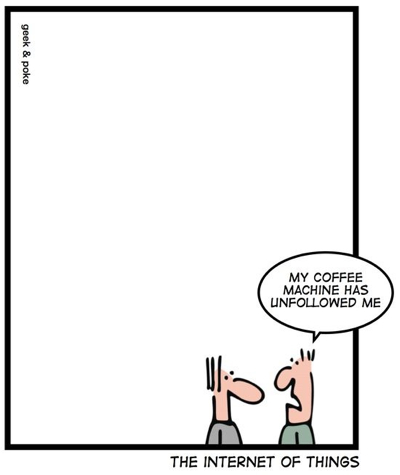
    IoT

    (via)

    until next time, objectifying social 🙂

    P.S. I was reminded of a term coined much earlier – social objects. In that context, it was anything that could be a conversation starter, and the focus was more on its ability to connect people around a subject of common interest. Social products have the ability to take that connection and give it a platform where even people who are not in the same time and place can be part of the conversation. This is beyond its ‘utility’ not just as a product but also as a device that talks to other devices and makes itself more useful. I’m actually thinking of that ‘bottle of memories’ I mentioned in an earlier post, probably in a smarter avatar – like this or this – but also ‘tagged’ (say, using an augmented reality app) with the people who are part of the stories associated with it. Now, at some point, when I see the bottle, and get particularly nostalgic, I could use the same app to see what those people are up to, and quickly ping them to start a conversation about the good old times. In the collaborative and sharing economy, think of the possibilities! (If you’re interested in this sort of thing, you should like this post) When I think about it, what we probably need to accelerate this is a browser (what it does for the web) equivalent.
  • Jump with a crowd

    ‘Jumping the shark’ is a phrase that has been jumping on to my face regularly, but something that got lost in the rigours of speed reading and processing. Thanks to Tom Fishburne’s excellent post on the subject in the context of brands, products and organisations, I got to think about it a little more. The quick definition would be (from the post), “the moment of downturn for a previously successful enterprise.” The problem with it? “The risk of jumping the shark isn’t getting eaten by the shark. It’s leaving your loyalists behind.”

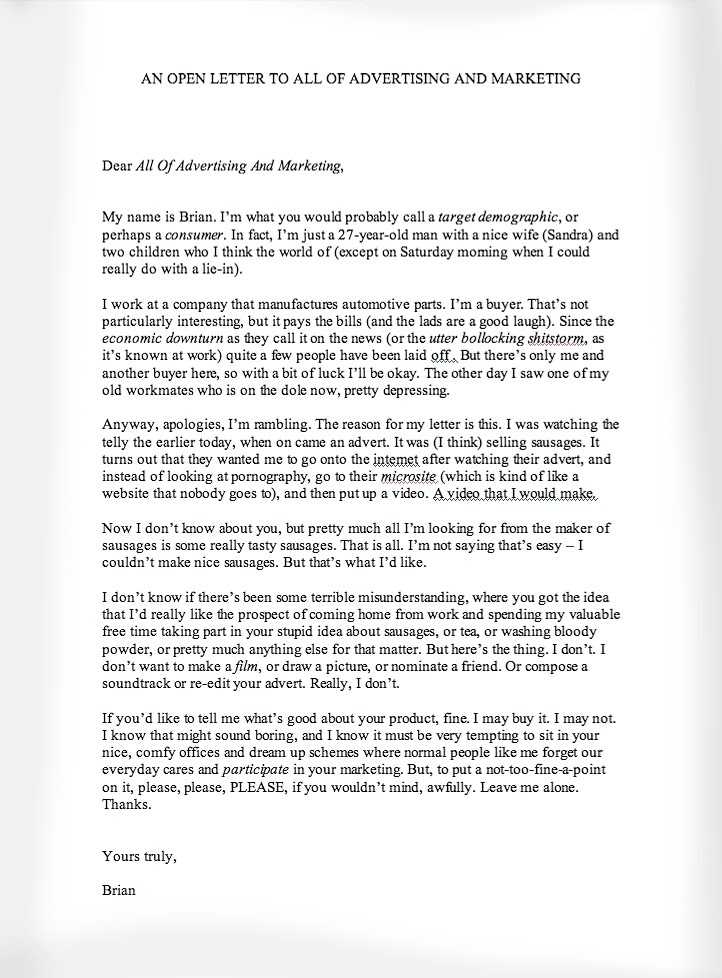
    I thought about it a bit, not in the context of brands or businesses, but more in terms of brand communication as a field, advertising specifically, and brands’ usage of the social web. Consumption patterns, media platforms available etc had pretty much created templates for creative agencies over a period of time. But the arrival of the web, social platforms and the democratization of media have managed to disrupt the ways of the one-way communication age. This post is a good one to read in that context, and talks about the change digital has made to campaigns, and the ‘role of the consumer’. But desperation, hype and the eagerness to get on board makes everyone concerned ‘jump the shark’. And unfortunately, the way I’ve seen many agencies and clients execute it (purely as a consumer), I’m quite inclined to agree with the author of this hilarious letter. (via PSFK)

    Clipboard01

    (click to enlarge)

    The job of the brand manager/creative agency is obviously a more difficult one now, and is made even more so thanks to the approach – of tool strategy. Like this (old but) excellent post states, ‘the technology that underpins social media is changing fast’, but its ephemerality ‘is a feature, not a bug’. It made me wonder whether brand communication/advertising, as a process (the way we see it now) had ‘jumped the shark’, mostly because the thinking process still sees  social platforms in the same light as traditional media and has not changed to be in tune with the former’s dynamics. In other words mistaking social media marketing for social media.

    Maybe they have to dig deeper, figure out the value that people are willing to pay for, and then find their ‘purpose idea + social object‘, and consistently. But that would mean a sea change in the way brands and creative agencies operate. Is adaption possible, or is complete disruption inevitable?

    I juxtaposed this thought with something that Seth Godin wrote recently, about the ‘red zone‘ – the joyless part of the learning curve. His graph also has a green dot, which represents ‘someone on the other side.. rooting us on, or telling us stories of how great it is on the other side’. Perhaps if brands can find from the existing consumer crowd a few who believe enough to play the ‘green dots’, they can adopt a more holistic approach to social platforms and carry the loyalists without it seeming like ‘jumping the shark’?

    until next time, safe jumping.

  • Social deluxe

    Sometime back, Mashable had an interesting post on luxury brands and social media. While a few points were raised on the challenges, the one that interested me most was how the facet of  ‘exclusivity’ could be balanced with the relatively open nature of social media, especially Facebook and Twitter. The post also highlights a couple of examples – the aspiration based FB fanpage of Gucci and the invite-only closed social network of Mercedes Benz – GenerationBenz.com. The examples were interesting because they were two different approaches – of how luxury brands can use social media. On a related note, Jeremiah Owyang wrote a post a few days back – 5 ways luxury brands can overcome the conundrum of social marketing.

    Before we discuss the specific usage on social media, how exactly do brands become classified as luxury? According to the post above, “When linked to brands, it is characterized by a recognizable style, strong identity, high awareness, and enhanced emotional and symbolic associations. It evokes uniqueness and exclusivity, and is interpreted in products through high quality, controlled distribution and premium pricing”. I assume the above takes into the account the parameter of service – not just in the case of say, hospitality or other service luxury brands, but even regular luxury brands, since the overall experience (from the retail experience of shopping for the brand to post purchase service) is key to earning the tag of a luxury brand.

    With regards to social media, I’d say that social media has this way of stripping the veneer, of removing the fluff around entities so that its reputation is made/broken basis its performance on the core value it provides. In fact, sometimes even the cost of ‘production’ is not taken into account, the audience expects things for free and the crowd makes its own sense of value for the product. (yes, I am referring to the interesting free vs paid debate) Wired has an excellent article titled ‘The Good Enough Revolution‘, where it takes examples from various sectors to show how, with advancing technology, consumers’ expectations from their purchases are changing drastically – the rise of the ‘good enough’ tools. While it is essentially attributed to the busy lives we lead now, the fact that it is also ideal for recessionary times is highlighted. From the article,

    We now favor flexibility over high fidelity, convenience over features, quick and dirty over slow and polished. Having it here and now is more important than having it perfect. These changes run so deep and wide, they’re actually altering what we mean when we describe a product as “high-quality.”

    Of course, there still is an audience that doesn’t live by these credos, but that’s perhaps not really a large number. One could argue that this was the only audience that mattered to luxury brands anyway, but If this trend catches on, then the entire premise of luxury branding becomes wobbly. PSFK has an interesting note on a Louis Vuitton Calabash – on mixing the notions of utility and luxury, and how the addition of a designer label on a commonplace item raises a question on the value of things. A lot of the luxury brand’s aura is through maintaining a perception among the audience, and keeping itself as an aspiration among potential consumers – couching utility in intangibles. This is not taking away anything from the quality of the product per se, but the entire concept of ‘brand’ is usually seen as a way to distinguish the product from similar products and take it to a level  above that of a commodity. A lot of communication these days is about the aura/show off value of the luxury brand than anything to do with the product superiority. In a way, its quite logical (and obvious) because if luxury brands focus on the utilitarian value of their product, they really wouldn’t get ahead. The counter point to this would be that the premium charged by the luxury brand is for the emotional high of using the brand, in addition to the (hopefully) superior quality that it provides. Does it mean that luxury brands would have to relook at the premiums they charge?

    But having said all that, there are quite a few things that seem to point towards potential synergy between luxury brands and social media. One of the points that Jeremiah mentioned in his post is the usage of celebrity associations. Celebrities are now running rampant on social networks, and luxury brands have a good means of weaving themselves into the conversation, and increasing their aspiration value. Usage by a celebrity also gives them a context to kickstart conversations. Also, social media is about emotional connect and sharing. If much of a luxury brand’s aura is built on the emotional appeal, then it can use social media very well to its advantage. After all, what other medium offers such easy methods to spread some ‘show off’ value? 🙂 I thought the Mercedes Benz idea of a closed network would be great if they allowed users at least partial portability of data to other networks. (to, rather than from) The ‘share’ aspect of social media will also help identify potential customers via existing ones. But most importantly, I feel the biggest use of social media (actually the web in general) for luxury brands is the audience data that is being generated on a regular basis, real time. It offers better segmenting and targeting opportunities, and while this is applicable to all brands, it is all the more important for luxury brands. This can be used for gaining more insights, encouraging sampling and so on.

    It is definitely an interesting conundrum, but the web, thankfully has space for all kinds, I think. Will appreciate your thoughts. 🙂

    until next time, the luxury of real time? 😉

  • Big brands, small ideas

    I ended last week’s post with a note that social media services provide brands a way of having their lifestream online, and weaving themselves into the consumers’ context. Last week, I read an interesting article on Six Pixels of Separation titled “Your Company is a Media Company“. It talks about how the different social media tools allow companies to publish their own content without the aid of the earlier generation’s tools and processes – newspapers, PR companies etc, and how these companies are finding new ways to tell stories. It also discusses how consumers now expect companies to be connected, listening and reacting – in a human voice. I remember touching upon this subject in a few old posts of mine – “The new media owners“, and “The Evolution of Content Marketing” a few months back.

    One of the biggest gripes that come up when big brands arrive on social media services is how they use it as just another broadcast channel for their TVCs/microsite/contest etc without adding any value to the reader/consumer. I have seen many a brand on Twitter completely disappear when their promotion ends, perhaps it came up only because ‘Twitter account, Facebook page’ were the current flavours in the marketing communication checklist. These are obviously generalisations, and the three examples that I’d discussed in the last post are obvious exceptions.

    While wondering why it has to be this way, I remembered an old post of mine, which though discussed the future role of a brand manager, had started out on a different premise. It had been triggered by a superb post by Russell Davies titled “the tyranny of the big idea“, and a couple of wonderful notes at Misentropy, which took the idea further. (All the three posts I have linked to are 1-3 years old, and I still find them great reads. What I’m trying to say is that you MUST read them)

    In the last few days, I have seen a few posts that have explored this theme, from different perspectives. Six Pixels of Separation has a post that discusses how the combination of 3 factors – a conversation based social media, real time and fragmented media would mean that marketing strategy would have to move away from the big idea and be more involved with smaller ideas basis the type of people the brand talks to, the platform of discussion, and the context. Closer to home, I read a good post  on afaqs – a question posed – whether television is hogging the resources (financial and talent) because in India it is the most preferred medium (not basis revenue) for marketers as well as the advertising fraternity. L Bhat has a very pertinent post on regional branding, and how Indian brands approach it with a one-size-fits-all approach, relying on translations which don’t do justice to the original idea, or showing contexts which have no relevance to the local audience. He notes (illustrated with examples) that brands which have developed communication specifically for the region have touched a chord with the audience. Another indicator that media fragmentation is not just about the web, let alone social media.

    With the advent of the internet, and specially social media, brands have the opportunity now to use this means of distribution to explore the long tail of audiences and marketing communication. The economies that dictate the usage of television, print etc – in terms of both production and distribution, do not really apply on the web. The NYT has an article on the rise of sentiment analysis – the social web as a ‘canary in the coalmine’, as a way to identify opinion leaders, as a forecasting tool, and so on. Its still early days yet, and we will obviously see much improvement in the current systems. In BlogAdda’s interview with Avinash Kaushik, Google’s Analytics evangelist, I had asked about the effect of the ’emotional responses’ in social media on the field of analytics. As he explains, there cannot be a single tool that can capture all data, and those who monitor this, will have to get used to the idea of multiplicity. From just deciding where communication will be distributed (and to a certain extent, consumed) to  having to track where conversations are happening in an ‘everything reviewed‘ (Transparency, Trendwatching’s September trend)  world, and then deciding the what-why – that is quite a drastic change. These are obviously not mutually exclusive, but it still is a challenge.

    The earlier models of communication (and even some elements of strategy) have perhaps been conceptualised and practised without factoring in instant two way communication, conversation among consumers, and multiple touch points. It was relatively easy for everyone concerned to have one big idea and push it into all the channels. That is perhaps what is happening as ‘social’ is seen as just another ‘media’, but it works differently. It involves a whole new set of rules, some yet to be even thought of. While there will be quite a few advantages, there will also be several challenges for the brand- to be different within the core brand idea, to add value to the different kinds of audiences in context, to decide levels of transparency and be comfortable with it, to be a ‘media company’, to be also comfortable with the rigours of listening and possibly having to react real time. There will be challenges for the brand manager, like I mentioned in the post earlier. There will be challenges for the creative agencies – when they develop ideas, they have to be medium and context specific, and also know how to respond in real time. They will also have to be churning out fresh ideas on a regular basis. There will be challenges for media agencies – to find out the maximum possible touch points relevant for the brand. And this is not just to do with the web and social media alone, but the better usage of other media too. Brands can actually be different things to different people, and be relevant. In short, a drastic overhaul of the system which currently operates, before they an get to being a media company. Being a ‘media company’ and ‘always on’ means that the ‘content’ cannot solely be made of big ideas. Possible, but impractical, I’d say, unless its an idea with several rendition and execution possibilities. From one big idea every quarter/year to a stream of small ideas. Not necessarily, perhaps, but probably so. I wonder, how many big brands and agencies will be game for playing with small ideas.. and failing sometimes?

    until next time, a tyrannosaurus hex 🙂

  • Aggregation and Segregation

    The ‘Morgan Stanley report‘, compiled by their 15 year old intern- on how teens (UK ) consume media- released a few days ago, got less than an enthusiastic response on the web, in spite of (or because?) their introduction stating that they don’t ‘claim representation or statistical accuracy’.

    While newspapers and radio find least favour with the teen crowd, with TV interest waning (except for spikes – sports/ specific shows), even the star on the horizon – Twitter is not spared their inattention, but Facebook, YouTube, and even Google are mentioned as regularly used services. Mobiles are used for talking and texting, and sharing files via bluetooth. (via RWW and TechCrunch) The report is based on anecdotal evidence (not statistical), so its no surprise that its been ripped on many sites. As TC mentions, probably the idea was only to spark off a debate, and not to showcase it as conclusive insights. It still shows how there is clearly not much data available on this age group, so anything goes.

    But I do remember a research published by Nielsen sometime back on how teens use media (US). According to that report, TV usage has gone up in this age group, teens spend less than half the time adults do on the internet, a quarter of them read a newspaper and texting is huge. In both reports, the relative unimportance of the internet is a revelation, especially when it is seen by many as THE medium that’s popular in this age group. As per a 16 year old’s post on TC, (this is anecdotal too 🙂 ) the other point to note is that the walled garden nature of Facebook is actually seen in positive light by this group. Twitter’s relative openness means that they have lesser control on who sees their status updates. The other factor is that they don’t want to waste money texting messages to Twitter, when they’d rather text their specific friends.

    So there are similarities within the age group and there are differences too. This is not the first ‘generation’ study out there. I remember reading at least a couple of comparative studies on how different generations use the net, or technology per se, and there again were trends. There were also quite a few articles on Gen Y (those born between 1980 – 95) – their top social networks (take a look, you’ll find very interesting sites, which you might not have heard about before) , how marketers goof up when targeting them, and a favourite post (and video – The Lost Generation. yes i know it is inspired 😐 ) of mine that talks about the motivations of different generations.

    Trendwatching had the concept of Generation G ( G for generosity), with the trend drivers of recession and consumer disgust, longing for institutions that care, and giving being the new taking, and sharing being the new giving. It also gives ways in which corporates can join this generation, and talks about joining being a fundamental requirement if they wanted to stay relevant to this generation.

    The Morgan Stanley report and the backlash that followed made me wonder as to how, even as we admit that there is indeed media fragmentation and user fragmentation, realise that a ‘one size fits all’ approach will not work, and that digital media gives users so much of content that there is choices galore and something for every niche, we still try to figure out broad patterns to carry out segmentation, and create some structure around all the crowds that inhabit all the spaces – real and virtual. We even call it social media so that we can put it under one umbrella and make a single plan for all the sites that come under it. Is it because marketers are afraid that dealing with an unstructured audience means fresher, better ideas all the while, without easy ways of targeting, without ready made templates and without real knowledge of how it will all end up?

    I also wonder whether this is a transition phase when new media are evolving, along with new communication protocols, or is this the way it is going to be from now on – a thoroughly fragmented audience which cannot be fitted into any stereotype – not even as Gen Y Facebook users? As the costs of distribution become lower thanks to multiple platforms/channels with fewer audiences and reversals of content demand-supply chains, will the spend actually be on the creation of multiple kinds of communication that will be designed with a tiny audience in mind, and the content creators could be anyone – a brand manager/ creative agency/ consumer or a combination, and the activities of a brand are as unstructured as the real time arena it operates in? Do you think it would ever come to that, or is this just the chaos in between while we figure out new ways of sorting consumers for new forms of media?

    until next time, agents of chaos 🙂

    PS. While on generations, read yet another great post from Umair Haque – the Generation M manifesto