Tag: planning

  • What makes a full stack marketer?

    On Twitter, GG asked a question that I felt compelled to answer because I have used this on LinkedIn for a while.

    I did borrow the phrase from tech, but sounding cool didn’t quite cover it. 🙂

    To begin with, why do I use it? First, the people I want to connect with on LinkedIn are from the consumer tech, digital marketing and brand domains. This usage would be familiar to them, and would help frame my experience and expertise. The experience straddles the offline and digital space, and has media, FMCG, e-commerce and fintech brands. The second part is to do with the skill sets that I think qualifies one for that description. This is my attempt to elaborate on the latter. The “frontend” and “backend” of marketing. It covers demand generation, lead generation, and conversion but I have refrained from classifying it because it is context-dependent.

    Disclaimer: These are my perspectives of things I have worked on. I do this with the understanding that “as our island of knowledge grows, so does the shore of our ignorance” (more…)

  • Certain, simple frames

    I read an article recently on decision making, which among other things wrote about how instinct could beat analytical thinking. An insightful heuristic that I found in it was this – ..if you are in an uncertain world, make it simple. If you are in a world that’s highly predictable, make it complex.

    While the article focused on decision making in the business context, I could relate to it in the personal context. I see the world at large as an uncertain and complex place, and have spent a lot of time in the last few years trying to contain its influence on my own life. It has been an evolution. The expectations frame  I have written about does a fairly good job of reducing the variables, but it isn’t perfect. There are people and events that frustrate me, I sometimes lose my cool, and my remorse later doesn’t really change anything for anyone, including me. (example) (more…)

  • Project Happiness

    Our “big” annual vacation typically happens around May-June. But at least six months of preparation precedes it, and my levels of preparation (which D has now been almost coerced into) might be considered way too orchestrated for practical purposes. My defense is that in all probability, this would be the only time we visit the place, so I’d like to make it as hassle-free as possible. Also, the fear of missing out.

    As a species, we are uniquely capable of projecting our future in our own minds. My plan is supposed to make us happy. The expectations are already set. And that means that things can go wrong in many ways. For instance, things might not go as planned because of events outside of my control. Or we see other possibilities once we’re in a place but we’ve already committed to our plans in terms of time/money/emotions! (more…)

  • ..the question remains

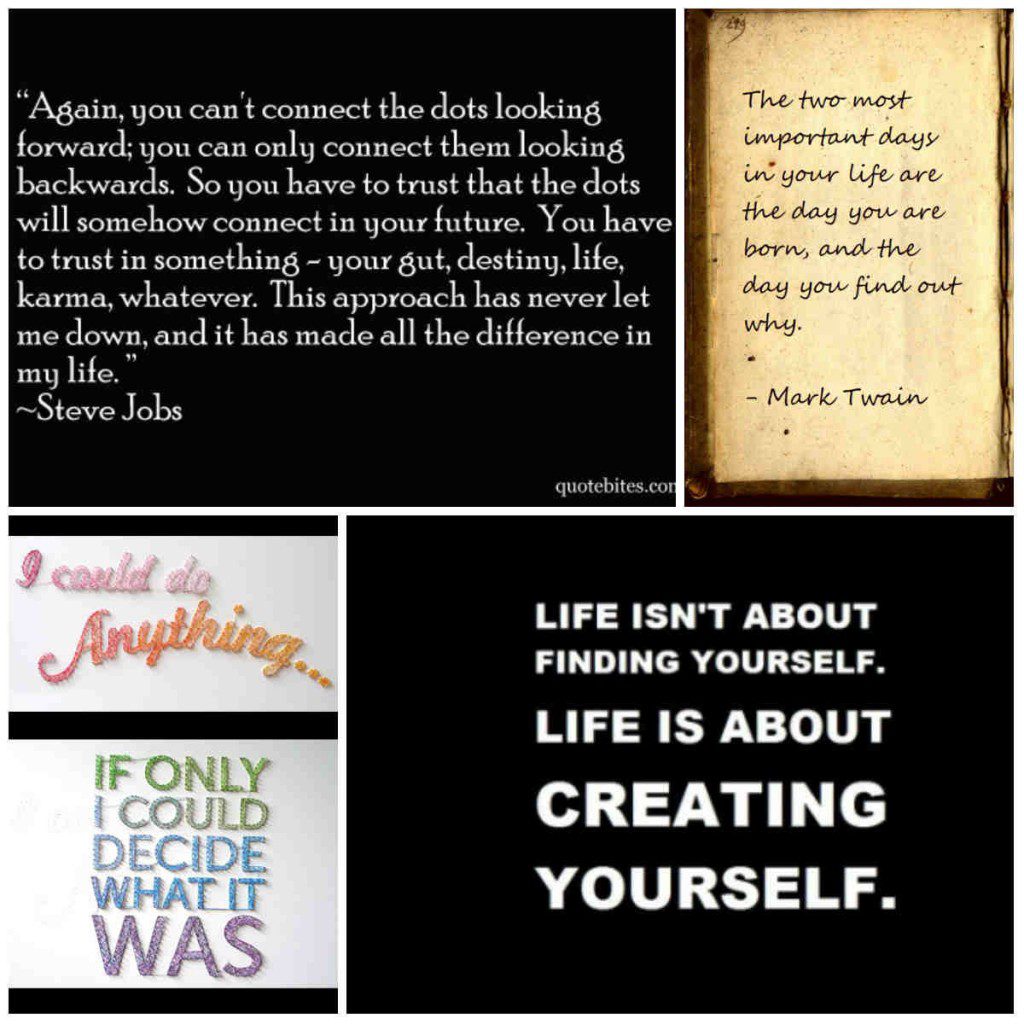
    It has been more than a couple of years since I wrote on the subject of planning – the acceptance of destiny vs free will in The Uncertainty Principles and the balance between change and stasis in its follow up. In my mind, the debate continues to rage, with flash points on a regular basis, thanks to various life scenarios and the things I read. I also realised that the recent narrative posts (1,2) are also a different way of framing this debate. Like I wrote in the posts, some narratives are already chosen for us, and some we choose, but these are all our attempts to fulfill our sense of belonging. In other words, our endeavour to find the reason for our existence – our purpose. Does one find it by working towards something or by dealing with life on a real time basis?

    A few days back, I read an article in HBR titled “It takes purpose to be a billionaire“, in which the author classifies ‘purpose’ into three buckets. Not that everyone’s idea of ‘purpose’ is to become a billionaire, but this is very clearly a planned path to achieve something that contributes to the sense of purpose. While the article does not mention it, the category I have always wondered about consists of people who have followed their passion – sports people, artists etc who have worked on a skill and honed it to near perfection. A very interesting perspective I read on that premise is the Scott Adams’ “Practice and Genes“, which takes a look at the theories on the subject and finally states that the critical element is luck. The most important skill involved in success is knowing how and when to switch to a game with better odds for you.

    Which brings me back to purpose and how we find it, and my introspection. “Who looks outside, dreams; who looks inside, awakes” ~ Carl Jung. (via) I thought about the ‘living in the moment’ perspective that finds a place in Buddhism texts and several other works of wisdom. At first, I thought it supported the destiny and real time approach, specially because it is difficult not to have baggage associated with the plans one makes. (literally and otherwise!) But then I realised that it was less to do with the planning aspect and more to do with how we deal with scenarios. Even if one works on a plan, how one deals with a setback to it is where the advice has value. In essence, that won’t help solve the debate.

    collage

    There are profound statements that support both ways of looking at it. I continue to rack my brains to find the path that will fit me, or make it. I think there is an element of subjectivity involved. That does not make the job easier, in fact, it probably makes it tougher. After all, “He who knows others is wise. He who knows himself is enlightened.” Lao Tzu

    until next time, the clock ticks away in real time

  • That’s the plan for now

    This ‘what could have been’ post on FB Platform and the broader theme of ‘move fast, break things’ made me think about planning – brand as well as business, how technology is reshaping it, and the fine balance that is required to ensure business growth goes hand in hand with retaining the trust of the ecosystem.

    Brand planning has always been an interest area, and I’ve had the good fortune of knowing a few brilliant planners, and learning what I could from them. Still continue to. A simple search would throw up a number of planning frameworks, and many of the fundamentals would still hold.  However, technology is throwing open more options in terms of manifestation/output. I found some good perspectives in this article which is about that CMOs can learn from technologists. The fundamental theme is dynamism. But such are the challenges that they remind me of We are trapped in our inadequate mental models ~ John Edwarrd Huth (via)

    I’d think that brand narratives are (also) shaped by the story telling devices at their disposal. As Mitch Joel points out here, the nuances of marketing vs advertising need to be understood as brands struggle to transition from the mass advertising era. One-way media allowed a linear flow, but current platforms demand flexibility, and customised rendition across contexts and platforms. If consumers are the new media, the stories should be ones that they can identify with, fit into their personal narratives, and therefore inclined to share.

    Many of the familiar narrative devices have focused on getting attention, but that is increasingly difficult. It’s not that ‘awareness’ can be ignored, but not only is it not enough, but attention for the sake of itself cannot work. I really liked this post (again by Paul Isakson) where he encapsulates the thought in the title itself Adding Value > Getting Attention. The > works not just as ‘greater than’ but also as ‘leads to’. Or, in other words, Be the Company Customers can’t Live Without.

    In a highly fragmented media and consumption scenario, how does a brand/business know what to focus on and when to shift from it?A wonderful blog I have discovered recently is that of Paul Isakson. This post, for instance, throws light on the need for the brand to stay true to its own story, and therefore focus on specific audiences. Another of my favourite posts focuses on something that I have always believed in and liked – the back story, and its relevance for brands. What we are today comes from our thoughts of yesterday, and our present thoughts build our life of tomorrow ~ Buddha

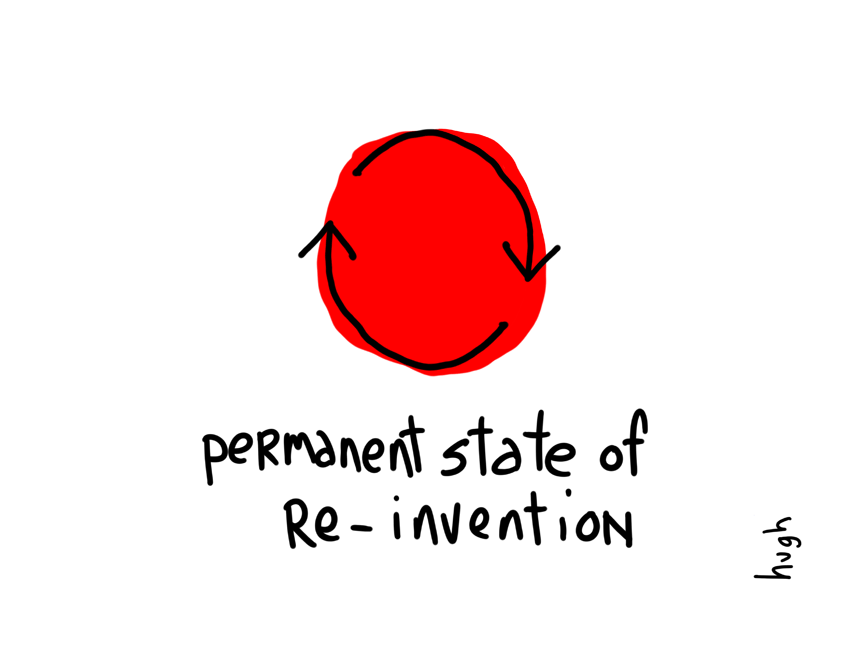
    To get there involves a cultural change, and tectonic shifts. I also think that this will force brands to think about scale. In a mass media world, a brand could get ‘reach’ by throwing money. That can still be done, even on social platforms, but when attention is not the only thing that matters, the challenge is to build relevancy and scale it – across time. That requires new planning frameworks, and possibly means a

    permanent_state

    (via)

    We started with FB, so let’s go full circle. Even as late as last year, there was massive skepticism around Facebook’s ability to adapt and thrive in the mobile space. In the last earnings call, they reported that mobile had contributed 41% to revenue. (read) It would seem that Facebook knew its story, what to focus on,  and stuck to it.

    until next time, refresh