
Tag: Orkut

  • Weekly Top 5

    [scribd id=79355855 key=key-2bakq016harbyf7n8bvf mode=list]

  • Weekly Top 5

    This week’s updates include Zynga’s tie up with Gate2Play, its entry into China with Tencent, lawsuit against Vostu and Orkut, Angry Birds in China and a patent case against it from Lodsys; the end of Old Twitter and the beginning of Promoted Tweet He Came Back From A Trip No Contact s in the timeline, increase in languages supported, funding; Apple leading the smartphone manufacturer category, beta launch of iCloud, iPad apps by Skype and AOL, and an html5 app by Twitter; Facebook’s bug bounty program and suing similar sounding domains, Ads API, acquisition of Push Pop Press, Randi Zuckerberg’s exit; Google+ stats, Google’s Page Speed Service, Hotel Finder and launch of Two Factor authentication in more countries.

    [scribd id=61669441 key=key-ipumnvv40uoltxdk701 mode=list]

    He Came Back From A Trip No Contact

  • Gulp fiction

    I’m quite a huge fan of Heroes and was quite sad to see Season 4 end, more so than normal season finales, because after quite a while, there was a villain that I could really empathise with.  Robert Knepper as Samuel Sullivan just rocked. Though the villainy is manifested in his selfish desire to become more powerful, there was something in his arguments that made me forget it at regular intervals. To give you some context, the entire series revolves around people with special abilities (think X-Men). This season, mostly through Knepper’s character- Samuel, emphasised a lot on how society treats such people. Samuel’s desperation to belong (and later make normal people respect his kind) is expressed very well in his conversation with another character with abilities, Claire.

    “Freedom is what you do with what’s been done to you”, says Claire, quoting Sartre.

    “I always thought freedom was just another word for nothing left to lose”, counters Samuel, without acknowledging “Me and Bobby McGee” 🙂

    The urge to belong and the pain of being different. Mo wrote a post recently on being chided for missing a reference in a conversation. A reference to Pulp Fiction.  At a broader level its also a small commentary about our consumption of popular culture, and second had experiences. Its a sentiment I share – that somehow the consumption of popular and even off beat culture and getting the respective references is the benchmark for judging a person. So, to get bombarded with “haven’t you seen/read/eaten.. don’t you know..” is now a common thing. Like I told her, thanks to everyone becoming media, C+ is actually a great grade, considering the noise.

    In some ways, I felt it also throws up our need for validation. The consumption and the opinions we have on that decide the kind of role we land in our immediate crowd, and now, the larger world. From “Govinda movies??!!” and “MLTR is why I go away from you” to “Eww, you’re still on Orkut?! .. Omigod, how can you play Farmville??”,  this judgment happens all the time  🙂

    At times, the validation is for others and their expectations, and at times for the self. In many ways, I think its like some gladiator fight where a person is just fighting himself, and the expectations he has set. The audience could be the self, or others. If its the latter, its all okay so long as the person conforms to a broadly accepted set of norms within the crowd.Even if one wants to get out of it, its difficult. Its difficult to sever the connection between a validation that is given to one without asking and the ties that one would want with other humans. 🙂

    In Heroes, Claire’s character’s ability is instant regeneration. Break a bone, receive a bullet wound, and she heals instantly. In the last scene of season 4, she throws herself from the top of a Ferris wheel, lands on the ground all broken up, and immediately heals, all in front of a waiting media crew. An open challenge to society to accept her the way she is. And another character says “Its a brave new world”. To me, it was a statement of hope, one that will get out of a TV show that’s part of popular culture, and enter the real world.

    But meanwhile, for now, until the pill happens, the moment one goes beyond what can be immediately understood, and what provides a point of reference, one has to be ready for “And I will strike upon thee… “:D

    until next time, reverence to reference 🙂

  • @having Maggi

    A couple of days back, I happened to see the TVC made as part of Maggi’s 25 years in India celebrations, and the association with the brand was so strong that I had to check it out and write a post on it.

    Right from school, when I used to exchange part of my lunch gladly for a classmate’s Maggi, until a little more than a year back, when Sunfeast Pasta replaced it, Maggi noodles used to rule the category. And even now, it makes its presence felt in the household, in the form of sauces and soups.

    The TVC has been well made and features the Maggi moments in the lives of different consumers – “camping wali maggi”, “first impression maggi”, “hostel ki maggi” etc, and even a “mumbai flood maggi”. I hunted for the TVC on YouTube, couldn’t find it, but thankfully remembered the site url from the ad. So you can take a look at it here – meandmeri.in – unfortunately no permalink, so click on the watch, and then ‘Currently on air’.

    From a consumer’s perspective, Maggi has built its entire equity based on a great product (they actually lost market share when they tried to change the product taste) . From a marketer’s perspective, the positioning has been awesome, they’ve created some memorable campaigns (most of us would still remember the Maggi jingle), and all of this has led to much emotional connect.  There are a million Maggi stories waiting to be told. So, to me, the web provided some great opportunity for the brand to connect with its consumers.

    I wanted to start with this urban legend(?) of a research which I have heard in B school, about how market research had predicted that Maggi would bomb as a product in India. It was often cited as THE example to ridicule the MR loyalists. I couldn’t find it online, but what I did find were some very cool notes. For those interested in Nestle’s brand strategy, positioning etc, here are a few links – Growth Strategy, an interview with the Nestle India MD (2007), and a case analysis.

    So, what are they doing online? I checked out the Nestle India corporate site and couldn’t see any mention there on the campaign or the microsite. Thankfully I remembered the microsite url, though I wonder why Maggi does not figure in it. The microsite is built on the concept of consumers sharing their Maggi stories, pictures, videos, and even recipes. The interface for that is decent. But what I liked best was the Maggi time machine, which shows ads from years back!! I wonder what prevented them from enabling comments on them!! So, in essence, except for a few ‘stories’, I couldn’t find a lot of conversations there.

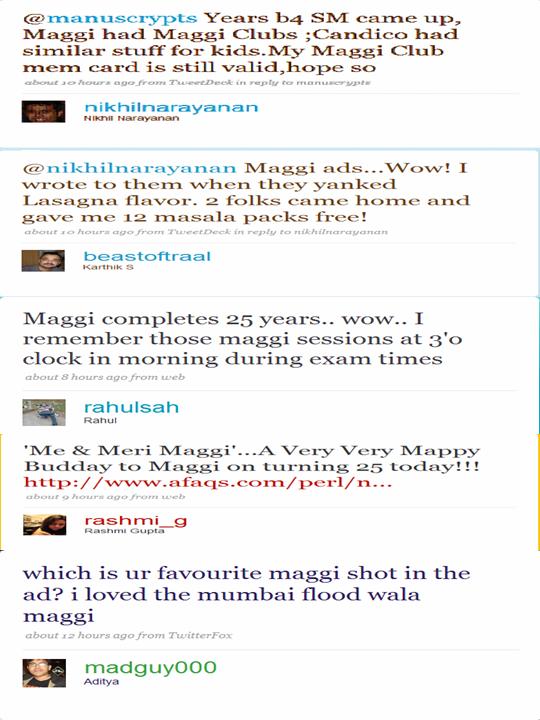
    Later in the day, I was on Twitter, and lo and behold – Maggi conversations.

    maggi

    (click to enlarge)

    I also got to know from @additiyom that there was a Facebook fan page too. While I did get a couple of Maggi pages with 5 figure fan followings, they were the international versions, and I thought this one (found on page 3 of search) with close to 300 fans was the desi version. There are many Maggi groups on Orkut, one with almost 40000 members, and 4 others with more than 5000 members. In the first group, there are about 160 responses for ‘which maggi flavor do you like most?’

    It made me think once again, of how brands make a website and  forget about the internet strategy. I’d have loved to see a more well thought out web campaign – with the microsite also serving as an aggregator of content from places where the conversation is happening, for starters. By all means use mass media and promote the site, but if the idea is about getting in touch with consumers, it definitely helps to seed and maintain conversations over at the usual suspects – Facebook, Orkut, YouTube and even Twitter. The audience is already there.

    until next time, 2 minutes definitely makes sense in real time 😉

    PS: Remember the old Maggi joke when Sourav Ganguly was out of form? 🙂
  • Social Deluge

    The last time I’d written about Bebo was a year back, in the context of AOL buying it, and a tongue-in-cheek suggestion of getting Kareena Kapoor (whose nickname is Bebo) to be the brand ambassador when they launch in india. Recently,Medianama reported that they were launching this month.  According to ContentSutra, they will be talking to content producers in India to further their strategy of ‘conversations around media content’. The Social Inbox also sounded interesting – “a utility that combines Yahoo Mail, Gmail, AOL Mail and Twitter feeds, and also helps users discover content they’re interested in”. I can’t help but remember Rediff’s attempts at Orkut and Facebook integration.

    AOL recently said that it was confident about Bebo doing well in the long run, and was for now, concentrating on getting users, more than revenue. In an interview with Paid Content, Joanna Shields, President, AOL People Networks, talked about the AIM client based strategy that gives it a wider reach than say, a Facebook. By aggregating feeds from various networks onto AIM, AOL allows people to be connected with friends’ activities in   sites like Flickr, Twitter etc, even without them being on it. Bebo has been busy with quite a few things recently – Lifestream – a basic Friendfeed like aggregator; Social Discovery Engine – which leverages profile data  to recommend related music, videos and people; Lifestory – puts uploaded photos, events, and (soon) videos into a scrollable, chronological series of postage stamp icons at the top of members’ profile pages. In the long run, Bebo is also planning to allow its users to subscribe to updates from other users, brands, bands, and celebrities, whose updates will then appear in their LifeStory timelines. (via TechCrunch) This could provide revenue opportunities.

    In the US, AOL has migrated all its AIM user profiles to Bebo, thereby doubling Bebo’s presence in the US, thanks to AIM’s massive popularity. The Lifestream is now one gigantic feed that will have updates from you and all your friends on Flickr, Twitter and Delicious, Facebook, MySpace and YouTube, and the moment you link a service to Bebo, it keeps track of  your new friends there too. And with Social Inbox, the lifestream updates, AIM updates and emails can all land up there.

    Now, how good are bebo’s chances in India? The last Comscore report on social networking in India shows that Orkut is far ahead of Facebook, which has BharatStudent, hi5 and Ibibo following it relatively closely. I’m a bit familiar with Ibibo, thanks to their properties that are heavily publicised on TV, but since I’ve never been the target audience of any of those properties, I have never tried out the site. I don’t know about their revenues, but I am not sure if building properties which are quite tactical in nature is a good way to build long term equity for the site. During the tenure of the property, there will be heightened interest and traffic surges, but sustainability is a big question. I also read recently that Bixee, owned by Ibibo has ventured into several verticals – finance, shopping and auto. I’m really not sure where this is heading especially with web 18’s presence in these spaces and several other independent entities who are strong in these verticals. The way Ibibo’s traffic is declining (-50%) I think they need to relook.

    There’s definitely a space for another social network, even in what some would call a  cluttered space, provided it differentiates from the existing ones, and gives the user a reason to try it out. I’m really not sure how random invites like the ones from hi5 work. They don’t, for me. While the AIM strategy for Bebo works well for the US market, I don’t think it can work that well in India, (inspite of the GMail connection) though it will give Bebo a start, along with the existing AOL users.

    From a product standpoint, the lifestream goes where Facebook still really hasn’t (despite having copied commenting on status messages and the ‘Like’ feature from Friendfeed, and the real time stream from Twitter) – updating friends’ activities on other services in your lifestream. Will that be too much of a deluge for users, we”ll have to see., the Facebook redesign response will give a clue. It also remains to be seen whether Facebook will tear down the ‘walled garden’ and integrate these services quickly, or will only pursue the internal activities+ Facebook Connect way of adding activity feeds. If it does not, the more social version of Friendfeed could prove an irritant for Facebook. The difference maker, however, could be the content tie-ups (Medianama reports this to be the start) and what Bebo will do to ensure that conversations happen around it.

    until next time, a new socialite 🙂