He was a shadow of his former self, and his memory was not what it used to be. But I could see his eyes light up when he was reminded of who I was. We spoke a bit, and I like to think that a bit of his joviality returned in those brief moments. My interactions with him are more than three decades old, and our memories of each other are probably a bigger bond than any relationship we have. He complimented my demeanour, much to the annoyance of the other M. He passed away a few weeks later. These days, I am ambivalent about meeting old people. On one hand, I think I’d like to remember them in their prime. But then again, there is a good chance that I’d be meeting them for the last time. So these days, when I do meet, my behaviour factors that in.
The worst thing about death is the fact that when a man is dead it is impossible any longer to undo the harm you have done him, or to do the good you haven’t done him…They say: live in such a way as to be always ready to die. I would say: live in such a way that anyone can die without you having anything to regret.
Leo Tolstoy, (via Arthur C. Brooks’ From Strength to Strength)
Sometime back, during a college reunion, D’s friend mentioned how she was shocked when she realised that she (and therefore us) were ‘those people’ who were being referred to as ‘middle aged’. A couple of years ago, I had written a blog post on entering the second half of my life, which I was hoping would not be a “mountain’s downhill, but instead, a series of small hills, gracefully undulating until the end.” So yes, I have been thinking of old age, and this book, though written back in 1970, is a great exploration of what it means to be old.
Srinivas Rao drives me to work on a Monday morning in his WagonR. He is probably in his 50s, there seems to be many more older cab drivers these days. At work, we are busy with the survey we run at this time of the year. We have been doing this for the last three years – asking our customers what financial freedom means to them. Retiring without worries is a common theme, and unfortunately, not something many are prepared for. Mr.Rao would have probably given me a sardonic smile if I had asked for his take. He is the dystopian future my scarcity mindset throws at me – me lasting longer than my money, and thus being forced to work even in old age.
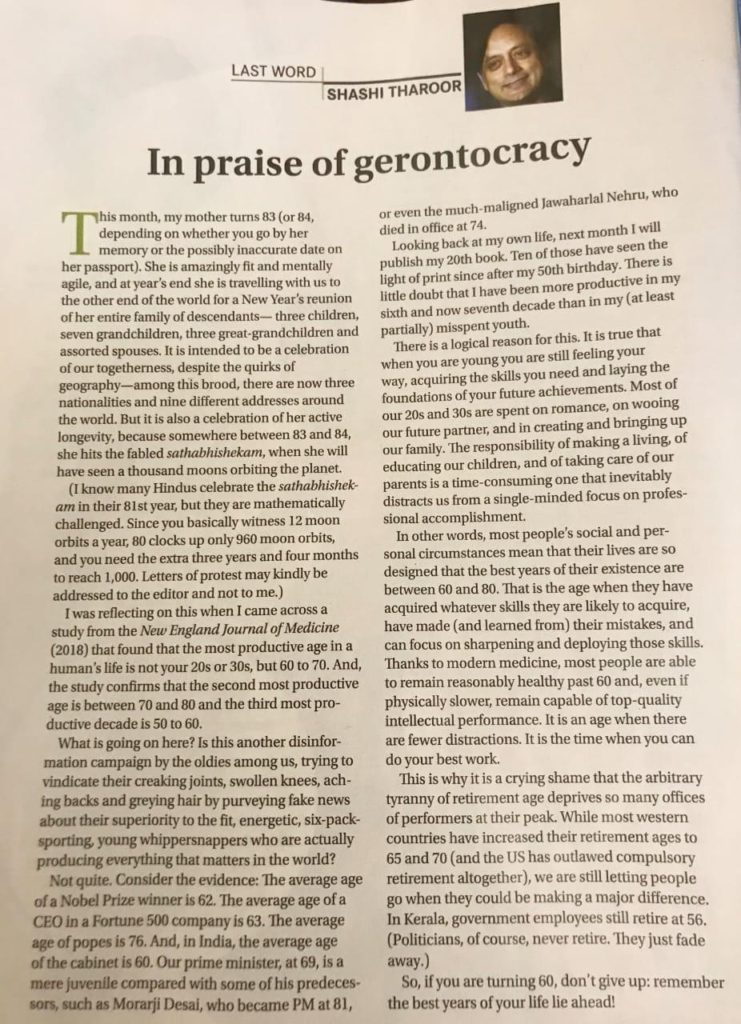
Later in the week, a friend sends me a Shashi Tharoor column from a few years ago, titled “In Praise of Gerontocracy“, in which he makes a case for the years after 60 being the most productive in one’s life.
D immediately and rightly pointed out how the privilege is so deeply embedded that it’s not even an afterthought. I also wondered whether the massive changes in physical (diet, exercise, pollution), as well as mental and emotional (social media, work stress) changes that separate the earlier generations from the current ones, have been factored in. There is a limit to what science and medicine can currently accomplish. In real life, we see our own elderly relatives sometimes struggling to even comprehend what is happening to the one person they thought they knew – themselves.
I have been reading Maus, which has had quite an effect on me. It wasn’t just the Holocaust and its horrors, it was also what happened to Vladek, the author’s father, a survivor, on whom the book is based. Old age with all of the baggage of what he had gone through, and no one around who could really understand his mindset and behaviour.
It took me back to something I had read earlier – The Coming of Age (1970). Simone de Beauvoir writes how old age exposes the failure of our entire civilisation. “The sadness of old people is not caused by any particular event or set of circumstances: it merges with their consuming boredom, with their bitter and humiliating sense of uselessness, and their loneliness in the midst of a world that has nothing but indifference for them.” The loss of standing, the fear of illnesses and injury, jealousy, and the resulting seeming selfishness, the grief of losing others whom they considered part of their future, are all poignantly captured in the book. They thus turn back to themes that are emotionally valuable to them, and replay them constantly, they ‘escape from the present and dream of former happiness, exorcise past misfortunes.’
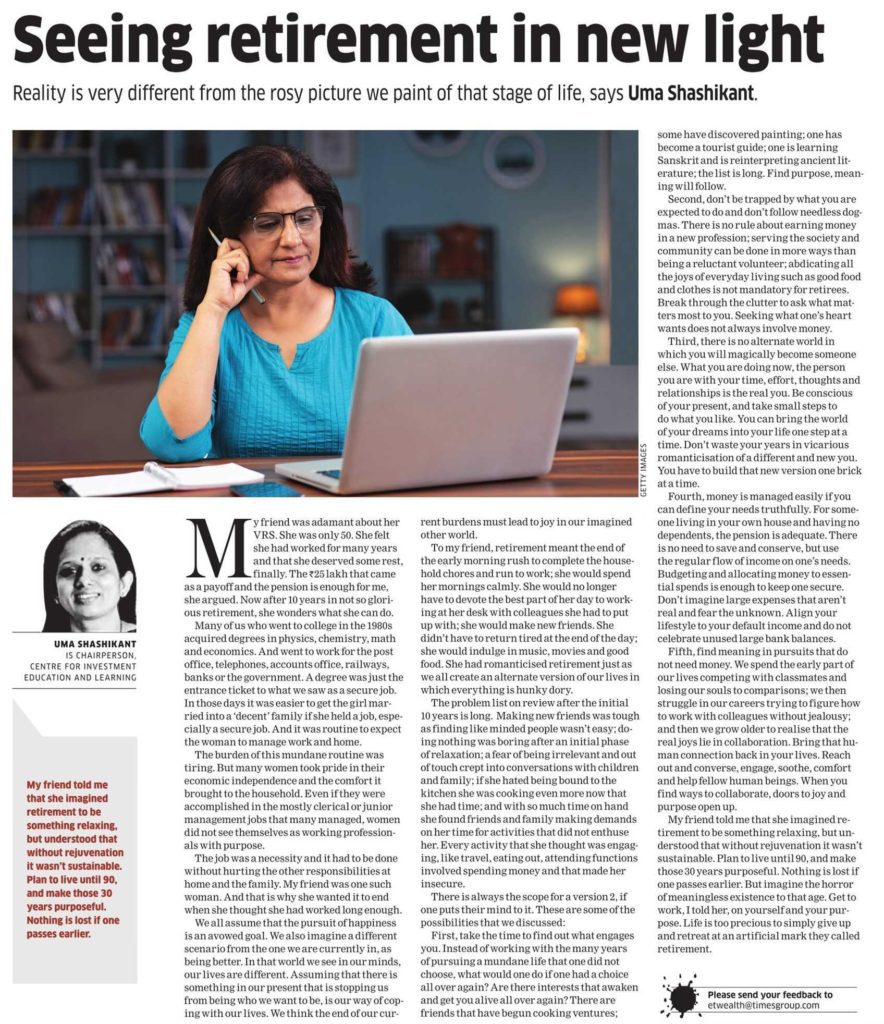
What is in our hands is how we prepare for it – mentally, physically, emotionally, and financially. Uma Shashikant sums that up quite well in her recent article.
There is really no freedom from old age, and I acutely realise that at some point, we will all end up saying “in my time” – about the time we looked upon ourselves as first-class individuals, doing our best work, feeling like we belonged in this world. It is indeed a great time, but that window is bound to close, and those who live long will ‘have that melancholy privilege of remaining alone in a new world‘. (Ninon de Lenclos)