Tag: Nike

  • Data beyond social

    A couple of weeks back, when I wrote about location based interactions, I’d said that the limits of my imagination prevent me from thinking of anything beyond brand ‘controlled’ interactive sensors in individual products as a way for non-retail brands to directly connect with their consumers – at the point of consumption.

    Thanks to RWW, I found this extremely interesting presentation which gives perspectives on the future of social media analysis and how brands will capture and use the data to increase business value – for itself and hopefully consumers too. I also remembered a McKinsey “Internet of things’ report from last year in this context.

    “social media is still viewed by many as just a tool rather than as an immersive environment.” Must admit I hadn’t thought about it that way. Meanwhile, there is indeed a lot of focus on the data we can get from social networks. But that’s only one source of data. There are many others too, including those which don’t even involve a consumer’s active communication. One look at the RFID wiki page will give you a perspective on the possibilities.

    If brands can take cognizance of the rapid advancements in technology, and work on how they can capture, analyse and apply data, then the contexts and ways they can interact with their consumers will substantially increase. Perhaps their dependency on existing communication platforms will decrease too, especially if they consciously build their own platforms. One old but still relevant example, which I have used earlier too, is Nike+, which uses popular social tools to augment the fundamental data capture.

    until next time, data entry barriers?

  • Banking on data

    There was an article recently at PSFK, which, in addition to the impending data explosion, also talks of the need for brands to invest in technology to mine, analyse and identify changing consumer needs and opportunities. Though probably, at a later stage, the automatic ‘sensors’ mentioned in the article would beat the self-expression media services as the largest data source, at this stage, the latter seem to be the biggest contributors.

    So what is the data that’s getting generated? As social networks evolve, the role that they play in the individual’s life is also evolving. While flow of information, and communication seem to find social networks as natural conduits, the networks are also now sources of entertainment for many. (study by Edelman) What does this entail for brands, their communication and the content they generate?

    Amidst the social network revolution, brands have been trying hard to eke out a place for themselves – to slide in easily into the conversations, and lives of individual users. Some have been successful, and some have not, the latter mostly when they try to use these as distribution channels for other media content alone. I read a few days back that the two official sponsors for the World Cup – Adidas and Coke, had been trumped by their competitors – Nike, and Pepsi, as far as WOM goes. Not surprising, both tell excellent stories. It makes us feel.

    httpv://www.youtube.com/watch?v=idLG6jh23yE

    httpv://www.youtube.com/watch?v=eQmu48sZohc

    There’s this excellent presentation by Rory Sutherland about intangible, and perceived value that brands create. A bit dated, but I happened to see it recently. It made me think about Maslow’s Hierarchy of needs and the tangibility of various levels.

    As civilisation advances and scarcities and abundance are rapidly traded, and as brands progress, don’t the lower levels of Maslow’s needs hierarchy become hygiene? So, would users prefer brands that help them in the esteem and self actualisation areas? It perhaps might be an example of ‘seeing the subtext you want to see’, but the Nike ad – ‘Write the Future’ seemed to be all about self actualisation and the Pepsi’s ‘Oh Africa’ seemed to be all about an ever-changing crowd that seems to be impossible to keep pace with. To quote Clay Shirky, “The category of ‘consumer’ is now a temporary behavior rather than a permanent identity.”

    Which brings me back to the data explosion. The challenge, I guess, is an old one. Finding motivations, sensing patterns out of all the data to understand why we ‘Like’, why we ‘share’, and so on, and then give us a value proposition. With rapidly evolving technologies, even the value needs to adapt much faster than before, because if the brand is late, there’ll be another that delivers. But then again, at higher need levels, when the individuality/uniqueness quotient increases, will the manifestation of needs show a collective pattern? Or will the individual’s behaviour pattern become more important for brands? Multiple data sets, multiple patterns, multiple challenges. Interesting times indeed 🙂

    Meanwhile, here’s one closer home. (via Gaurav) A very interesting project by Tithiya Sharma – The 100 Heroes Project. I’m sure it’ll be a wonderful story and if I were an airline brand or even a MakeMyTrip/Cleartrip or anything to do with travel, I’d take a look at the project.

    until next time, tripping on data

  • Beyond run-of-the-mill

    ..and I took a look at the last few posts and realised, that the excitement of the Facebook -Google- Twitter three way fight was making me obsessed, and I figured you guys would like a break from that too. Thankfully, I came across two activities, that I thought showed a fundamental way of approaching the internet as a medium.

    At a basic level, the internet (and mobile) differ from say, print, OOH, television and even radio (in spite of call ins) simply because it allows two way expression. And if we go meta on that, even the internet, like other media, is after all a tool, as far as brands go. Its just that in many cases, its a much better enabler than the others because of its features. So, Facebook, Twitter etc are only tools – I have to keep reminding myself of that. The two examples below have shown how to use the web to increase the utility and value they are offering consumers. I liked these two all the more, because while they have presence on the usual suspects, these activities do not use the services.

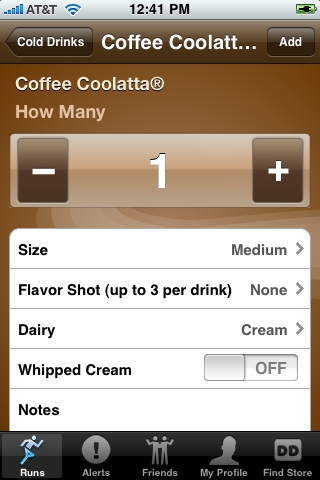
    Some of you would’ve read about the Dunkin’ Run iPhone app and website by now. For those who haven’t here’s the gist. Going out for coffee? Want to get your friends something too, but can’t be bothered to remember their order? You become the ‘Runner’, and use the app/website to initiate a group order. Your friends/colleagues ( a list you’ve made, and you can make different ones) get an interactive alert, and they can place the order online/app. If they’re registered users, they can even pick from their favourites/ previous orders. Once the list is made, take a print out/show it on the phone. Oh, okay, you can display the run status on facebook too. This is how the app looks on the phone

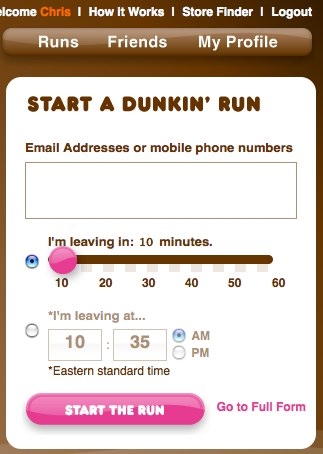
    dunkin dunkin1

    (Thank you, Chris Brogan, Mashable)

    ‘Run’ seems to be the operative word since the second example is to do with a product and activity right in that space. Nike. On Wired, I read about this excellent service called Nike+, which is now helping users track personal metrics and thus adding value. By using a sensor, and syncing an iPod to the website, (after the run) users can now track distance run, time taken, calories burned, weight lost etc and over a time period. These are displayed visually, on their profile, and it can be shared, and for extra motivation, users can even take up a challenge or set individual goals, and if that’s not enough, you can even create a list of people who could motivate you for completing it. They are updated about your progress. When i visited the India site, I could see a ticker that showed updates about various runners.

    According to Wired, “Nike has attracted the largest community of runners ever assembled—more than 1.2 million runners who have collectively tracked more than 130 million miles and burned more than 13 billion calories.” It has not only helped the users, but think about all that data Nike has, which it can use to provide even more value for customers and build better products. Amazing, I think I just might end up doing this stuff!!  Oh, okay, there’s a twitter app too – Twiike.

    Two ideas, which use the concept of sharing without needing the tools that I keep discussing here. A good reminder that while the tools race for users, and web domination, brands can quietly use the philosophy of web 2.0 and build communities around users through simple ideas and wonderful execution.

    until next time, Just Donut it 😉

  • Nick Niche

    Trendwatching has a small preview of the consumer trends of 2009 – half a dozen, to be exact. You can catch all 6 here. The one that interested me most was “nichetributes”, which is defined as

    the power of making products and services relevant by incorporating ‘attributes’ and features that cater to distinct (if not niche) consumer lifestyles and situations.

    While the explanation does say it’s different from the long tail, and is about “additions to existing products”, I am not convinced that its so disconnected. I’d say that its the long tail within the product users. How many times have we wished that this product had just that extra feature we were looking for – from apparel to furniture to electronic goods? But yes, I am in agreement with the fact that it is a hot trend. The explanation of nichetributes ends with the following line

    * NICHETRIBUTES is decidedly not about advertising, i.e. tailoring a mass product’s message to a specific audience; it’s about tailoring the product itself to that specific audience.

    I agree with that too, but why not advertising too, thanks to the web and social media. In fact, I think it would work great if collaborative product building was backed by a communication to let customers know that customised products can be made to happen. This would help engage the ‘minority markets’ that look for these specific features/attributes in their existing product. It could mean more affinity for the brand and may even bring in new users who were waiting for this feature. There are quite a few brands that allow customisation- NikeiD comes immediately to mind.

    In fact, I’d say that this is perhaps a great way for brands to start out on social media. While mass advertising could cater to the consumers that constitute the head of the long tail graph, social media could cater to the thinner portions. It would be great to have product customisation happening side by side, but it could also start with customised advertising to specific ‘minority markets’ – the long tail of brand communication.

    until next time, minority reports

    PS. while on trends, a great read 🙂

  • Communities and Brandstreams

    Last week, I’d written about transparency in organisations, and touched upon something that’d force transparency on them – conversations about them. While conversations can happen on the organisation itself, I believe the brand will also act as a starting point in many conversations. A transparent organisation will transfer some positive equity to the brand and vice versa. What comes first is a good chicken-and-egg question. Whether they can exist independent of each other is also a good thought.

    Since I have written on organisations, I’ll veer towards the brand this time. There is a good article here on what brands should consider before jumping into the ‘create communities’ game. But then, brand associations should never be restricted to communities, it can be as basic as listening in on conversations that happen not just on the brand itself, but the specific and generic categories it belongs to.  Moreover, communities don’t need to be very rigid in the way they operate. Check out Dell’s efforts here. The second half of this article also succeeds in conveying this fabulously. In a convenience driven, information overloaded consumer’s mind, it is difficult for the ‘four times a year’, ‘when we feel we have to communicate something’ TVC-print-outdoor campaign that many brands follow, to find a place.

    So, what are brands doing? From small businesses that give ‘prewards‘, to FMCG giants that attempt buzz marketing, everything is being tried. Some succeed, and some are questioned. What the last link, Nike shows is that brands cannot escape now with lip service. They have to be true.

    Which brings me to possibilities. Quite sometime back, I’d read this post about user generated advertising and product wikis, a sort of the brand’s lifestream, if you will. I found it a very refreshing thought, even thought Heekya (via Mashable) might be a good tool to start the journey, and was happy to read a tangential post  here. Please note that, though the second article uses ‘brandstreaming’ it is more to do with engaging the community through social media. Its still interesting though.

    But the best read I saw on this subject would be this post by Chris Brogan. I think it offers a great way for brands to balance their ‘official’ presence online with all the user generated stuff that’s bound to exist. But I’d still say community building has to start at home, i.e. organisation.

    until next time, start your brandstream..