Tag: Nike

  • Brands, Activism & Morality

    A while back, someone had joked on Twitter that by 2025, babies will be born outraged. But in 2020, the joke, at least in Indian advertising, is that when the Tanishq brand manager begins to think of a campaign, #BoycottTanishq starts trending. When I was writing the article on brands and empathy for Business Insider, I realised it would need a lot of effort for brands to go beyond signalling.

    However, with inequities becoming even more of a pressing topic, and the expectation from brands to be active participants in society – activism to action, is there an inevitable movement that we will see? And hence, this post on brands through the prism of activism and morality, from the perspectives of a consumer and a brand marketer, and the safety of an armchair.

    We are living in an era of woke capitalism in which companies pretend to care about social justice to sell products to people who pretend to hate capitalism.

    Clay Routledge
    (more…)
  • Provoke the Woke?

    Originally published in afaqs

    “In these unprecedented times”, brands have been making many efforts to stay relevant by inserting themselves into cultural narratives, but it isn’t that easy. In fact, they are increasingly realising that their plans might actually backfire when they provoke the ‘woke’.

    Woke versus Broke

    Nike’s path-breaking campaign in 2018, featuring (American football quarterback) Colin Kaepernick, is now a case study for brands taking a stance on matters of societal relevance. But it also had a relatively lesser-known second order consequence. In 2019, Nike was forced to take sides in the Hong Kong protests.

    When Daryl Morey, general manager, Houston Rockets (a professional basketball team in the US), tweeted his support for the protesters, China gave the National Basketball Association (NBA) a cold stare. The NBA apologised, and Nike gave an assist by pulling its Houston Rockets merchandise from five stores in Beijing and Shanghai.

    It didn’t just end there. Courtesy LeBron James (professional basketball player), with whom Nike has an association worth north of $1 billion. James’s response was that Morey was misinformed, and that “We do have freedom of speech, but there can be a lot of negative things that come with that, too. I don’t think every issue should be everybody’s problem.

    Nike took a stance, by staying silent. But having taken an unflinching stance in the US on a ‘freedom of expression’ issue, Nike’s response to China reflected poorly on the brand. Unsurprisingly, they got called out by quite a few commentators. Nike had its reasons. Its China business was worth $6 billion, having doubled in five years, even as the US sales remained flat.

    All the world’s staged

    In ‘The Presentation of Self in Everyday Life’, Erving Goffman uses the metaphor of a theatre to describe human interactions. Backstage is where “the performer can relax; he can drop his front, forgo speaking in his lines, and step out of character.” On stage, though, there is a performance to be delivered. These days, thanks to the proliferation of social platforms, the ‘backstage’ is shrinking. We’re always ‘on show’ for some audience – on Instagram/Facebook/LinkedIn/Twitter, and yes, TikTok.

    The same goes for brands as well. Advertising, PR communication, social media content, all ‘performances’ are not just watched, but connected, too, with everything that is known about the brand. Every expression is an impression. Goffman emphasises that the audience is also a part of the performance, and without their tacit agreement, the show would fall apart. Taken together, this means that the option to be selectively woke is disappearing.

    Moments of truth

    Back in 2017, a three-second body wash ad on Facebook, which featured a Black woman turning into a White woman, almost cost Dove years of ‘real beauty’ work. It managed to redeem itself by making some smart moves, both tactically and strategically. Things have become more difficult these days. Because ironically, we are all even more touchy in the era of social distancing! And bad news travels faster. All it takes is one status update.

    Even as (Amazon’s) Jeff Bezos drew applause for “And Dave, you’re the kind of customer I’m happy to lose”, there were questions being asked about the use of Amazon’s tech by police for racial profiling. While resolving that, the company got called out for treatment of workers. It’s not just Amazon. When brands like Uber, Apple, Adidas, etc., take a stance on racism, they are being questioned on the lack of diversity in workforce and leadership. Google and Facebook are even facing employee activism.

    Closer home, #BlackLivesMatter, and celebrities endorsing fairness creams make for an interesting Venn diagram. And, it’s not just celebrities. In the name of ‘Moment Marketing’, many brands have seen their woke moments in the sun rapidly become sunstrokes!

    Don’t get me wrong, this is not to say that brands shouldn’t make topical and relevant narratives a part of their messaging strategy. But in an increasingly polarised world, communication is a full contact sport.

    Dave or Dove, the message is clear, brand communication is no longer a skin-deep game, it is about having skin in the game. As consumers move upwards in the hierarchy of needs, their expectation from brands is moving down – in a direction that’s familiar to marketers. Rather than just creating awareness and interest on things that matter, consumers desire action from brands!

  • Nike: Big shoes to fill

    It has been just over a year since Nike celebrated the  30th anniversary of its “Just Do It” campaign with a series of ads, featuring athletes including Colin Kaepernick, and triggered a controversy. I wrote then, about Nike’s “skin in the game” approach to brand messaging, and argued that it was perfectly placed to polarise and reap dividends in a world of attention-scarcity. But..

    Woke might make you broke!

    One year later, a (rightfully) sharp post on Pando alerted me to how the NBA got embroiled in the Hong Kong protests conversation, thanks to Daryl Morey, General Manager for the Houston Rockets tweeting his support. China vs NBA resulted. The NBA apologised. Nike pulled its Houston Rockets merchandise from five stores in Beijing and Shanghai (via). It didn’t stop there. LeBron James, refusing to be left out, waded in by stating that Morey was misinformed. Thanks to Nike’s $1 billion lifetime association with LeBron, that dragged the brand further into it. As per USA Today Nike’s business in China from June 1, 2018 to May 31, 2019 is upwards of $6 billion, and has doubled in the last 5 years, while remaining flat in the US. The stakes are high. (more…)

  • Brand with a worldview – Part 2

    I think my first thoughts on the subject appeared in 2012 – Mean better than average, featuring Cleartrip, who had put a non-customer in place with sarcasm after a polite conversation failed. It took another 5 years for a redux in Feels & Fields in Marketing. The framing was that if the end game was for the brand to be the first choice when a consumer thinks of the category, what would be the strategy in a world of attention scarcity? Using the powers of targeting and personalisation to catch the customer at the right time and place (medium + stage of a funnel) with the right messaging, or having a world view that is so relatable to a kind of customer that the brand becomes entrenched in his/her mind? Or both?

    I followed it up with  Brand with a worldview, which had examples from the Super Bowl 2017 ads, many of which had an overt or covert political stance. My inference was that we are largely irrational creatures, and absolutely prone to confirmation biases. We’d love our brands to echo our world view… Smart money would be on brands that can use data to glean consumer sentiment beyond domain, and leverage that understanding when forming a world view.

    This post takes the thought forward, and I have framed it quite simplistically with 3 aspects – customer, competition, and company. We also have a hot example to embellish the hypothesis – Nike! Tons have been written about its latest adventures, but let’s just overdo it anyway. (more…)

  • The utility of a brand

    After the ‘social product‘ post, the brand guy in me wanted to reconcile this evolution of the product with the brand story. After all, ‘network effects’, ‘purpose’, ‘community’ etc are essential parts of the brand story as well. But I thought of stepping back a bit before moving forward.

    The ‘tyranny of the big idea‘ is oft discussed here and the more I see platforms evolve, the more I feel the need (for brands) for nuanced strategy and propositions that are relevant in various contexts and take into account the radical change that is two-way communication. (as opposed to broadcast) I think this is an inevitability of consumption fragmentation as well as changes in attitudes/behaviour/expectations, and sustained nuanced propositions is one of the key ways to create ‘network effects’ across platforms.

    In this context, I thought the ‘Moving Forward’ section in this insightful post titled “Killing Big Strategy” captured it perfectly. Also, through it, I came across something that helped link the product-brand stories – “Finding the right job for your product“, a fantastic alternate perspective on traditional market segmentation, and some excellent lessons in defining competition and positioning. Not to forget this gem from Drucker “The customer rarely buys what the company thinks it is selling him.”

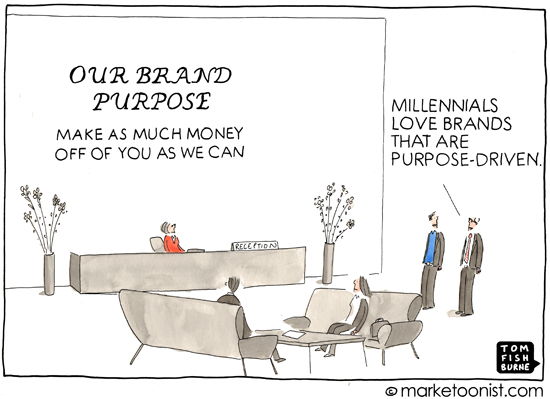
    So where does this all begin? Though ‘purpose’ is increasingly being used as a buzzword  and also espousing a corporate-centric view (unfortunately) I still get to see a lot of relevant literature that does more than lip service. At a broad level, this little framework of Purpose – Delivery – Resonance, for instance, is a good start. There are many needs that brands fulfill and many reasons why they are loved, and these could start as pointers for a brand to figure out its purpose. John Hagel’s “The Untapped Potential of Corporate Narratives” offers some excellent perspective on how user-centric narratives gets several ‘pull’ factors to work in tandem and offer numerous sustainable advantages. The examples include my usual favourite – Nike, and this is a subject I have touched upon earlier as well, (1,2) though not as eloquently. 🙂 If you think about it, this is also another way of ‘finding the right job for your product’.
    brandpurpose

    (via)

    On delivery. Russell Davies’ “Activities not audiences” draws the distinction between users and user needs and calls for focusing on the latter. Again, another rendition of a product doing its ‘job’. This post, titled “Brands: One System Of Touch“, explores the misalignment of brands which view customer experiences in isolation, by channel, whereas customers of course view and grade their experiences cumulatively. This is a good starting point to think about what needs to be changed internally to deliver a cohesive, relevant and useful experience to the consumer.

    In the meanwhile, I came across quite a few examples of brands adopting the ‘product doing a job’ approach even though it might be an isolated exercise at this point –  Hermes’ silk knot app, Volkswagen’s and Audi’s Augmented Reality apps to repair/know the features of their cars. While they might seem too self serving to qualify for the concept under discussion, they’re definitely a step in the direction. Uber’s response to a bus driver strike with free rides might be a more evolved example. Another one might be Ford’s platform to ‘hack’ its car hardware and software. Many more examples of ‘branded utility’ can be seen here. I think that in the looming collaborative economy, platforms like Google Helpouts will help brands become a real time utility in their domains.  Interestingly there are also examples of brands (Citi, Kleenex) which are trying to create value beyond their core purpose/utility. Levi’s’ ‘School of Make our mark‘ is another example.

    The last bit in the framework (though the framework also mentions differentiation, I see it as something that needs to be built into purpose and delivery) I referred to earlier is resonance. I think these above experiments will not only help brands learn what it takes to build sustained resonance in various consumer contexts but also how to amplify this to potential consumers who might share similar needs. This will require learning and application beyond the conventional mass reach tactics employed currently. The corollary is that measurement paradigms would also need to change. I could see this being aligned to all the points mentioned in this superb post –  ‘The Future of Marketing‘ – messages to experiences, rational to passion, adaptive strategy, simulations, brands to platforms.

    To bring it all back to the link between the social product and the brand, I now (again) see technology (including social) as an enabler in the product and marketing road maps – working in tandem to deliver the brand’s purpose and help it augment resonance.

    until next time, utilising brands
