
Tag: Mythology

  • I am the absolute

    The translation of Ahaṁ Brahmāsmi. Don’t worry, it isn’t my ego talking.

    I was reminded of this thanks to this fantastic episode on Lex Fridman’s podcast – with Joscha Bach.

    I remember it was a while back when I first heard the postulation that Adam & Eve hurriedly covering themselves after eating the apple was an allegory for humans first developing consciousness about themselves. Joscha extends this and talks about how the Bible, specifically Genesis 1, has sections on the mind systematically creating a a game design that helps interact with the world. In his own words,

    where it’s being described that this creative spirit is hovering over the substrate and then is creating a boundary between the world model and sphere of ideas, earth and heaven, as they’re being described there, and then it’s creating contrast and then dimensions and then space, and then it creates organic shapes and solids and liquids and builds a world from them and creates plants and animals, give them all their names. And once that’s done, it creates another spirit in its own image, but it creates it as men and women, as something that thinks of itself as a human being and puts it into this world. And the Christians mistranslate this, I suspect, when they say this is the description of the creation of the physical universe by a supernatural being. I think this is literally a description of how in every mind a universe is being created as some kind of game engine by a creative spirit, our first consciousness that emerges in our mind even before we are born and that creates the interaction between organism and world. And once that is built and trained, the personal self is being created and we only remember being the personal self, we no longer remember how we created the game engine.

    This is basically the development of consciousness. And we cannot remember the time we made it. The game engine is the universe we keep building until we are no longer around.

    And the Bible is not alone in this. Remember Samudra Manthan from Hindu mythology, it is full of symbolism. An individual in this world seeking immortality. Transcendence. The mountain Mandara represents the human mind and the manthan is its churning in the vast collective consciousness. The devas and asuras obviously are the positive and negative influences. Vishnu’s koorma avatar (turtle) which stabilises the mountain during the churn point to how we should try to focus our mind. (on God, but I will abstain from that part :D)

    Halahala, the emergent poison that Shiva swallows (earning him the name Nilkanth) shows how we must confront our inner demons . From Kamadhenu to Airavata to Kalpavriksha, there are all sorts of distractions that are possible. Dhanvantari appearing with the amrit symbolises the importance of health. The amrit is what allows you to merge with the collective consciousness and thereby in a sense become immortal.

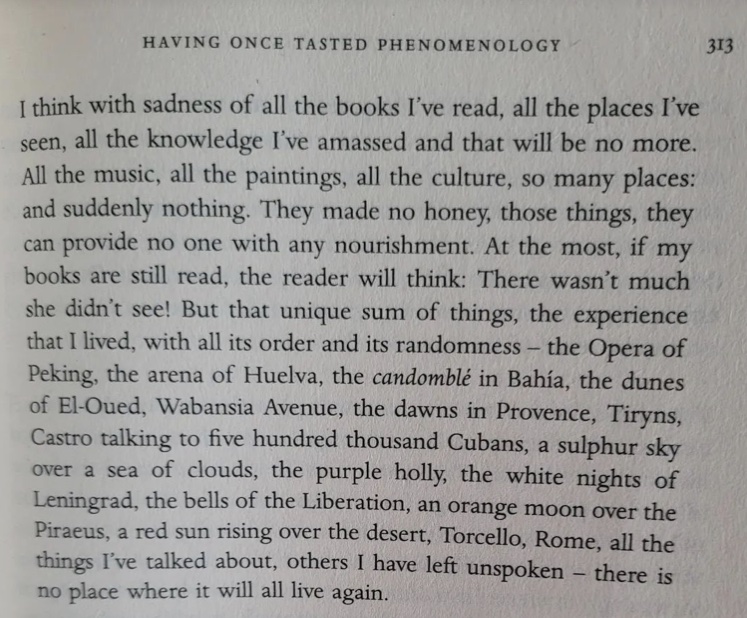
    Ok, snap. I don’t think I will get there. In The Flavours of Death, I had posted an excerpt from Simone de Beauvoir’s The Coming of Age
    Simone de Beauvoir Death The Coming of Age

    …’there is no place where it will all live again’. And that’s just it. Outside of photos, notes like these or maybe conversations with friends, the universe that was created in my mind will no longer exist when I die. It dies with me. And thus Ahaṁ Brahmāsmi. The universe that I made with all its affections and peeves and desires and animosities and fears and longings and expectations, disappears when I take my final breath. I will not be around in the aftermath to feel that sadness, but I am here now, and I do feel the twinge.

    Aham bummed asmi ? #okbye
  • Sons of Sita

     Ashok K Banker

    The final book in Ashok Banker’s Ramayana series. It is also the concluding part of the Uttara Kaanda, and is set a decade after Rama banished Sita. Luv and Kush, her sons, grow up in the hermitage of Valmiki, and from the first page, set out, unwittingly, on a collision course with their father.

    The author departs from the various versions I have read and puts a new spin on the events leading to the family reunion. I can’t be sure, but it would seem as though Banker’s version of Ayodhya is modeled after a superpower, complete with a political group called Republicans! Its acts of aggression, citing necessities that would seem selfish to an objective viewer, are easily comparable to what the US has been doing. Rama is portrayed as a king who takes on the mantle of an emperor on advice from a set of people motivated by their own vested interests. His relationship with his brothers has moved away from one of affection to more between that of a monarch and his vassals. (more…)

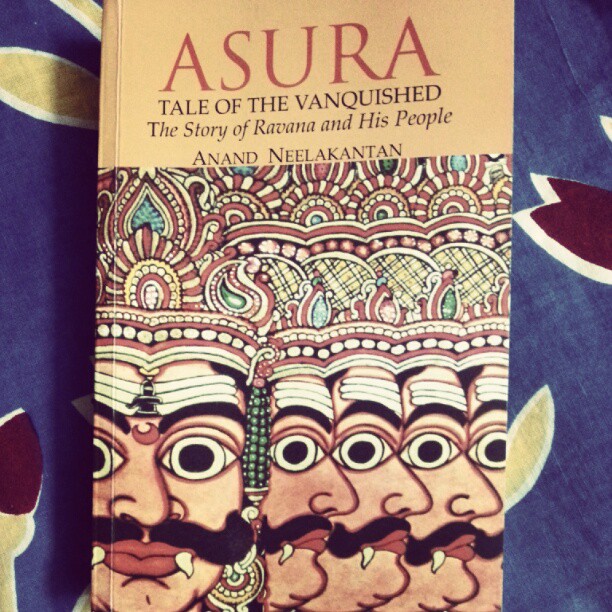
  • ASURA: Tale Of The Vanquished

    Anand Neelakantan

    Asura is partly a Ravana perspective on where his life intersects with that of Rama, (and thus Ramayana) and partly a social commentary of his life and times. (how society treats women, the caste system etc) The tale is narrated by Bhadra, an asura who fought under Mahabali and several others before becoming a recurring (and key) figure in Ravana’s life from the time he led a ragged army against Kubera. The narrative begins with Ravana’s last moments, as he lay dying on the battlefield.

    Predictably, the book shows Ravana in a good light, whose only fault was that he defied the prevalent societal norms and lived life on his own terms, as opposed to Rama, who was deified by the higher castes and made into an ideal image. For all we know, this is probably true, since history is after all, written by victors.

    While most of the story is essentially known, the author deserves credit for demystifying the myth – from the big picture details of which region was ruled by which king to smaller details like Pushpak as a flying machine prototype and Jatayu becoming a bird that got caught in its rotors. This does require that he has to gloss over some of the events, but that’s easily something we could forgive because the author largely keeps it true to the original tale. Varuna as a pirate, Kubera as the merchant king, Yama as the drug lord, various Indras, are all superb renditions of familiar mythological characters. There’s some intelligent use of Bhadra in the final events, and the author leaves ample clues for the reader to predict it. The author tries to show that in many ways, things have remained unchanged – the generation gap between Bali/Angada and Ravana/Meghanada is a classic example, and this is something that gives the narrative a lot of credibility. (+5 points for the Jabali mention)

    But I did feel that it could have been edited better. Bhadra’s character, though used well to show how the life of a common man changed, or remained unchanged as the ruling class switched, is prone to long winded discourses which slackens the pace. The working of Ravana’s mind too becomes preachy once in a while, but thankfully not too often. If I had to nitpick, I’d say that mistaking navel for naval while describing a woman’s anatomy is not a sign of good proofreading. (-5 points for not connecting Chandrahasa to Shiva and relegating it to a blacksmith origin)

    But in essence, it is a fresh take, and was good enough for me to visualise how it really must have been – as something that really happened, and not just a myth.

    asura

  • Visage.. envisage

    In the first book of the Ramayana series, Ashok Banker uses a line, a statement made by Rishi Adhranga to Lakshmana, as the brothers are about to enter Bhayanak van, where Tataka resides – “Over time, truth becomes fact, fact is rewritten as history, history fades to legend, and eventually, legend remains as myth.” In the myth 🙂 , these words are  spoken in the Treta Yuga (the Age of Reason), which follows Satya Yuga (the Age of Truth). The character also states that by the time its the Kali Yuga (the Age of Darkness, which is last and after the Dvapara Yuga), devas and asuras would be just race-memories and dismissed as fantasy by the rational and the scientific.

    In science fiction, there are many stories of the ravages of time. One, where, man comes across computers and other technological specimens, but does not know how to use them, since the lack of energy had made humans de-evolve. Another, where man discovers that the canals on Mars were made by a race of humans, ten thousands of years back, in an older ‘cycle’ of evolution and de-evolution. Interesting? 🙂

    So the other day, I was thinking about facts, truth, history and stories. It further led me to thinking about these blogs of mine, the lifestreams on Facebook and Twitter and on the blog. The digital snapshots of our lives, the way we are storing our life almost by the second, for many reasons. Our experiences, our thoughts, our desires, our emotions, our fears, our happiness and sorrow, and so many more things. To share, to look back….. to create an image of ourselves for whoever sees it?

    In Cochin, at home, there are these old albums with black & white and sepia photographs. The ones with which we, as children, had fun trying to identify Mom and Dad in their childhood photographs. There are other characters in them – grandparents, uncles, aunts and other relatives, friends of theirs. While many of them are easily identified by the earlier generation, some remain unknown, or rather, ones who aren’t remembered. Either ways, other than direct interactions, these photos are perhaps the only remains of people who lived a few decades back. Ever wonder who they really were, as persons, what were their thoughts, what did they think of their life, and others’, did they question their existence, or were they busy running a life, as we are? Did they think that someone, somewhere in the future would look at their photographs and peer into their lives beyond the confines of the frame? Would they have smiled a bit more if they knew, or would they try to look more serious? Maybe they wouldn’t have cared enough to strike a special look or pose?

    With the advent of the web, there are now more means than ever to store ‘life’. Sound, pictures, videos, enough material to make sure that a life is much more documented than the two dimensional photographs. Though my lifestreaming purpose is limited to my life, when I read posts about what happens to a person’s blog/Facebook account etc after his/her death, I can’t help but wonder about the future of digital lifestreams.

    With relationships getting redefined on a  regular basis, will there be anyone later who cares enough to go through another person’s life. After all, with the explosion of user generated content, an individual’s lifestream is just a statistic. (yes, even otherwise, it might just be that, but these are perhaps our efforts to move from being an irrelevant statistic  to a relevant individual). Yes, perhaps truth won’t become facts and so on, though the objectivity of truth itself can be questioned. But meanwhile, I am reminded of the science fiction tales. Maybe no one will be able to access all this content. Or it could be a deviant of this scenario. I have quite a lot of music cassettes. While I can still easily find devices to play it, a few years later, that might not be the case – either that, or the tapes would be in no state to be played. There are many tracks in these which I can’t find online. In the near future, they will be lost to the past. So in essence, technology might advance so much that those data items which have not been updated might be inaccessible anyway.

    A life. A lifetime of experiences, which defined not just what happened to a single person, but also to those around. Multiple lives. A web of existence. Humanity. Statistics and non-stories. All of which would be rendered inaccessible or meaningless in the future, but without which the future would not exist. An endless stream, which may have the larger picture of its origins, but has only hazy notions of the details. Makes me wonder. About the construct of our lives.

    until next time, streaming out loud…

  • The powers that be

    Decision making is something we try to be good at, maybe it has something to do with the little bit of a control freak we have in all of us. And we judge some as good decision makers, and some as bad, not pausing to think that the seemingly good or bad decisions can be reversed so quickly by a twist of fate. Of course, there are some who would refuse to attribute even a small iota of it to fate, but then that’s an age old argument, so I’d not want to get in there now.

    Meanwhile, though decisions affect any number of people from an individual to nations, depending on who takes them, I tend to believe that the control that we have been given seems to be reducing with each passing period. No, not as individuals, but as humanity in general.

    Reading mythology, Indian and otherwise is taking its toll on me 🙂 , so humour me. Every civilisation speaks of gifted individuals, and several of them who could cause epidemics, control the elements of nature, and change things in a way that would be inconceivable to us (that a human could do such things) Our mythology (which I believe to be history as opposed to myth) has a liberal splattering of sages who could give curses, heroes who could change the course of battles with a single weapon and so on.

    Stories, you say, but do you think that at some point of time, a higher power trusted humans enough to give them the liberty and the ability to do such things, and because of what we have done to ourselves, it has been taken away from us?

    until next time, fall from grace